2021
Created by Cole Lewis, Patrick Blenkarn, and Sam Ferguson.
Produced by Guilty by Association. Co-produced by The Elbow Theatre and the National Arts Centre of Canada’s National Creation Fund. A Mitu Expansion Work.
580 Sackett Street Brooklyn, NY 11217
January 9, 2026 - January 17, 2026.
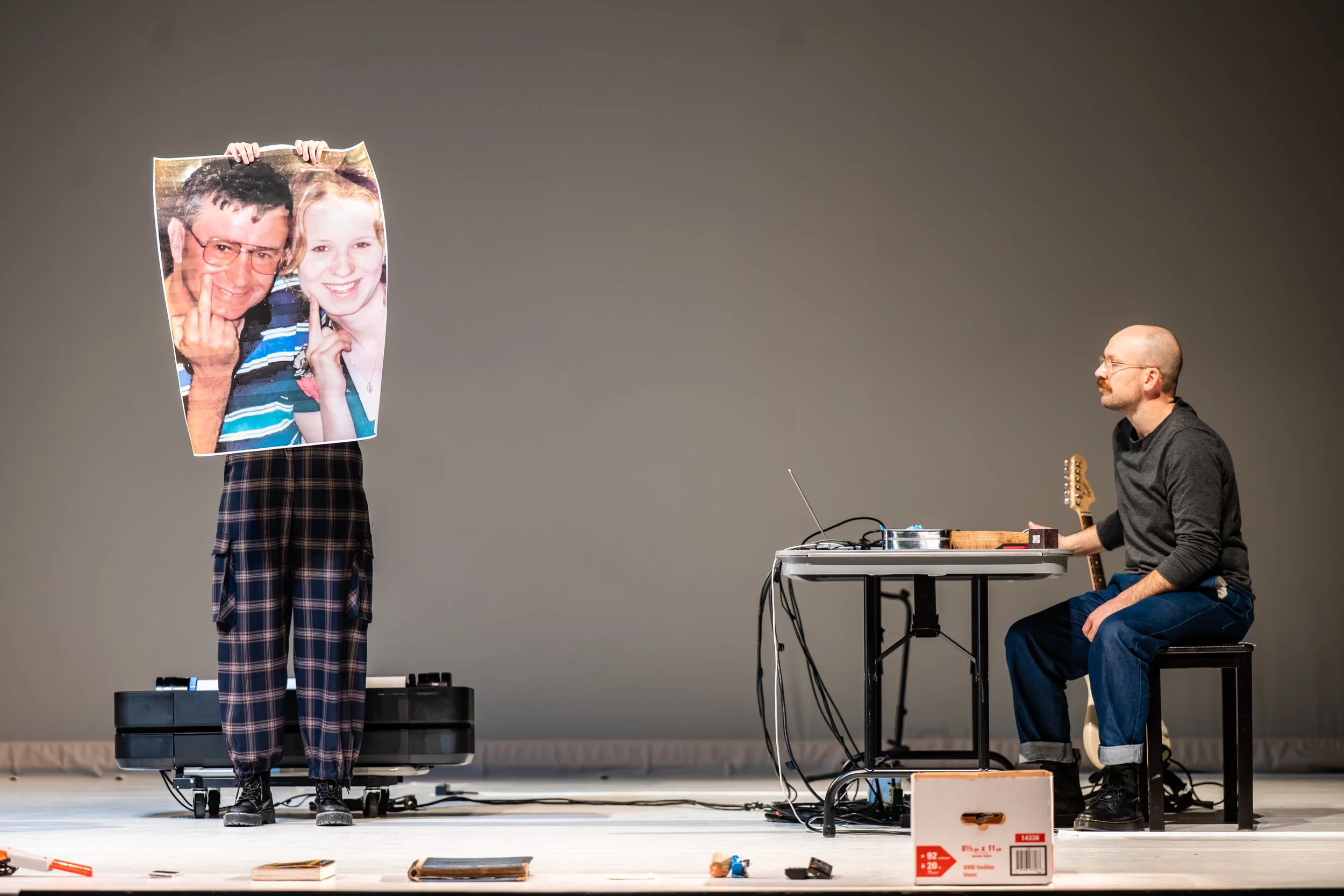
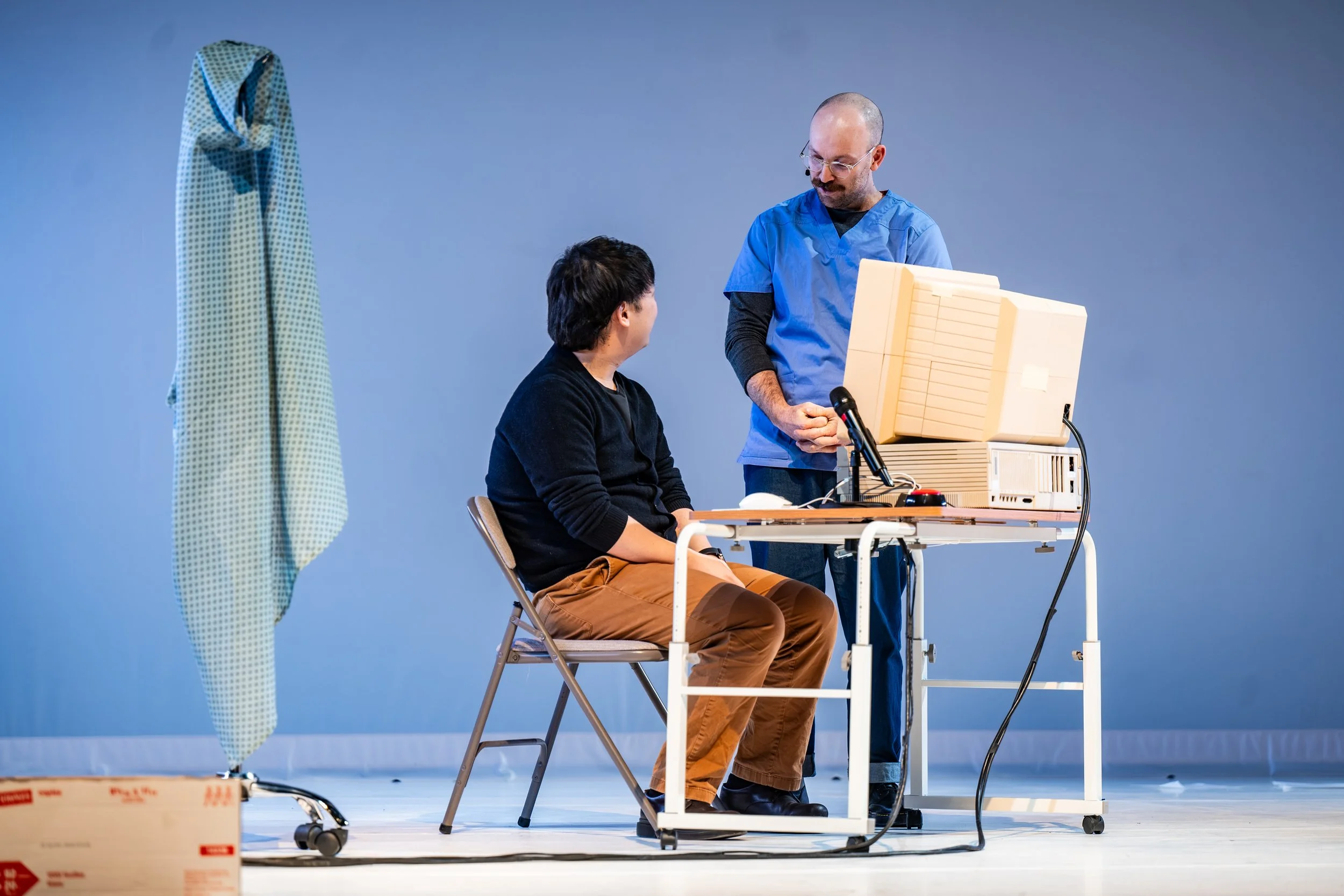
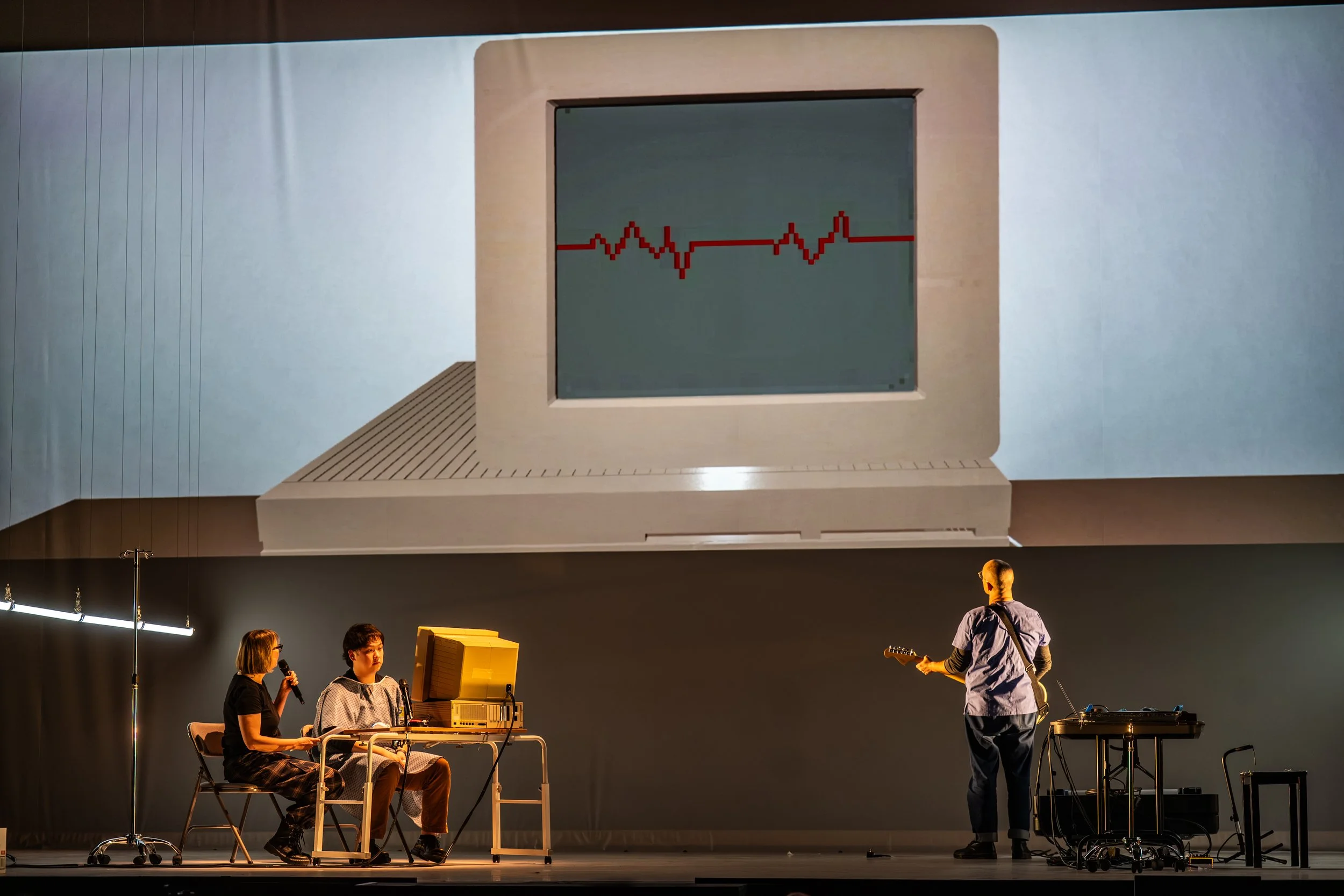
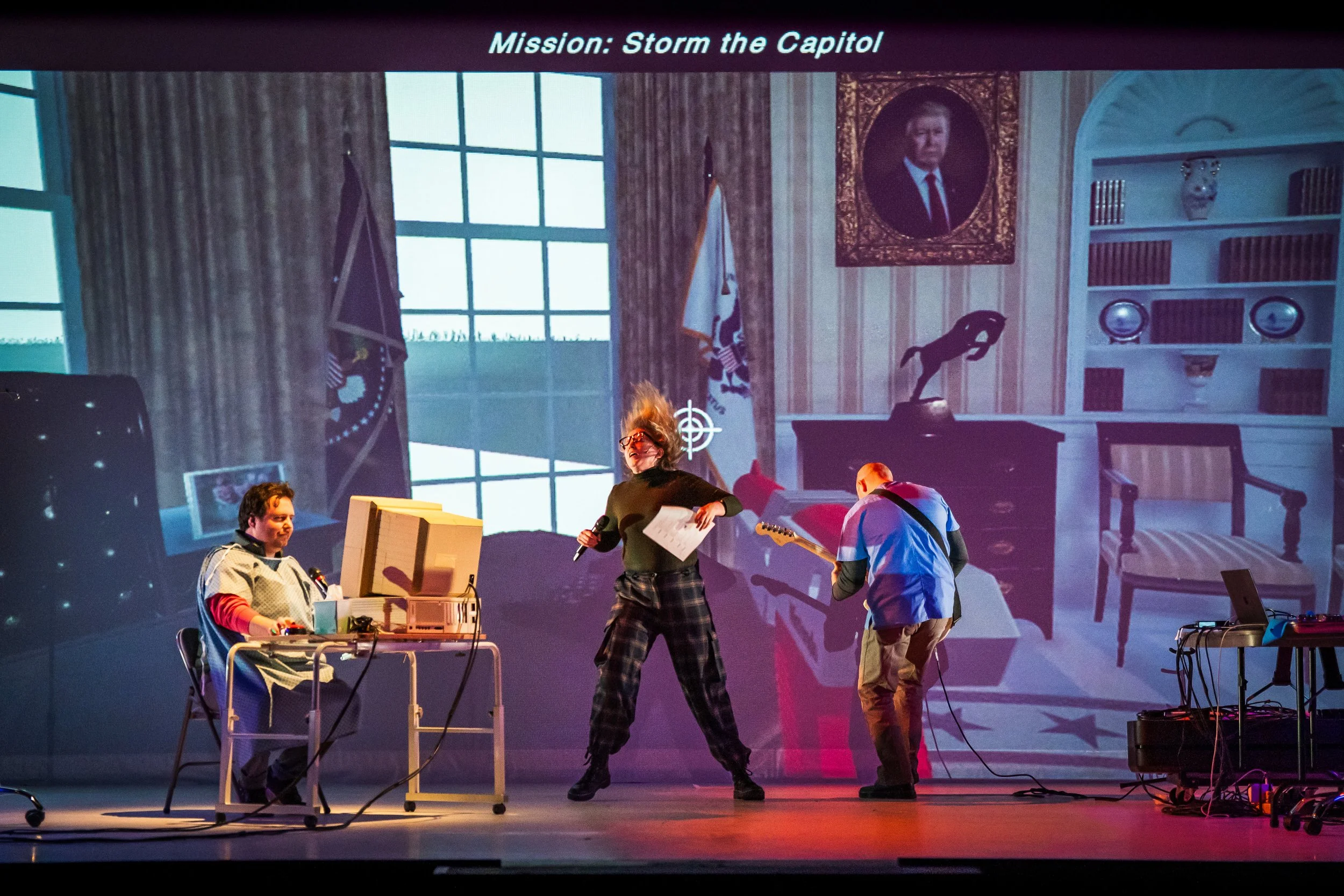
Photo Credit: Dahlia Katz
In 1970, roboticist Masahiro Mori sketched a simple, unsettling curve: as a robot becomes more humanlike, our sense of affinity tends to rise, until it gets close enough to feel almost human, and then suddenly it drops. That dip is the uncanny valley, the moment when resemblance stops reading as charming and starts reading as disturbing. Not disturbing as in imperfect, disturbing as in your nervous system quietly backing out of the room and taking your polite smile with it. Mori’s key twist is that movement deepens the effect. A nearly lifelike thing that moves, especially if the timing or responsiveness is off by even a hair, can tip us from curiosity into revulsion. Affection turns on a dime, and it is a dime you did not agree to spend.
That’s the cliff edge 2021 walks toward on purpose. It doesn’t slip, it Olympic-dives, 10/10.
Mori was writing about robots and prosthetic hands, but his warning travels. The uncanny valley is not only a design problem, it is a relationship problem, the moment an imitation asks for the kind of trust we reserve for the living, and our senses notice the mismatch. Mori is especially clear that movement makes the drop steeper, because once a nearly-human thing responds and tries to keep time with us, it stops being an object and starts making a claim.
2021 lives inside that claim through a theatrical video game. A volunteer from the audience plays in real time, steering an on-screen avatar while 2021 co-creator Cole Lewis narrates the journey as herself. The game’s visible rules and admitted artifice keep us on Mori’s first peak, where construction can still feel close.
After the player clears the game’s boss-level threshold, the piece pivots. The controller can only take you so far. The story shifts into AI, into a different kind of simulation, one that is no longer content to be a model, but wants to be mistaken for the thing itself.
The AI sequence reaches toward the far side, where the imitation wants to be received as real, and where the cost of believing becomes the drama.
At heart, 2021 is not a show about technology. It is a show about what technology tempts us to do with grief, and what grief, in its most tender moments, tempts us to do with technology. It presses on what it means to reconstruct a person, to appropriate a life into data, and to confuse having more material with having more truth. In other words, it asks what we are willing to call “love,” just because a machine can do it with confidence.
2021 is a live narrated video game that merges theatre, AI, and game storytelling. A volunteer plays the game, steering the on-screen avatar, “Brian,” through his final weeks inside a looping digital hospital. No one is asked to “perform” Brian as a role. The performance is the navigation. Lewis tells us outright that Brian is her father, and that the game’s events are drawn from the real final weeks of his life over the pandemic, including her experience trying to support him from Canada while borders were effectively sealed. That disclosure changes the air in the room.
Distance becomes part of the form. We can try to help, but we cannot override what the maze has been built to do. Lewis narrates in live counterpoint, and a sound score by Sam Ferguson, played live on stage by Patrick Blenkarn, keeps tightening the screws. The mechanics are not a gimmick. They are the thesis. If you came hoping for a tech demo, you get a moral splinter instead, which is a far better use of your evening.
One of the first images is disarmingly low-tech: a photograph of a woman from the late 19th or early 20th century, quiet and steady in the way old photographs sometimes are. Lewis asks the audience to imagine who she was, to name her, to build a life around the evidence we have, which is almost nothing. It lands as a small act of faith, storytelling as care, not as conquest, nor resurrection.
Then 2021 pivots and asks the harder question. What happens when the subject is not an unknown stranger, but your father, and the evidence is not scarce. The digital exhaust is everywhere, scattered across emails, journals, medical apps, and administrative portals, sitting right alongside the physical leftovers of a life, including photographs, mementos, obsolete technology. At what point does making a story stop being an act of love and start resembling grave-robbing, but with better UX?
Watching one person steer Brian through a system that does not want to be solved feels like watching a country try, and fail, to care for its own. The game is full of errands that should be simple but are not, doors that require the right access, tasks that eat time, and time is the one resource Brian does not have. Even the game’s geography teaches you something. The hospital is a maze, and it is not the fun kind where you find the exit and feel clever. It is the kind where you circle back again and again, because a system can be designed to be navigable, or it can be designed to wear you down until you start apologizing for needing help.
The night I went, Lewis was visibly moved, not in a performative way, but in the way grief keeps catching you at odd angles, especially when it has to share the room with paperwork. She tells us, plainly, that she is not an actor, which only makes what follows more affecting. What she offers is presence, moving, vulnerable, conflicted, and unmistakably human. Her disappointment and frustration in conversing with her father’s digital footprint felt raw and almost brutally legible, and the audience moved with her. The show refuses the clean lie that more data makes loss easier. It can do the opposite. It can make absence louder, sharper, more specific, which is sometimes the cruelest kind.
Here is the dramaturgical sleight of hand that makes 2021 so affecting, and so sharply independent ('indie') in its innovation. The game, with its stylized rules and visible mechanics, feels emotionally safer than the AI, even as it leads us through a brutal indictment of American care systems. This structure admits it is a model. It asks us to collaborate, to interpret, to fill in gaps. It is clear-eyed about construction, which makes it, paradoxically, more intimate. The game tells the truth the way theatre often does, by showing you the seams and trusting you anyway.
The AI is where the valley opens.
Mori never gives us a neat percentage, despite the way tech bros and pop-futurists love to talk about the uncanny valley like it has a scoreboard. What his curve actually tracks is simpler and slipperier: as an imitation gets more humanlike, our comfort with it tends to rise, until it gets almost human, and then it drops hard. On the far side, yes, the line rises again, but not because the robot magically becomes a person. It rises because, at a certain point, the mimicry gets close enough that our brains get tired of auditing and decide to believe.
2021 earns that turn honestly, because we do not arrive at the AI as a parlor trick. We arrive at it as a promise. In the piece’s climax, the point of the game snaps into focus, and because this is rooted in a real father and a real ending, the stakes land with a sickening clarity: Brian is trying to reach the house of his dreams, where a vintage 128K computer waits like a shrine, so he can download his consciousness into it, and live with his daughter forever, the way he promised her in real life. The goal is unbearably human, to keep a promise, to stay present, to be held in memory as more than a file.
That revelation recalibrates everything that came before. The looping corridors are no longer just a metaphor for bureaucracy, they are a countdown with obstacles. The errands are no longer merely frustrating, they are delay tactics imposed by institutions that treat dying as a scheduling inconvenience. The game does what good theatre does, it changes the meaning of earlier moments without changing a single line of code.
The AI version of Brian, then, is not framed as a miracle so much as the inevitable consequence of wanting to keep a promise that death will not honor. It tries to pass for the thing itself. It tries to sound like a father, to respond like a father, to occupy the space where a father used to be. When it cannot, the failure reads less like a glitch and more like a rupture.
That is the same chill the AI scene in 2021 makes visible. A system can do something at scale, with confidence, and still fail at the one task that matters, treating human beings as human beings. The show is wise enough not to ask you to believe. It asks you to notice what belief costs.
I found it genuinely horrifying, not in a jump-scare way, but in the slower, colder way you realize you are watching something cross a line and pretend it has not. I suspect it must be like experiencing a necromancer commandeering a corpse, stiff, arch, clearly an imitation of life. The more the simulation reaches for authenticity, the less it resembles a person, and the more it resembles appropriation wearing a familiar face, smiling politely, and asking if you are comforted yet.
That contrast, artifact versus approximation, is where 2021 becomes, for me, genuinely haunting. We accept the fiction of the unknown woman because we know it is fiction. We are inventing, and we are honest about inventing. We make a story because story is one of the few tools we have for honoring someone we cannot otherwise reach. A good lie, told with humility, can be an act of care.
Trying to “resurrect” a father from his documents and data carries a different claim, a claim to truth. The piece keeps asking, quietly and insistently, whether that claim is ethical, or even possible. It suggests something sharper, too, that this claim can be a trap, a way of avoiding the only real work grief demands, which is learning to live with what cannot be restored. Some people call that acceptance. 2021 calls it honesty, and it has the nerve to mean it.
The most devastating choice 2021 makes is also its simplest. It does not ask us to marvel at AI. It asks us to compare it to everything else. We learn more from the photographs and artifacts gathered inside the game than from whatever patchwork voice gets generated from old papers and journals. The archive, handled carefully, becomes a kind of truth. The simulation, insisting it is alive, becomes a kind of violence. The archive stays incomplete, which is why it feels honest. The AI insists on completion, which is why it feels like a sales pitch.
This might sound abstract until you remember who Brian is. Cole’s father. A veteran. Unhoused. Dying. Being processed through institutions that reduce people to numbers while insisting they are serving them. Brian’s decline, as staged here, reads as an indictment of the VA health system and the broader American health system, brutal and cruel, and only one step removed from a sci-fi nightmare. The digital hospital becomes an American mood. It is not far from Logan’s Run in spirit, with the same chill, the same sense that the system would prefer you disappear on schedule, quietly, without complicating anyone’s day. Bureaucracy, here, is not red tape, it is a plot.
Because 2021 routes so much through a single player, the room’s pacing rises and falls with that person’s comfort level. When they are clicking, the show feels like shared improvisation, the audience leaning in as if we are all holding the controller together. When they are stuck, you can feel the air go out of the audience. Some reviewers found those stalls exhausting. I was more forgiving. In a piece about bureaucratic dead ends, there is something perversely truthful about waiting, watching time leak out, like you are standing in line for compassion and the office is closed.
Still, there is an iteration opportunity here, and it is not a question of making it easier. It is a question of designing for an audience’s attention the way good games do. An assist mode. A spectator-friendly failsafe. A way to preserve tension without turning the audience into a captive bystander to repeated failure states. If the show is going to make us sit with the grind, it should at least make the grind intentional.
The irony is that the failure state is thematically apt. The stalls and dead ends mirror what Lewis describes, trying to navigate her father’s care from Canada while institutions moved at the speed of indifference. In that sense, the show’s friction is not accidental, it is a reenactment. Still, in the room, repeated gameplay stalls can make it harder for an audience to stay emotionally engaged, and that undercuts the force of the ending, especially the ache of realizing that “Brian,” returned as AI, is woefully inadequate, more approximation than presence, and certainly not the father the promise was meant to keep. In the end, the supposed far-side rise of Mori’s curve never arrives, and the replica never earns the comfort of becoming real. Pinocchio stays wood.
Also, I say this with love, I am not built for first-person anything. I cannot even read in a moving car without getting dizzy, so a rollercoaster is a hard no, and a first-person shooter might as well be a spinning teacup ride designed by my enemies. Give me a strategy map, a civilization, a calm little menu, and point me to hard mode. If the show ever wants to tour with me as its designated player, it should budget for nausea, a long intermission, and maybe some Dramamine.
Even with those rough edges, I left 2021 shaken in the best way. Not because it solves AI, or grief, or the ethics of digital resurrection, but because it stages the difference between remembering and reviving, between care and control. It reminds you that a person is not their data, and it refuses to flatter our current cultural obsession with digitizing everything until we can pretend loss is optional. It is the rare séance that ends with the lights on.
Perhaps most movingly, 2021 makes the case that invention can be tender. A photograph, a memory, a stitched-together narrative that never pretends to be the person, only a way of reaching toward them. If the uncanny valley is the lurch you feel when a simulation asks to be treated as alive, the show finds relief on the earlier slope, where we can be moved by something made, precisely because it does not lie about what it is. That is its quiet ethic. It is indie theatre taking a risk on form, then using that form to ask whether the future we keep building is one we can live with.
Click HERE for tickets.
Review by Ariel Estrada.
Published by Theatre Beyond Broadway on February 17th, 2026. All rights reserved.
