
CALF SCRAMBLE
Presented by Primary Stages
Written by Libby Carr, Directed by Caitlin Sullivan
59E59 Theaters, Theater A, 59 East 59th Street, in Manhattan
February 28 - April 12, 2026
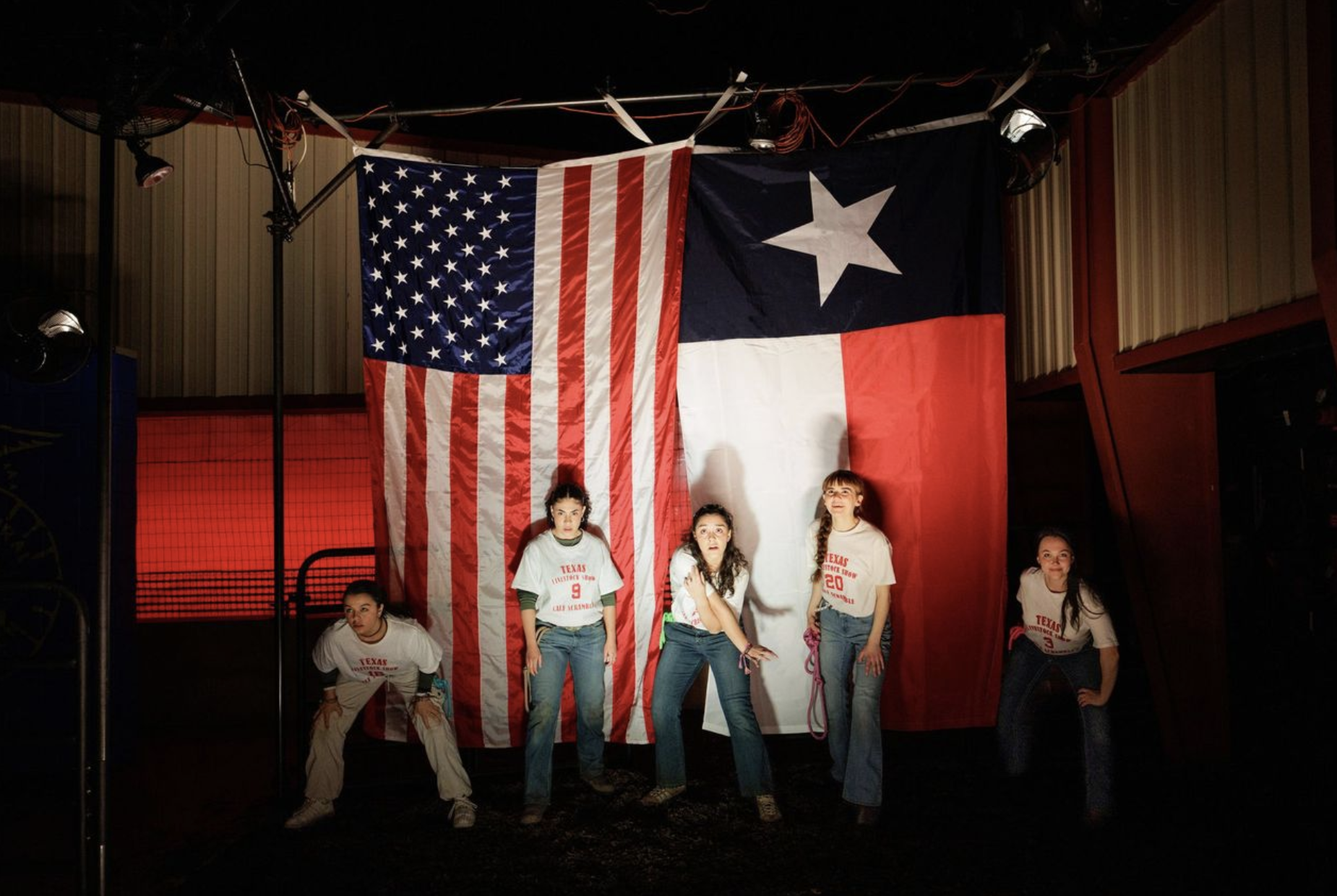
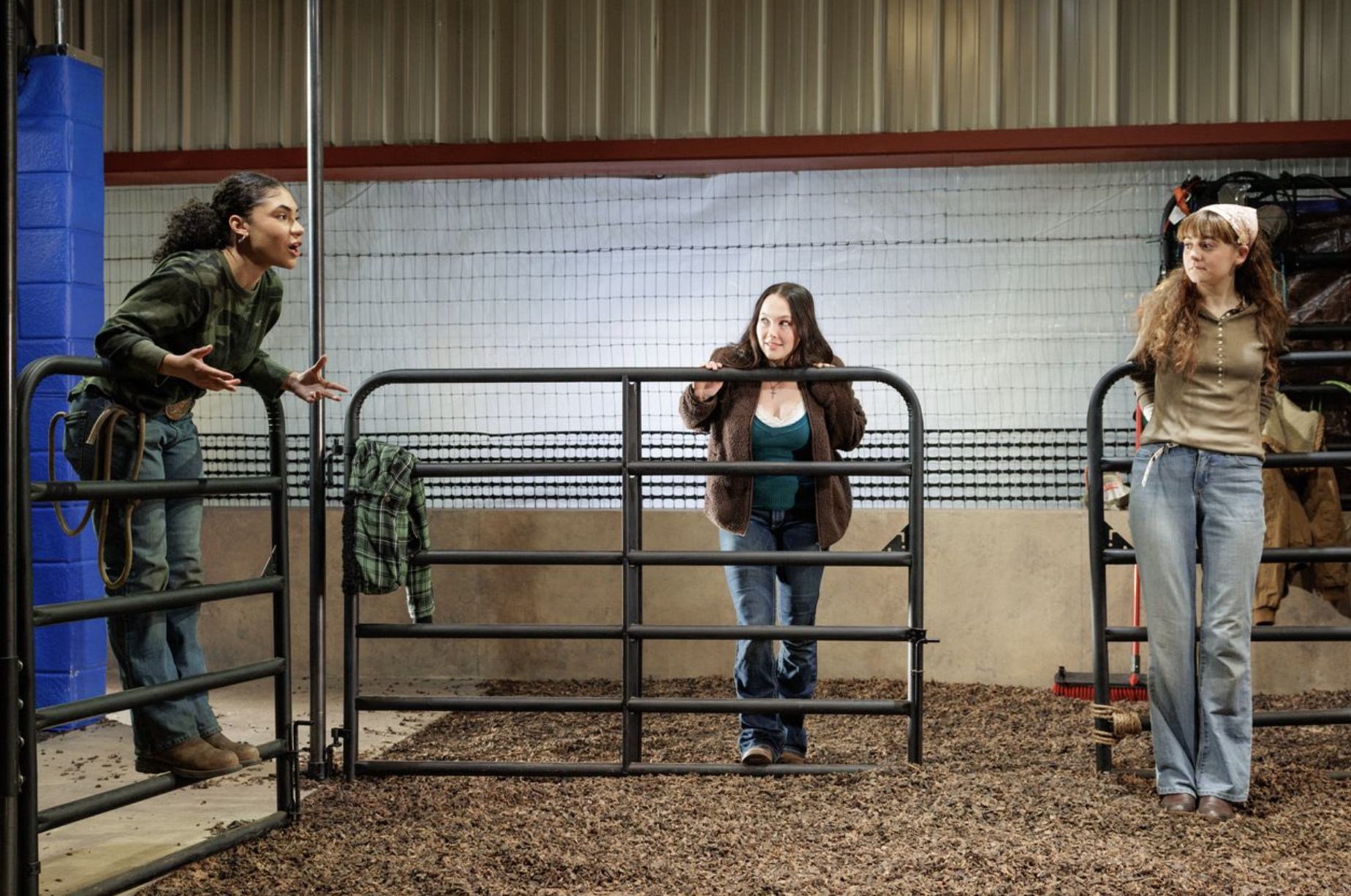
There is, in the opening moments of Calf Scramble, a kind of dramaturgical sleight of hand so assured, so quietly exacting, that one scarcely registers how completely one has been transported until the air itself seems to change. Libby Carr’s play, directed with lucid, unhurried confidence by Caitlin Sullivan, does not so much begin as it accumulates—flag by flag, hymn by hymn—until the world of rural Texas announces itself with a specificity that feels less like representation than recollection. An American flag and its Texan counterpart hang in companionable symmetry; a pre-show chorus of “Our God Is an Awesome God” hums through the space. Before a single line is spoken, the production has already tuned the audience’s inner ear.
Carr’s subject—the ritualized competition of the Future Farmers of America, in which young women vie to secure and raise a “scholarship calf” whose eventual sale might alter the trajectory of their lives—is, on paper, almost anthropological in its specificity. A “calf scramble,” as rendered in Carr’s play, is not merely a regional curiosity but a ritualized contest in which spectacle and aspiration are braided tightly together. Typically staged under the auspices of a rodeo or county fair, the event begins with a sudden release: a small herd of donated calves loosed into an arena, their uncertainty mirrored by the charged anticipation of the youth participants who pursue them. What follows is equal parts athletic contest and communal rite, as these young competitors attempt to corner, halter, and claim one of the animals amid the dust and din.
The rules, like so much else in this corner of American life, shift subtly from place to place. Yet the essential structure remains constant, and Carr’s dramatization adheres to it with telling precision: those who succeed in securing a calf are granted not simply a prize, but a responsibility. Over the course of the ensuing year, the animal must be raised, tended, and prepared for exhibition. The culmination of this labor arrives at the next season’s fair, where the now-grown calf is shown and ultimately auctioned.
It is here that the scramble’s deeper stakes come into focus. The proceeds from that sale—divided between the young handler and the sponsoring body, in this instance the local chapter of the Future Farmers of America—represent more than a modest financial gain. They function as a kind of provisional future: seed money for education, stability, or escape. In Carr’s theatrical imagination, the calf scramble becomes a crucible in which adolescence, labor, and hope are tested against one another, each halter fastened not only around the animal’s neck but, in a sense, around the contours of a life just beginning to take shape.
Yet what unfolds is neither documentary nor pastoral reverie. Instead, Calf Scramble reveals itself as something more elastic and more daring: a theatrical language in which bodies, identities, and even species blur in pursuit of emotional truth. The ensemble, working with remarkable cohesion, gives this inquiry its human texture. At the center of this finely observed ensemble stands Vivvy (Marvelyn Ramirez), ranch-bred and possessed of an easy authority that feels less asserted than simply understood; she moves through the group as its actual leader, her confidence both a stabilizing force and a quiet provocation. Orbiting her are a quartet of vividly drawn counterparts: Anna Lee (Ferin Bergen), the preacher’s daughter, whose sass arrives edged with knowing wit; Maren (Maaike Laanstra-Corn), luminously devout, her faith worn with a kind of unguarded sincerity; and El (Gabriela Veciana), whose accommodating nature masks a keen emotional intelligence. And then there is Sofi (Elisa Tarquinio), El’s fiercely driven, chronically overextended best friend, who resists easy containment. If the others fall, however loosely, into a shared rhythm, Sofi pushes against it—restless, striving, and thrillingly unwilling to be neatly corralled.
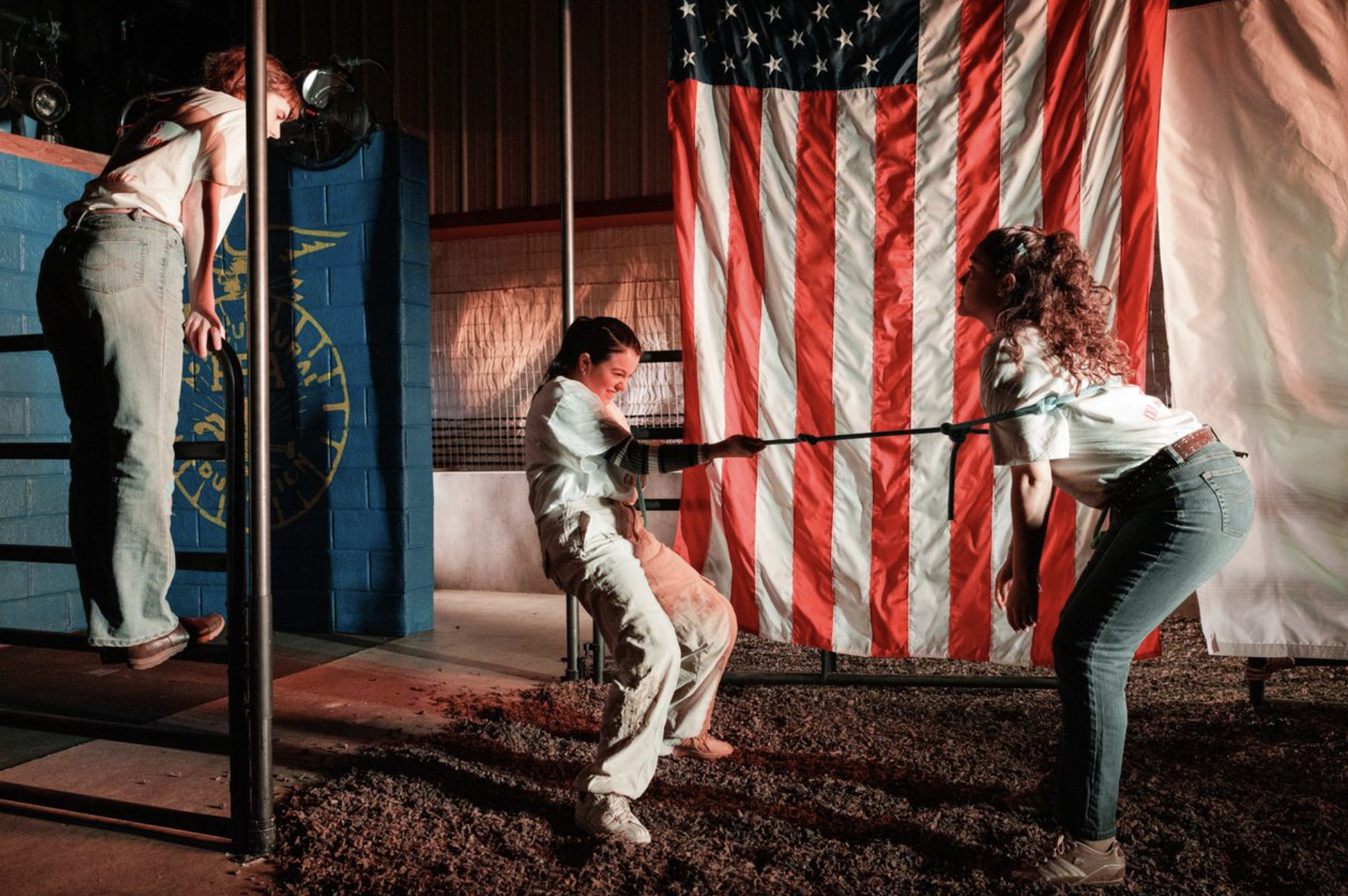
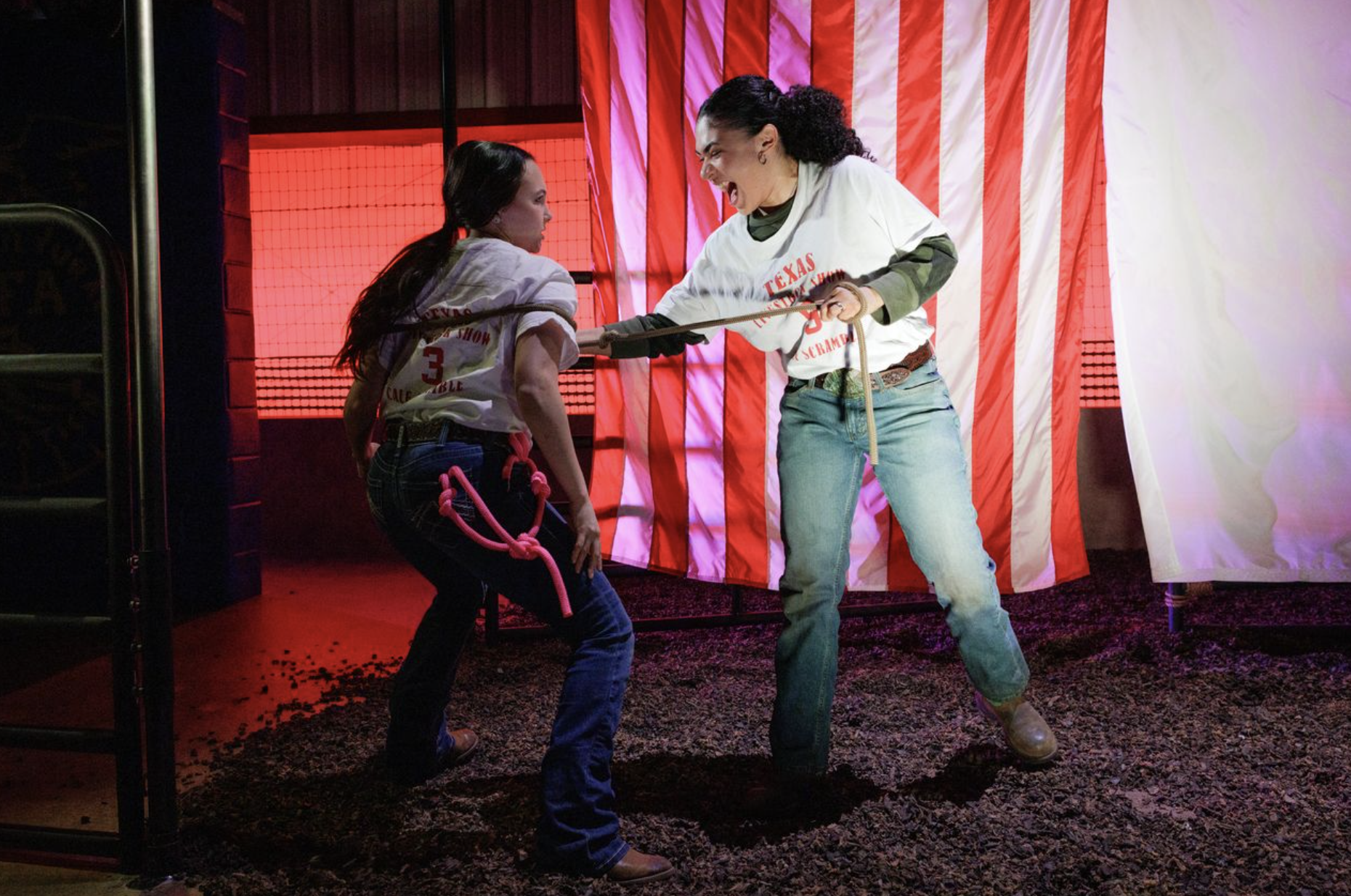
In one of the production’s most striking gestures, the five performers assume a dual existence, embodying not only the young wranglers but the calves themselves. Under Sullivan’s assured, unshowy direction, and shaped by Hannah Garner’s eloquent movement work, these transformations occur with a fluid, almost instinctual grace. A shift of weight, a recalibration of the spine, and the human figure yields to something more tentative, more exposed. The effect is not merely theatrical ingenuity but a deepening of the play’s emotional architecture, gently illuminating the parallels between these young women and the animals in their care—their circumscribed freedoms, their vulnerabilities, and their latent, hard-won strength.
The device might, in lesser hands, curdle into preciousness or parody. Here, it achieves something close to the sublime. A young woman becomes an animal: haltered, brushed, led. The transformation is not merely physical but ontological; the boundary between caretaker and creature dissolves into a shimmering ambiguity. Sullivan leans into this friction, trusting that the strangeness will resolve into recognition—and it does, with a force that is both intellectual and deeply felt.
It is especially compelling to witness the friendships refracted through the ritual of calf raising, a practice that quietly gathers around it the textures and particularities of life in an insular, conservative Texas town in the mid-aughts. Carr allows these cultural contours to emerge organically, so that the rhythms of labor, faith, and community become inseparable from the emotional lives of the girls themselves. Within that carefully rendered world, the evolving bond between Anna Lee and Vivvy carries a particular charge, their friendship deepening into something more with a tenderness that feels both surprising and inevitable—its stakes sharpened, rather than constrained, by the very environment that surrounds them.
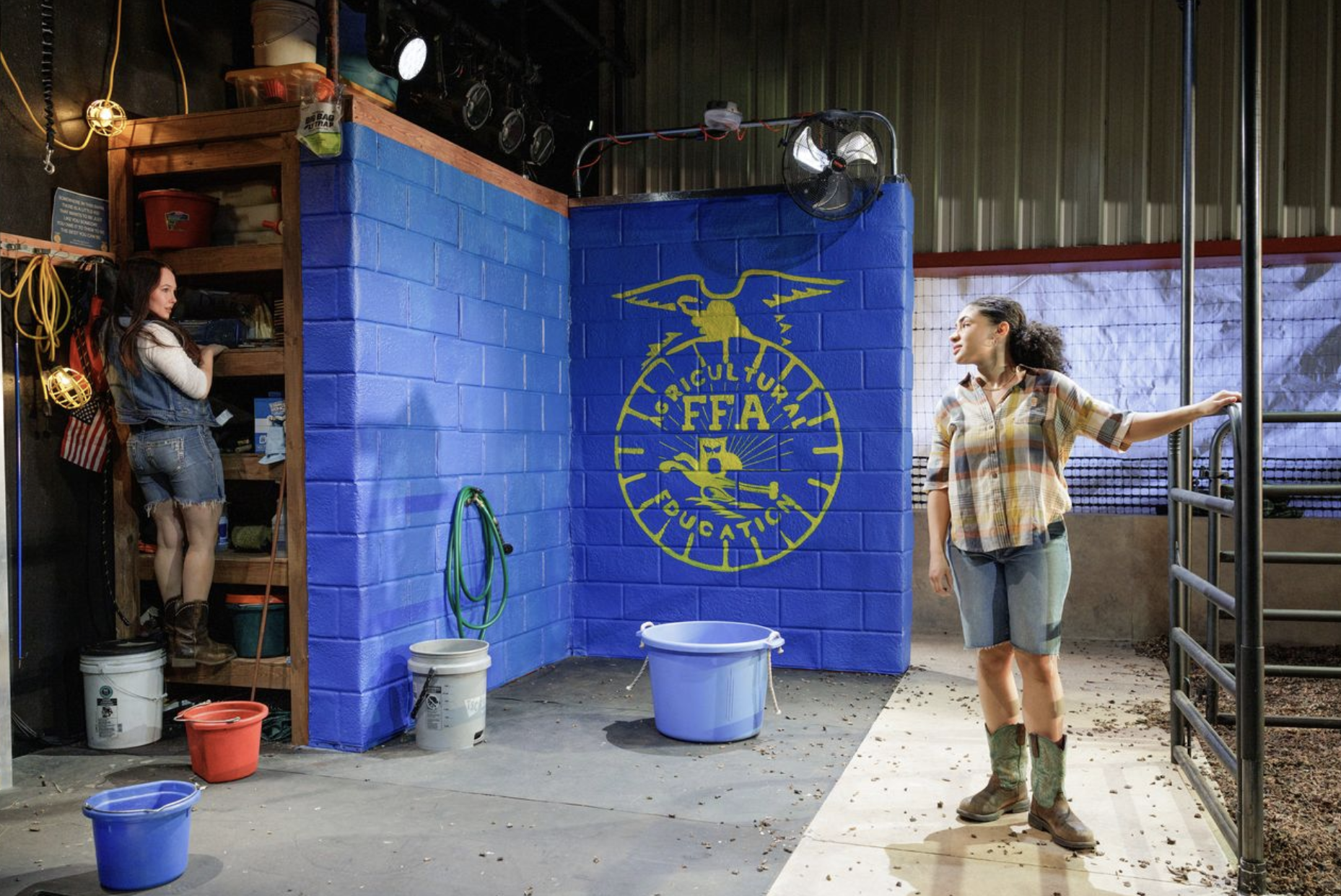
Much of this success rests on Cate McCrae’s extraordinary scenic design. The set does not approximate a barn and its cattle stall so much as conjure its memory: cinder block walls bearing the insignia of the FFA, muck buckets and hoses, shelves dusted with hay and the residue of labor. One can all but smell the mingled sweetness and acridity of cedar shavings and animal life. The illusion is completed, even elevated, by Barbara Samuels’ lighting, which charts the passage of time with painterly precision—dawn leaking through cracked rafters, the harsh fluorescence of barn lights flattening space into something almost existential.The singularity of this microcosm proves immediately alluring, its specificity inviting a kind of attentive curiosity that deepens as the play unfolds. That intrigue is further sweetened by the gentle patina of nostalgia that accompanies a story set in 2007, with costume designer Haydee Zelideth offering a series of deft, unshowy nods to the era—details that quietly situate us in time while never distracting from the lived-in immediacy of the world onstage.
What emerges within this meticulously realized world is a portrait of adolescence under pressure—economic, spiritual, and corporeal. These young women are, quite literally, betting their futures on their ability to master another living being. The stakes are neither abstract nor sentimental: a successful season could mean financial stability, a measure of independence, perhaps even escape. And yet Carr resists the temptation to frame this struggle in purely sociological terms. Instead, she locates drama in the porousness of identity itself—in the way these girls oscillate between dominance and submission, agency and vulnerability, selfhood and surrender.
If the play gestures toward broader contexts—the shadow of the prison system, the omnipresence of evangelical Christianity—it does so with a lightness that feels intentional rather than evasive. These elements hover at the periphery, shaping the girls’ lives without fully defining them. One senses that Carr is less interested in explicating systems than in tracing their emotional residue: the way belief, inheritance, and circumstance settle into the body, informing gesture, desire, and fear. Laanstra-Corn’s Maren, at once devout and disarmingly guileless, emerges as a figure of particular poignancy—a young woman whose faith is both anchor and constraint. Yet there are no weak links here; each performer contributes to a collective portrait of girlhood in flux, where friendship and rivalry, tenderness and cruelty, exist in uneasy but generative proximity.
By the time Calf Scramble reaches its quiet, hard-earned revelations—touching on sexuality, mortality, and the elusive nature of compassion, for animals as well as for each other—the audience has been so thoroughly inducted into its world that the play’s more improbable conceits feel not only plausible but necessary. What began as an exercise in theatrical imagination resolves into something richer and more enduring: a meditation on what it means to be shaped, and reshaped, by the forces—human and otherwise—that claim us.
We are invited—graciously, even generously—to expand our own lexicon in response to the play’s world, rather than expecting it to translate itself for us. Carr offers not an overdetermined map but a lived-in landscape, trusting the audience to meet it with curiosity and imagination. The dense, inward-turning logic of this farming community, and the interior lives of these young women, unfold with a tactile fidelity that feels both immediate and earned, even as certain social codes and inherited silences retain a beguiling, evocative mystery.
Far from a limitation, this sense of partial revelation becomes one of the production’s quiet triumphs. It allows these voices—so seldom given sustained presence on a New York stage—to resonate on their own frequencies, unburdened by the need for easy translation. What emerges is not opacity, but richness: a textured, specific, and deeply felt portrait that honors the integrity of its subjects while inviting us, attentively, into their world.
In its fusion of formal daring and emotional clarity, Calf Scramble announces Libby Carr as a playwright of uncommon sensitivity and ambition, and Caitlin Sullivan as a director attuned to the delicate alchemy of performance and space. It is, above all, a work that trusts the theater’s oldest magic: that with a few bodies, a few objects, and a shared act of belief, entire worlds can be made—and felt.
Click HERE for tickets.
Review by Tony Marinelli.
Published by Theatre Beyond Broadway on April 25, 2026. All rights reserved.
