Jewish Plot
Written by Torrey Townsend; Directed by Sarah Hughes
Theatre 154 | 154 Christopher Street, New York, NY 10014
October 22 - November 10, 2025
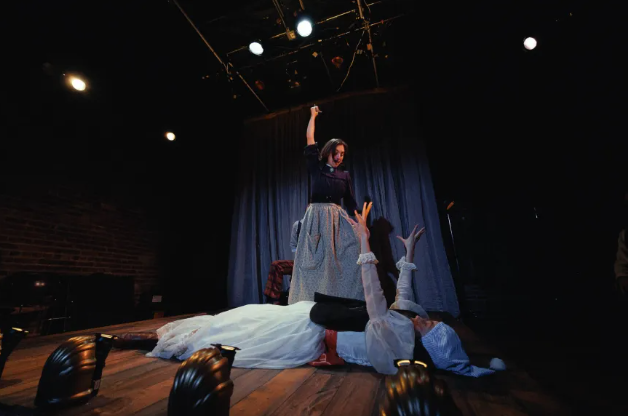
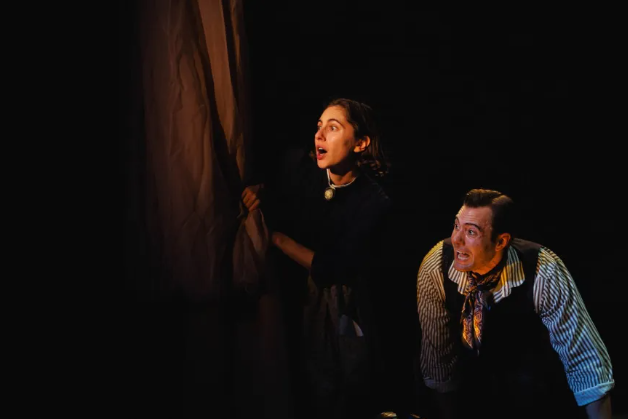
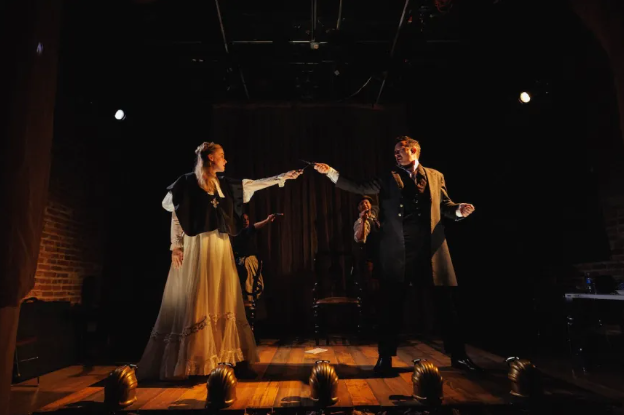
Photo Credit by Ken Yotsukura
Torrey Townsend’s Jewish Plot begins as an act of resurrection—an arch, entertaining exhumation of a long-lost (and entirely fictitious) 19th-century melodrama about antisemitism—before tumbling headlong into a fever dream of self-laceration, identity, and meta-theatrical despair. What starts as a crisp literary hoax ends as a howl. By the time the playwright himself, unseen but omnipresent, begins to unravel through his actors’ mouths, the piece has slipped its historical disguise and become something far messier: a psychic auto-da-fé on the subjects of Jewishness, art, and self-regard.
It all begins innocuously enough. Actress Madeline Weinstein, appearing as herself, greets us with scholarly aplomb, introducing Jewish Plot, or The Semite of Mayfair, a play allegedly penned by one Irwin Willoughby Bruntmole, “last performed briefly in 1889” and rediscovered in a London pub attic in 2006. She explains that Townsend has spent years painstakingly reconstructing this missing work, so much so that he is—at this very moment—backstage, still scribbling Act II. With this winking bit of theatrical archaeology, we are ushered into Act I, a farrago so precise it nearly convinces: powdered diction, florid gestures, and moral outrage rendered in sepia tones.
We meet Baron Morris Von Azenberg, an aristocratic Jew in love with a Christian actress, Miss Sophia Fitzkernerton—she, too, enamored, but bound by the virulent prejudice of her family. “My brothers,” she wails, “frothing and foaming, all of them crying out, ‘Death! Death to the filthy Jew beast!’” The language is purposefully purple. The acting is delightfully overwrought, a page, nay, an entire chapter from Michael Green’s classic The Art of Coarse Acting. The final triad of first act scenes centers on Abbé Artemis de Romantis, a flamboyantly self-satisfied French cleric whose notoriety rests on the authorship of a virulently antisemitic tract, and on a sordid pair of siblings who preside over a dilapidated hostelry of ill-repute known, with suitably grotesque flourish, as The Sgorg. For the first thirty minutes, it’s both a sly genre exercise and a comedy of artifice—a lampoon of the very theatrical conventions it mimics.
Weinstein and the irresistibly wide-eyed Neil D’Astolfo, as the conniving yet oddly endearing siblings who preside over their ramshackle inn, conjure a vision of Dickensian destitution so vivid one can almost smell the damp straw and desperation. Their greedy fixation on the Abbé’s money bag—an emblem of salvation and sin alike—feels both grotesque and heartbreakingly human. Tess Frazer, in turn, invests the Abbé with a deliciously ironic solemnity, her deadpan composure a sly mirror to the pious hypocrisy the play so gleefully skewers. When she reemerges as the Christian actress Sophia Fitzkernerton, she seems to be giving a masterclass in the art of period performance—her every gesture a parody of the exaggerated theatricality of a bygone age. Meanwhile, Eddie Kaye Thomas anchors the first act with quiet authority as the sympathetic Baron Von Azenberg, offering a performance of such understated intelligence that his restraint itself becomes the play’s moral compass amid the surrounding cacophony.
Perhaps it is the sheer persuasiveness of Frank J. Oliva’s scenic conjuring—a meticulous evocation of a late-19th-century playhouse, complete with the patina of time and the scent of gaslight—that renders the transition into the second act so profoundly disorienting. Oliva’s stage within a stage feels so authentic, so steeped in period illusion, that when the artifice fractures, we find ourselves as startled as the players themselves. His daring use of the vast, shadowy expanse beyond the proscenium—the “negative space” of the theater—imbues the arrival of the paramedics with an eerie verisimilitude, as though reality itself has breached the confines of the script. Caity Mulkearns’s exquisite period costumes in the first act complete the illusion, enveloping us in silks and corsetry that speak of another age. Yet it is in the second act that Jordan Barnett’s lighting design and the immersive, almost cinematic soundscape devised by Peter Mills Weiss and Robin Margolis seize the reins, transforming the production into a sensory spectacle where light and sound become the true protagonists, articulating what words no longer can.
Without warning, the illusion collapses. The actors return clutching freshly printed scripts—Act II, hot off the printer and still metaphorically wet with Townsend’s ink. What follows is less a continuation than an implosion. The playwright’s fictional madness seeps into the text, and Weinstein informs us, with unnerving calm, that “the set transforms into a symbol of what has happened to my brain… a gigantic pit of ash and bone.” The production becomes a spectacle of unraveling: the 19th century gives way to the 21st, and parody dissolves into confession, rant, and self-excoriation.
Townsend’s voice, filtered through the ensemble, alternates between mordant wit and manic despair. He rails against his peers—real playwrights by name, their reputations caught in the crossfire of his breakdown. “Maybe if you had given us an Oslo,” sneers his imaginary agent, “a Lehman Trilogy, an Indecent… but instead you totally fucked yourself.” The attack is scathing, and, for a moment, perversely funny. But the humor curdles. The screed expands into politics, theology, inherited guilt. Townsend indicts Congress as “neo-Nazis,” Zionists as colonizers, and even his own lineage—channeling his grandfather, Meyer Steinglass, a speechwriter for Golda Meir—who appears, grotesquely reanimated, to welcome Ebenezer Scrooge to a Zionist Jerusalem. “Next decade,” he assures him, “they won’t be here anymore… next decade, Riviera of the Middle East.”
Director Sarah Hughes finds herself at the mercy of a script that begins in playful pastiche and spirals, with unnerving velocity, into full-blown delirium. For the first thirty minutes, she delivers pure theatrical confection—a winking immersion in a bygone world so richly realized that one might almost smell the dust of the footlights and the starch of the petticoats. Yet the fissure between the two acts proves treacherous: the shift is so abrupt, so audacious, that the audience is left reeling, unmoored from the genteel amusements that preceded it. As the play careens into its meta-theatrical breakdown, there is the very real peril of exhaustion—Miss Weinstein, indefatigable and formidable, bears the Sisyphean task of navigating the play’s textual onslaught nearly alone. One cannot help but wonder whether the burden might be better shared among the four actors, diffusing the density of the prose and granting the audience some reprieve. Mr. D’Astolfo is the first to revolt, breaking the illusion entirely as he bolts through the crowd like a man escaping his own fiction. Mr. Thomas departs soon after, only to reappear in the jarring new reality as a paramedic—a figure of grim pragmatism amid the chaos. And poor Miss Frazer—she remains seated, her face a mask of stunned composure, absorbing what shards of meaning she can, as though mirroring the audience’s own baffled endurance. Some spectators, unable to weather the storm, clomped indignantly out into the night; others—stout of heart or perhaps simply mesmerized—stayed to the end, compelled to see just how far the madness would go.
And yet, for all its excesses—for all its self-conscious flailing—Jewish Plot remains undeniably alive. It is an experiment in implosion, an artist’s nervous breakdown staged as postmodern farce. One leaves the theater not enlightened but dazed, wondering whether Townsend’s descent was ever meant to be cathartic, or merely contagious. The audience may also wonder if the much-maligned-in-Act II playwright Joshua Harmon was invited to the opening night.
Click HERE for tickets.
Review by Tony Marinelli.
Published by Theatre Beyond Broadway on November 10, 2025. All rights reserved.