
MAMI
Conceived and directed by Mario Banushi
NYU Skirball, 566 LaGuardia Pl, New York, NY 10012
January 7, 2026 -January 10, 2026
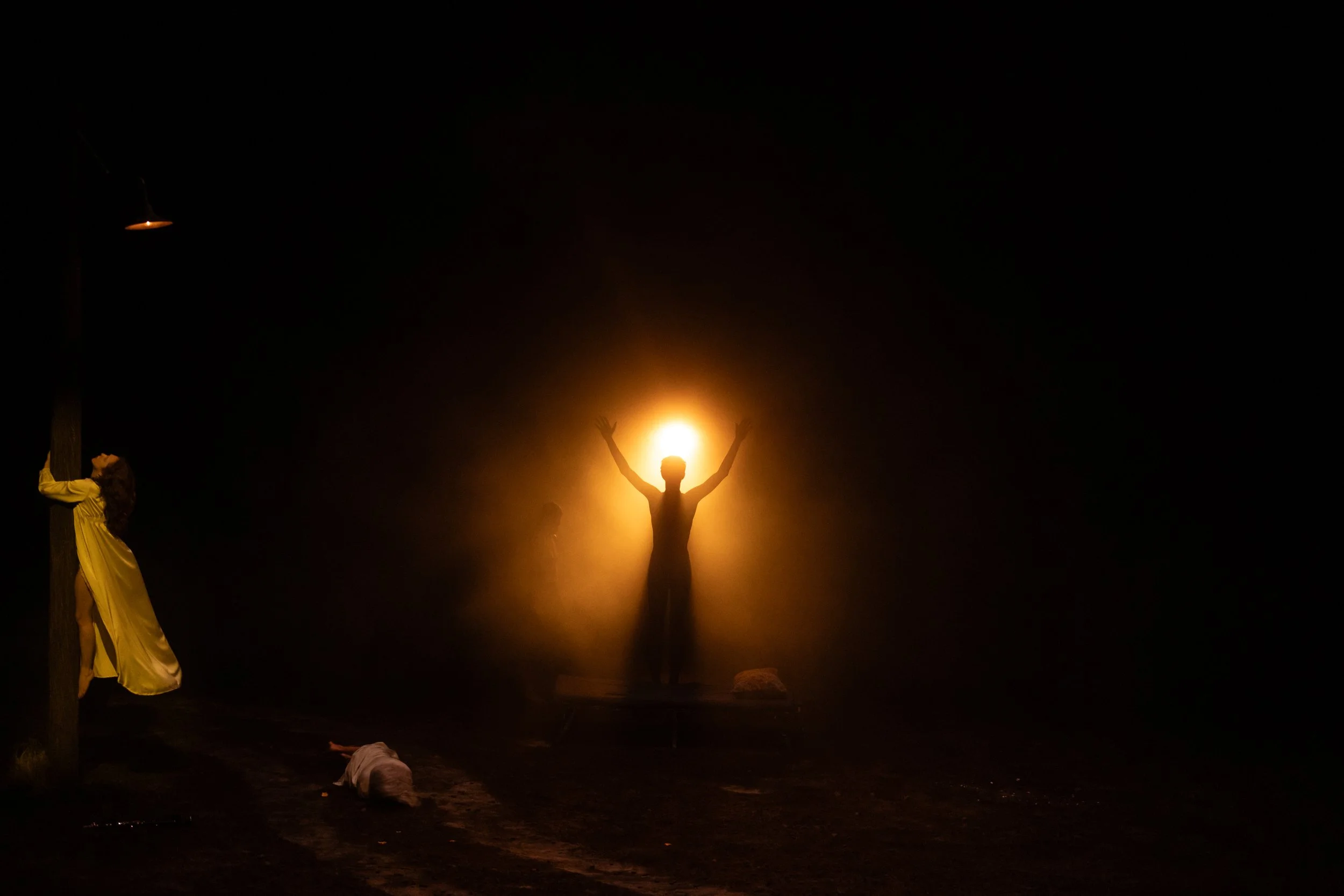
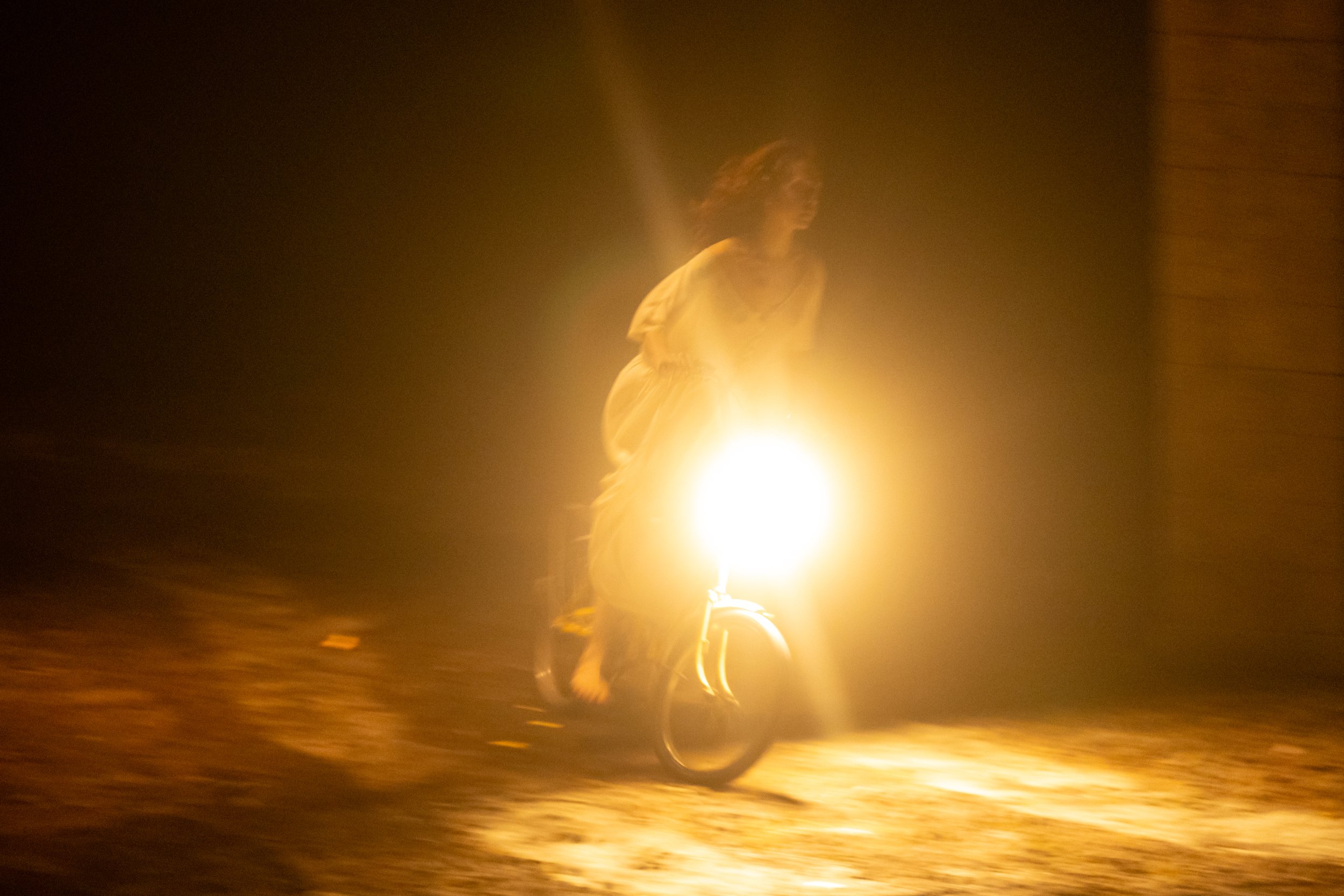
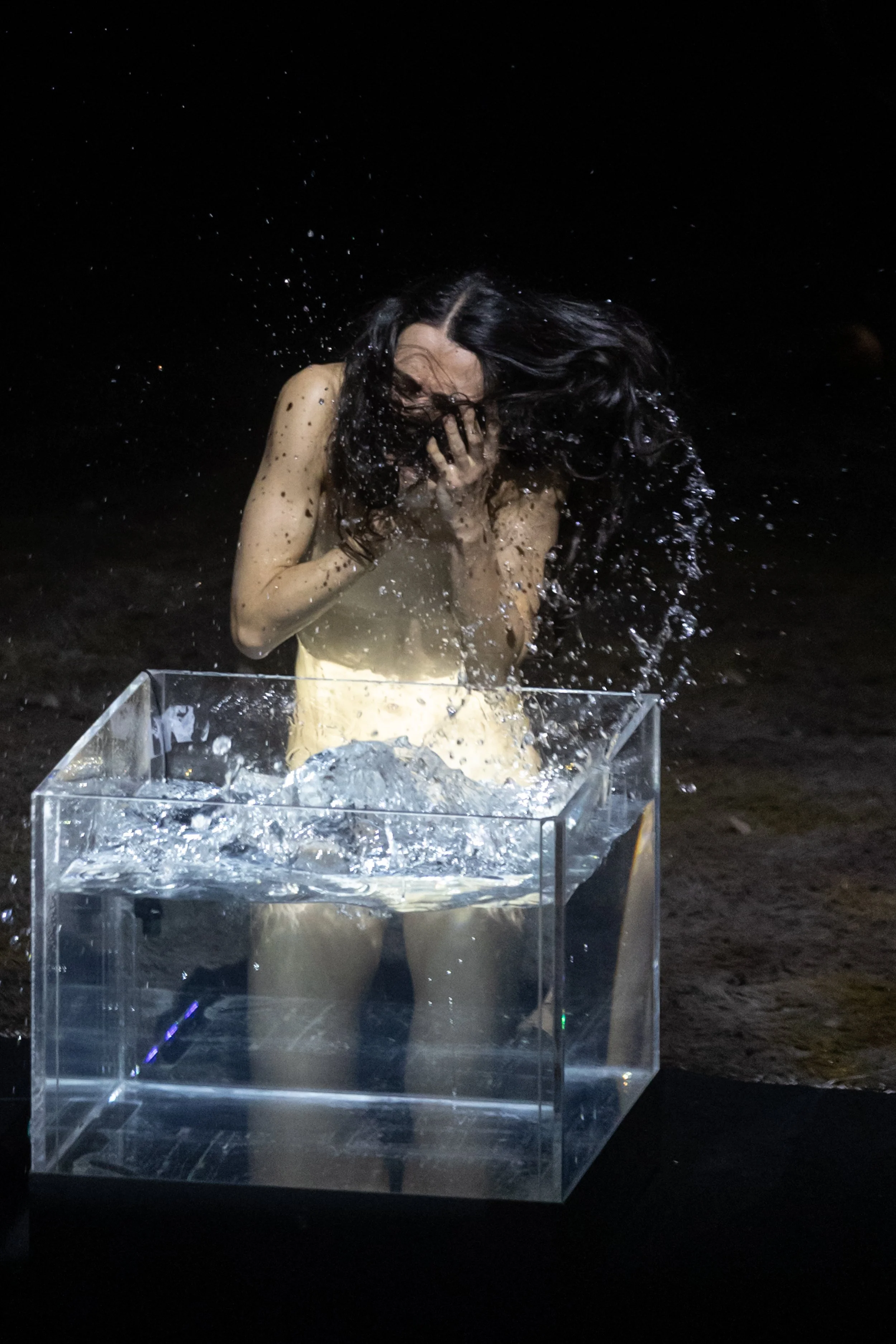
Photo Credit: Pinelopi Gerasimou for Onassis Stegi
The word “MAMI” means “mother,” though it carries a phonetic closeness to “MAM”, “food,” nourishment itself. In that almost-childish slippage between meanings lies the conceptual engine of Mario Banushi’s latest work: the mother as origin, sustenance, and gravitational center of an endless spiral of care, dependence, refusal, and return. With Ragada (2022), Goodbye, Lindita (2023), and Taverna Miresia-Mario, Bella, Anastasia (2023), he constructed a triptych of mourning. MAMI marks a decisive pivot—not away from loss, but toward life itself, and toward the fraught, sacred mechanism by which life insists on renewing itself. The work, conceived and directed by Banushi, is deeply personal without ever collapsing into confession. Banushi has spoken of growing up calling his grandmother “mami,” while addressing his biological mother by her given name—an arrangement shaped by migration, separation, and necessity. Born in Albania, he moved to Athens at the age of six; only later did the word “mother” become available to him in its full, unguarded sense. MAMI, he has written, is dedicated to the woman he could not previously name as such. The title itself becomes a belated act of recognition, a gift returned after years of estrangement from the word that names the bond.
As in Banushi’s earlier work, language is largely absent. Meaning is carried instead by visuals, rhythms, and a meticulously sculpted soundscape that blends the personal with the archetypal. Here we hear a dog howling in the distance, the persistent rasp of crickets, and human noises produced by the performers themselves—breath, friction, exertion—stitched together with an original score by Jeph Vanger. Alongside Sotiris Melanos’ spare yet evocative set and costume design, these elements coalesce into something like a “theatre of images and sound”: not an argument about motherhood, but an extended meditation on its textures and contradictions. The stage picture marks a quiet but significant departure for Banushi. In Stephanos Droussiotis’ exquisite mood-drenched lighting, under a glow of a streetlamp, we find ourselves outside a house—apparently rural, indeterminate in time and place. There is a yard, a bed, and a bicycle. The action is not enclosed within four walls, in fact the house tips over onto its side revealing the interior making the wall we see straight ahead actually the ceiling. The openness feels deliberate, even symbolic: the exterior as a womb turned inside out. One senses the director tugging gently at the umbilical cord, not to sever it, but with curiosity examining its structure.
This openness allows for a broader physical vocabulary. The performers move through images that feel uncannily familiar, yet never prescriptive. We witness birth; adolescence, marked by a young girl drinking milk but then spitting it upwards into the air giving us in effect a light show; erotic discovery; care extended upward as well as downward in time, as a son or grandson feeds an aging woman, changing her diaper and her bedding; and finally, the tenderness of a mother consoling an elderly figure on the threshold of death. Roles reverse, then reverse again. Care circulates. Authority dissolves. It is never clear who is giving and who is receiving for very long—an instability that mirrors lived experience more faithfully than any fixed hierarchy could.
Drawing unapologetically from the raw matter of his own life, Banushi erects what might best be described as an unholy shrine to the mother–child relationship—a site of devotion that refuses piety, and of reverence that is inseparable from disturbance. This is not a monument meant to console. It is a space in which motherhood is at once sanctified and profaned, celebrated and driven out, burdened with whispered vows and muttered curses. Banushi seems determined to experience the bond in every register at once: to submit to it, to wrestle it into form, to recoil from it, and finally, impossibly, to fall back in love with it. The work understands the maternal tie not as a stable origin story but as a charged and volatile exchange, one that leaves lasting marks on both bodies involved. Love here is never simple; it arrives entangled with obligation, resentment, dependence, and awe. To be born is to be torn from intimacy, to enter the world through an act of separation that nonetheless claims to be an act of care. In staging this reversal, Banushi gives theatrical form to a truth most people carry but rarely articulate: that the first gesture of love is also the first rupture, and that everything which follows is an attempt—tender, furious, doomed, and beautiful—to make sense of that original wound.
Interspersed among these recognizably human tableaux are moments that feel drawn from surrealism or nightmare: gestures that hover between the symbolic and the inexplicable. Objects, too, accrue meaning without settling into allegory. A basin filled three-quarters with water becomes, in turn, a womb, a site of purification, a baptismal font, and later a dangerous body of water in which two boys struggle violently. Banushi refuses to resolve these images into a single reading; their power lies precisely in their instability. The stage slowly resolves into a terrain of memory, a psychic landscape as unsettling as it is recognizably our own. It is a place where the past does not announce itself with clarity but seeps in through atmosphere and gesture, where what feels strange is also, uncomfortably, intimate. In the near-absence of language, the performers work within a charged silence, shaping time through stillness, breath, and carefully weighted movement. Each action seems to summon something half-buried—an echo rather than a statement—allowing emotion to accumulate rather than be declared. As we watch, we are gently but insistently pressed to recognize the outlines of our own memories, to confront the complicated textures of our relationships, and to acknowledge the emotional inheritance we carry with us—often unconsciously—throughout our lives. The theatre, in these moments, ceases to be a site of representation and becomes instead a space of reckoning.
Crucially, MAMI neither sanctifies nor condemns motherhood. It presents it whole. Birth is shown as miracle and as burden, as gift and as compulsion. The nurturing mother shades easily into the monstrous; the child is at once blessing and weight. The act of witnessing life can feel like fireworks—or like standing, terrified, before the relentless cry of a newborn. If there is a single image that cuts through this ambiguity, it is breastfeeding, which Banushi presents as the most unambiguous signifier of motherhood’s physical reality. And when a mother cannot breastfeed, a midwife does.
The performers Vasiliki Driva, Nontas Damopoulos, Eftychia Stefanou, Angeliki Stellatou, Fotis Stratigos, and Panagiota Υiagli, work with a remarkable restraint, allowing emotion to surface without being declared. Their immersion in silence, a charged quiet, sharpens our attention, making each movement, each pause, resonate with an intensity that language might only dilute. In these moments, the performance turns its gaze back toward the audience, gently but insistently urging us to confront our own histories—our intimate relationships, our unresolved attachments, and the emotional inheritance we carry forward, often without realizing how deeply it shapes us. There are moments when the piece’s stillness and deliberate pacing threaten to withhold more than they reveal. MAMI is not an easy work, nor does it court accessibility. But its difficulty feels earned. In a theatrical landscape that can too easily default to irony or polemic, Banushi offers something rarer: an earnest, unsparing attempt to look at motherhood without consolation or accusation. The result is a brave, unsettling, and resonant work—one that suggests not only a remarkable young artist, but a theatre scene newly alive to the necessity of his voice.
What unfolds is less a narrative than a rite: a sequence of intensely personal evocations offered up to the audience without prescription, inviting interpretation rather than obedience. The stage becomes a ceremonial ground marked by exposed flesh and decelerated movement, where bodies appear not to perform but to submit—to time, to gravity, to memory itself. Images arrive with a dreamlike logic: the sudden, unsettling irruption of spiders; the charged, almost feral struggle between two male bodies locked in a lustful, ambiguous combat; the prolonged immersion of a performer in a bathtub of water. All of this unfolds in near-constant darkness, as though light itself were something to be rationed.
There is little here that might be described as joy, and almost nothing that courts visual pleasure in a conventional sense. Color drains from the stage, replaced by an atmosphere of sadness and quiet melancholy that seems to press down on every gesture. Yet within this somber register, the work achieves moments of striking poetic force. The visual compositions are meticulously stylized, shaped with a painter’s eye for balance and duration, and at their best they achieve a haunting beauty that lingers long after the image dissolves. The rigor of the aesthetic—its insistence on restraint, on darkness, on emotional coolness—can at times create a distance, yet it never dulls its impact. One admires the craft, the seriousness of intent, even the courage of the vision, while occasionally feeling held at arm’s length, allowing for contemplation.
The objects that appear onstage are never mere props or functional accessories; each arrives bearing a distinct symbolic charge, as though it had been summoned from a shared reservoir of memory and ritual. They do not explain themselves, nor are they fixed in meaning. Instead, they accrue resonance through repetition, context, and the physical relationships the performers establish with them. An object is lifted, carried, submerged, or abandoned, and in these simple actions it begins to suggest histories, emotions, and states of being that extend far beyond its material form. In Banushi’s theatrical universe, objects operate as silent witnesses. They anchor the abstract emotional terrain of the performance, offering points of tactile focus amid the fluidity of bodies and images. Their presence sharpens the sense that what we are watching is not illustrative but incantatory—a world in which things are charged with memory, vulnerability, and latent violence, and where meaning emerges not through explanation but through accumulation and attentive looking.
Through a carefully composed sequence of visual tableaux, and an almost obsessive attentiveness to gesture, posture, and physical proximity, Mami gives shape to the unspoken dynamics of filial love—its tensions and impulses, its sudden withdrawals, and its eloquent silences. Meaning here is not advanced through plot or dialogue but accumulated through the body: a bent back held too long, a hand that hesitates before touching, a stance that signals both protection and resistance. These images do not explain themselves; they resonate, inviting the spectator to feel rather than decode the emotional currents at work.
The production announces, without apology, its allegiance to non-linear dramaturgy and to a theatrical language rooted in the physical and the intimate. This is a work that speaks most directly to audiences attuned to abstraction, to the expressive capacities of the body, and to narratives that unfold through sensation rather than story. Mami trusts silence as much as sound, presence as much as action, and in doing so offers a deeply personal meditation that unfolds in a language beyond words—one that must be received slowly, attentively, and on its own terms.
Review by Tony Marinelli.
Published by Theatre Beyond Broadway on January 11th, 2026. All rights reserved.
