Written by Nazareth Hassan; Directed by Keenan Tyler Oliphant
Peter Jay Sharp Theater| Playwrights Horizons, 416 West 42nd Street, New York, NY 10036
October 30 - December 14, 2025
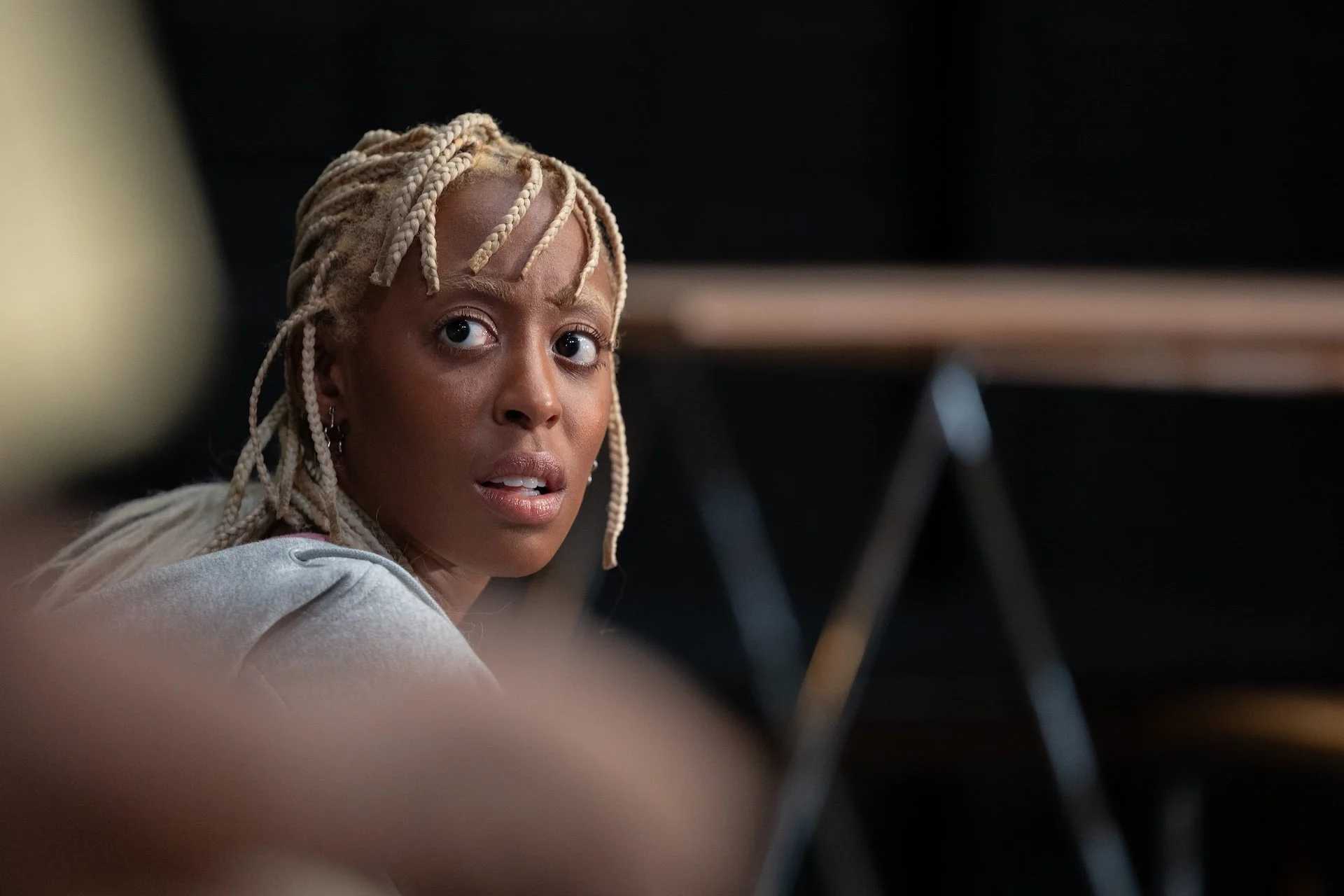
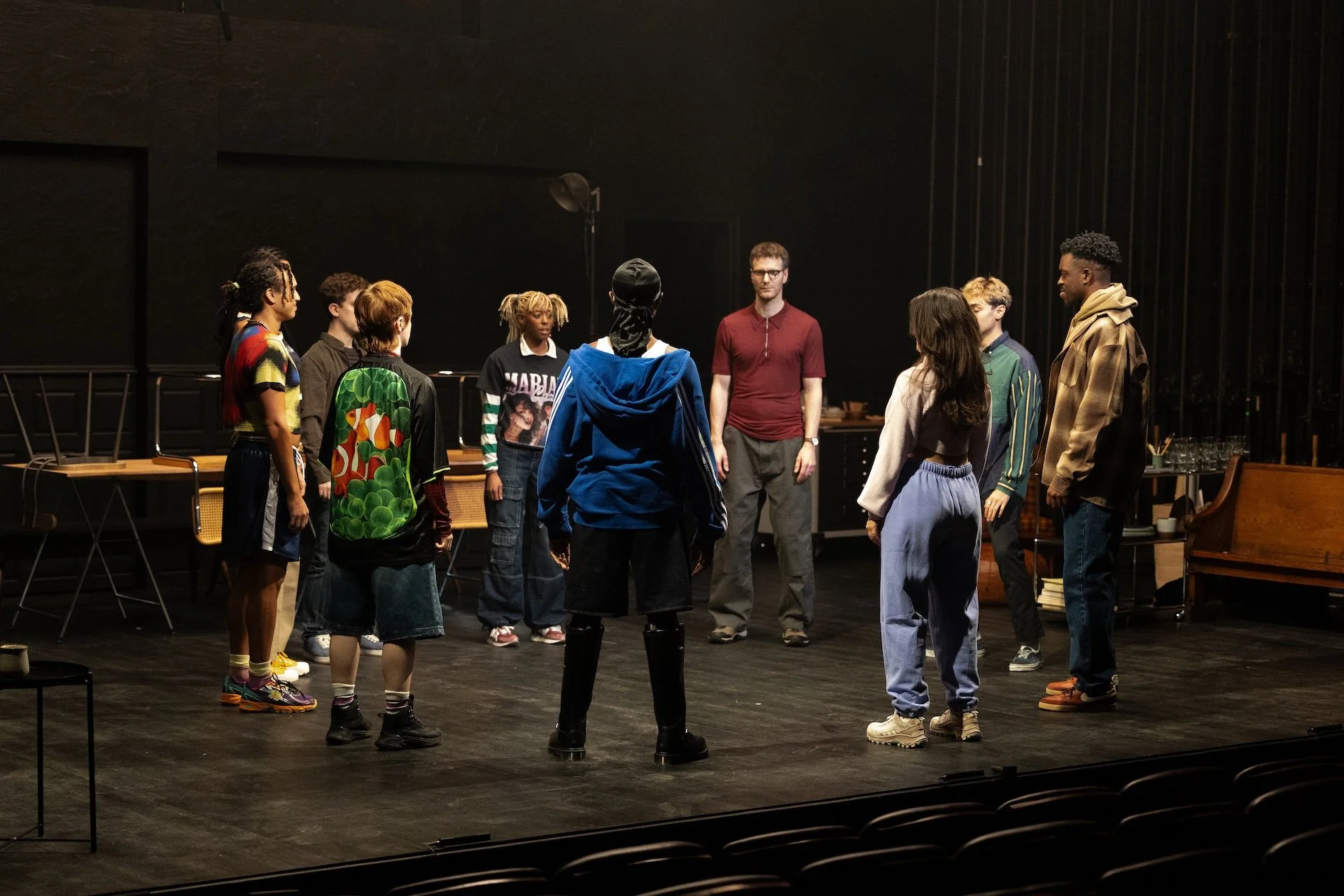
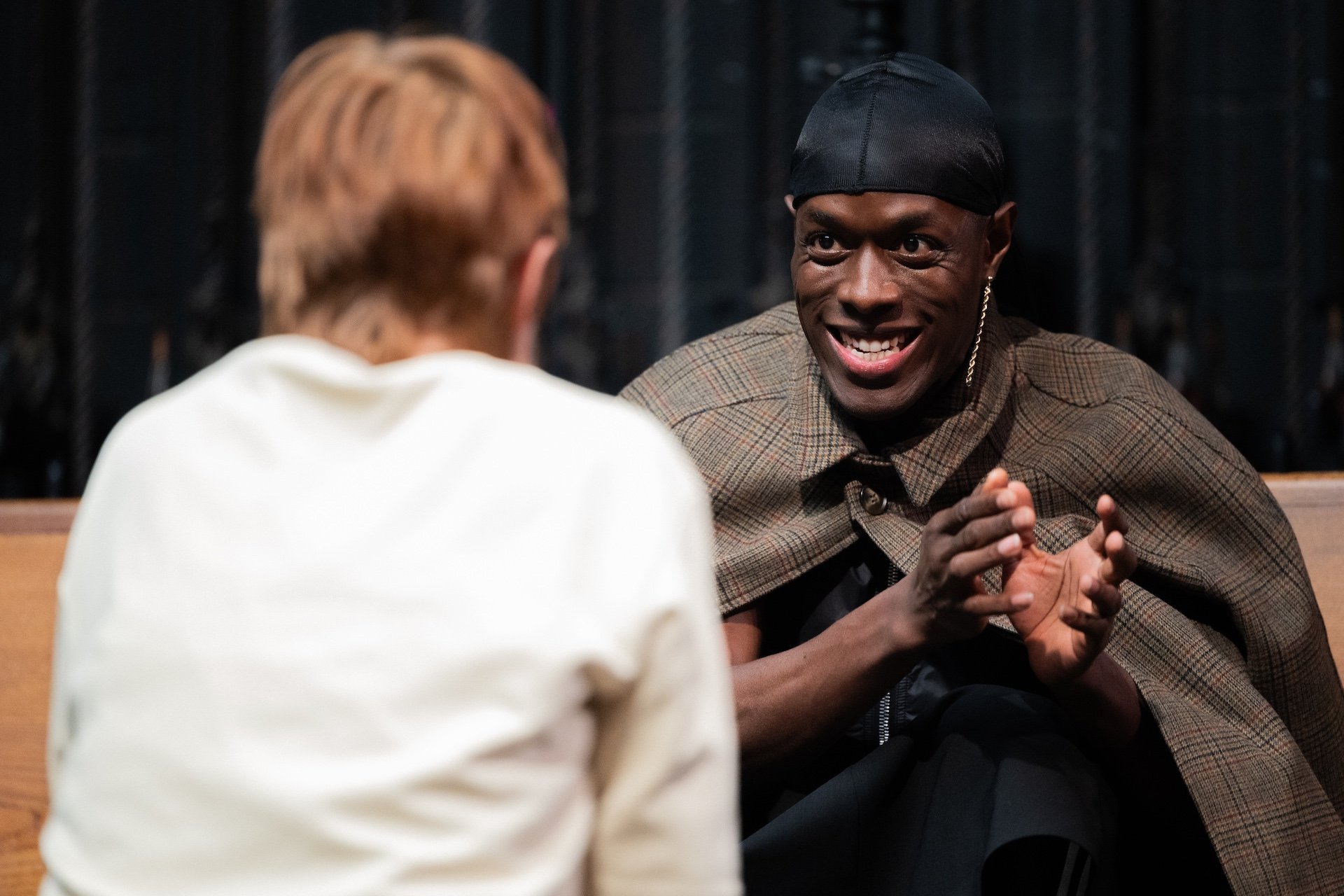
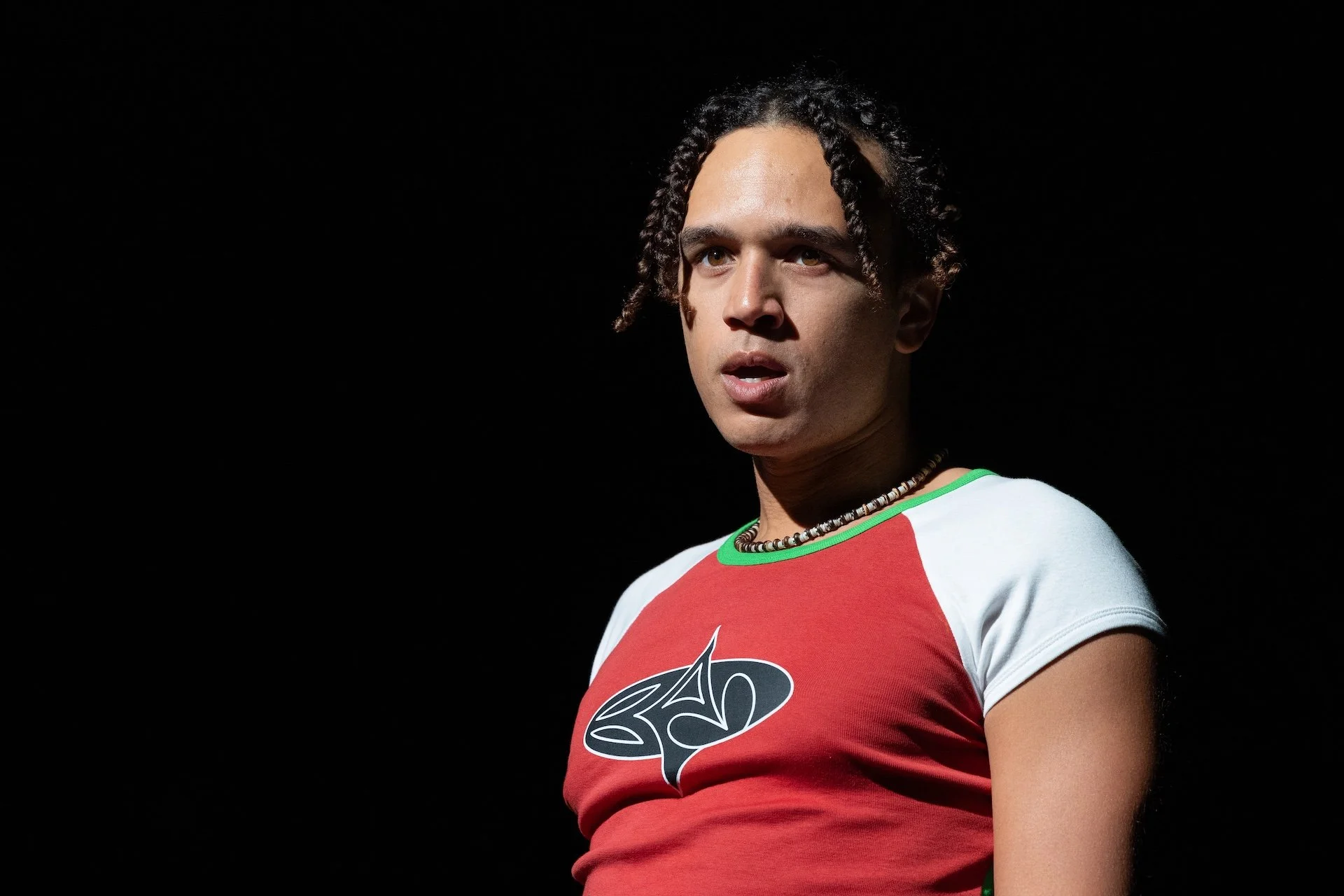
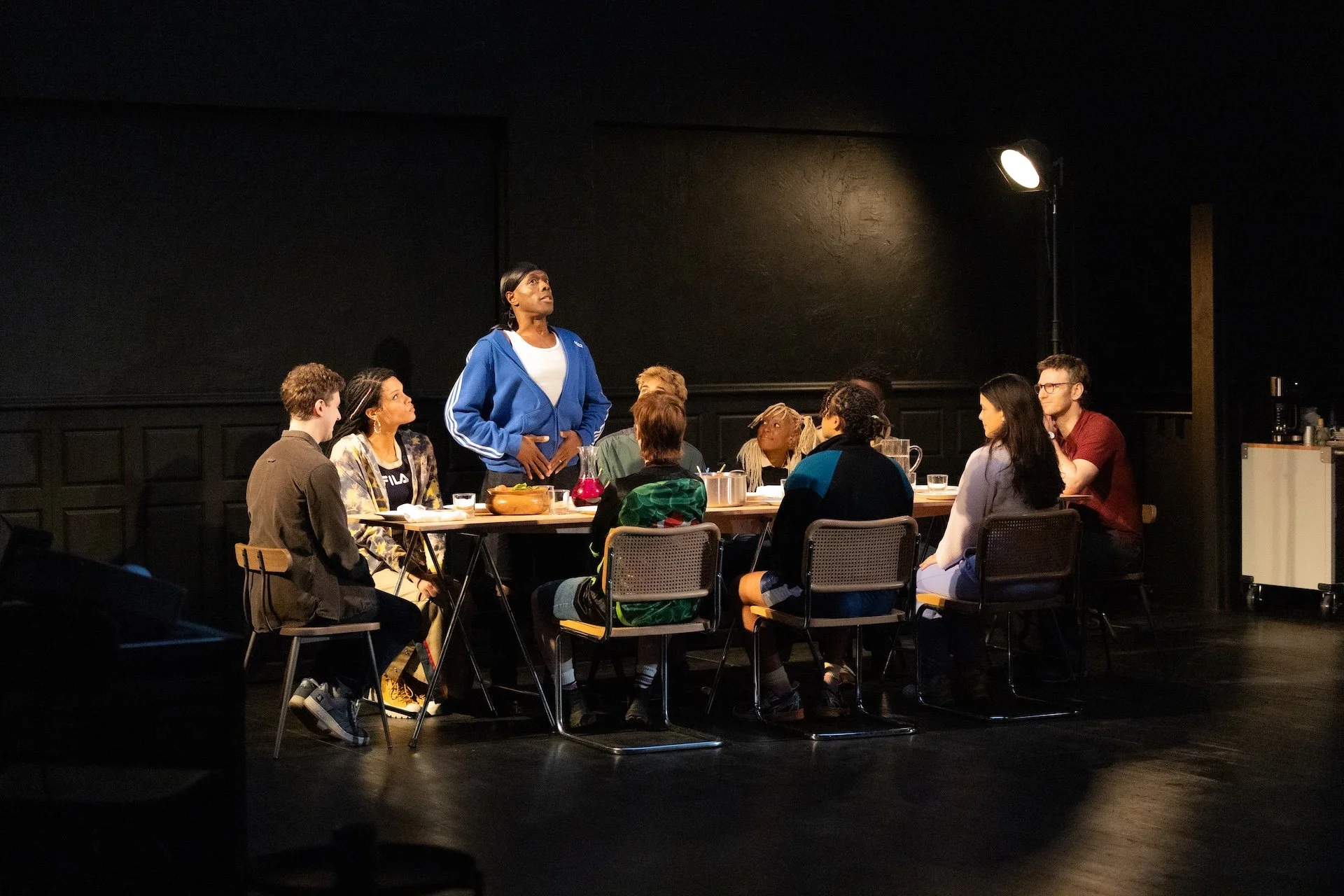
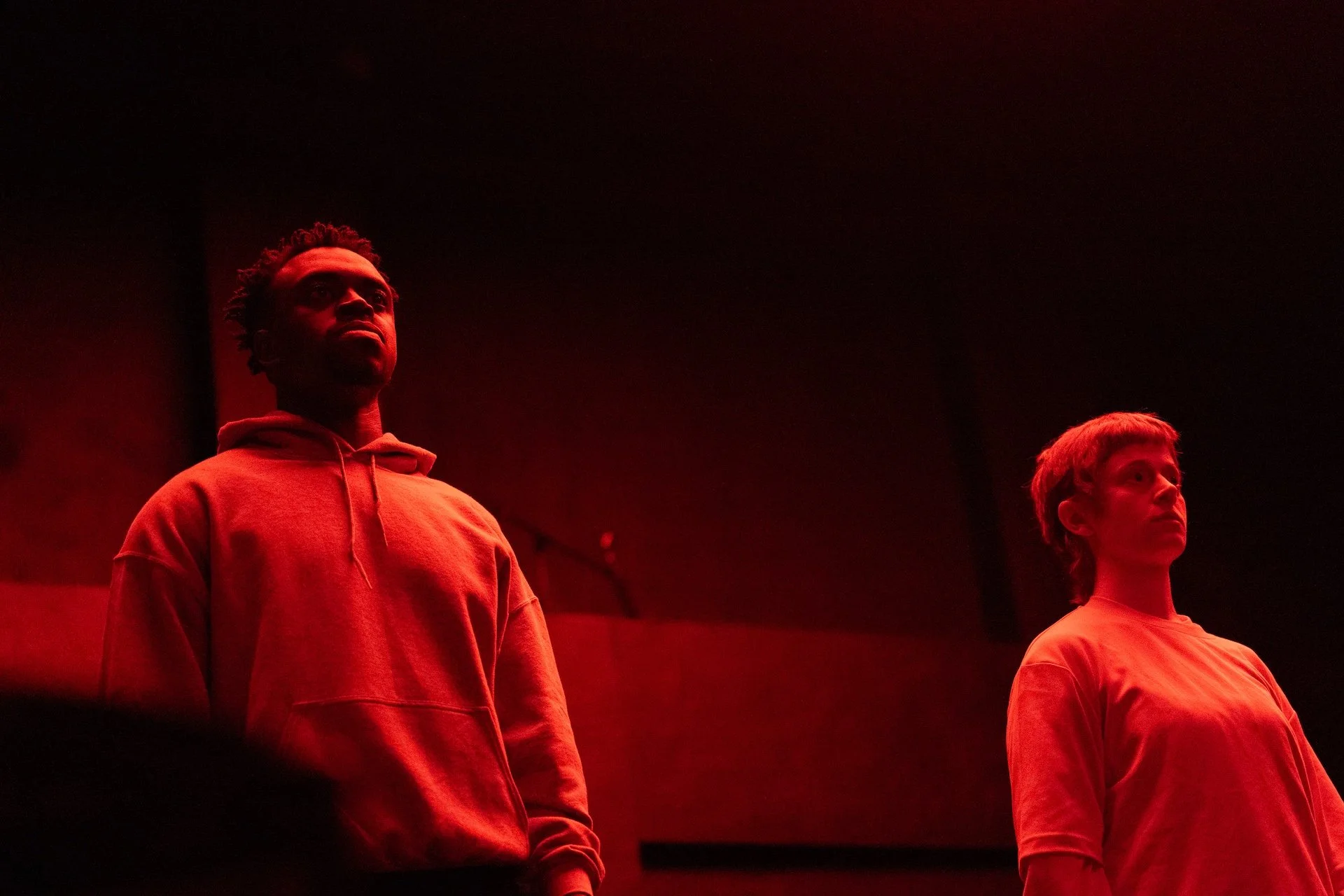
Photo Credit: Alexander Mejía, Bergamot
For anyone attuned to the delicate mechanics by which theater reveals itself even as it conceals—the most arresting insight in Practice, Nazareth Hassan’s bristling new work at Playwrights Horizons, arrives in its opening breaths. Before we have yet oriented ourselves to the production’s tonal temperature, we are confronted with a kind of ritualized repetition: seven actors—young, variously gendered, ethnically and nationally diverse, that shimmering demographic mosaic on which so much contemporary theater stakes its cultural currency—file in to audition with the very same monologue for a director whose voice hovers disembodied, a controlling spirit without corporeal form. It is, unmistakably, A Chorus Line reimagined for a more suspicious age, though here Asa Leon (with an incredible Tony Jenkins stepping into the role at this critic’s performance) will ultimately occupy the stage far more persistently than that earlier musical’s imperious, unseen Zach.
When the monologue first emerges—through the casually electric Ro (Opa Adayemo), a tall Black man whose relaxed charisma ripples through the room—the audience may briefly indulge the natural assumption that we are meeting the play’s protagonist. But that presumption evaporates at the first interruption, the first note, the first intrusion of directorial authority. We soon watch six more performers assay the same material: the Spartan simplicity of German Rinni (Susannah Perkins), the poised, flirtatious Keeyon (Hayward Leach), the jittery, self-effacing Brit of Tristan (Omar Shafiuzzaman), the open-faced sociability of Chilean Mel (Karina Curet), the singularly riveted Savannah (Amandla Jahava), and the messy, yet coiffed Black trans Angelique (Maya Margarita). In each performance, we perceive something essential about theater’s double helix: the actor’s will, intention, and embodied technique spiraling around the director’s shaping pressure and the playwright’s preordained language. It is a veritable eustress—perhaps the essential tension. The God mic Asa may direct, correct, and cajole, but it is the actor’s body that bears the expressive burden, the playwright’s words that anchor the dance between impulse and instruction.
In these early moments, beneath the bright veneer of artistic inquiry, a subtle shadow creeps. Another voice intrudes, one we cannot place, offering Asa tidbits—some innocuous, some disquieting—about the auditioners. We will later learn that this spectral presence is Danny (Alex Wyse), Asa’s dramaturg and unofficial confidant, whose role hovers uncomfortably between archivist and intelligence operative, a custodian of process who becomes an agent of surveillance, as in every moment being subjected to audio and video collection.
Once the full company is gathered, the equilibrium tilts almost immediately. Asa is merely a few years older than their troupe of twenty-somethings, yet already they possess the aura of the anointed: a MacArthur grant gleaming in their résumé, a commission from a prestigious German avant-garde house, and a position within a pair of husband & husband theatrical juggernauts—Asa the ascendant Black visionary, and their husband Walton (Mark Junek), a white, older designer whose trust fund quietly bankrolls more of this enterprise than anyone admits aloud. What has been advertised to the young performers as an “extraordinary opportunity”—eight weeks of communal living, artistic rigor, and the forging of a devised work that will tour continental Europe—is also, quite nakedly, a crucible into which Asa intends to pour their performers’ traumas, mining personal histories for aesthetic capital.
As the obvious manipulating accumulates, the rehearsal process metastasizes into something more corrosive. The benign enthusiasm of “let’s all put on a show together” begins to curdle, gently at first, then with unmistakable acidity. The first act traces these eight weeks with a slow, inexorable torque, urging the audience into mounting suspicion about Asa’s methods—a suspicion given articulate voice by Angelique (Maya Margarita), a trans Black woman who becomes increasingly unwilling to liquefy her boundaries in the service of someone else’s artistic mythmaking. Faced with a recording of one of her own “private” conversations signals her need to exit and puts the other six very much on notice that they have no privacy.
None of this is, on its surface, a startling revelation. The theater has long been haunted by the specter of the manipulative auteur who demands emotional strip-mining as the price of entry into art. Yet Practice, under Hassan and director Keenan Tyler Oliphant’s unnervingly exacting eye, pushes the dynamic to both sinister and absurd lengths. The exercises become laced with an unmistakable whiff of tyranny—tyranny made all the more galling by the triviality of the final product: a mere half-hour piece of performance, not the strategic blueprint for a theatrical revolution. It is a blackly comic gesture that Asa deploys gourmet jellybeans as instruments of psychological torment, getting someone to admit to pilfering from his “cupboard” or the entire troupe will be fined to repay the theft; it is notably less amusing to see the apparatus of surveillance—tapes, transcripts, fragmented confessions—turned weapon against the very performers it purports to document…even now as they are down to six victims, er, players.
Act I stretches beyond two hours, a long simmer in which revulsion at Asa’s methods steadily intensifies yet never quite extinguishes a lingering question: What does Asa believe they are doing? Are they a victim of their own legend, or a sadistic puppet master playing with pliant bodies? Might even the most transcendent art justify such excavation? Or is the joke, finally, on us—the complicit spectators eager to consume a product borne of quiet cruelty? The financial underpinnings of this endeavor complicate matters further. Walton, the “human ATM” whose trust fund bankrolls the project—and who also, as it emerges, preys sexually on vulnerable young men of color like the impressionable Keeyon (Hayward Leach)—casts a long, queasy shadow across any attempt to parse artistic merit from material corruption.
Then arrives the mercifully brief but tonally seismic Act II, revealing the resulting work: Self Awareness Exercise 001, first in Berlin, then on the brink of performance in London. Performed inside Walton’s set—a hermetic cube of two-way mirrors (rendered with cool precision by Afsoon Pajoufar as is his believable revamped church-as-studio for the first act)—the ensemble moves in pastel masks with painted eyeholes and Personal Protective Equipment suits, reenacting one another’s traumas refracted through Asa’s distorting lens. Brenda Abbandandolo and Karen Boyer provide the comfortable clothing for the ensemble in Act I, then the pseudo-hazmat garb for Act II, but the most interesting work is for Asa as each entrance gives the impression he is being dressed by a personal couturier backstage. Lighting designer Masha Tsimring, with an alchemist’s flair for the sublimely excessive, transfigures mere realism into a pulsating futurist dreamscape, orchestrating battalions of fluorescent tubes that throb, flare, and sigh with the emotional temperature of the piece. Meanwhile, sound designer Tei Blow inundates the room in an extravagant aural bath—club beats ricocheting off the architecture, choral phrasings rising like vapor, and, most audaciously, a looping operatic solo that insists on droning through the entire intermission with a kind of perverse, near-comic obstinacy, as though daring us to question where immersion ends and irritation begins. Hassan and Oliphant deserve credit for the eerie slickness of Self Awareness: the stylized choreography (conceived by Oliphant and Camden Gonzales), the interchangeable costuming, the ventriloquizing of each other’s stories. Yet the narration the company must deliver in unison feels too overt, too eager to confess its own malignancy. Indeed, the performers’ continued complicity becomes its own indictment; the tension between creator and creation collapses into flat hierarchy.
And still—and this is the play’s final, cunning twist—they know. They perform, quite literally, for themselves, trapped in a reflective cube where each actor confronts only their own image. As they mimic one another’s accents and verbal tics, we are reminded of the essential artificiality threading through both acts.The ensemble manages to persist, even after hints of violence, cycling through performances as Danny quietly continues his surveillance with an ever-watchful camera. Where Act I seeded suspicion; Act II refracts it back, confirming our worst fears and then implicating us in having wanted them confirmed. An audience can sit there in horror all they want but haven’t they been in on it all along?
Practice is the answer writ large to a question no actor should ever have to ask themselves: How ugly does it have to get before the actor gives up and searches out what the rest of the world calls “a real job”? We have Asa as avatar (and as commanding as he was as the chilling central character of Larry Kramer earlier this season in Figaro/Faggots at Baryshnikov Arts, Tony Jenkins rises to the occasion once again now as a demonic, malevolent “creative”), the piece itself as self-indictment, the audience as both witness and accomplice. Yet even within this self-lacerating inquiry, the ensemble remains largely instrumentalized, their interiority subordinated to the machinery of the concept. It is a narrow ledge between exposé and exploitation, and the production dances precariously along it.
It is easy for an audience member to be unable to stop thinking about Practice—its slyness, its serrated humor, its insistence that artistic authority is always haunted by the specter of capital. Threaded through all the interpersonal manipulations is the cold, hard fact of money: who has it, who needs it, and who must submit to it. “I surely couldn’t afford to be an artist until I found a white man rich enough to provide for me,” Asa declares in Self Awareness Exercise. The line lands with the dull thud of truth. Asa may be the Emperor of his own cult, but Walton holds the keys to the bank. In the theater, as in life, the power behind the power is the one we would prefer not to see.
Review by Tony Marinelli.
Click HERE for tickets.
Published by Theatre Beyond Broadway on December 3, 2025. All rights reserved.