Written by Dan Giles; Directed by Matt Dickson
the cell | 338 W 23rd St, New York, NY 10011
November 6-22, 2026
Siblings. Some people have one; others have two, or many. Perhaps you feel like you have too many. Whether you consider yourself lucky to have a great bond with a sibling and still talk to this day, or you’re estranged and haven’t spoken in years, it stands to reason that you have shared experiences from your childhood.
This is one of the biggest themes that writer Dan Giles explores in The Charioteer.
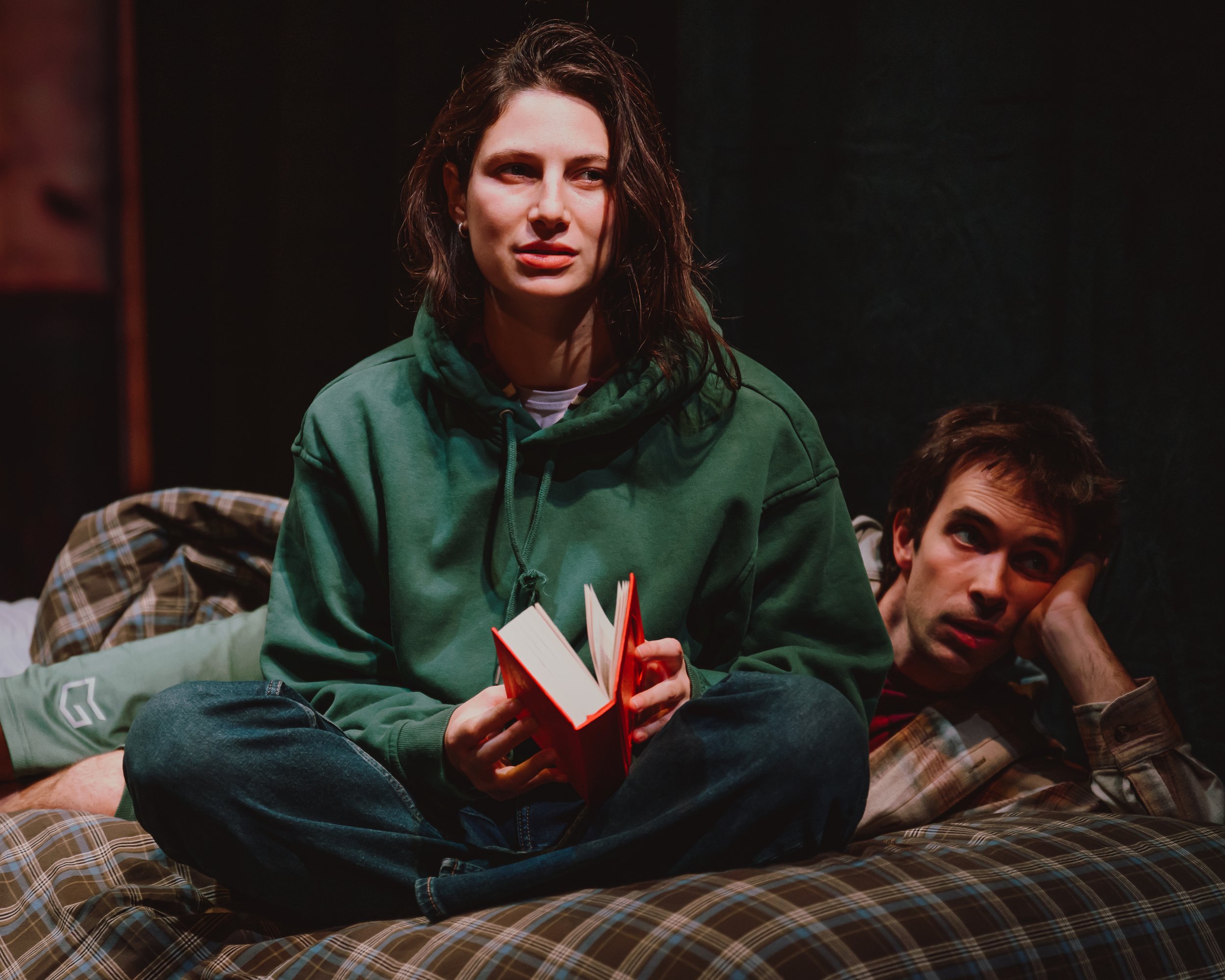
The siblings on display are Charly, played by Mia Wurgaft, and her older brother, Owen, played by Jake Horowitz.
At the top of the show, Charly just begins talking. The audience quiets down as they realize that the show has begun. The house lights begin to fade as everyone focuses on Wurgaft. No curtain speech. No announcement. We jump into this slice of life. A nice touch by director Matt Dickson.
Wurgaft puts us at ease immediately with her authentic and captivating demeanor, making acting look easy. She’s alone onstage, speaking to her mother, setting up the circumstances of the piece and catching the audience up. Teetering on the edge of exposition, we learn that this is her first visit to her brother at college and that she is nervous but wants to come out to him.
The scene shifts to Charly in Owen’s dorm room, demarcated by a giant screen featuring the torso of Pamela Anderson in her Baywatch-era swimsuit. This was such a fun reveal, and Wurgaft’s expression of disgust mixed with adoration emulated her character perfectly.
Owen finally enters, clad only in a towel, and awkwardly yet expertly jumps into underwear while still wrapped in the towel. Another great touch to let us know the relationship between these two.
The first half of this piece is the most endearing and engaging. Horowitz does a great job of portraying the college student who has been exposed to new people and new ways of thinking. He takes a moment to settle into the character, but quickly rises to meet Wurgaft at a place of authenticity and believability that soon has the audience laughing at and/or agreeing with his newly found beliefs.
Wurgaft is stellar as she tries to connect with her brother – while concealing a secret that is aching to break free, dealing with her overprotective mother, and trying to be cool in the presence of the brother she admires so much.
Horowitz is unrelenting as he goes on multiple diatribes about everything from their parents to the climate crisis and everything in between. His convoluted delivery has us wanting to shake his hand, while at the same time slap the crazy out of him.
The second half picks up ten years later. Charly is living in an apartment in Brooklyn and Owen shows up bedraggled and limping from a wound on his foot. The pair haven’t spoken in years, and it is clear that time apart has changed them individually, and more importantly, as a duo.
The tension of the second half is great, and both Wurgaft and Horowitz do a wonderful job of holding their own as these changed characters. However, the play – and this half in particular – suffers from a lack of specificity. We don’t know exactly what went down with the parents and their childhood, which was a major point of contention as well as a highlighted bonding factor, especially in the first half. What happened at that college party to make Owen think of it so often and bring him to Brooklyn ten years later? So many questions go unanswered.
There is something to be said about being able to act in the silent moments – to even have moments of silence. Wurgaft and Horowitz act their pants off in the second half’s moments of silence. Unfortunately, there are far too many of them, causing the second half to drag out.
The lighting design by Yiyuan Li masterfully sets the tone for the piece and expertly brings us into each new location.
Perhaps now knowing everything is part of the play’s great design. These siblings, who went through so much together, eventually become strangers. It makes sense that they, and we, don’t get all the pieces of the puzzle. Maybe we’ll never know everything that they want because the characters themselves also don’t know.
Click HERE for tickets.
Review by Nick Radu-Blackburn
Published by Theatre Beyond Broadway on November 9, 2026. All rights reserved.