THE MEETING
Written by Brian James Polak
Directed by Richard Piatt
Presented by Theatre Unleashed, Los Angeles, CA
Presented by the New York City Fringe Festival
Chain Theatre Studio, 312 West 36th Street, New York, NY 10018
Wed April 1 at 7:55pm, Thu April 2 at 7:55pm, Fri April 3 at 7:55pm, Sat April 4 at 10:35pm & Mon April 6 at 7:55pm
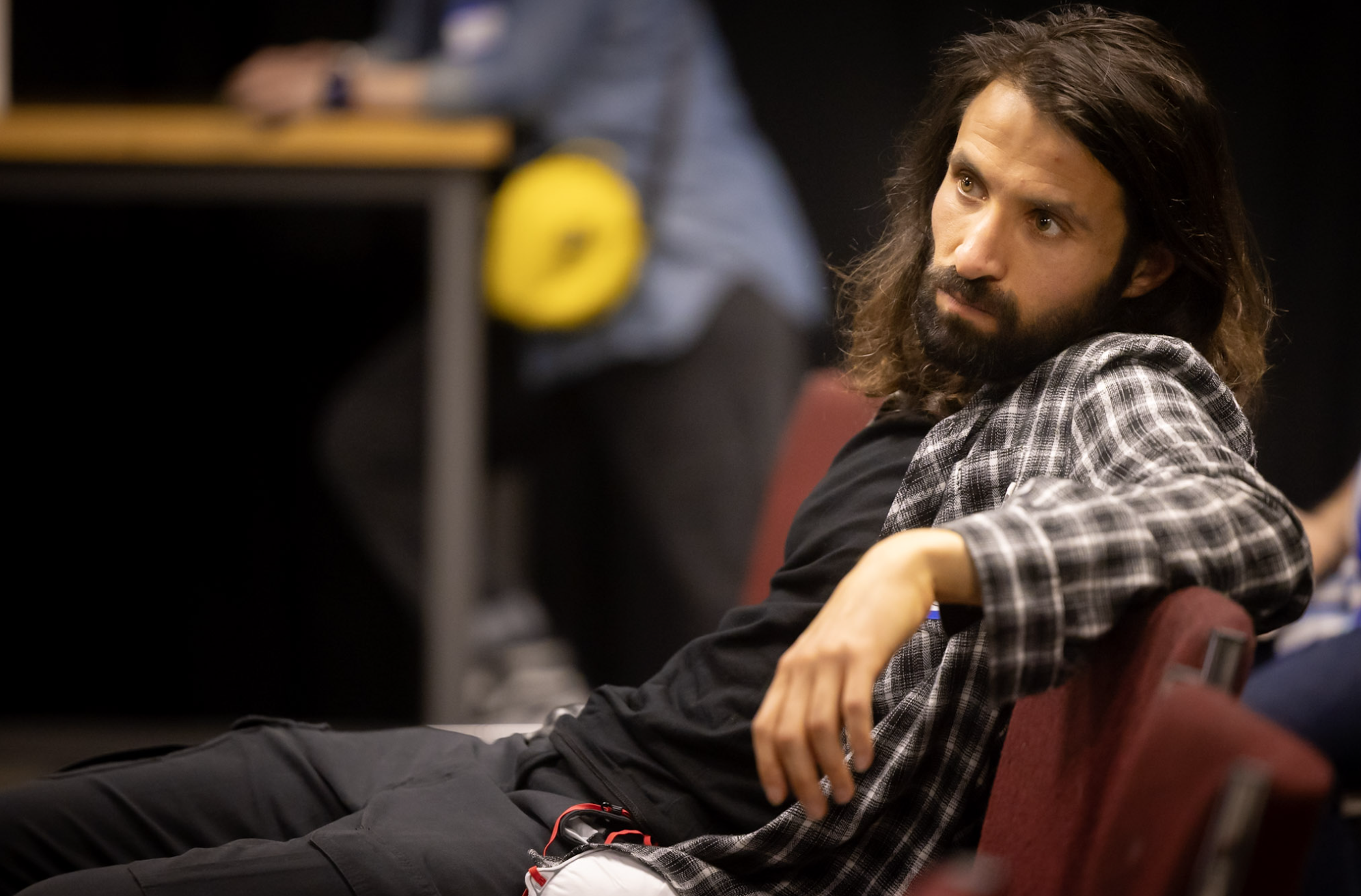
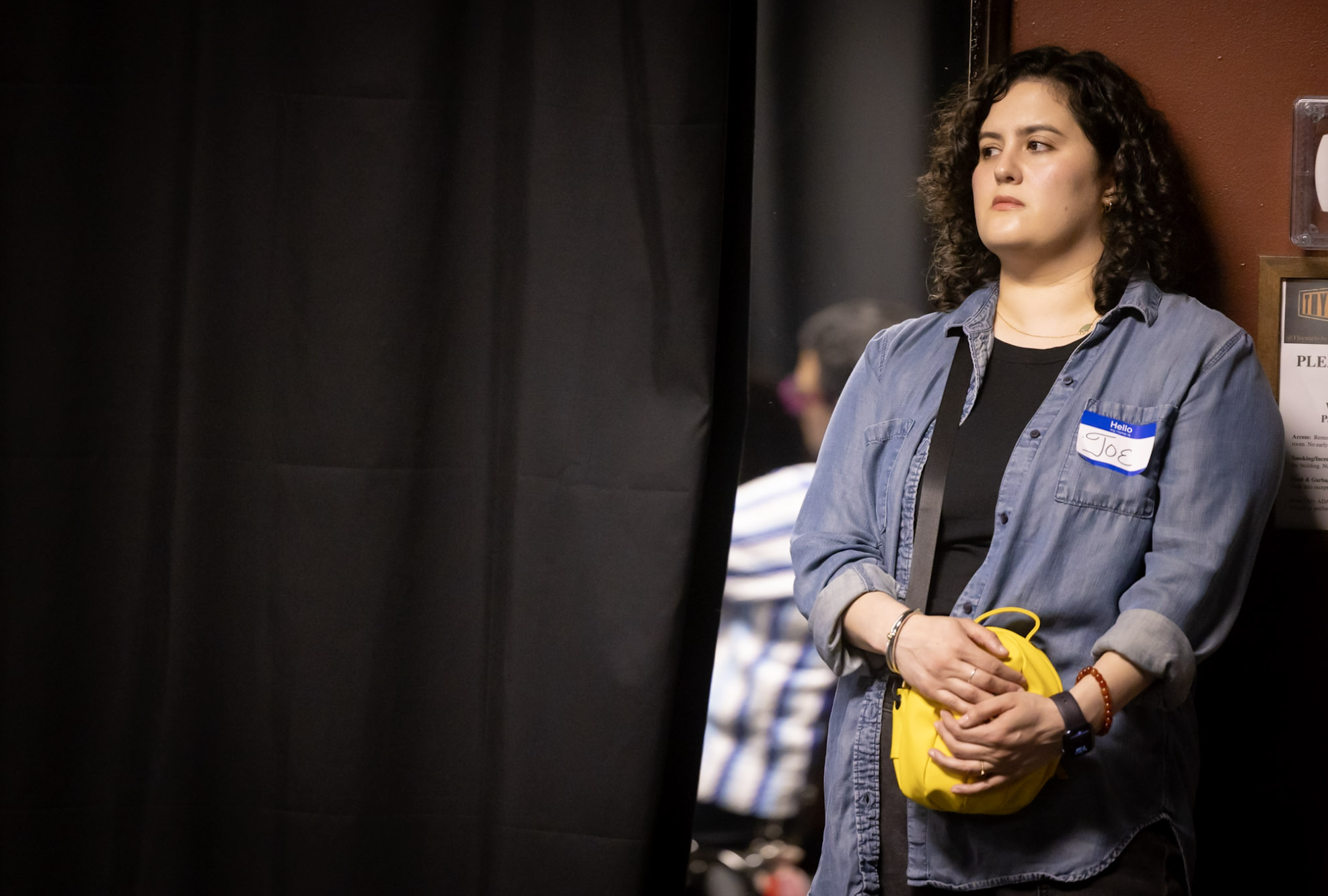
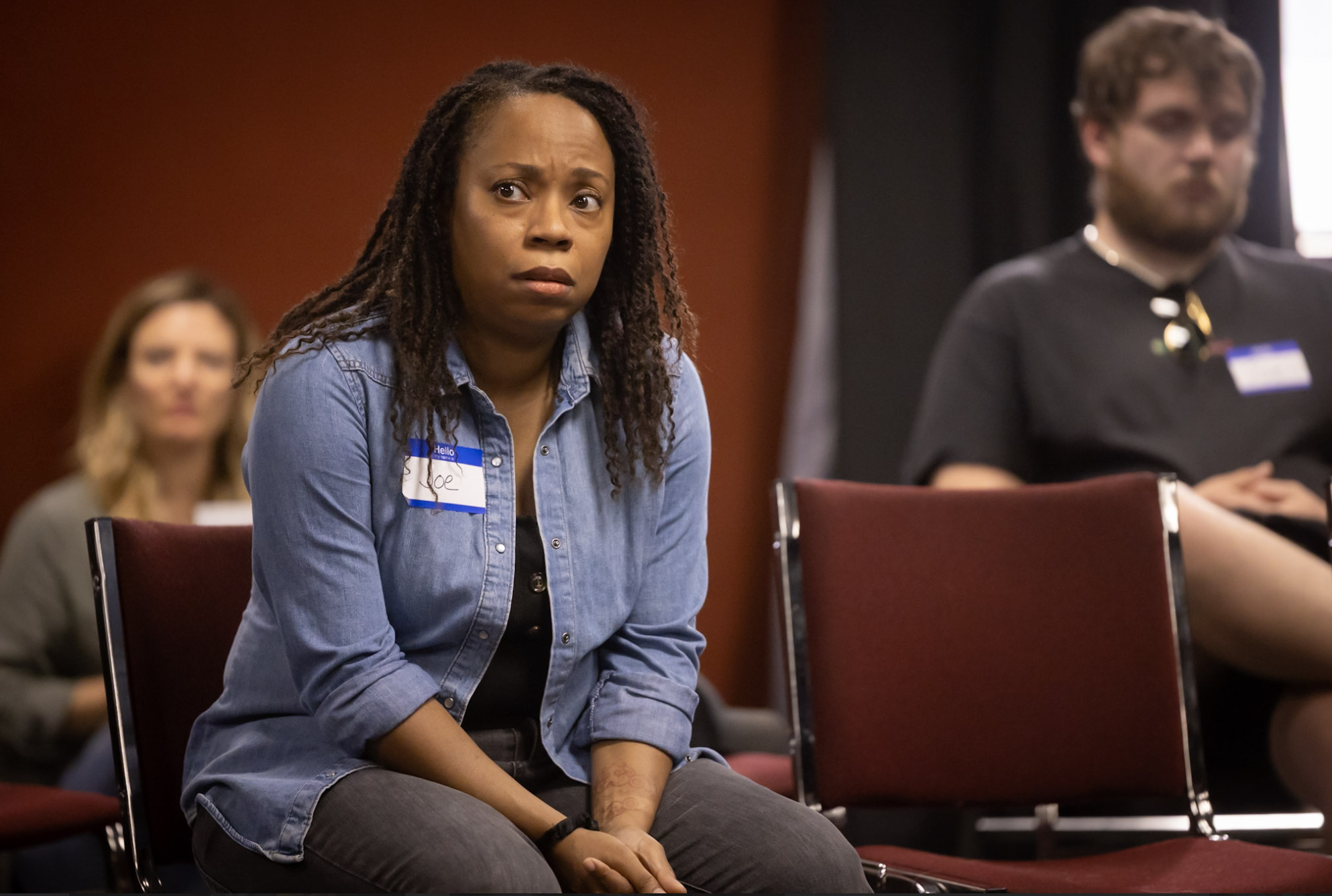
There are moments, sitting in the theater, when the distance between fiction and the present tense collapses so completely that one feels less like a spectator than a participant in some uneasy civic ritual. The Meeting, written by Brian James Polak, is one of those unnerving occasions—a work whose imagined prohibitions arrive already half-familiar, as though the play were merely articulating, with a dreadful clarity, impulses that have begun to circulate in the culture at large. We are in a near-future where art has been outlawed and language itself policed into submission.
Presented as part of the 2026 New York City Fringe Festival, the production feels not only stark and aesthetically urgent but contextually charged. The Chain’s Studio Theatre serves less as a neutral container than as a co-conspirator, an intimate space in which the line between audience and assembly dissolves with disquieting ease.
Indeed, the play’s immersion begins before one has properly entered. A name tag—“Joe”—is affixed to each attendee, an act at once banal and faintly coercive, flattening identity into a collective alias. The posted rules, repeated with bureaucratic insistence, suggest both safety protocol and ideological script. By the time one is asked, in hushed tones, whether one has been followed—and urged to power down the small, glowing devices we habitually carry and studiously ignore as instruments of surveillance—the transformation is complete. You are no longer simply watching The Meeting; you have joined it. Inside, the room is arranged in a semi-thrust of half-circles that feels less like staging than like a condition of thought. Performers and audience members occupy the same plane, each wearing the same name, each implicated in the same fragile enterprise. A table with water, a coffee urn conspicuously unfulfilled—these modest details accrue into a portrait of provisional community. The Joes, as they are all called, reveal themselves, through careful circumlocution, to have once been artists: an actor (Julia Plostnieks), a playwright (Kristen Bennett), a director (Veronica Matthews), a stage manager (Marcela Barrientos), a musician (Mitch Lerner). Now, in the aftermath of what they refer to only as “The Changes,” they gather in secret to do what they can no longer do publicly: speak, argue, remember.
What unfolds is less a plot than a series of charged exchanges—debates that feel at once spontaneous and eerily inevitable. The former musician mourns the erosion of human connection, conjuring a populace sealed inside private “cubes,” while the former stage manager cautions against the quiet violence of such generalizations. Optimism and despair trade places with unsettling fluidity: one Joe insists that complacency reigns so long as repression is directed elsewhere; another counters that empathy, properly engaged, might yet interrupt the machinery. Environmental collapse, linguistic policing, the ethics of survival—each topic ignites briefly, before giving way to the next, as though the group were circling a center it cannot safely name.
Polak’s great intelligence lies in allowing these arguments to remain unresolved. The friction between the stage manager’s procedural faith and the musician’s needling skepticism becomes a kind of moral engine, propelling the play forward even as it resists conclusion. When the musician dares to ask what, precisely, this meeting is accomplishing, the question lands with an almost unbearable force—not because it is answered, but because it is not.
And threaded through all of it is fear: the ever-present possibility of the “boots,” those unseen “police” whose arrival is signaled only by a sound, by a knock that may or may not belong to the world outside the play. Over all of this hovers the threat of the unseen enforcement apparatus whose violence is both rumored and, at times, horrifyingly confirmed. The faint wail of sirens—whether designed or accidental—bleed into the room, implicating the city itself in the drama.
Yet The Meeting is not content to dwell solely in dread. Its most piercing passages arrive in moments of memory: a recalled smell, a childhood sensation, a letter to a mother who has aligned herself with the regime. These fragments of the past feel less like nostalgia than like resistance—proof that something persists beyond regulation, beyond decree. If language is being stripped of its expressive capacity, memory restores its texture.
By the time the Joes hazard their small, collective risk in the play’s quietly devastating climax, one is reminded of the clandestine performances and texts that circulated under regimes determined to extinguish them. The comparison is not ornamental. The Meeting understands, with bracing clarity, that art does not simply reflect freedom—it enacts it, however precariously, in the moment of its making.
There is something almost perversely thrilling about the way director Richard Piatt disguises the play’s architecture. The piece announces itself—quietly, insinuatingly—as improvisation, and though one senses the invisible ligatures of design holding it together, it sustains the illusion with remarkable poise. What emerges is not disorder but a cultivated precariousness: a theatrical language in which hesitation, overlap, and the actors’ searching glances toward one another become the very grammar of the event. The performers appear to build the play in real time, soliciting reassurance, testing pathways, even drawing the audience into their fragile consensus. The effect is not chaos, exactly, but something more finely calibrated—a nervous, responsive organism of a play, alive to every tremor in the room.
These former artists now stripped of their vocations, gather in secret not only to strategize but to remember what it felt like to make something, to be something, beyond the sanctioned limits of survival. What might, in lesser hands, calcify into allegory is here rendered immediate—thanks largely to a cast of uncommon sensitivity and nerve. They do not declaim the play’s ideas; they inhabit them. Anxiety flickers across their bodies in minute calibrations: a pause held a fraction too long, a sentence abandoned midway, a shared look that registers both terror and defiance. Hope appears, but tentatively, as if it might itself be overheard and punished. Despair, meanwhile, seeps in not as spectacle but as attrition—a wearing down of the spirit under constant watchfulness.
Then there is a moment—one of those small detonations that theater, at its most potent, can deliver without warning. From another room, a piano begins to play Debussy’s “Clair de Lune”. The melody, at once delicate and immense, drifts into the space like a memory of a world not yet extinguished. And then, just as suddenly, it stops. The player is seized, brutalized, erased. The silence that follows is not merely absence of sound but the obliteration of a possibility. One feels, with a kind of physical clarity, what it means for art to be extinguished—not as abstraction, but as rupture.
The play understands that art is not ornamental to life but constitutive of it, and that to strip a society of its expressive capacities is to reduce its citizens to mechanisms—efficient, perhaps, but spiritually inert. For all its apparent looseness, the piece is cunningly controlled, its digressions accruing into a portrait of a world in which fear has become the primary idiom. One leaves not with the satisfaction of resolution but with a lingering unease, a sense that the play has not so much ended as withdrawn, leaving its questions suspended in the air. It is, finally, a work of quiet audacity—wandering, yes, but purposeful in its drift, and devastating in its implications.
One leaves the theater not reassured but sharpened, newly attentive to the fragility of the conditions that make such a gathering possible. It is a rare work that manages to be both discomfiting and galvanizing, a play that lingers less as narrative than as atmosphere, as question. As one of its Joes suggests, we may be living through “this disastrous moment in time.” The Meeting does not pretend to resolve that diagnosis. It simply insists, with quiet ferocity, that we not look away.
Click HERE for tickets.
Review by Tony Marinelli.
Published by Theatre Beyond Broadway on April 11, 2026. All rights reserved.
