
THIS IS NOT ABOUT ME.
Written by Hannah Caplan
Directed by Douglas Clarke-Wood
Presented by Hannah Caplan and Douglas Clarke-Wood for WOODFORGE STUDIOS
59E59 Theaters | 59 East 59th Street, New York, NY 10022
May 13, 2026 - June 7, 2026
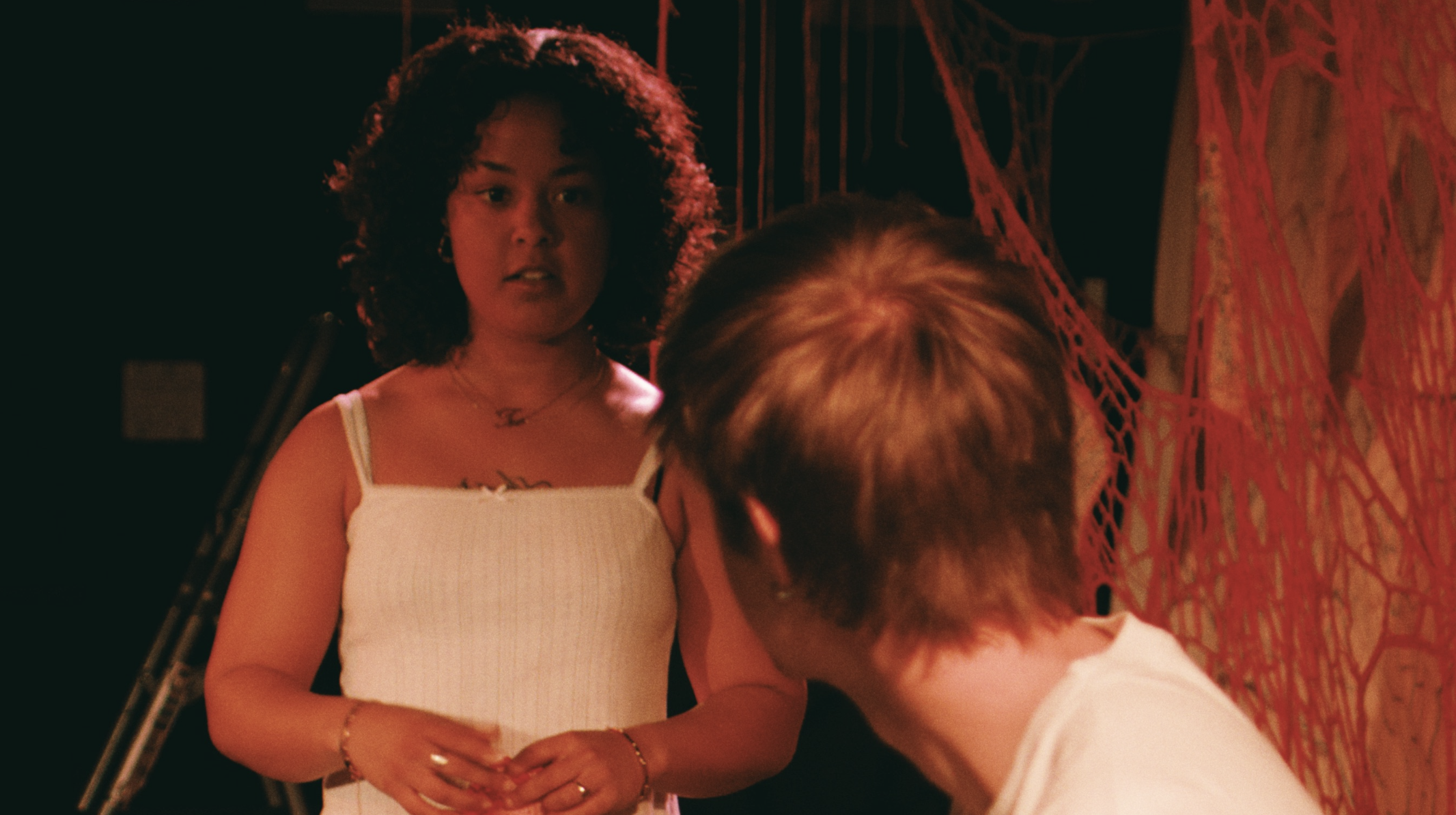
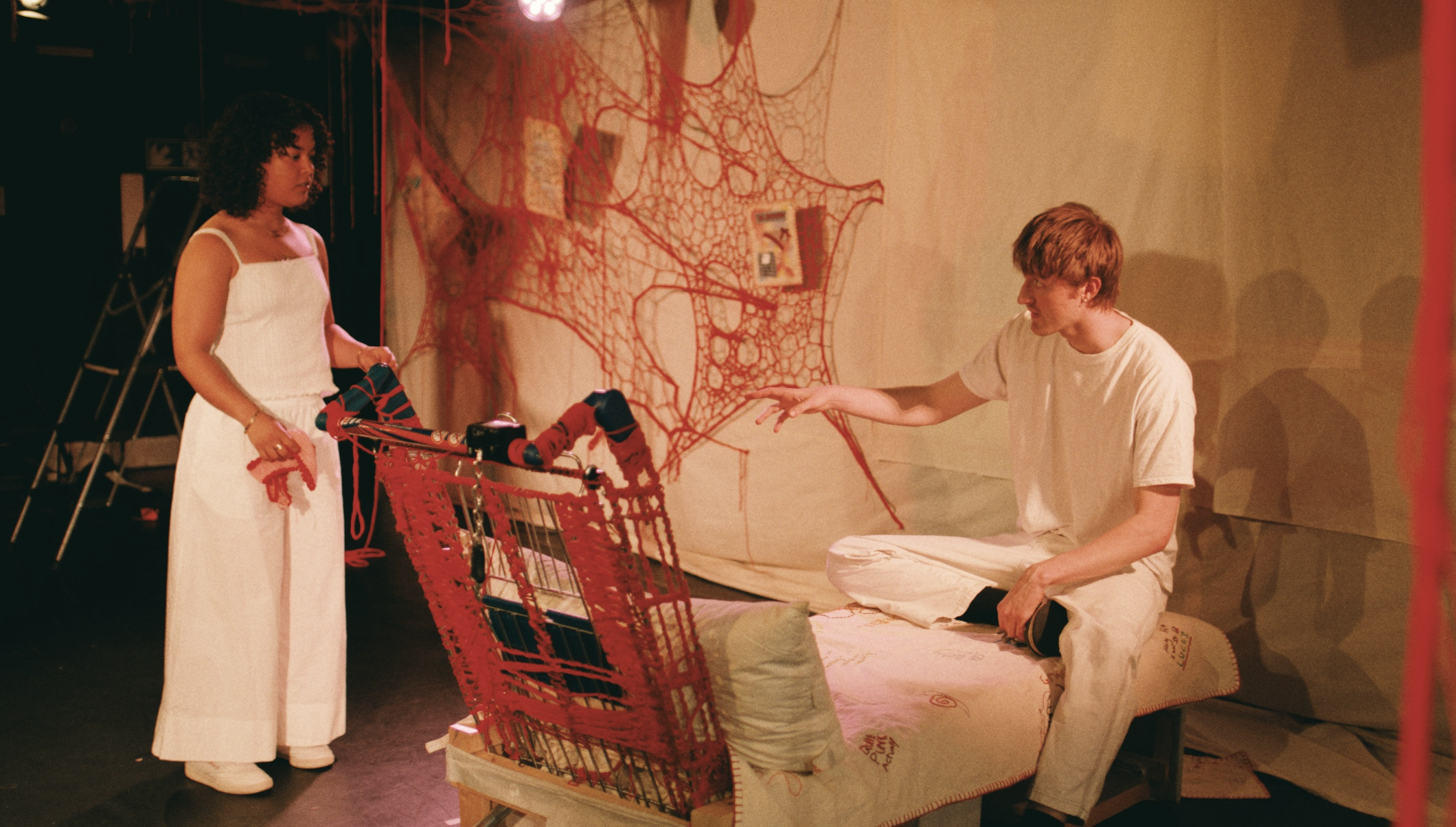
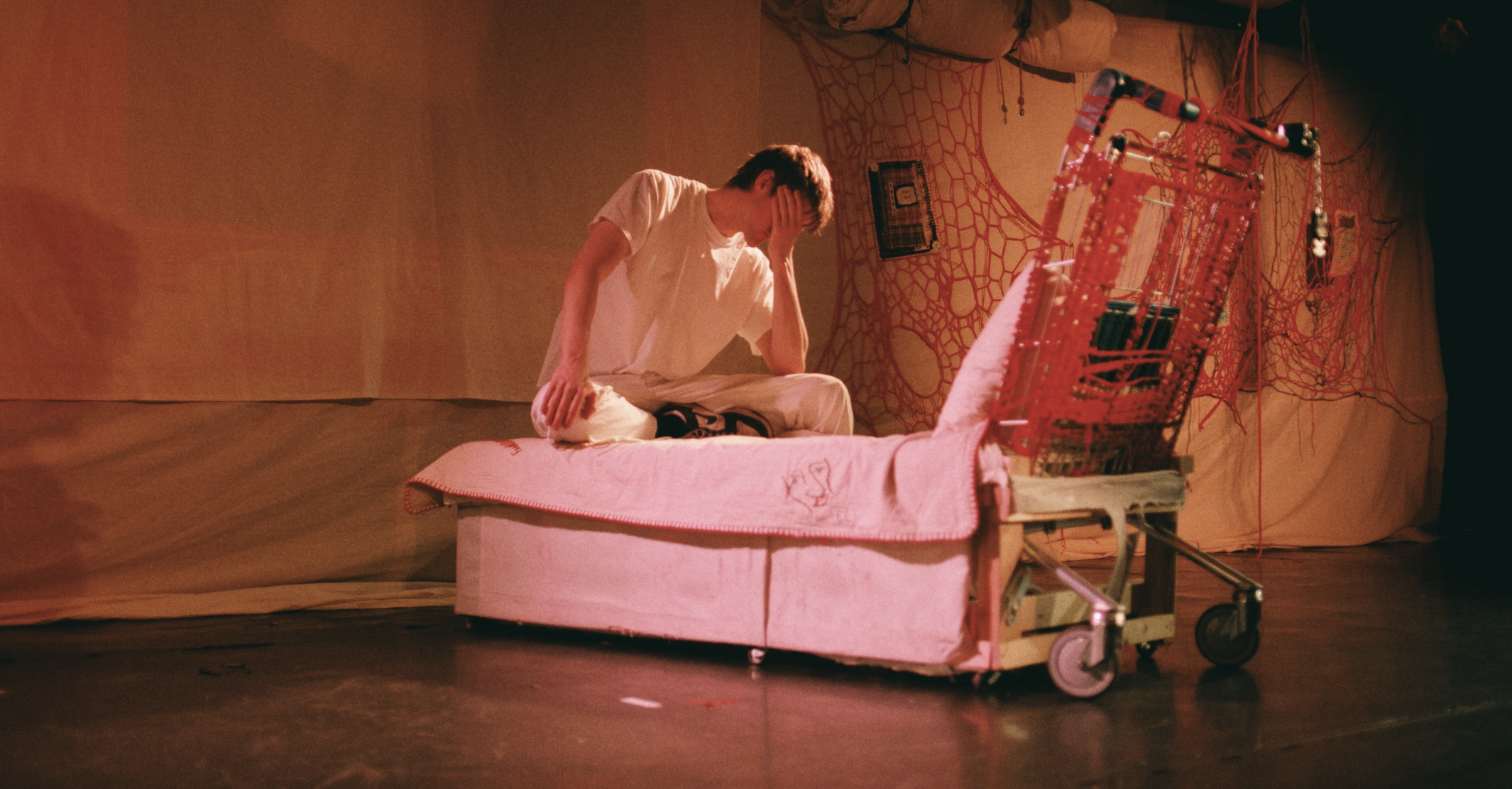
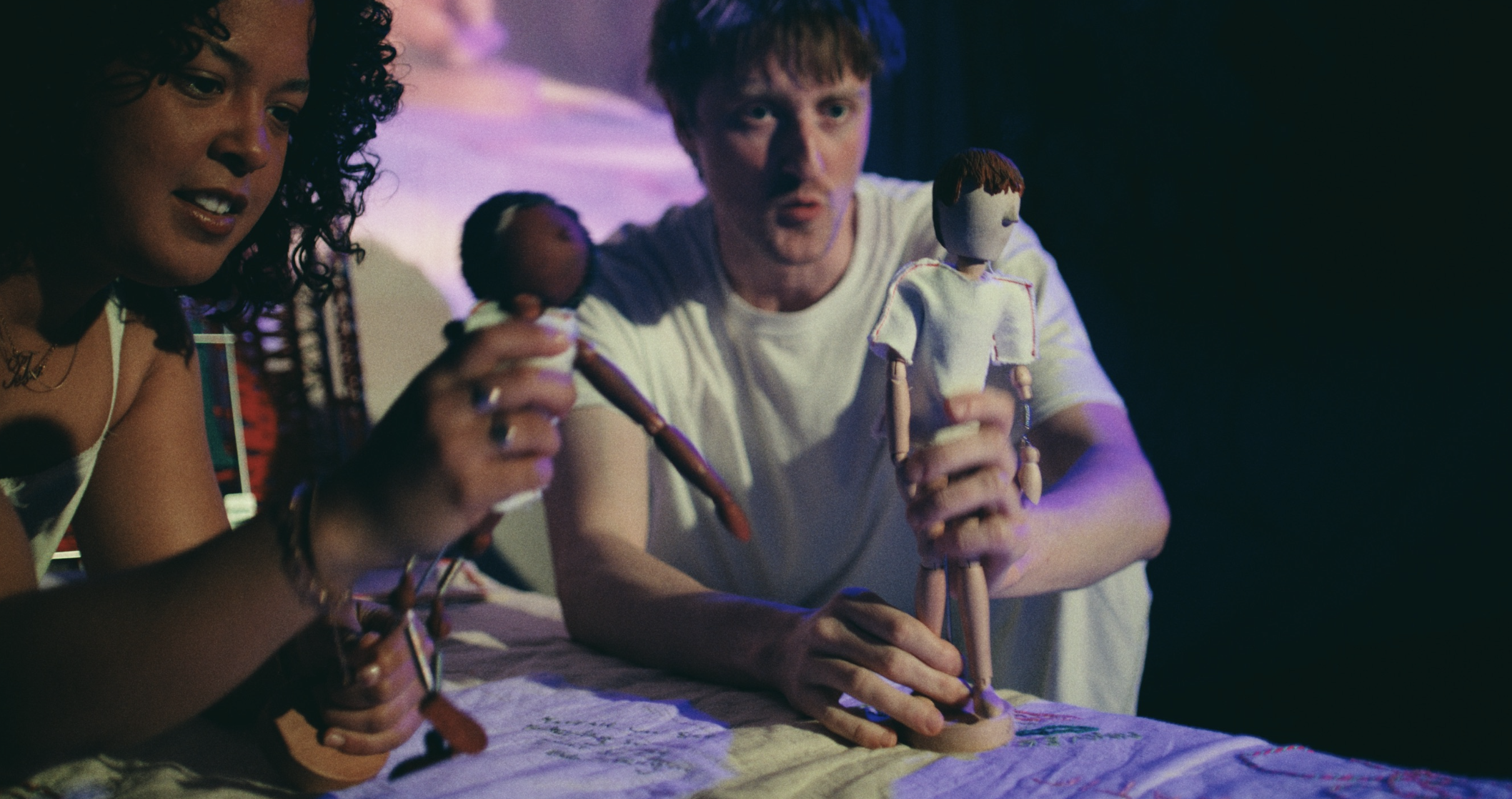

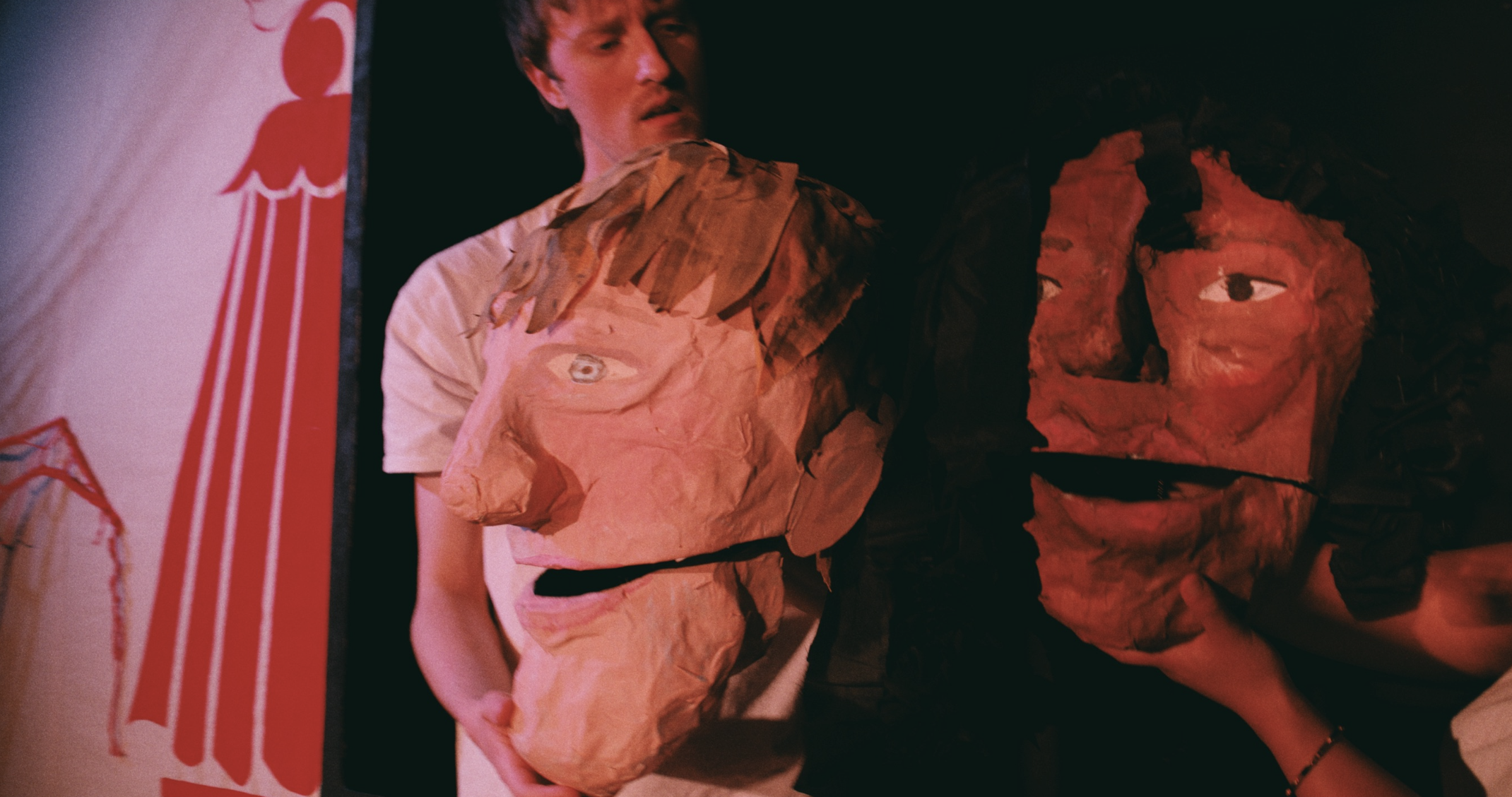
Photo credit by Inigo Woodham-Smith
There is a moment early in Hannah Caplan’s astonishing debut play This Is Not About Me. when it becomes clear that what we are watching is not merely a romance, nor even a memory play, but a theatrical act of excavation. The production begins amid a tangle of red thread, crocheted webs, embroidered confessions, handmade puppets, and fragments of text suspended like insects caught in a spider’s web. It resembles the contents of a particularly unruly craft drawer spilled across the stage. Yet what first appears whimsical soon reveals itself as a striking metaphor for the play’s central concern: the impossibility of untangling love, memory, authorship, and truth.
Caplan’s play follows Grace and Eli, friends since adolescence whose relationship has spent more than a decade oscillating between friendship, desire, dependency, absence, and reunion. They are the sort of pair who seem magnetically incapable of leaving one another’s orbit, no matter how many years, lovers, disappointments, or self-inflicted catastrophes intervene. Their story unfolds through a dazzlingly non-linear structure, moving across time with the associative logic of memory itself. What emerges is not simply a chronicle of a situationship but an examination of intimacy in all its contradictory forms: exhilarating and painful, sustaining and destructive, profoundly familiar and perpetually unknowable.
Caplan’s script possesses the rare ability to feel intensely contemporary without succumbing to fashionable cynicism. In an era obsessed with defining relationships through social-media aphorisms and therapeutic jargon, This Is Not About Me. captures the peculiar ache of wanting someone permanently in your life while being unable—or unwilling—to give them what they truly need. The play understands that every relationship generates competing narratives and conflicting recollections. Yet it also recognizes that stories ultimately belong to those brave enough to tell them. Grace’s version may be subjective, incomplete, and self-serving. That does not make it any less true.
What distinguishes the piece most powerfully is its remarkable theatrical imagination. Caplan, who also designed the production (co-designed by Lolly Whitney-Low), fills the space with handcrafted visual poetry. Red thread stretches across walls and bodies like visible emotional scar tissue. Props emerge from hanging webs of memory. Bed linens are embroidered with fragments of shared history. A shopping trolley transformed into a bed becomes a vessel carrying years of longing and regret. Every object appears touched by human hands, lending the production an intimacy that feels almost startling in an age of increasingly digital theatre.
The multimedia elements are equally inventive. Projections, subtitles, video sequences, voicemail recordings, puppetry, and live-feed imagery are deployed not as decorative flourishes but as extensions of character psychology. Particularly inspired are the scenes in which Grace and Eli use dolls and puppet doubles to narrate one another’s flaws with devastating precision. Elsewhere, oversized papier-mâché heads transform moments of physical intimacy into something simultaneously comic, grotesque, and heartbreakingly vulnerable. These devices externalize memory’s distortions, allowing Caplan to dramatize not merely events but the act of remembering itself.
Douglas Clarke-Wood’s direction orchestrates this complexity with extraordinary confidence. The intimate traverse staging, with the audience on two sides of an elongated triangle, becomes a living organism through which dialogue ricochets, timelines collapse, and emotional allegiances shift. Actors dart through audience space, thread ropes across walls, enlist audience members, and transform every corner of the room into part of Grace and Eli’s shared consciousness. Clarke-Wood never allows the production’s formal ingenuity to become an end in itself. Instead, each theatrical flourish deepens the emotional stakes, drawing the audience ever further into the tangled web of the relationship.
At the center of this elaborate construction stand two exceptional performances. Amaia Naima Aguinaga gives Grace a ferocious vitality, balancing self-awareness, humor, vulnerability, and stubbornness with remarkable precision. Her Grace is both author and subject, simultaneously controlling the narrative and being consumed by it. Aguinaga navigates these contradictions beautifully, revealing a woman whose confidence often masks profound uncertainty. Opposite her, Francis Nunnery brings immense charm and emotional intelligence to Eli. He captures the easy likability, evasiveness, tenderness, and confusion of a man struggling to reconcile his own memories with the version being presented before him. Together they generate a chemistry so natural that even their smallest exchanges seem freighted with years of accumulated affection and disappointment.
What lingers most powerfully is the play’s understanding of how people continue to inhabit one another long after relationships have supposedly ended. Caplan writes with uncanny sensitivity about the strange intimacy between former lovers, the way familiar jokes can suddenly become weapons, and the way old habits of affection survive beneath layers of resentment. The production is frequently hilarious, often excruciating, and unexpectedly moving. Its sharp observational comedy coexists comfortably with moments of startling emotional nakedness, creating a portrait of human connection that feels both painfully specific and universally recognizable.
By the time This Is Not About Me. reaches its beautifully ambiguous conclusion, the question of what truly happened between Grace and Eli has become almost irrelevant. The play’s achievement lies elsewhere. Caplan has transformed the messy process of remembering into a thrilling theatrical event, one that interrogates authorship, desire, and self-mythology without ever losing sight of the beating human heart beneath its formal experimentation. This is a debut of uncommon confidence and imagination: funny, inventive, visually sumptuous, emotionally piercing, and alive with love for the possibilities of live performance. Few new plays manage to feel this personal and this expansive at once. Fewer still leave audiences feeling so thoroughly entangled in their web.
Click HERE for tickets.
Review by Tony Marinelli.
Published by Theatre Beyond Broadway on June 6, 2026. All rights reserved.
