Written by Phoebe Potts; Directed by Christopher Griffith
the RAT NYC | 68 Jay Street, Suite 117 (storefront), DUMBO, Brooklyn, NY 11201
October 6 – November 24, 2026
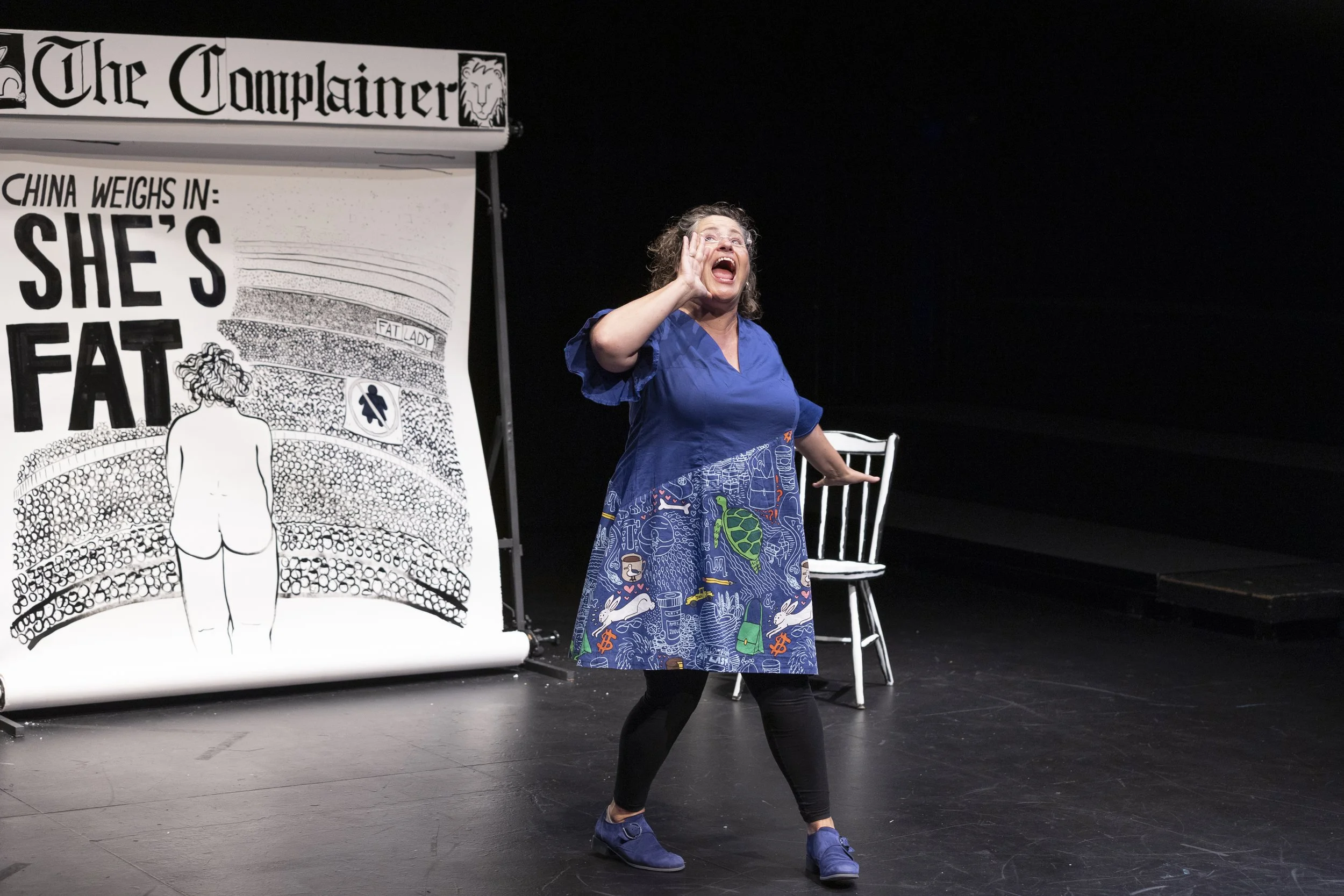
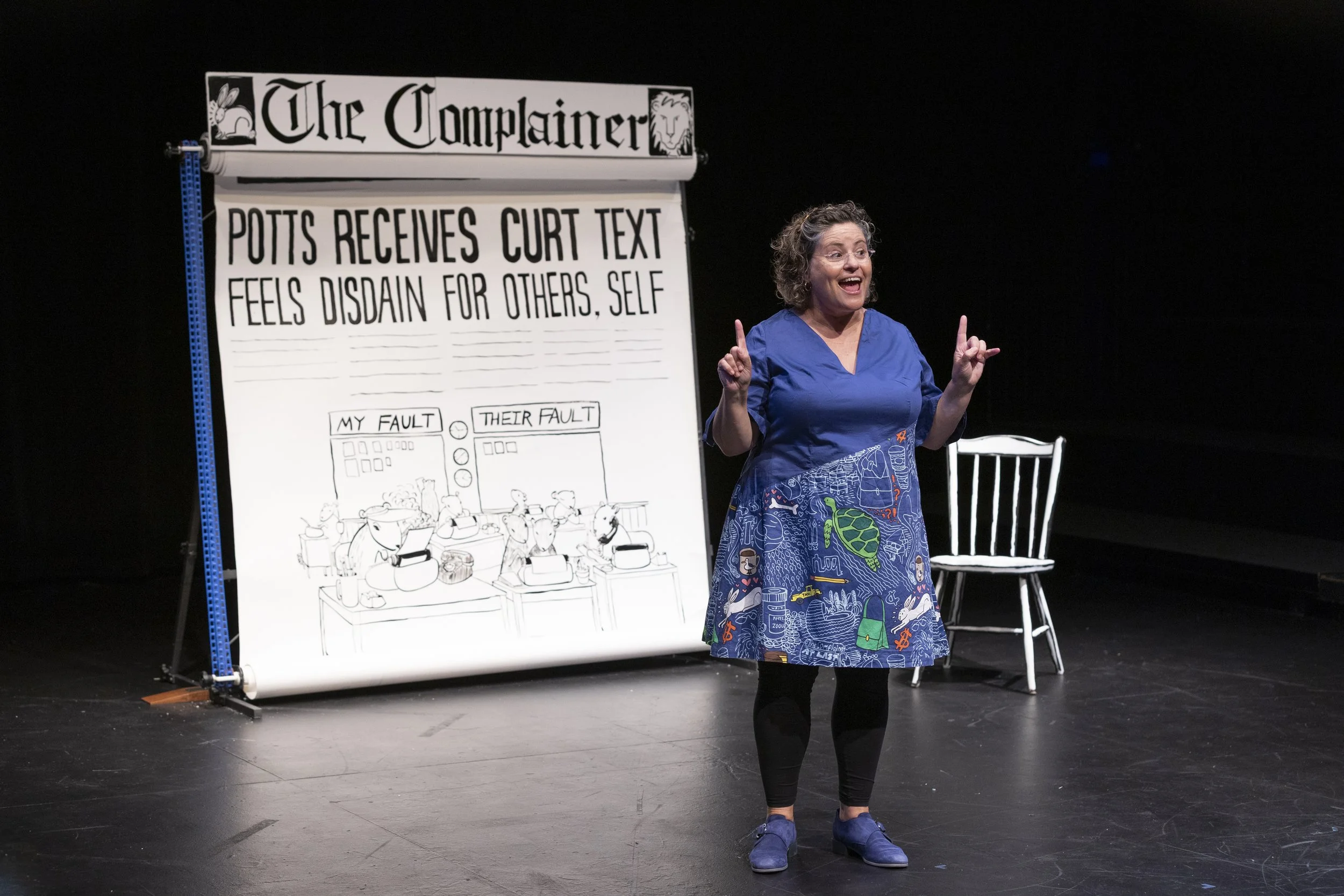
Photo Credit: Jason Grow
A story can be told before the artist even takes the stage. In Too Fat for China, written, drawn, and performed by Phoebe Potts, the set establishes the visual language of the piece before the storytelling begins. A large rolling set piece for signage, a white chair, and a simple table create an environment reminiscent of journalistic art. It is uncomplicated, purposeful, and perfectly suited to the intimate cabaret space at The Rat NYC.
An engaged audience is welcomed into what is billed as a comedy about the agony of adoption. And while there are plenty of laughs, Potts takes us on a much deeper journey, one that examines the emotional, financial, political, and sociological complexities of building a family through adoption.
International adoption is not a subject I have spent much time considering. Over the years, I have heard different stories and experiences, but Potts offers an extraordinarily detailed account of a woman's desire to become a mother and the steps she is willing to take to make that happen. What unfolds is not simply a story about the trials and tribulations of raising an adopted child, but an exploration of the process itself: the laws, the fine print, the regulations, and the business of adoption.
The title references one such regulation: China's BMI requirement for prospective adoptive parents. It is a striking illustration of how bureaucratic requirements can determine who is deemed eligible to become a parent.
Potts is equally candid about her experience with domestic adoption in the United States. Following a disastrous situation in which the birth mother ultimately decides to keep her child, Potts and her husband are left with an emotionally painful experience and a considerable financial loss. The process also forces her to confront an uncomfortable reality: the feeling of being a customer purchasing a product from a vendor. Her account opens the door to a larger discussion about the commodification of adoption and the racial and economic disparities surrounding the adoption of children, particularly Black children and Black boys.
I appreciated the history lesson Potts incorporates into the narrative, helping us understand how the adoption industry developed and how its business practices intersect with politics, economics, and race. She smartly weaves these larger societal questions into a deeply personal story without losing the humanity at its center.
Another particularly effective element is the newsroom, the voices in Potts' head. This becomes a wonderful visual metaphor for the piece, giving form to the internal conversations, competing perspectives, and constant stream of information that accompany her journey. It is an inventive storytelling device that reinforces the journalistic sensibility established by the set.
When Potts and her husband decide to pursue international adoption, there is a beautifully understated moment in which they look into each other's eyes, hold hands, and name a country. Their first decision is the United States. The second time, they choose Ethiopia, Potts' preference. A simple exchange, yet one that marks a significant turning point in their journey.
For me, the emotional heart of the production is what comes next: Potts' ability to share her son's story with him. His history. His heritage. His lineage. She connects him to the Queen of Sheba and King Solomon, to the Jewish faith, and to a powerful historical lineage rooted in Africa. She is not simply telling him where he comes from; she is giving him a connection to a history that is his to know, embrace, and carry forward.
This is especially meaningful when contrasted with the earlier domestic adoption experience, in which the child's story is left disconnected amid an already painful set of circumstances. Here, Potts' storytelling becomes an act of connection and recognition. Her son's identity is not an afterthought. It is an essential part of the story.
The account of their journey to Frankfurt, Germany, and the bonding experience with her son is particularly moving. These moments remind us that adoption is not only about the desire of a parent to have a child. It is also about honoring the child who comes with a history, a culture, an ancestry, and a story of his own.
Potts' greatest strength is her ability to move between comedy, personal reflection, historical context, and emotional vulnerability. She invites us to laugh at the absurdities while asking us to consider the very real ethical questions beneath them.
Too Fat for China is an intimate, thoughtful, and often hilarious exploration of the lengths we go to for love, family, and belonging. At The Rat NYC, the cabaret setting provides an ideal home for this kind of solo storytelling. Phoebe Potts leaves us with more than the story of her journey to motherhood. She reminds us of the importance of knowing where we come from, honoring the stories that precede us, and ensuring that the next generation has the opportunity to know and embrace its own history.
Click HERE for tickets.
Review by Malini Singh McDonald.
Published by Theater Beyond Broadway on November 19, 2026. All rights reserved.