
IVANOV
Written by Anton Chekhov. Translated by Paul Schmidt. Directed by Michael DeFilippis.
The West End Theater, 263 W 86th St, New York, NY 10024
March 11, 2026 – April 5, 2026
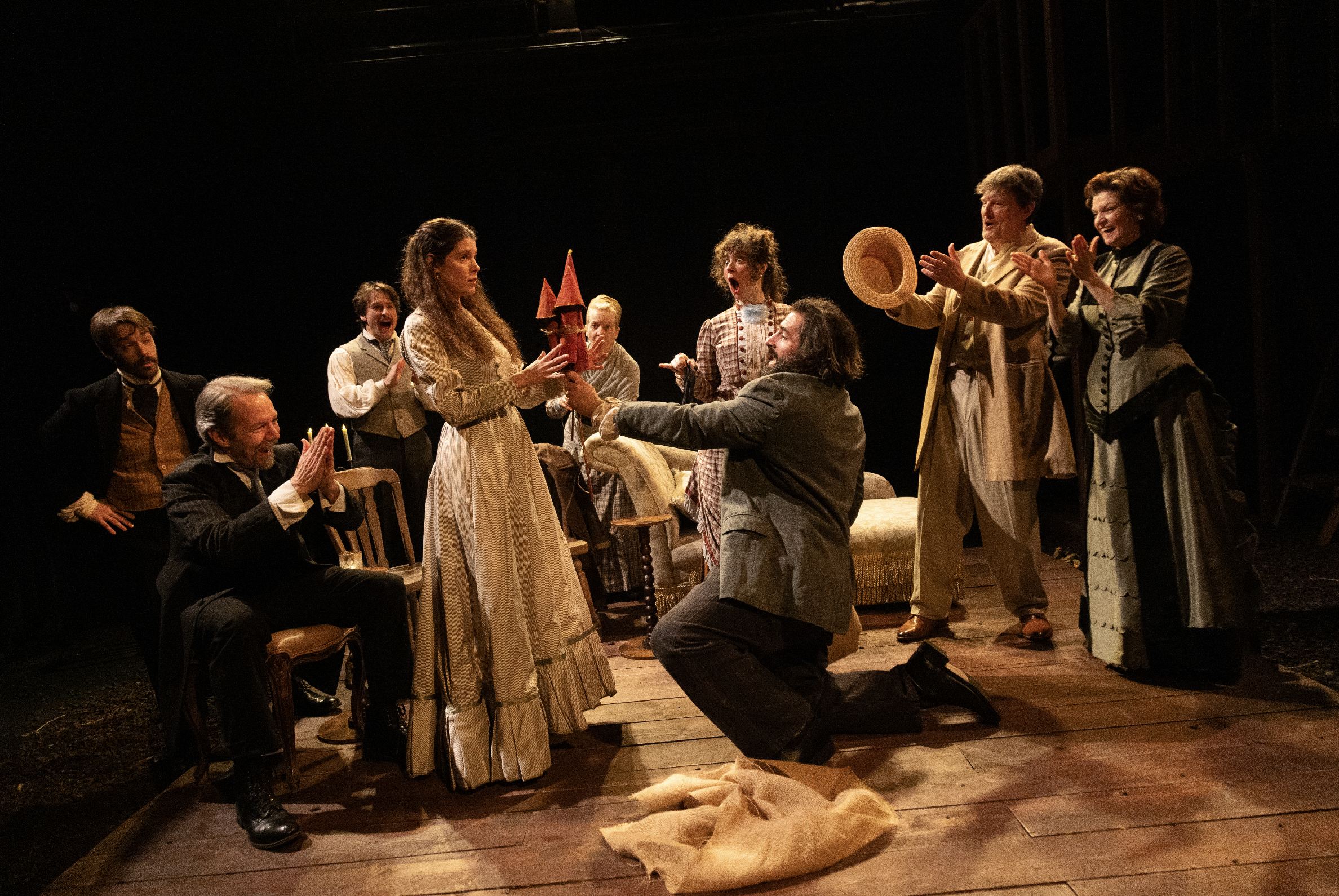
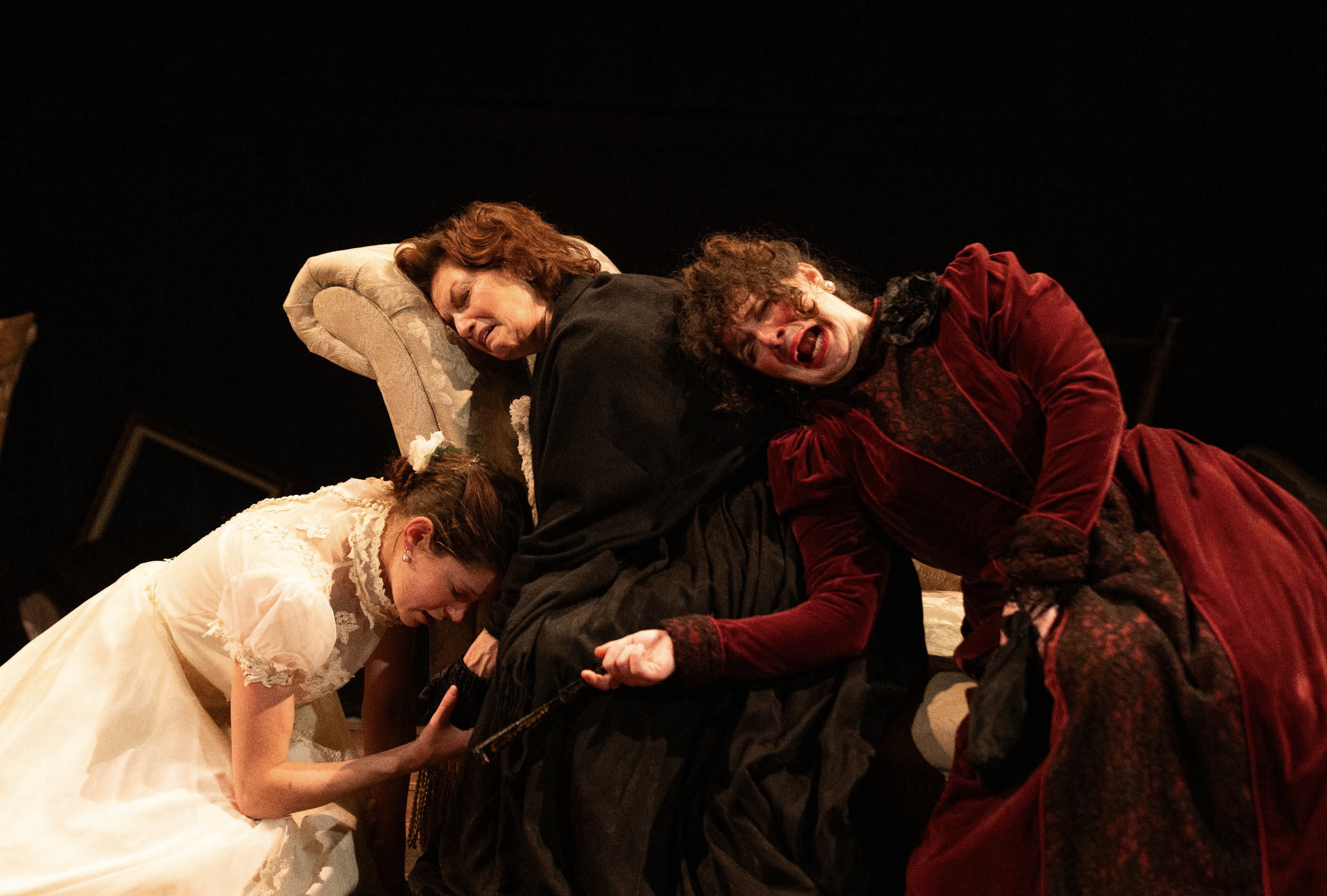
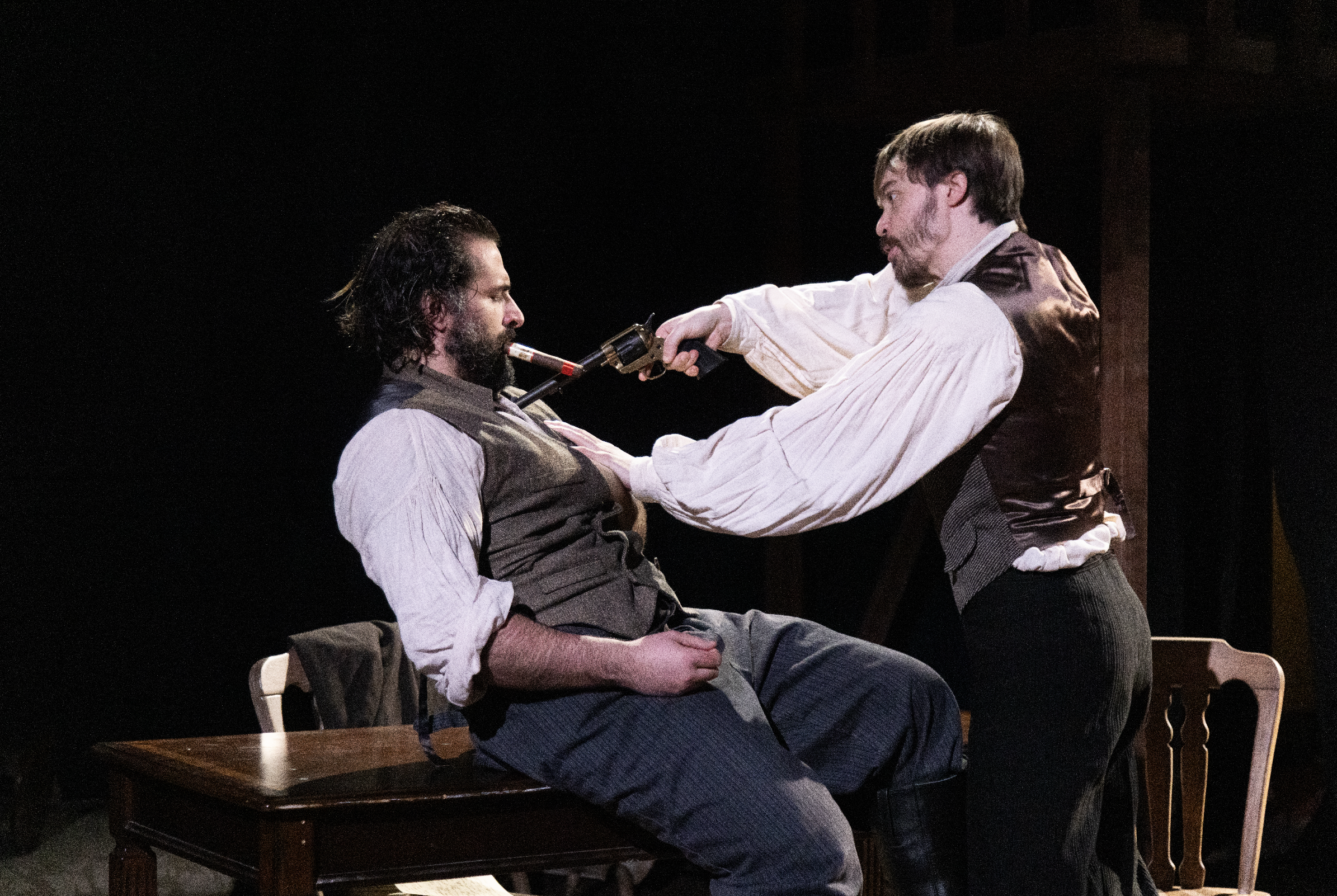
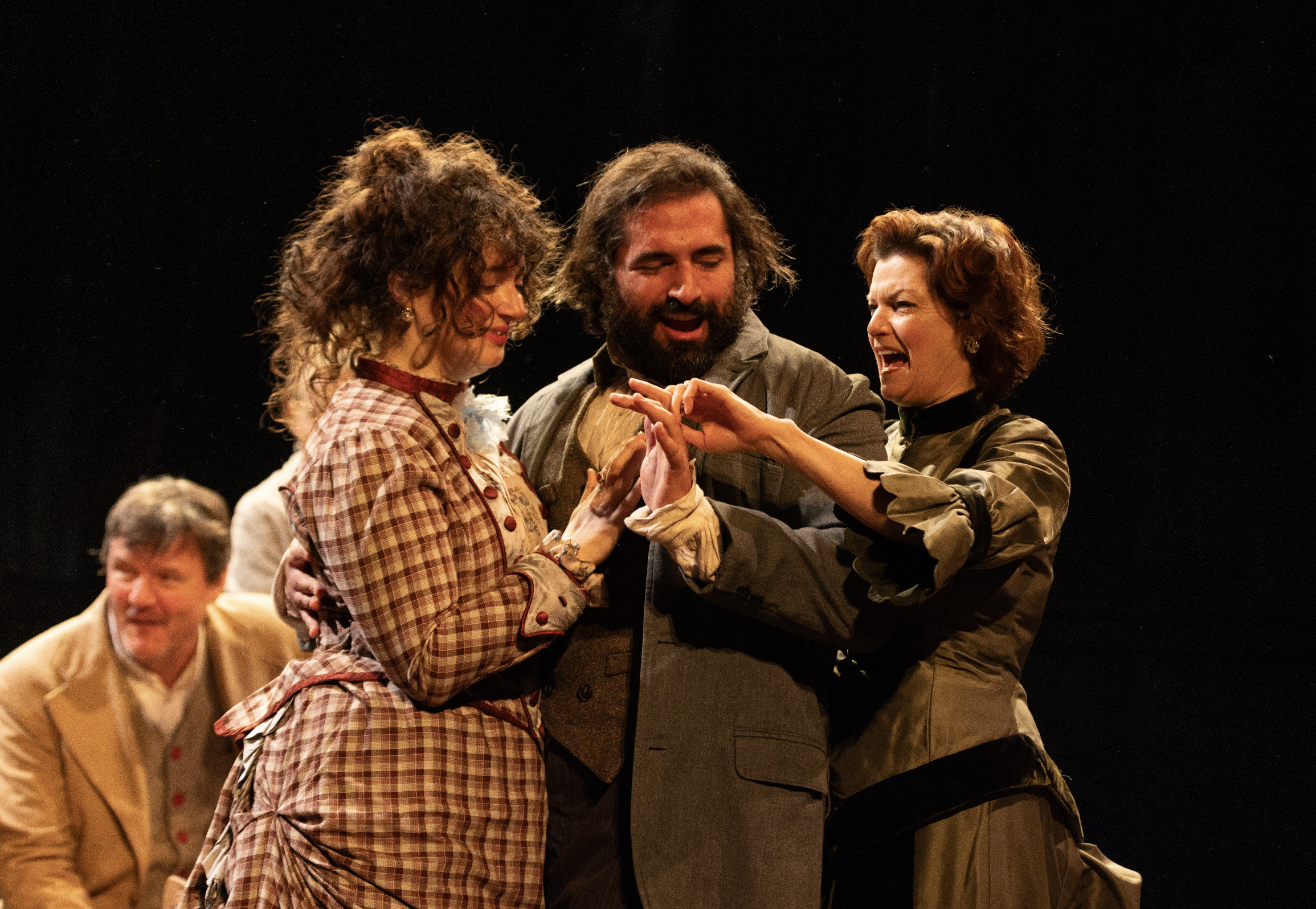
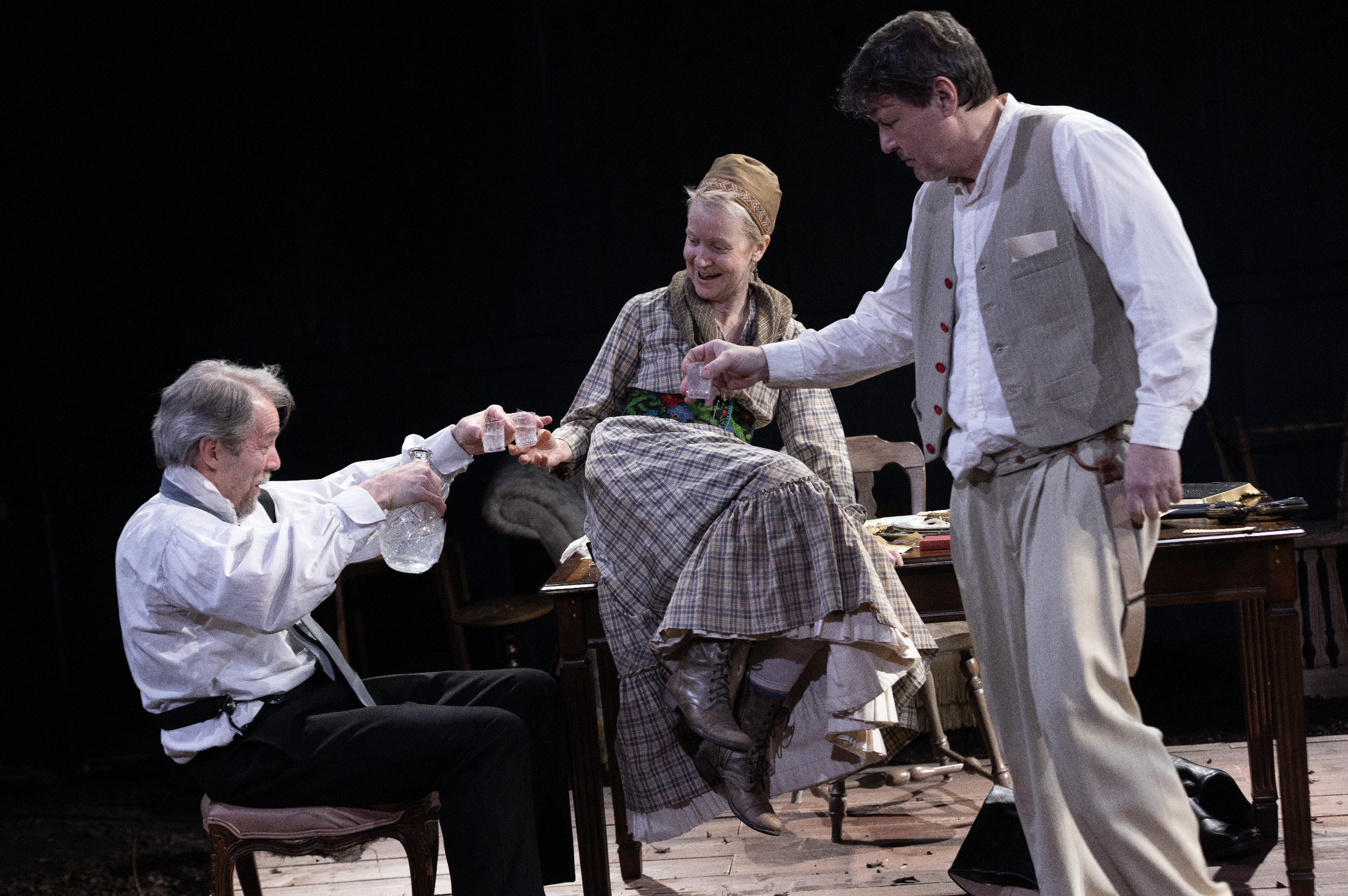
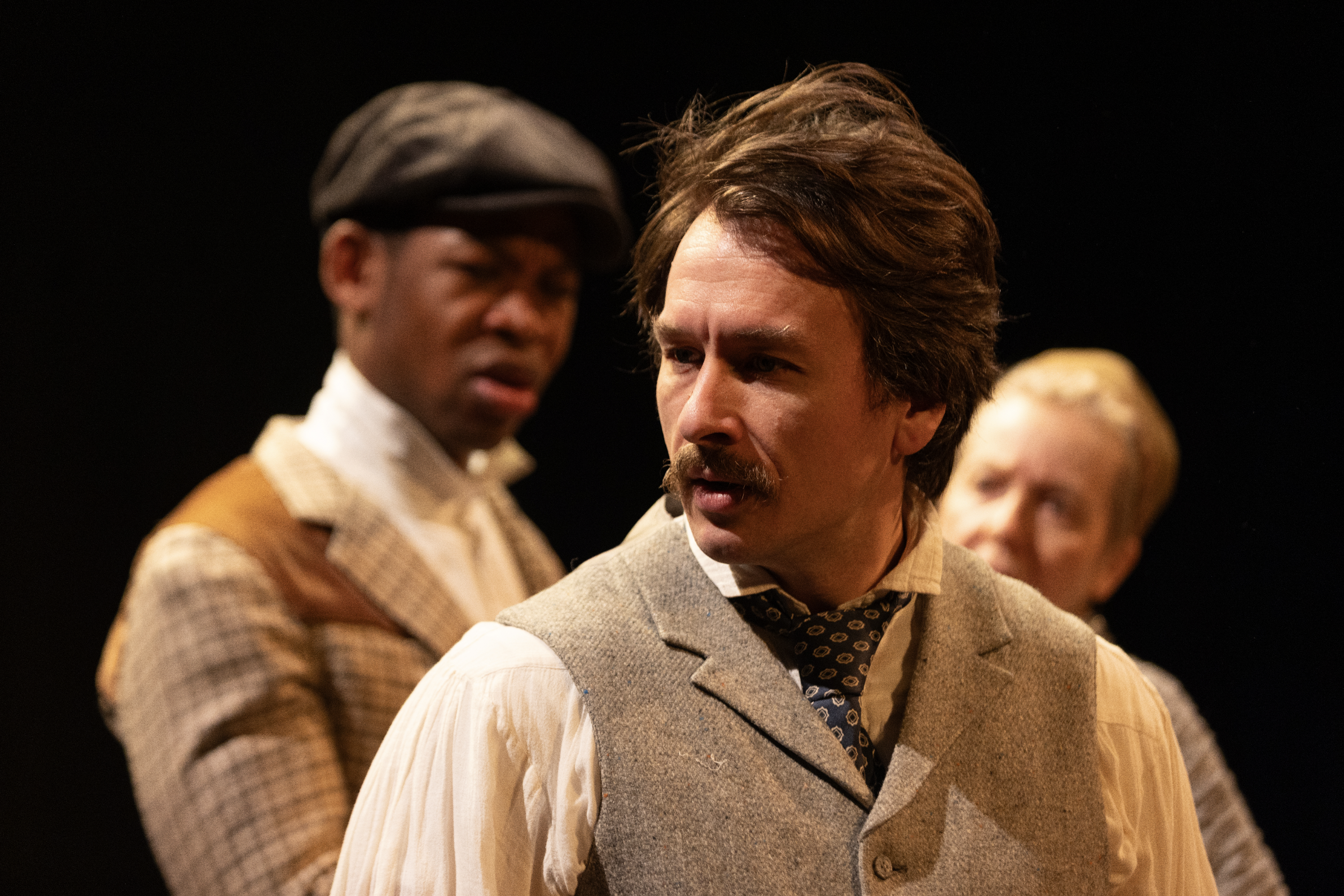
Photo credit by Bronwen Sharp
“All is vanity. What does man gain by all the toil at which he toils under the sun? A generation goes, and a generation comes, but the earth remains forever.”
Ecclesiastes 1:2–4
You smell it before you see it. Real mulch, earthy and clean, a faint cool damp rising from the floor of the West End Theater as you walk through the vomitorium. Beneath your feet: earth. Before you: a wooden platform rising from it like a raft on a sea of clay, or perhaps an eruption of human vanity, progress built on a mound of dirt. Above the platform, a dead tree hangs from frayed ropes. And on the platform, standing absolutely still, staring at the sky with the expression of a man who has just been told the rules of a game he already lost: Nikolai Ivanov. He shimmers. He is present and completely absent at once. The house fills around him, the pre-show chatter washing over his stillness the way water moves around a stone, and the stone does not care. The entire company crowds the stage around him, a community already in tableau, already failing him. It is an image the production will return to. Its meaning will be irrevocably altered by everything that comes between.
This is the central conceit of New American Ensemble’s brilliant and necessary production of Anton Chekhov’s IVANOV: all is vanity. What does man gain by all his toil? A generation goes, and a generation comes. The earth remains. The only question is what damage the people on this raft of dead wood do on the way down.
Walking into the space, you find yourself flanked by the two things this world runs on: the stage on one side, the bar on the other. Performance and alcohol. You have to choose which to face first, and either way you are already inside the play’s argument before a word has been spoken. The bar is period-designed, operational, and full. The stage rises from mulch. Together they announce: this is a comedy, and this world runs on alcohol, and you are inside it now, not watching from a safe distance. Immersive theater is too often made clumsily, as if immersion were its own reward. NAE uses it as a storytelling tool: the audience’s experience from the moment you cross the threshold, shaped with the same intelligence that governs every other element of the production.
Ashley Basille's scenic design is audacious for a 70-seat house. The stage thrusts into the audience, two vomitoria carved through the seating risers, a lone wooden platform and balcony staircase set against a dead tree trunk hanging from distressed ropes, white as birch but thick as oak, its roots splaying outward like exposed nerves. The effect is claustrophobic, and not accidentally so: the discomfort of the space mirrors the discomfort of the people inside it, who cannot bear each other's proximity and cannot escape it either. You are not watching a community collapse. You are sitting inside one.
The tree is the production's central image. Butoh-like, it is beautifully ugly, the kind of thing that takes up residence in the body before the mind has finished processing it. My second thought, arriving a beat after the first purely aesthetic one, was frankly a little inappropriate: that is one enormous phallic symbol for the death of white male supremacy. The ropes holding it aloft begin a motif that accumulates through the whole show: things bound, suspended, held in place by constraints that are themselves part of the image. Set against the dead trunk, the lone wooden platform and balcony staircase complete the argument: next to something dead, everything built for human use is revealed for what it also is. Dead wood. Doomed to decay. The platform holds the actors the way the trunk once held its branches. The humans it supports are on the same schedule.
Stan Mathabane’s sound design opens the show with a lone piano melody played with the mournful weight of a religious rite. Its most purely theatrical moment belongs to the collision of sound and set, and it involves an owl. In Russian folklore, the owl carries a dual nature: guardian of wisdom and omen of death, a creature of night and the spiritual world. When the owl hoots directly above the hanging tree, and Anna says simply, “There’s that owl again,” and the Doctor responds with frustrated dismissal, the moment is stage magic. The absurdity lands first. Then the chill follows. Sarah Woods deserves every award available to her. Her lighting design illuminates every inch of the playing space with a deliberate, abstract storytelling intelligence: walls, ceilings, set pieces, all of it considered with the hand of someone who understands that light is not decoration but statement. The opening image, Ivanov in the dim cool twilight, glowing with an unearthly stillness, sets the register. The Act Two fireworks sequence is the production’s single most dazzling moment: projections blazing across the ceiling combined with Woods’s light and Mathabane’s sound, producing something that forty-one years of theatregoing has not prepared me for. I won’t describe it further. You need to be in the room.
Adeline Santello’s costume design thinks the way DeFilippis thinks: minimalist choices, maximum impact, each detail studied. Clothes here are not period decoration. They are constrictions. The production makes this explicit in its opening sequence, in which the Count and Anna dress Ivanov for the world’s consumption rather than his own comfort. The men’s clothes are loose and too large, as if their bodies have begun to diminish inside them. The older women’s clothes are too tight, the body straining against what propriety requires. The color palette is earthy, dusty, eroded: we are all made of dust. Anna’s subtle Christian cross is worn as both declaration and wound. The Count’s clothing runs two decades behind current fashion, evoking the pathos of that scene in Boogie Nights where a man arrives in a car that was magnificent once, and so was he, and neither fact has quite registered yet. Santello knows we are mere feet from the actors, and she rewards that proximity with a richness of detail that reveals more with every viewing.
"Chekhov spent his career anatomizing a Russia in violent economic transition: the aristocracy hollowing out, a predatory capitalism rising to fill the space, replacing old feudal extraction with a shinier, faster, more cheerful version of the same brutality. The mechanism appears in IVANOV naked and early, in Borkin's scheme to build a dam and extort the village downstream, presented with the gleeful energy of a man who has discovered that the cruelty of capitalism is indistinguishable from entrepreneurship. What is less often said is that Russia's transition produced winners as well as losers. The serfs' grandchildren became factory workers. The factory workers' grandchildren became, in some cases, something resembling a middle class. America built that chapter and then lost it. The common populace shrinks in power as a kakistocracy consolidates its grip; the American Lopakhin, the union worker, the factory foreman, the person who rose from nothing and briefly owned something, was not a failure of ambition but a casualty of policy, dismantled by the same greed that produced Borkin. Lopakhin, in Chekhov's THE CHERRY ORCHARD, is the merchant who rises from serfdom to buy the estate his father worked. That figure arrived in America too, and was taken apart. Pew data shows middle-class households falling from 61% of adults in 1971 to 50% in 2021, a contraction that has not produced a new generation rising from below. Instead that same squeeze produced a concentration so extreme that the Federal Reserve reported the top 1% holding 31% of the country's wealth as of Q3 2025, while the bottom 50% held 2.5%. The men of Ivanov's Russia were failing because history had moved on without them. The men of our moment are failing in a system still nominally designed for them. That makes the rage more confused and the cruelty more diffuse.
Paul Schmidt, who died in 1999, was the rare translator with full command of both the Russian literary tradition and the demands of the American stage. His mission: not to Victorianize Chekhov, but to give American actors language as natural in their mouths as Chekhov’s Russian felt in the original company’s. It shows. The dialogue lands like overheard conversation. When characters say horrible things about each other, the viciousness arrives without the buffer of theatrical distance. You wince.
DeFilippis has given this production something American stagings of IVANOV have rarely attempted: sustained, deliberate direct address. Not formal soliloquy or drawing-room aside, but genuine confrontation: they look at you, they wait, and it is not only the obvious moments but little ones peppered throughout, small turns of the head, a line delivered to the room rather than to a scene partner. We are the community. We are the ones who couldn’t help. Lambert Tamin’s Lvov delivers his Act One soliloquy directly to the house, his outrage at Ivanov’s neglect of Anna becoming an appeal to us, a plea for someone, anyone, to intervene. We don’t. Zachary Desmond’s Ivanov uses direct address with the precision of a comedian who knows exactly when the knife goes in.
Chekhov set out to demolish the “superfluous man” as a literary type and accidentally invented something worse: a portrait of how entire social systems manufacture men who are functionally useless to everyone around them and then provide those men with endless cultural permission to be so. Every male character here is toxic. What DeFilippis understands, and what prior productions missed by centering everything on Ivanov’s interiority, is that the toxicity is structural. These men are not aberrations. They are the natural endpoint of a rotten, amoral system: a farming economy built on serfdom, on extracted labor, on a social hierarchy that concentrated power among the least equipped people to wield it, and which then collapsed under its own weight. This is where Ivanov meets 2026: not as history but as diagnosis. The disease is a system that manufactures useless men, extracts everything from the women around them, and calls the resulting wreckage a personal failure. Chekhov's name for it was the superfluous man. Ours are incels, groypers, accelerationists. NAE's production doesn't use any of them. It doesn't need to.
There is no subtle playing of drunkenness here. Chekhov famously professed his love for ordinary people, warts and all, and DeFilippis honors that love by playing the drinking for equal parts comedy and tragedy without apology. The comedy comes from the physical revelation that alcohol produces, the loosening of all pretense, every grip on what one is supposed to be. The tragedy comes from recognizing what it medicates: pure rage, self-hatred, the grinding frustration of lives descending in slow spirals toward irrelevance. We laugh because we recognize it. We are one bad day from it ourselves. The vodka drinker is us. The self-medication is ours. The system that made it necessary is ours too. The American opioid epidemic is not a metaphor for this. It is the same phenomenon, wearing different clothes.
The predominantly white cast is deliberate, and what it says is specific: these are the people the system was designed for, who inherited every structural advantage it offers, who have had every benefit of every doubt, and they are still burning it down around themselves and everyone in their path. The indictment is not of individual character. It is of the system that produced them and keeps producing them. Two performers are positioned entirely outside that inheritance. Lambert Tamin, the sole non-white actor in the company, plays the man who watches the damage accumulate and cannot stop it, his isolation built into the casting. Volok's Shabelsky, the company's sole immigrant, is the only character onstage with a foreign accent, which makes his outsider status audible as well as theatrical: a man from elsewhere, playing the proof of where the whole apparatus ends up, surrounded by people for whom this world was always home. Those outside the inheritance watch it burn. Those inside it do the burning. The women pay for both. Anna, Sasha, Zinaida, Avdotya, Martha bear the full force of its failure differently: some accommodating, some resisting, none spared. This is not a play that gives women agency. It is a play that is honest about what happens to women when men refuse to take any.
The sharpest comparison for what NAE’s production does with Anna is not another IVANOV. It is Arin Arbus’s 2022 TFANA production of THE MERCHANT OF VENICE, in which Lorenzo is not a man rescuing Jessica through love but the abused subject of an elopement motivated by Judeophobic hatred. That is the marriage Ivanov and Anna are already deep inside when the play begins. Anna has already surrendered her religion, her family, her dowry, her name. She has already discovered, in the daily texture of her marriage, who her husband really is. What she has not yet surrendered is her life, and the play takes that too. The Schmidt translation refers to her only as “the Jew,” a softening that is itself a dramaturgical position. The violence the text elides still has to live somewhere in performance, and DeFilippis and Jackson make it live.
Quinn Jackson plays Anna with a radiant, steadfast hope she carries like a lamp into every room, right up until the moment she cannot carry it anymore. Her fall is made all the more terrible by the length of time she holds on. When that choice finally collapses, Jackson does not spare us. The collapse is made beautiful by its sheer ugliness, its complete vulnerability. In the production's most shattering moment, the Count cradles her with a tenderness so specific it blurs the line between actor and character, his hand moving gently through her hair while Jackson weeps with an abandon that brings you right to the edge of worrying about her. Right to the edge, and no further. The memory of it brings tears to the eyes.
Zachary Desmond's Ivanov: absolutely charming, absolutely the golden child, and at the same time utterly nondescript. Another handsome, privileged man among many, distinguished only by the specific quality of his unraveling. He runs an actor's marathon, a mountain more challenging in some ways than HAMLET. His vanity, his bedrock belief in his own exceptionalism, his total inability to accept his limits: these are only the beginning of his undoing. He refuses to surrender to the very end, and it is not admirable. But is he a monster? Is he mentally ill? Is he well-meaning and utterly devious at once? Chekhov refuses to decide, and so does Desmond. The production holds all of it open, and Desmond drives it toward its terrible final reckoning, when his judgment is delivered by Anna, the person who suffered most for his weakness and his monstrosity.
The production's most precise acting moment arrives in the Act Three scene between Ivanov and Lebedev. Both men are sprawled on the floor in front of the desk, which tells you everything about where they are in the world and in the night. Pasha pulls out eleven hundred rubles, places them on the floor between them, and offers them without condition. He is giving his friend the one thing that could stop the spiral. And then he looks at Ivanov's face. The stage direction reads only: he sees the look. What Desmond puts there is something best discovered in the room, a delicious, frightening moment too rich to spoil here. Niebanck's Lebedev snatches the money back before either of them has consciously processed what just happened. The scene is over in seconds. It stays with you for the rest of the night.
What we discover is that Ivanov is no hero but a villain. If Borkin, the scheming estate manager who fills every room he enters with a cheerful, poisonous energy, is a predator, Ivanov is something more insidious: a super-predator who believes himself a super-man. He has convinced himself that his suffering, his sensitivity, his exceptional nature place him beyond the ordinary calculus of harm and accountability. He took, as Borkin took, but he wrapped the taking in philosophy and feeling. He willfully refused to see the damage because seeing it would have required him to stop. He is also, genuinely, a victim, bullied and harassed from all directions, never allowed a moment's peace. What he turns out to be devastatingly good at is the one thing he never claimed to be: a villain. There is one moment where the production's ambition slightly outpaces its landing: the Act Three bales of rye speech, Chekhov's answer to 'To be or not to be,' the moment Ivanov arrives at the conclusion he cannot yet admit. When I saw the production, still in previews, it was a touch too careful, the performance still more in his head than in his body. This is nitpicking of a work of acting genius, and exactly the kind of thing that resolves itself in the first week of performances. If Desmond isn't nominated for an Obie or a Drama Desk for this portrayal, I don't know what is wrong with the universe.
Lambert Tamin's Lvov stops the show, and not by doing anything loud. In Chekhov's plays, the doctor is almost always a self-portrait: the educated outsider, the man of science and conscience who watches the world around him collapse and cannot stop it, the author standing in the room in borrowed clothes. DeFilippis casts that role as a Black man in America, and the casting says everything about what we are actually watching: a history of slavery, displacement, and human trafficking, of a community that has always known what these people are doing to each other and to the world, and has never once been listened to by them. The one exception is Anna. She knows what it is to be outside the circle of people whose suffering counts. When she clings to whatever decency Lvov represents, two people who have been told their pain is not the point find each other across a room full of people who still believe it isn't. Tamin commands that room from his first entrance with a basso profundo voice of such gorgeous authority you understand immediately why she reaches for him.
The casting of Ilia Volok as Count Shabelsky lands as the production’s deepest irony. Volok is Ukrainian. He plays the only character in the production with an actual Russian accent: the stand-in for the endpoint of the Russian aristocracy, irrelevant, dependent, grand in his bitterness, headed nowhere. A citizen of a country being shelled by the inheritors of the society this play anatomizes, playing the ghost of that society’s ruling class with a specificity no native-born American actor could bring. Anna calls the Count nasty, malicious, querulous. Volok plays him as a sad clown with a heart of gold, embarrassed to death by the downward turn his life has taken. The moment in Act Four when he weeps at the sight of the cello, undone by the memory of the duets he and Anna used to play, is the one moment in his arc when grief arrives without armor.
Mary Bacon locks onto Zinaida with a comic ferocity, playing a woman whose burning secret is, in the way of all secrets in this play, obvious to everyone except herself: the family wealth hidden in her husband Lebedev's secret reserves, which Paul Niebanck's marvellously complex, heart-on-his-sleeve alcoholic squirrels away and then squanders through indiscriminate generosity. When Bacon's Zinaida turns to the audience and says admiringly of Borkin, 'The minute he comes in, the atmosphere improves. Did you notice that?', a shiver runs through the room. We have all said this about someone. We all know how it ends. Maude Mitchell's Avdotya watches all of it with the vinegary clarity of a woman who has assessed every person in the room and found them wanting. Mitchell, a Mabou Mines stalwart, plays her as a woman of no known occupation and no shortage of opinions, whose apparent warmth is the thinnest possible cover for a sourness that is, in its way, the most clear-eyed reading of this world that any character onstage manages..
Niebanck’s Lebedev is perhaps the production’s most deceptive performance: all shambling warmth, until it isn’t. In a blink-and-you-miss-it moment, when his daughter Sasha sits near him during one of his drunker passages, he strokes her hair in a way that no father should, and Sasha grows visibly more uncomfortable with every beat. Niebanck doesn’t underline it. He just does it, and lets the discomfort spread through the room like a slow stain.
Alexandra Pearl’s Martha carries her secret on her body: the loneliness, the desire for love, the social ambition that Borkin has weaponized into an ill-advised courtship she can already feel going wrong. Pearl commits to the drunk scene that follows with a bravery that makes both our skin and hers crawl. The staging is raucous in a way that is increasingly rare in a theater culture where careful, respectful intimacy choreography is properly standard. Watching the trio, I did not worry for the safety of any of the actors. That is no small feat.
Maya Shoham as Sasha is the production's aerial silks act: the most dangerous thing onstage, and incandescent when the routine holds. In the comic and emotional crown of the fourth act, when a quartet of emotionally ravaged friends and family are spontaneously combusting all around a stupefied Lebedev, Shoham is the crown's diadem: the moment when Ivanov begs her to walk away and she refuses, a young woman who has staked everything on a choice she made with her whole heart, staring at the wreckage it has produced, and still cannot unmake it.
Casey Worthington’s Kosykh is hilariously, irredeemably clueless, a gambling-obsessed man so consumed by the injustice of a lost card hand that the collapsing world around him registers only as a rude interruption. And John Austin, the production’s assistant, makes a wordless cameo as Gavrila, Lebedev’s long-suffering butler, with hilarious precision. He is, notably, the only person in the play who never complains.
Throughout the production, a motif accumulates: people recoil from each other. From voice, from touch, from presence itself. The very act of human contact fills this community with revulsion. Every outstretched hand lands wrong. That Borkin is the exception to this makes a particular kind of sense. Mike Labbadia plays him with sickening, slithering oiliness, a voracious physical appetite, and a menace that coils beneath the charm like a wire under silk. He occupies each space he enters, weaponizing the physicality that everyone else has abandoned. He is charming and enticing, and Labbadia makes you feel both the pull and the threat simultaneously. The production holds both truths about Borkin without resolving them, because Chekhov held them, and so does life.
The script stages Ivanov’s death offstage. DeFilippis refuses this. In NAE’s production, Ivanov dies in front of us, gruesomely, finally claiming power over his own body while his community watches in horror. He begged us to leave him alone, looked directly at us when he said it, and we stayed. We watched. We always watch. But the play doesn’t end there. We return to the image we walked in on: the entire company crowded onstage around Ivanov, who stands exactly as he did at the top of the show, dumbfounded, staring at us, the whole scene now awash in deep purple-blue, the color of a bruise, a community submerged and under siege, unable to stop eating its own. DeFilippis earns this landing. The fourth act is the funniest in the play, and he lets us laugh hard. Then he collects the bill for each of those laughs with a denouement that is equal parts tragedy and bathos, and the ratio keeps shifting the longer you sit with it. The play ends where it began. Nothing has changed. Everything has changed. The community is still just standing there, staring back.
New American Ensemble is three productions old. They are also, without question, the most exciting new theater company working in New York right now. The bar, the mulch, the dead tree, the casting, the translation choice, the direct address, the thrust configuration in a 70-seat house: nothing in this production is accidental. You can feel the care. In a city full of theater made in a hurry, that alone is cause for joy.
Go. Go before April 5. Go now.
Click HERE for tickets.
Review by Ariel Estrada.
Published by Theatre Beyond Broadway on March 23rd, 2026. All rights reserved.
