
Whitman in Love
Presented by Summoners Ensemble Theatre and Merchant’s House Museum
Conceived and Performed by John Kevin Jones
Sound Design by Tojo Rasedoara
The Garden of The Merchant’s House Museum, 29 East Fourth Street, in Manhattan
June 24, 2026 - June 28, 2026
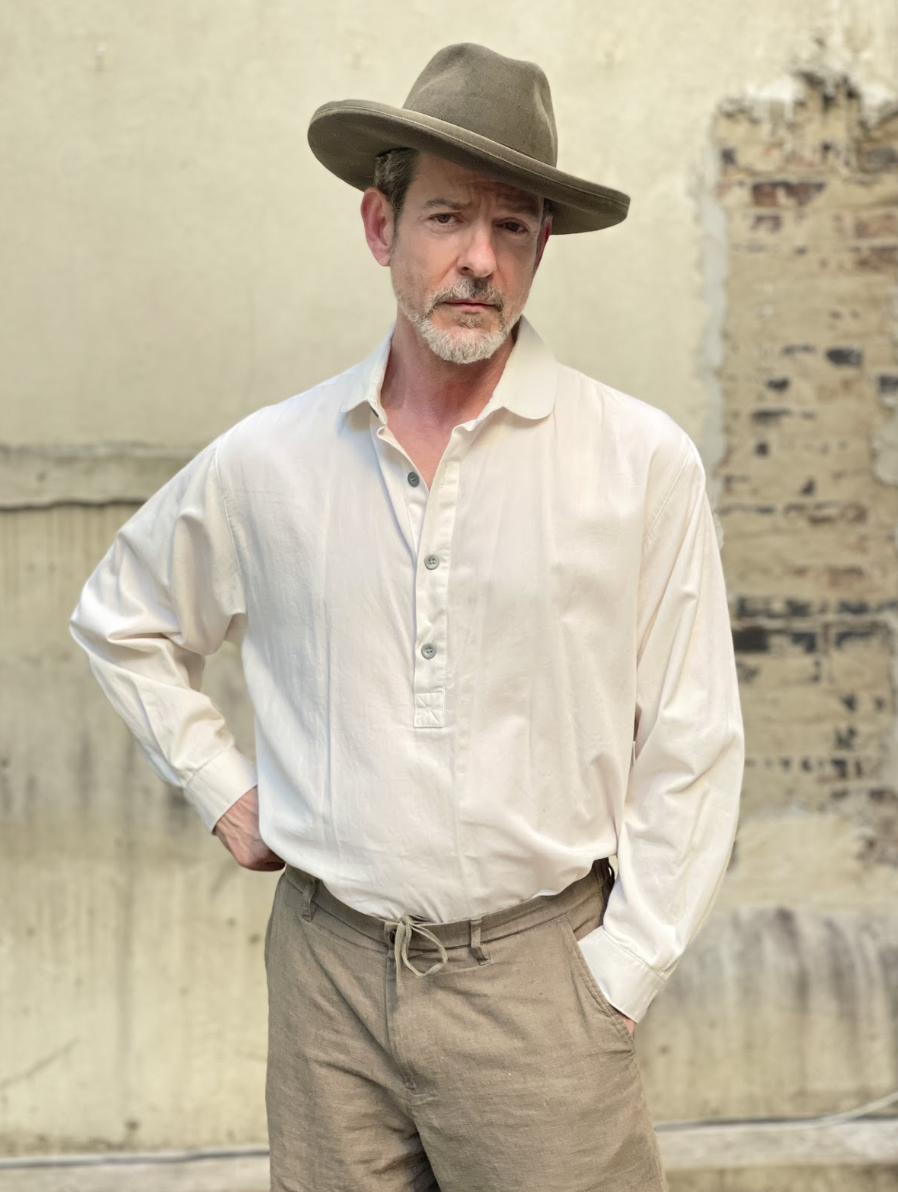

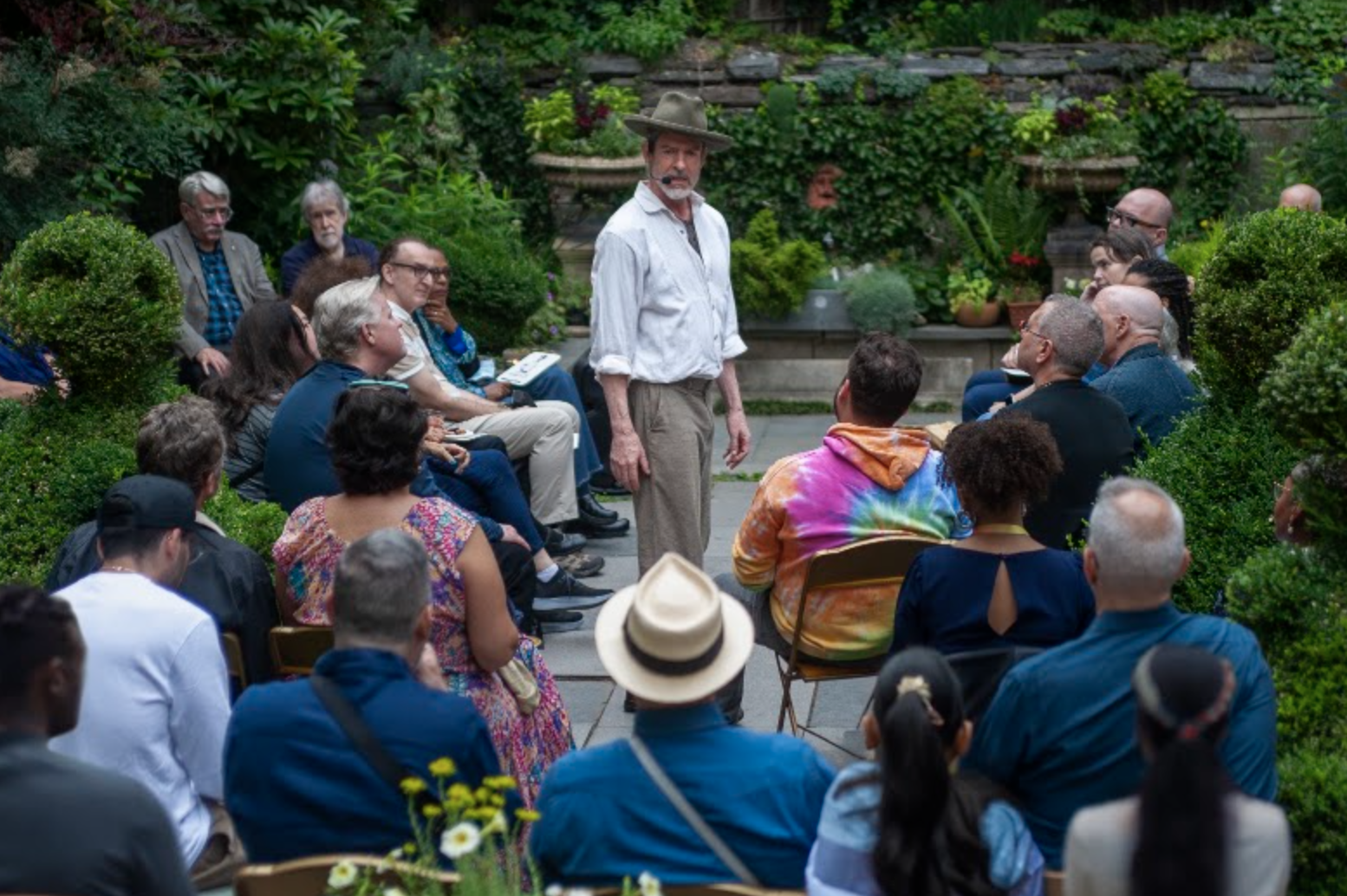
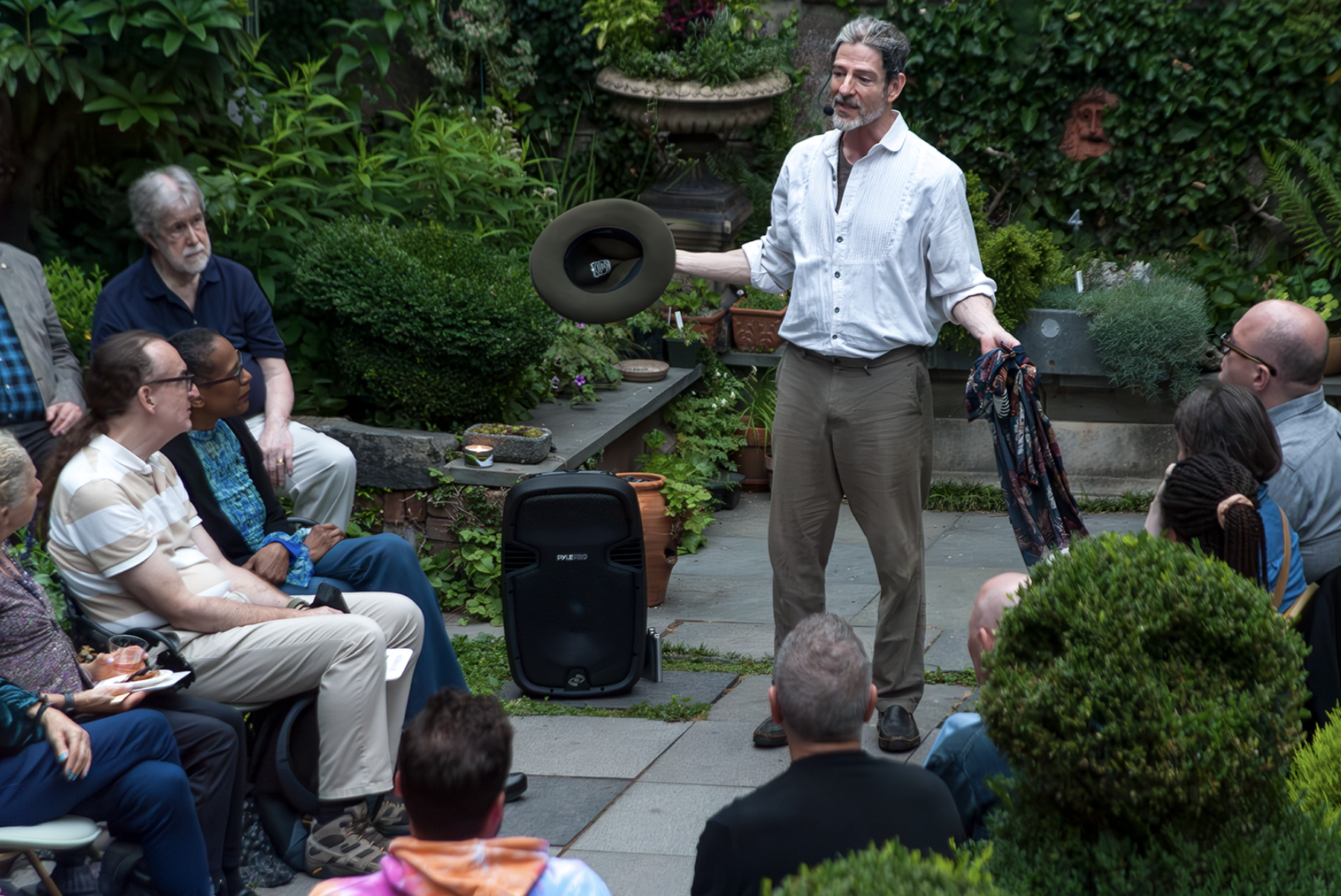
There are few places in New York where history seems less preserved than suspended, waiting patiently for the right voice to awaken it. The secluded garden of the Merchant's House Museum, the city's last fully intact nineteenth-century family residence, possesses precisely that quality. Just a short walk from the former site of Pfaff's beer cellar on Broadway—where Walt Whitman found fellowship among artists, radicals, and fellow outsiders—the space becomes more than a venue in Whitman in Love. It becomes a portal into the emotional geography of a poet whose public mythology has long obscured the startling intimacy of his private heart. Presented before an audience scarcely larger than a Victorian salon gathering, the seventy-minute performance feels less like theater than a privileged act of literary eavesdropping.
John Kevin Jones, beloved by Merchant's House audiences for his decade-long incarnation of Scrooge in A Christmas Carol, exchanges Dickensian austerity for lyrical vulnerability with astonishing ease. His Whitman is not the marble-bearded national bard immortalized in textbooks, nor merely the expansive prophet of democratic possibility, but a flesh-and-blood man overwhelmed by longing. Jones strips away generations of scholarly reverence to reveal someone infinitely more compelling: a lover, a dreamer, a man capable of ecstatic devotion and devastating grief. His performance possesses the quiet confidence to trust Whitman's language above theatrical embellishment, allowing every pause and breath to carry as much meaning as the poetry itself.
Although Whitman formed profound attachments to several young working-class men throughout his life, the great love that echoes through this production is Peter Doyle, the Irish-born streetcar conductor and former Confederate soldier whom Whitman met in Washington in 1865. Whitman was forty-five, already celebrated as America's poet; Doyle was just twenty-one, largely self-educated, and recently returned from fighting for the Confederacy. Their first meeting—on a rainy evening aboard Doyle's horse-drawn streetcar, with Whitman his final passenger—has entered literary history with the inevitability of myth. Against every political, social, and educational divide, the two men forged a relationship that endured until Whitman's death in 1892. Their surviving correspondence, collected as The Calamus Letters, reveals a tenderness that still startles with its emotional transparency, and Jones wisely allows that romance to become the quiet heartbeat of the evening.
The production centers upon Live Oak, with Moss, the extraordinary twelve-poem cycle Whitman composed in the late eighteen-fifties before quietly dismantling it and dispersing its verses throughout the "Calamus" section of Leaves of Grass. Rediscovered only in the twentieth century, the sequence is now recognized as one of the earliest sustained explorations of same-sex love in American literature.
Each poem marks another station along that emotional pilgrimage. One opens with the solitary speaker searching for companionship before unexpectedly discovering perfect reciprocity in another man. Another exults in physical closeness, celebrating the miraculous ordinariness of shared affection. Elsewhere, Whitman contemplates the almost sacred completeness that love briefly grants, only to confront betrayal, abandonment, and the bewildering silence that follows intimacy's collapse. Images of live oaks, moss, birds, roads, and open landscapes become emotional rather than pastoral symbols, externalizing an inner life that oscillates between exultation and despair. By the sequence's conclusion, grief has not disappeared, but it has been absorbed into a broader vision of human fellowship, suggesting that even broken love enlarges rather than diminishes the soul.Seen through the lens of Whitman's relationship with Doyle, the sequence becomes almost unbearably moving—an intensely painful yet profoundly beautiful reflection of one man's love for another in an era that denied such love public acknowledgment.
Jones navigates these emotional currents with remarkable precision. The performance glides effortlessly between poems, letters, narration, and the imagined voices of Whitman's correspondents, the actor employing subtle shifts in accent, rhythm, and physicality to distinguish one speaker from another without sacrificing the evening's lyrical momentum. Rather than constructing a conventional biographical drama, Whitman in Love allows Whitman's writings themselves to become the action. The audience listens not for plot twists but for emotional revelation, and Jones' extraordinary command of language ensures that every phrase lands with renewed immediacy. One has the uncanny sensation of overhearing letters never meant for public eyes, their confessions surviving across centuries to find new listeners beneath the evening sky.
The production's environmental design deepens this sensation of communion. A soundscape woven from layered voices reciting Whitman's poetry drifts almost imperceptibly through the garden, dissolving the boundary between performer and surroundings. The rustle of leaves, the shifting light, the architecture of the Merchant's House itself, and the awareness that Whitman once wandered these same downtown streets create an atmosphere in which literature seems to reclaim its original habitat—not the classroom or library, but the living world. One imagines these words traveling on the breeze, crossing neighborhoods and generations alike, finally arriving in receptive ears as naturally as birdsong.
There is also something quietly radical about encountering Live Oak, with Moss during Pride Month, not as an academic artifact but as living testimony. As Jones has observed, Whitman insisted that love between men deserved poetry, dignity, and song long before such convictions could safely be proclaimed aloud. The production never reduces Whitman to an emblem or historical curiosity. Instead, it restores the urgency of a voice that refused to separate erotic desire from spiritual transcendence, reminding us that the most enduring acts of courage are often whispered rather than shouted. The poet emerges not simply as a queer ancestor but as an artist whose emotional honesty remains perpetually contemporary. The evening concludes with an image of devastating simplicity: Jones gently places Whitman's familiar slouch hat atop Doyle's bowler, a silent gesture that collapses biography into memory, transforming two ordinary hats into a monument to enduring love. Few theatrical tableaux in recent memory have conveyed so much with so little.
In an era increasingly dominated by spectacle, Whitman in Love accomplishes something rarer and ultimately more profound. It reminds audiences that language, spoken with conviction in the right place, can become an event unto itself. The evening asks for little beyond attentive listening, yet offers an experience of remarkable emotional abundance in return. Leaving the Merchant's House garden, one carries away not only renewed admiration for Whitman's genius but gratitude that these hidden poems, once concealed within the pages of Leaves of Grass, have finally been allowed to bloom openly in the city that first inspired them.
Click HERE for tickets.
Review by Tony Marinelli.
Published by Theatre Beyond Broadway on July 10, 2026. All rights reserved.
