International Human Rights Art Festival (IHRAF): Artists-at-risk
I never take for granted the freedom I have to create art in New York City. Over the past decade, through the Gilder/Coigney International Forum and New Perspectives Theatre Company’s Theatre from the Streets program, I have had the privilege of connecting with artists from around the world. I even had the opportunity to direct one of my favorite musicals, The Wiz, in Liberia, West Africa, with the Matsiko World Orphan Choir. It was a humbling experience to collaborate, teach, and witness firsthand the power of theatre to bring people together across cultures and borders.
This year, I am working with the International Human Rights Art Festival (IHRAF) in anticipation of its December festival. Last year, I had the opportunity to perform my solo show, Excavating My Family, with this remarkable organization. My work with IHRAF has further deepened my appreciation for the role artists play in telling difficult stories, challenging injustice, and preserving the freedom to express who we are.
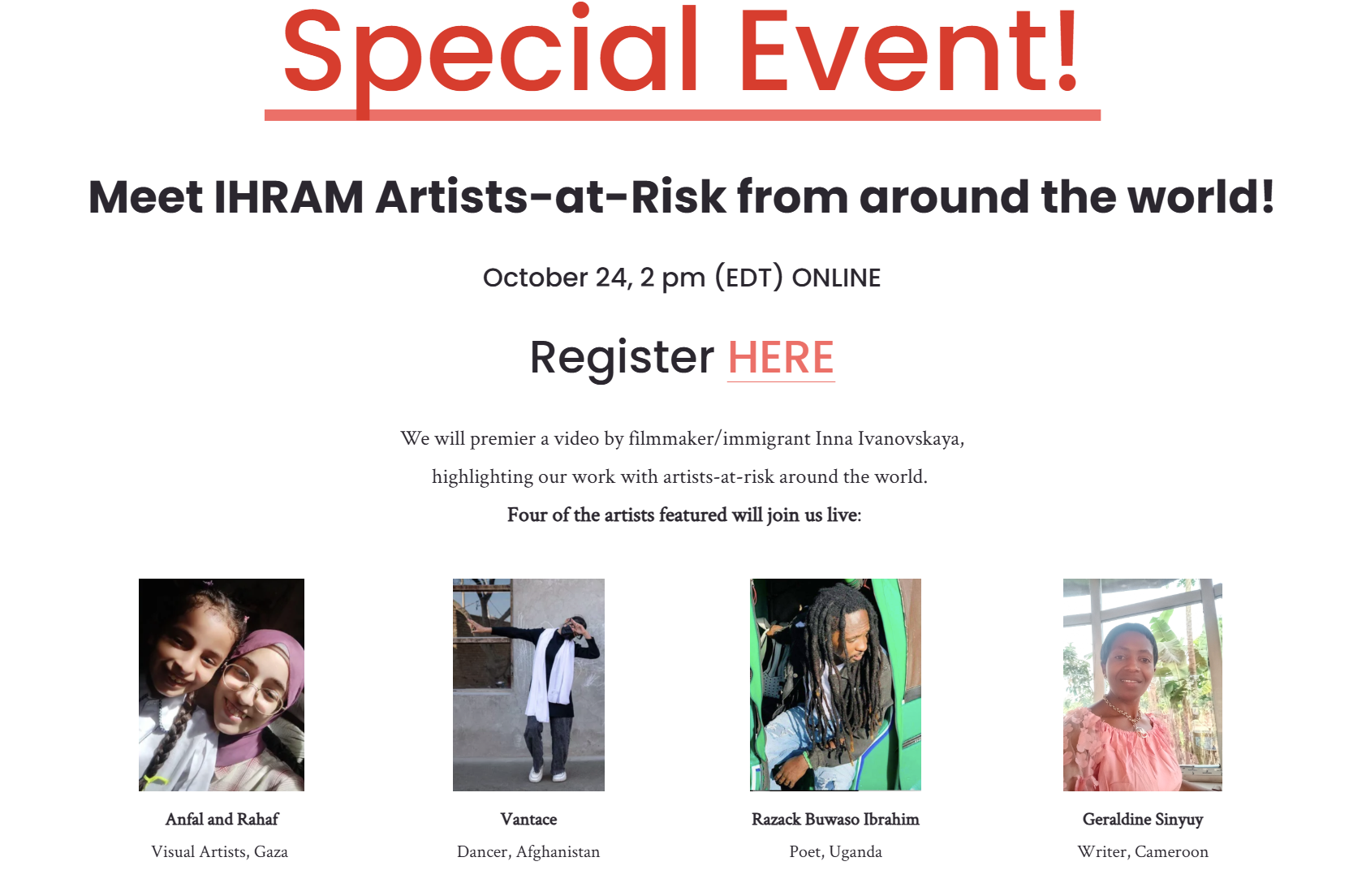
On Saturday, October 24, at 2 p.m. ET, IHRAF will present Artists-at-Risk, a free online program featuring the world premiere of a documentary about artists around the world who risk their safety, and sometimes their lives, simply to create. Several of these artists took the time to share their stories of resilience and resistance, offering a glimpse into what it means to make art when artistic freedom cannot be taken for granted.
Additionally, four of the artists will be joining us live, to deepen the discussion and answer questions, including:
Anfal, 15, and Rahaf, 7, Palestinian artists living in Gaza: “All we want is to be safe and follow our dreams.”
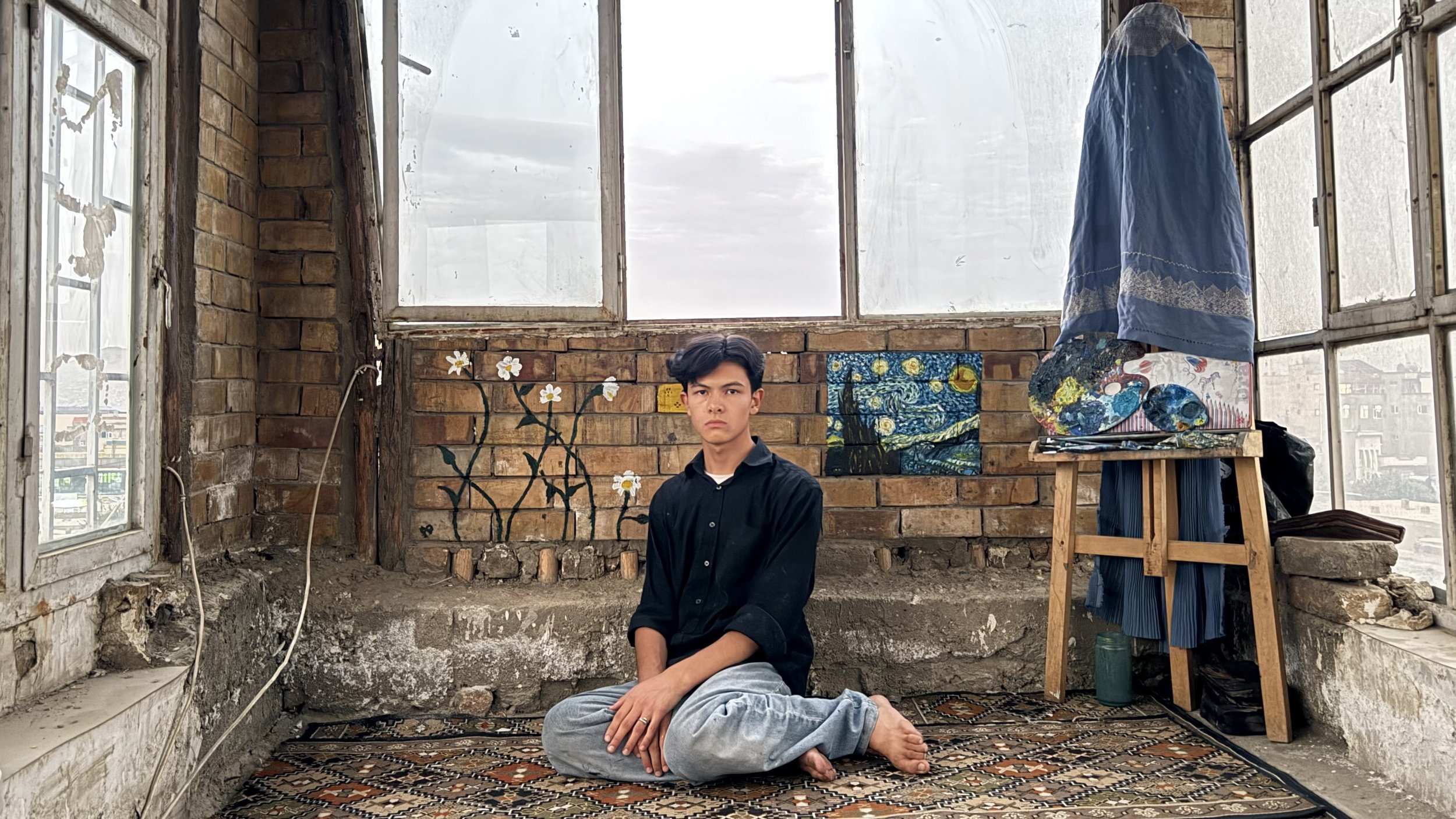
Vantace, a 16-year-old Afghan Hazara queer dancer: “The Taliban kidnapped and tortured my father because I dance.”
Razack Buwaso Ibrahim, poet from Uganda: “They could do whatever they wanted with me — they ripped my fingernails out.”
Khaled Radwan, playwright from Syria: “I survived an assassination attempt.”
Meet Sinyuy Geraldine
Could you tell us a little about your artistic work, what inspires you, and what you hope to communicate to audiences through your art?
My artistic works sit astride many facets of the society. I write mostly prose and poetry and each piece of work addresses crucial issues in my community and the world around me at a given time. That means that my writing flows with tides. Writing has been and is still for me a way of communicating my thoughts, ideas and the meanings I see in the things around me. I draw my inspiration from daily life and experiences, nature and the way of the world. I believe that writing is a form of rebirth, recreation, revolution, redemption and revival. Thus, each piece of writing, be it a poem, flash fiction, short story, short play, or a novel, becomes a sacred leaf in which messages to salvage mankind are wrapped and carefully handed out to those in need. The main core of all my writings, whether they are castigating or glorifying certain societal aspects is a call to maintain the beauty that is, or that ought to be in the world.
What does artistic freedom mean to you, and what do you hope audiences will take away from the IHRAF Artists-at-Risk program?
Artistic freedom is essential for the development of every writer. However, we cannot pretend that artists have such freedom per se as long as there is censorship. One is not always in the position of saying whatever he or she wishes to say. Thus, one sees more, but considers the consequences of saying as much as one sees. What am I saying here? Silence is the shield of most arts around the world. My conclusion is that what is not written about is more than what is written about. I hope that artists will go home with the message that we need to advocate for peace in the world for there is no freedom with peace and there is no peace without freedom.
Meet Mbizo Chirasha
Having experienced exile yourself and worked with IHRAM over several years, how has that journey shaped your understanding of the challenges artists-at-risk face and the support they need?
My journey in exile was tough, I hopped from country to country due immigration laws and Xenophobic attacks in some countries I lived. Exile is depressing especially on issues of safety and freedom because you always running. You usually don't know who is following you or watching your movements. Over my years in exile, I realized that best stories work of art, best literary is produced in times of crisis, in times of running. You can't produce best work in comfort. I produced the bulk of my awarded writings while in exile. My work touches on political freedom, free speech, human rights, gender rights, cultural and historical matters. Through Tom Block, IHRAM and IHRAF played a biggest role for my living conditions, artistic personality growth, and development. IHRAM and IHRAF gave me speaker platforms during festivals and other interventions. I am the inaugural IHRAM and IHRAF fellow (2019 to 2020) .In 2020, IHRAM and IHRAF awarded me an artist-at-risk grant scholarship to continue writing and advocating for rights. I was also given the opportunity to curate books about human freedoms as well as contribute to IHRAM and IHRAF press. My relationship with IHRAM resulted in getting a fellowships with PEN GERMANY, Jamie Dedes, Poem A Day Magazine, Bezine Publications, Fictional Cafe, Glasgow University Creative Writing Speaker Series, UNESCO artistic affiliation, and the World Beyond War peace anthology collaboration.
What does artistic freedom mean to you, and what would you like audiences to take away from the IHRAF Artists-at-Risk program?
I believe artistic freedom is telling truth to power through any form of art, it might be risky especially these dark days all over the world. It is the ability to interrogate conditions around through works of art. It is using art as instrument of advocacy and activism against human rights abuses, corruption, dictatorships, bad government, war and other decadent tendencies.
My audiences should take way from my journey the following ethics that including positive thinking, revolutionary stamina, resilience, commitment for change and the power of collaborations.
Meet Razack Buwaso
Your poetry gives voice to experiences and perspectives that are often overlooked. What stories or truths do you feel compelled to explore through your writing?
As a Ugandan poet, multidisciplinary artist, and human rights activist, I feel compelled to write about the truths that societies often find uncomfortable to confront: the silence of the oppressed, the cost of speaking out, the weight of injustice, and the human stories that disappear behind political narratives, statistics, and public indifference.
My writing comes from a deep desire to document the experiences of people whose voices are frequently overlooked, particularly those living under systems where questioning authority can become dangerous. I am interested in the lives of ordinary people who carry extraordinary burdens: the young person denied an education, the mother struggling to protect her children, the activist whose freedom becomes negotiable, the artist forced to choose between silence and the consequences of telling the truth.
Growing up in Uganda and engaging with questions of governance, corruption, human rights, and freedom of expression have profoundly shaped my artistic practice. Through poetry, spoken word, theatre, and film, I explore what happens when people are denied the freedom to express themselves, when fear becomes part of everyday life, and when silence is demanded in exchange for safety.
But my work is not only about suffering. It is also about dignity, resistance, memory, and the extraordinary human capacity to imagine a different future. I believe that even in circumstances designed to diminish people, there remains something powerful in the human spirit that refuses to surrender completely.
For me, poetry is a form of witnessing. It allows me to preserve what others might prefer to forget, to question what others might accept without examination, and to give language to experiences that are difficult to explain. Sometimes, a poem becomes a record of an injustice. Sometimes, it becomes a conversation with a wounded society. And sometimes, it becomes a letter to a future generation, asking them to understand what happened before they arrived.
I am particularly interested in the silences that exist between what a society claims to be and what its people actually experience. Who gets to tell our stories? Whose pain is considered important? Who is allowed to question power without being punished? And what happens to a society when its people become afraid to speak honestly?
These questions continue to shape my work.
Ultimately, I write because I believe that forgotten experiences deserve to be remembered, that uncomfortable truths deserve to be examined, and that human dignity should never depend on whether a person’s voice is convenient to those who hold power.
I do not expect poetry to solve every injustice. But I believe it can make indifference more difficult. It can challenge the comfort of looking away. It can remind us that behind every statistic is a human being, behind every act of repression is a life affected, and behind every silenced voice is a story that still deserves to be heard.
My poetry is my way of refusing to let human experiences disappear simply because they are difficult, uncomfortable, or dangerous to acknowledge.
What do you hope international audiences will understand about the relationship between poetry, freedom of expression, and the experiences of artists working under threat?
I hope international audiences will understand that, for some artists, poetry is not simply an artistic practice. It is also an act of courage, a form of documentation, and sometimes a personal risk.
In societies where freedom of expression is restricted, a poem can become more than a collection of words. It can become a question that authorities do not want asked, a memory that people are being encouraged to forget, or a voice that refuses to participate in the silence surrounding injustice.
When an artist works under threat, the consequences of creative expression can extend far beyond criticism or rejection. The artist may have to consider their personal safety, their family, their freedom, and their ability to continue working. Decisions that other artists might make purely on creative grounds can become questions of survival.
This is one of the realities I want audiences to understand. Freedom of expression is not merely an abstract democratic principle. It is a condition that determines whether people can tell their stories, challenge injustice, question authority, and participate honestly in shaping their societies.
My own artistic journey has strengthened my understanding of the relationship between creative expression and vulnerability. My work explores issues of governance, human rights, and social justice, and my experiences have made me acutely aware that the freedom to create cannot always be separated from the risks associated with what one chooses to say.
Yet I do not want international audiences to see artists working under threat only through the lens of victimhood. We are more than the dangers we encounter. We are thinkers, witnesses, cultural workers, and creators who continue to imagine possibilities even when our circumstances attempt to narrow them.
An artist-at-risk is still an artist with ideas, ambitions, unfinished projects, and a contribution to make to the world. When we focus exclusively on the threats artists face, we risk overlooking the work itself and the futures that could be built if those artists had the freedom and security to continue creating.
I therefore hope this program will encourage audiences to look beyond the individual artist and consider the wider implications of silencing creative voices. When a poet is threatened for writing about injustice, the loss extends beyond that poet. A community may lose the language through which it understands its experiences. A younger generation may lose an important record of its history. The international community may lose perspectives that could challenge its assumptions and deepen its understanding of the world.
I also hope audiences will recognise that solidarity must extend beyond listening. It should include creating meaningful opportunities for artists at risk to publish, exhibit, perform, collaborate, protection programs and international residencies for multiple countries and continue developing their work without having their entire identities reduced to their experiences of persecution.
For me, poetry is a meeting place between the personal and the political, between memory and history, and between an individual’s experience and our shared humanity. It can cross borders that people cannot safely cross. It can carry stories into rooms where the people who lived those stories may never have the opportunity to enter.
When a poet is silenced, we should ask not only what has happened to the poet, but also what truths a society has become afraid to hear.
Through the IHRAF Artists-at-Risk program, I hope audiences will understand that protecting artists is not simply about protecting individual careers. It is about protecting the human right to imagine, question, remember, and express ourselves freely.
Because when artists are free to speak, societies retain the possibility of confronting their contradictions. And when artists are forced into silence, we must all be concerned about what that silence is being asked to conceal.
I believe art must remain a space where difficult questions can be asked, where human dignity can be defended, and where even the most uncomfortable truths can find a voice.
Meet Khaled Radwan
What kinds of stories are you most drawn to tell through theatre, and what makes those stories important to you?
I am drawn to stories that tackle religious extremism, political Islam, and authoritarian control over human thought. My play The Devil’s Chair (كرسي الشيطان) was a direct attempt to critique rigid ideologies and expose how they crush individual freedom. That specific work and the fierce controversy it sparked preceded an armed assassination attempt against me, forcing me to leave my home and eventually relocate to France.
These stories matter deeply to me because silence is never an option when art becomes a target for speaking the truth.What role can theatre play in helping audiences understand the realities of conflict, displacement, and the struggle to preserve artistic freedom?
Conflict and displacement are often treated as mere news headlines. Theatre changes that by bringing the human cost right in front of the audience. For me, theatre is a powerful educational and psychological tool that can awaken people to the dangers of extremist ideologies and rigid dogmas. When audiences experience these realities live on stage, abstract political struggles become deeply human stories, helping people understand why defending artistic freedom and human dignity is a battle we cannot afford to lose.
As I continue my journey in France, I am determined to keep creating, refining my artistic tools, and deepening my understanding of the human experience. I want to draw on my background in psychology and my postgraduate studies in Media Psychology to develop a theatre practice that brings together artistic expression, psychological insight, and critical reflection on the ways media, ideology, and power shape human thought and behaviour.
For me, this is not only a commitment to defending freedom of expression, but also an ongoing journey of learning, growth, and artistic development.
Meet Abolfazl Hussaini (Vantace)
What first drew you to dance, and what are you able to express through movement that words cannot fully capture?
In Afghanistan, dancing is often seen as something shameful, especially for a boy. Since childhood, dance has been the one thing I could turn to for comfort and freedom. At first, I danced with my sisters and female friends, and later, I found myself dancing to all kinds of music.
Dance has never been just a hobby or a way to entertain myself. It is a part of who I am, and in many ways, it is one of the reasons I am still here today. Through dance, I can express my true self and everything I carry inside me that words cannot fully explain. It gives me a way to show the world that no restriction should ever force someone to give up on their dreams or their goals.
Art and dance have always been, and still are, the ways I can be my authentic self. They also allow me to be a voice for those who are silenced in Afghanistan, especially children and women who are denied the freedom to express themselves.
What do you hope people around the world will understand about the importance of being able to pursue your art and express your identity freely?
It is incredibly difficult to grow up in a country where your dreams, your art, and even your true self can be seen as something unacceptable. I want people around the world to understand how important it is to express their art without fear. No restriction should be powerful enough to silence us or make us abandon who we are.
I also want people to remember the artists who are living under circumstances like ours, where expressing yourself can put your freedom and even your life at risk. Please be a voice for those artists who cannot safely speak for themselves.
Our identity is one of the most important parts of who we are. In a place like Afghanistan, being different can come at a terrible cost. Because of my gender identity and sexual orientation, I have experienced sexual violence, sexual harassment, humiliation, suppression, and physical abuse, including being sexually assaulted multiple times. Yet I have never allowed these experiences to make me hate myself. My identity is one of the most beautiful and meaningful parts of who I am, and nobody has the right to make me feel ashamed of it.
I refuse to let other children suffer the same way without trying to do something. I want to stand up for children who, like me, have experienced sexual violence and abuse, and for those whose voices are ignored or whose rights are denied. They deserve protection, dignity, justice, and the chance to grow up without fear. We must listen to them, believe them, and defend their rights.
Above all, I hope people understand that being different is not something to be ashamed of. Art, identity, and freedom are deeply connected, and everyone deserves the right to live authentically and express themselves safely.
Never let the world make you forget who you truly are. Keep being yourself, keep creating, and keep raising your voice for those who cannot raise theirs.
Click HERE to register for the event.
Editorial by Malini Singh McDonald.
Published by Theatre Beyond Broadway on October 21, 2026. All rights reserved.