A Tribute to Big Mama Thornton
Conceived and Written by Pamela Sneed
Performed by Pamela Sneed, Viva DeConcini, Mara Rosenbloom, Bernice “Boom Boom” Brooks, and David A. Barnes
Presented by Joe’s Pub in partnership with Under the Radar Festival
Joe’s Pub | 425 Lafayette Street, New York, NY 10003
January 11, 2026 - January 17, 2026
A Tribute to Big Mama Thornton arrives as both an invocation and a corrective, a theatrical séance intent on summoning a voice that history has too often muffled. Conceived, written, and hauntingly brought to life by the poet and performer Pamela Sneed, the piece is less a conventional biography than a living, breathing act of reclamation—an insistence that Willie Mae “Big Mama” Thornton be restored to her rightful place in the cultural imagination as one of the indispensable architects of twentieth-century American music.
Sneed frames Thornton not as a footnote to rock and roll history but as one of its originators: a Black, queer, blues-rooted force whose sound was mined, diluted, and monetized by others more palatable to the mainstream. Best known, if she is known at all, as the original voice behind “Hound Dog” and “Ball ’n’ Chain,” Thornton here emerges in full dimensionality—brash, tender, wounded, ecstatic, and ferociously alive. Sneed’s performance crackles with a sense of urgency, as though the evening itself were a belated appointment history has kept Thornton waiting far too long to attend.
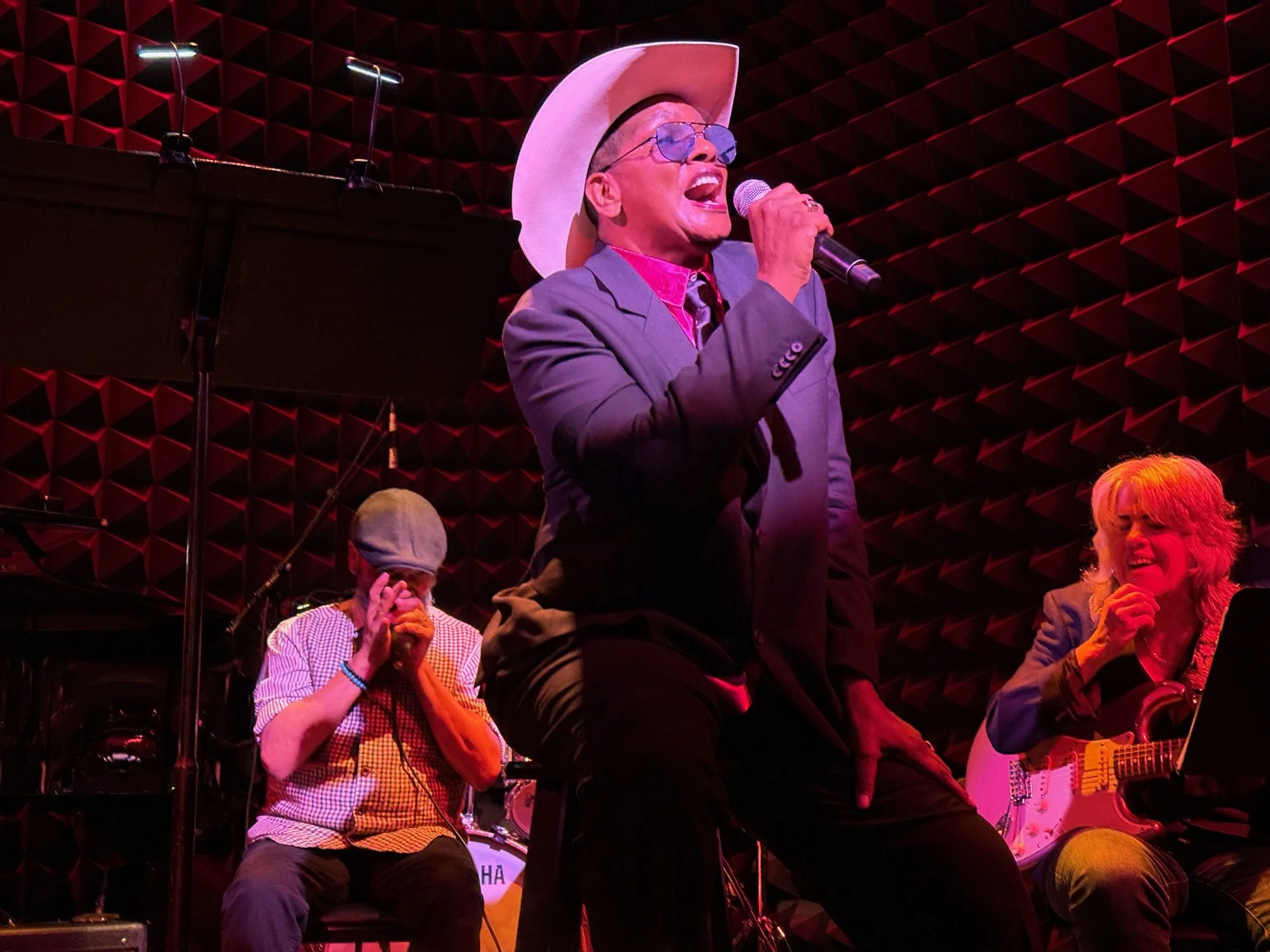
Structured as a vivacious cabaret, the show moves fluidly between song, spoken word, and direct address, with Sneed shifting registers effortlessly. Towering over the band in a suit over a red silk shirt, gently hidden by sunglasses and a cowboy hat, she sings with reverence and grit, speaks with the precision of a poet who understands the weight of every syllable, and inhabits Thornton with a generosity that resists imitation in favor of communion. The live four-piece band, led by guitarist and music director Viva DeConcini, provides more than accompaniment; it forms a muscular, responsive backbone that allows the music to surge and recede in conversation with Sneed’s storytelling. With Mara Rosenbloom on piano, Bernice “Boom Boom” Brooks on drums, and David A. Barnes on harmonica, together the four musicians create an atmosphere that feels at once celebratory and mournful, a party haunted by the knowledge of who was left out of the guest list.
Sneed hits the ground running with bluesy renditions of snarly, yet playful songs representative of the Thornton oeuvre: “They Call Me Big Mama,” “T’ain’t Nobody’s Biz-ness If I Do,” and Willie Dixon’s classic “(I Got A) Little Red Rooster,” before having fun with a lesser known 1955 hit for Mindy Carson, “(They Call It) The Fish,” in a way a tongue-in-cheek set-up for a point she is about to make with two other songs in the program. One of the evening’s most galvanizing passages arrives when Sneed takes hold of “Hound Dog,” that endlessly recycled American anthem whose origins are so often misattributed as to border on willful amnesia. Sung first by Thornton and later refashioned into a career-making vehicle for Elvis Presley, the song here is restored to its original temperature and menace. Sneed’s rendition is all brass and abrasion, a voice sharpened to a snarl. The performance aims its fury not only at the faithless man named in the lyric but outward, across decades, at the machinery that siphoned Thornton’s invention into a palatable spectacle for a white star. What emerges is less a cover than a reclamation—an act of musical repossession carried out in real time.
“Ball ’n’ Chain,” another Thornton composition that achieved wider fame only after being taken up by a white performer—Janis Joplin, in this instance—receives an equally unsparing treatment. Sneed resists the temptation to mythologize the song as a romanticized blues lament. Instead, she leans into its weight and repetition, allowing its anguish to accumulate rather than dissipate. Heard this way, the song becomes an indictment not just of personal sorrow but of a cultural pattern, in which Black women’s pain is mined, amplified, and rewarded only once it passes through a different body. In Sneed’s hands, both songs are returned to their source, newly charged with anger, history, and a fierce, clarifying sense of ownership.
A soulful cover of Leiber & Stoller’s legendary “Stand By Me,” a powerhouse interpretation of the Gershwins’ “Summertime” which takes us out of the opera house and back to Charleston’s Catfish Row where it simmers, and uplifting renderings of spirituals “Go Down Moses” and “Down By The Riverside” with its propulsive “I ain't gonna study war no more” speaking to us now in 2026 as clearly as when it was originally intended, complete a breathtaking set.
What distinguishes A Tribute to Big Mama Thornton is its clear-eyed commitment to reparative justice. This is not nostalgia dressed up as homage, but a pointed act of redress. Sneed makes space for the contradictions of Thornton’s life—the triumphs and the erasures, the power of her artistry and the violence of the systems that exploited it. In doing so, the production asks the audience to reckon not only with Thornton’s legacy, but with the broader patterns of cultural theft and historical amnesia that continue to shape American art.
Towards the end of the evening, the performance executes its most daring modulation: Sneed loosens her grip on Thornton’s voice and allows her own to bleed through. The impersonation gives way to confession, and biography opens into autobiography. What might, in less assured hands, feel like a rupture instead registers as an earned deepening. Sneed speaks of her own early departure from home, of the necessity—and the cost—of leaving in order to make art, and of the unexpected freedom such exile affords. Like Thornton, she discovers that distance can be both wound and permission, a space in which sexuality, long constrained by circumstance and expectation, finally finds room to name itself.
These parallels are not offered as clever dramaturgical symmetry but as lived evidence. Sneed’s meticulous research grounds Thornton firmly in her historical moment, yet it is Sneed’s willingness to implicate herself that animates the past with present tense urgency. She becomes less an interpreter than a vessel, a living conduit through which Thornton’s struggles—artistic erasure, bodily autonomy, the precarity of Black queer life—are revealed not as relics but as recurring conditions. The bridge Sneed builds between then and now is sturdy and unsettling; it suggests not progress so much as persistence. In casting her own shadow alongside Thornton’s, Sneed illuminates the contemporary terrain with a harsh, necessary light, reminding us that the injustices Thornton endured have not vanished so much as changed costume.
Thornton feels less like a subject and more like a presence—resurrected not as a saint, but as a complicated, magnificent artist whose influence reverberates far beyond the credits she was denied. A Tribute to Big Mama Thornton does what the best theater can do: it restores breath to the past, and in that act of restoration, demands a more honest accounting of the present.
Review by Tony Marinelli.
Published by Theatre Beyond Broadway on January 18th, 2026. All rights reserved.
