Bellow
Written by Feidlim Cannon, Gary Keegan, Danny O’Mahony; Created and Directed by Brokentalkers
Irish Arts Center | 726 11th Avenue, New York, NY 10019
January 7, 2026- January 18, 2026
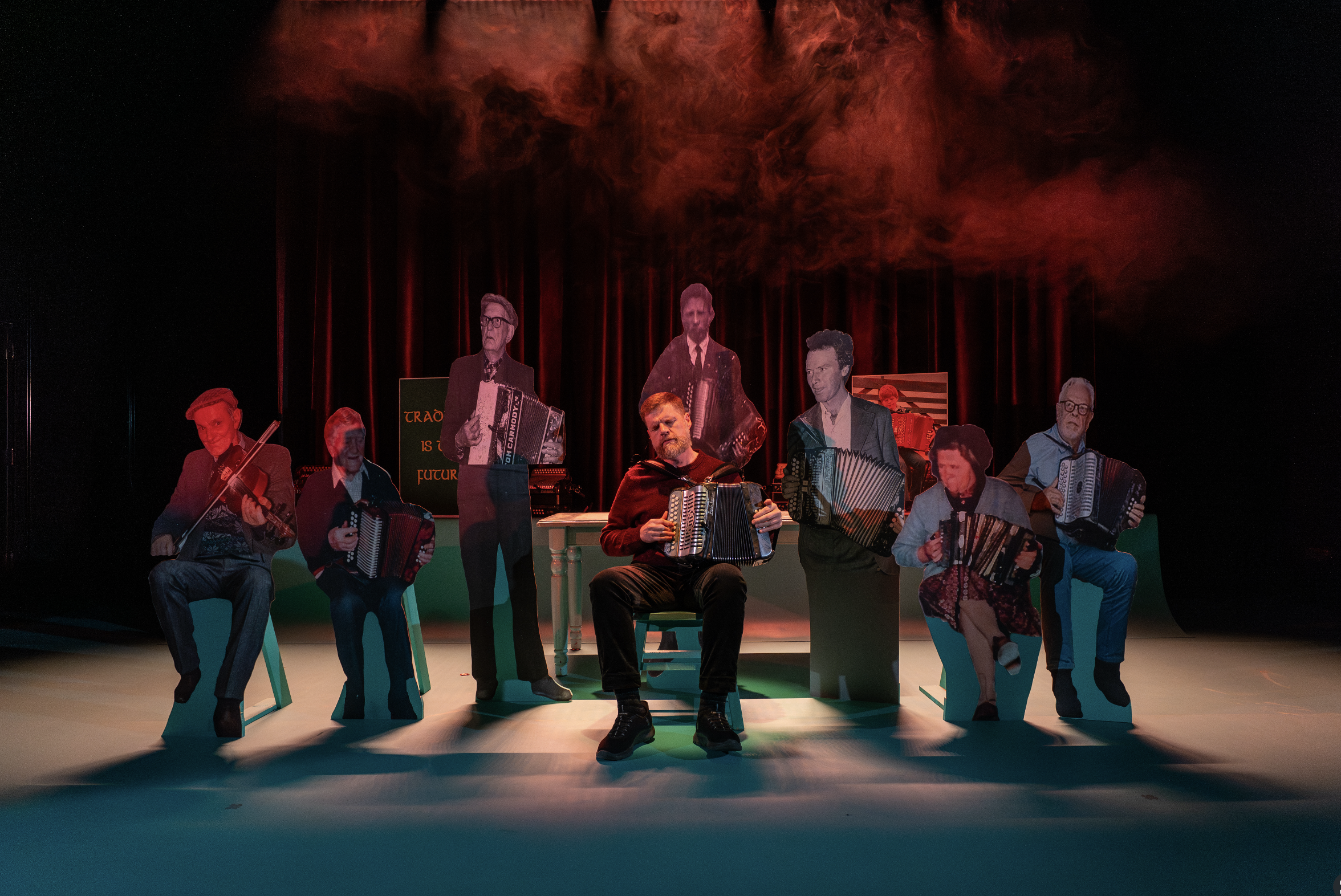
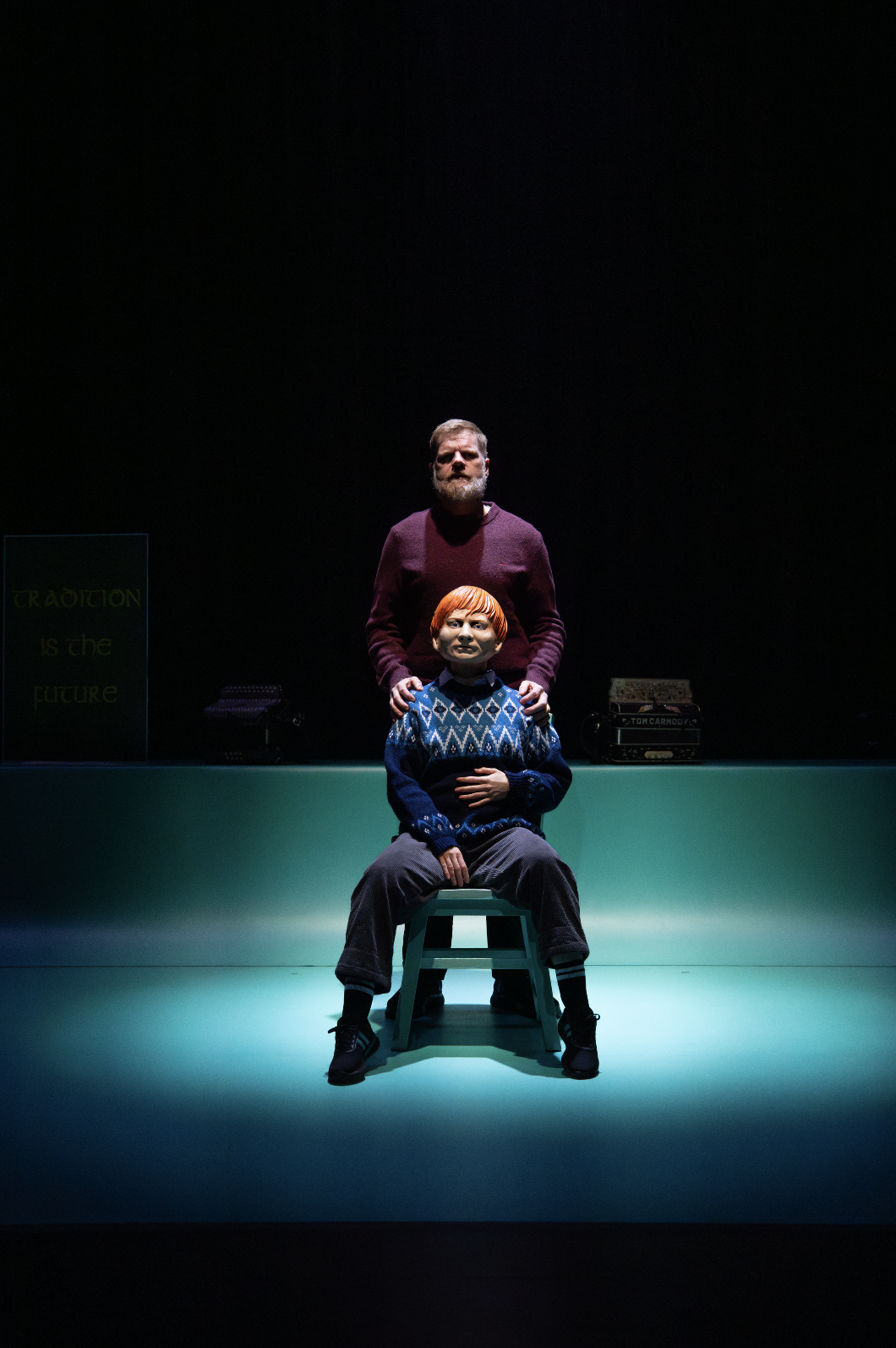
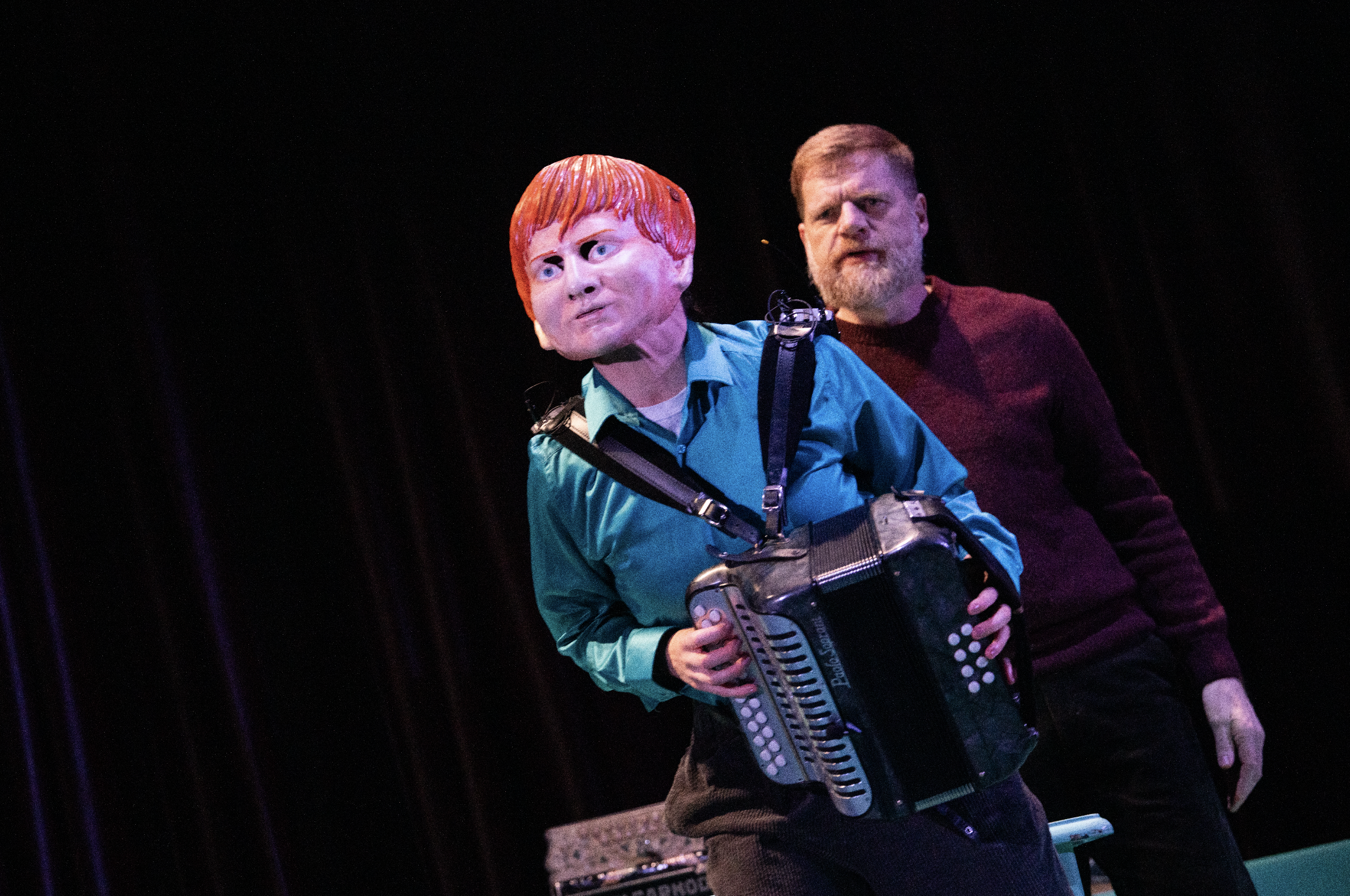
Photos by HanJie Chow
Bellow sets out to chronicle the life of Danny O’Mahony, one of Ireland’s most accomplished accordionists, but it quickly becomes something more unsettled—and more compelling—than a celebratory portrait of mastery achieved. O’Mahony is introduced as a man who has devoted himself with near-monastic rigor to the preservation of traditional Irish music, to the careful stewardship of a form whose survival depends on discipline, repetition, and fidelity. Yet the performance resists hagiography. What it offers instead is a searching, often disquieting inquiry into what such devotion costs, and how an artist learns to live inside the echo chamber of his own excellence.
The structure of Bellow folds time in on itself. Past and present coexist onstage as O’Mahony revisits formative moments: the first electrifying encounter with music in childhood; the teachers and mentors who recognized his talent and refined it; and the relentless pursuit of technical and expressive perfection that demanded focus at the expense of almost everything else. These recollections are not presented as nostalgic milestones but as pressure points, places where identity was shaped through discipline as much as through joy. The production understands that mastery, particularly when it begins early, can be both a gift and a narrowing of the world.
In Bellow, a collaboration that begins as an ostensibly modest act of self-portraiture gradually reveals itself to be something deeper: a meditation on what it means to make art in public while carrying private damage. The premise is disarmingly simple. O’Mahony, a virtuoso Irish accordionist whose career began in childhood, approaches the experiential-theatre maker Gary Keegan with the desire to fashion a stage work about his life and music. What follows, however, is not the reassuring arc of a prodigy’s rise, nor a museum-friendly documentary about tradition faithfully preserved. Instead, under Keegan’s insistently present guidance, the piece becomes an excavation—of habit, of defense, and of the artist’s uneasy reliance on the very instrument that made him visible.
Written by Feidlim Cannon, Keegan, and O’Mahony, and directed by Brokentalkers Theatre Group, Bellow operates as theatre about theatre-making, and about the peculiar courage demanded by the word “Yes.” O’Mahony arrives with a wish to honor lineage and form; Keegan counters with a process that refuses the comfort of rehearsal-room consensus. His work, as he explains to both O’Mahony and the audience, must be remade each time from the ground up, requiring not virtuosity but a willingness to unlearn. The tension between these approaches—between inherited structure and radical presence—provides the drama’s pulse.
The performance unfolds as a sequence of exercises, drawn in part from Keith Johnstone’s influential manual Impro (Impro: Improvisation and the Theatre is a seminal 1979 book by Keith Johnstone that teaches actors how to foster spontaneity and narrative skill through exercises and technique), through which Keegan (after the first few performances of this Under the Radar run Feidlim Cannon stepped into the role of “Gary Keegan”) coaxes O’Mahony away from mastery and toward exposure. At first, the accordionist speaks cautiously, as if aware that language itself might betray him. Then, almost against his will, he confesses how completely he has fused his sense of self with his instrument—how, without it, he feels unmoored, even abandoned. As childhood memories surface, the emotional temperature rises, and the audience begins to understand that the music, for all its buoyancy and craft, has long functioned as both refuge and risk.
The accordion’s bellows—opening, closing, drawing air in, forcing it out—become the show’s central metaphor. Their motion mirrors O’Mahony’s own oscillation between fidelity to tradition and Keegan’s insistence on rupture. When words prove insufficient, or merely dull, the piece makes a decisive turn. The dancer Emily Kilkenny Roddy enters, not as accompaniment but as translation. With uncanny acuity, she registers the emotional states that pass through O’Mahony as he plays, rendering them in movement that is by turns ecstatic, fragile, and deeply unsettling. She comes to embody his younger self, carrying memories that include not only exhilaration and pride but isolation, imbalance, and hints of harm. The body, here, remembers what the voice hesitates to name.
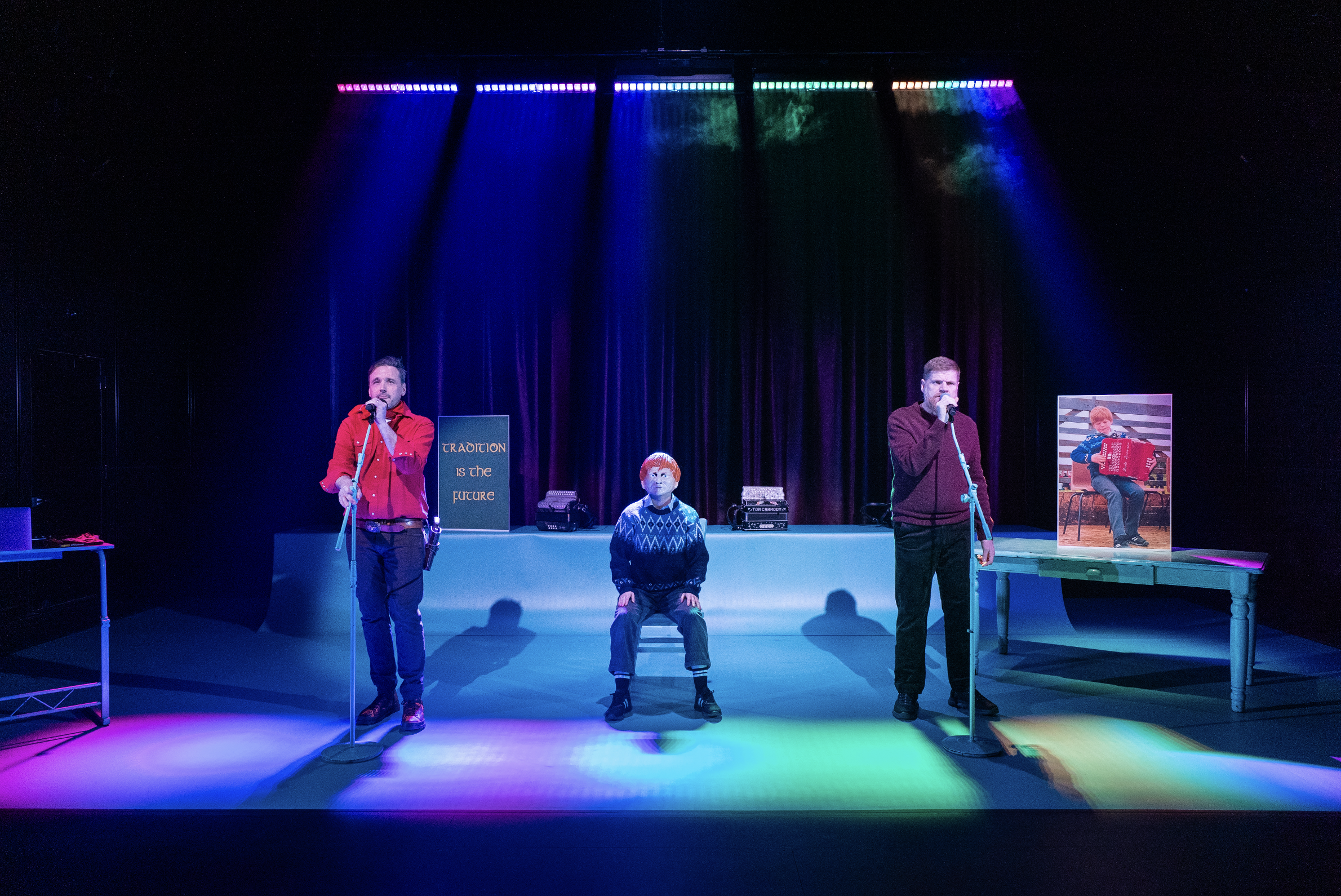
In one of Bellow’s most quietly devastating gestures, Emily Kilkenny Roddy appears in a mask, assuming the role of the young Danny O’Mahony—not as a literal impersonation, but as a living repository of memory. The mask creates a deliberate estrangement, allowing childhood to be seen not sentimentally but at a remove, as something both formative and already lost. Through her presence, the accordion is revealed not merely as an instrument but as an organ, as vital to O’Mahony’s survival as his own pulse. Music, here, is not an extracurricular passion; it is the mechanism by which life has been regulated, sustained, and made legible.
As the narrative darkens and the production traces the psychological fracture that nearly undid him, Roddy’s doubled presence with O’Mahony takes on an added gravity. The performer and his embodied past stand side by side, each acutely aware of the body’s limits. What begins as an exploration of how art saved a life becomes, almost imperceptibly, a meditation on its fragility. Both O’Mahony and Roddy are drawn into an unspoken reckoning with the future—with the inevitable day when the work that defines them can no longer be physically pursued. Time, in these moments, presses in. The virtuosity that once seemed inexhaustible is suddenly revealed as contingent, bound to muscles, breath, and stamina. Beneath the beauty of the playing and the elegance of the movement lies the specter of absence: the fear that when the body falters, something essential will vanish with it. Bellow does not offer consolation here. Instead, it allows the emptiness to hover, unresolved, reminding us that for artists whose identities are fused with their craft, the ticking clock is not merely a metaphor but a constant, intimate presence—one that must, sooner or later, be faced.
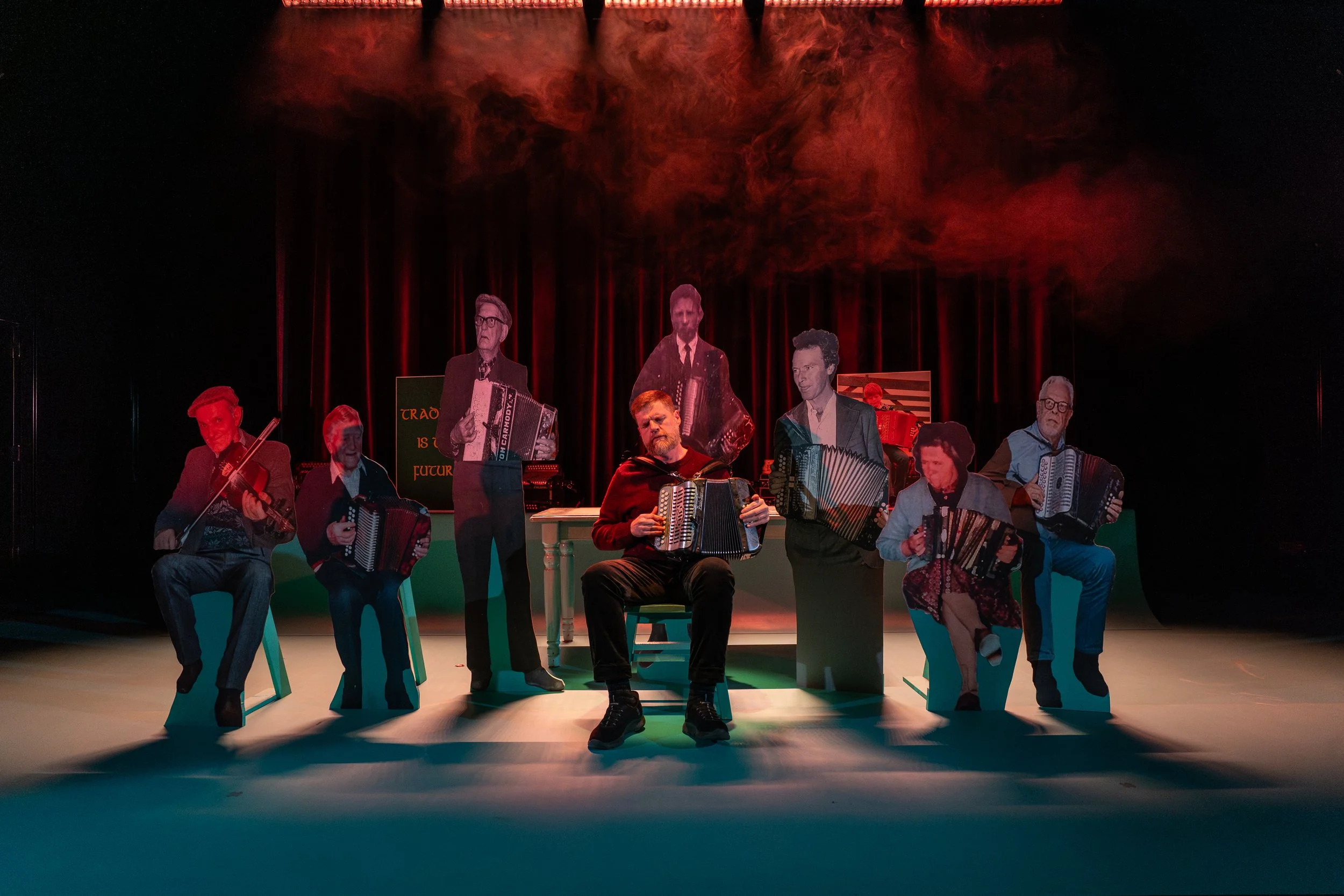
Live music anchors the evening. O’Mahony’s playing—precise, muscular, and often rapturous—serves as both subject and engine of the work. But it is continually set in dialogue with an original electronic score by Valgeir Sigurðsson, whose textured compositions press against the traditional melodies rather than simply cushioning them. The result is a charged sonic landscape in which old forms are neither embalmed nor eclipsed, but placed under stress. That tension is further intensified by newly written text and contemporary dance, which supply a physical and emotional counterpoint to the music’s formal discipline. Movement becomes a way of externalizing what the instrument alone cannot say: the bodily strain of performance, the loneliness of singular focus, the ache of time passing.
O’Mahony articulates the paradox at the heart of the work with painful clarity. Music, he tells us, has been his means of giving himself ease, joy, and delight—and of offering those same gifts to others. Yet within that brightness lies something dangerous. The space of music was not always safe; it was also a corridor toward darkness. This admission, delivered without melodrama, lands with the force of lived truth.
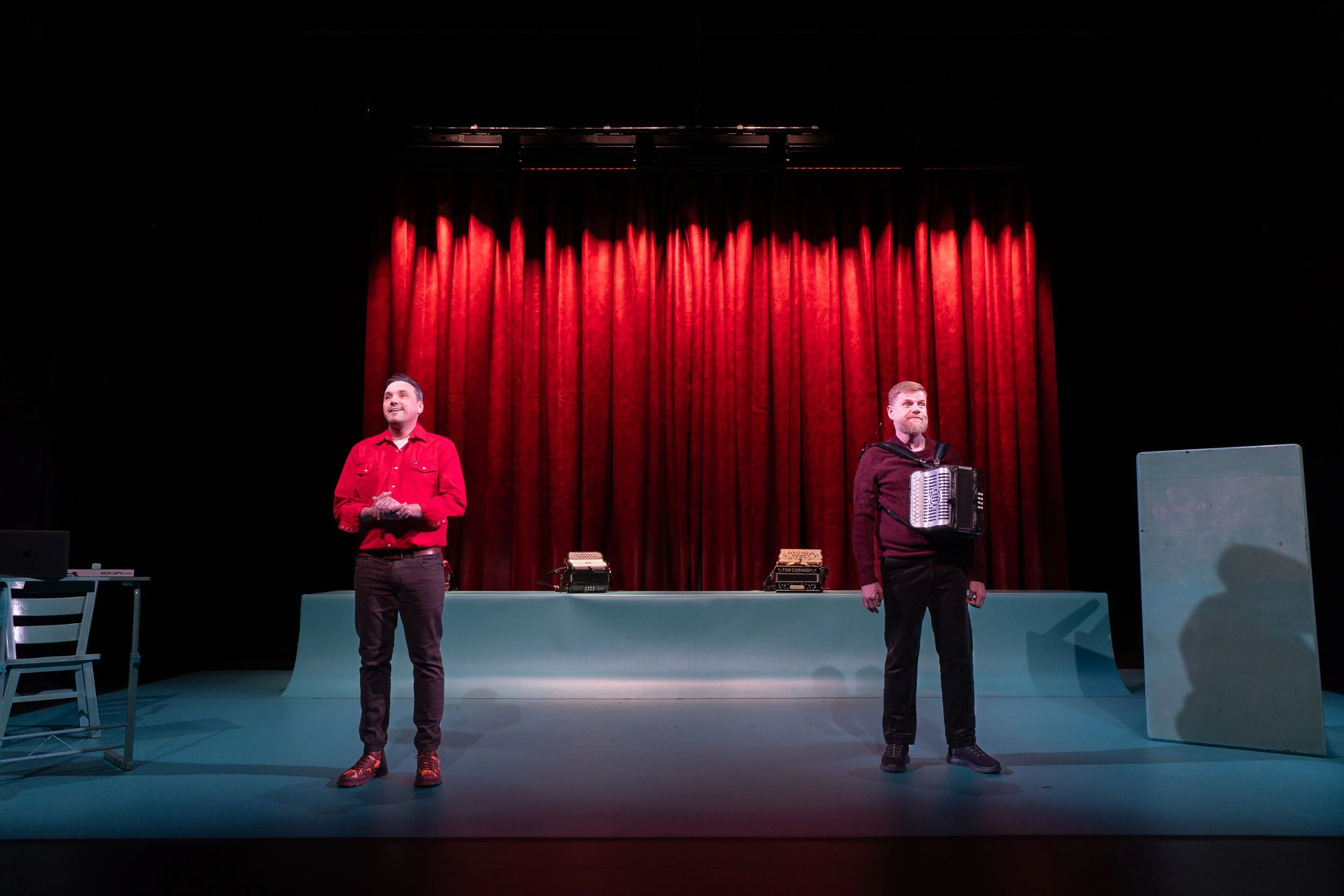
The stagecraft surrounding these revelations is exemplary in its restraint. Sabine Dargent’s spare set is a lesson in purposeful minimalism: objects are continually reassigned, their meanings shifting as the narrative deepens. An easel that once charts emotions on a crude stick figure becomes, moments later, a table, and then a platform for Roddy’s movement. Sarah Jane Shiels’ lighting traces the work’s subtle emotional gradients, while Sigurðsson’s sound design frames O’Mahony’s playing without smoothing its edges. At moments when feeling overwhelms speech, voiceovers supply O’Mahony’s inner thoughts, allowing the piece to breathe without forcing confession.
What distinguishes Bellow is its refusal to frame O’Mahony’s life as a straightforward triumph of talent and perseverance. Instead, the production dwells in the uneasy space between passion and compulsion, asking what it means to give oneself so fully to an art form that it becomes inseparable from one’s sense of self. The accordion’s breathing bellows seem to mirror the artist’s own—expanding with possibility, contracting under pressure—suggesting that the act of playing is also an act of survival.
Midway through the performance, Keegan poses a question that seems almost accusatory: are they really going to make a piece about something as self-evident as the healing power of music? The answer, by the end, is both yes and no. Bellow acknowledges music’s capacity to soothe and sustain, but it is equally invested in the idea that experimental theatre—messy, process-driven, and resistant to easy uplift—can offer its own form of repair. What emerges is not a celebration of art as cure-all, but a clear-eyed recognition of art as a site of risk, revelation, and, occasionally, grace. At the Irish Arts Center, Bellow emerges as a rare theatrical offering: intimate without being confessional, reverent toward tradition yet unafraid to interrogate it. It is, finally, less about the preservation of music than about the preservation of the artist who carries it. In tracing O’Mahony’s lifelong dialogue with his instrument, the performance offers a quietly devastating reflection on what it means to be an artist—how beauty is made, sustained, and paid for, over the long arc of a life. For Danny O’Mahony, and for the audience bearing witness, that seems to be healing enough.
Review by Tony Marinelli.
Published by Theatre Beyond Broadway on January 24th, 2026. All rights reserved.
