Blackout Songs
Written by Joe White; Directed by Rory McGregor
Susan & Ronald Frankel Theater at The Robert W. Wilson MCC Theater Space | 511 West 52nd Street, New York, NY 10019
January 15, 2026 - February 28, 2026
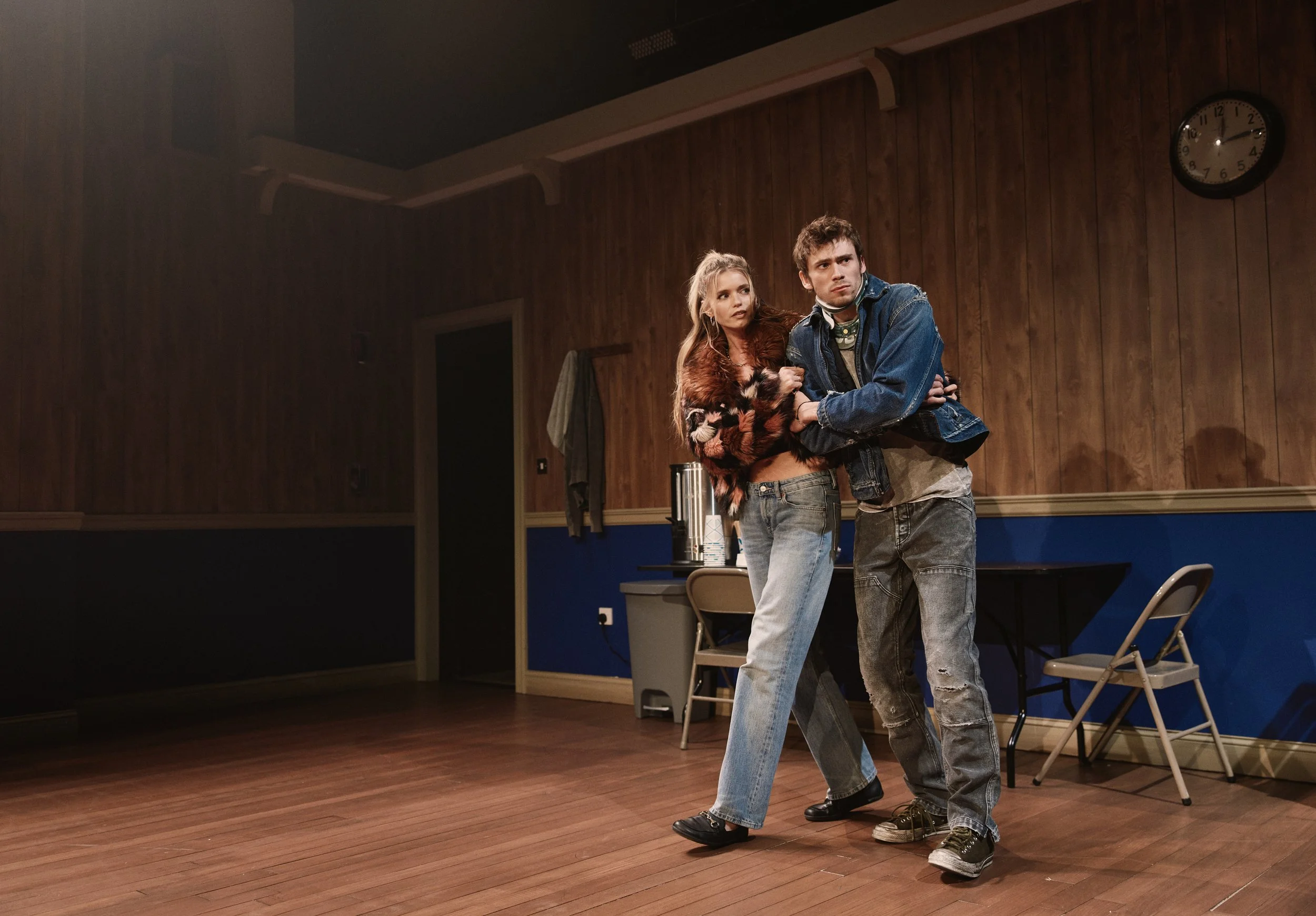
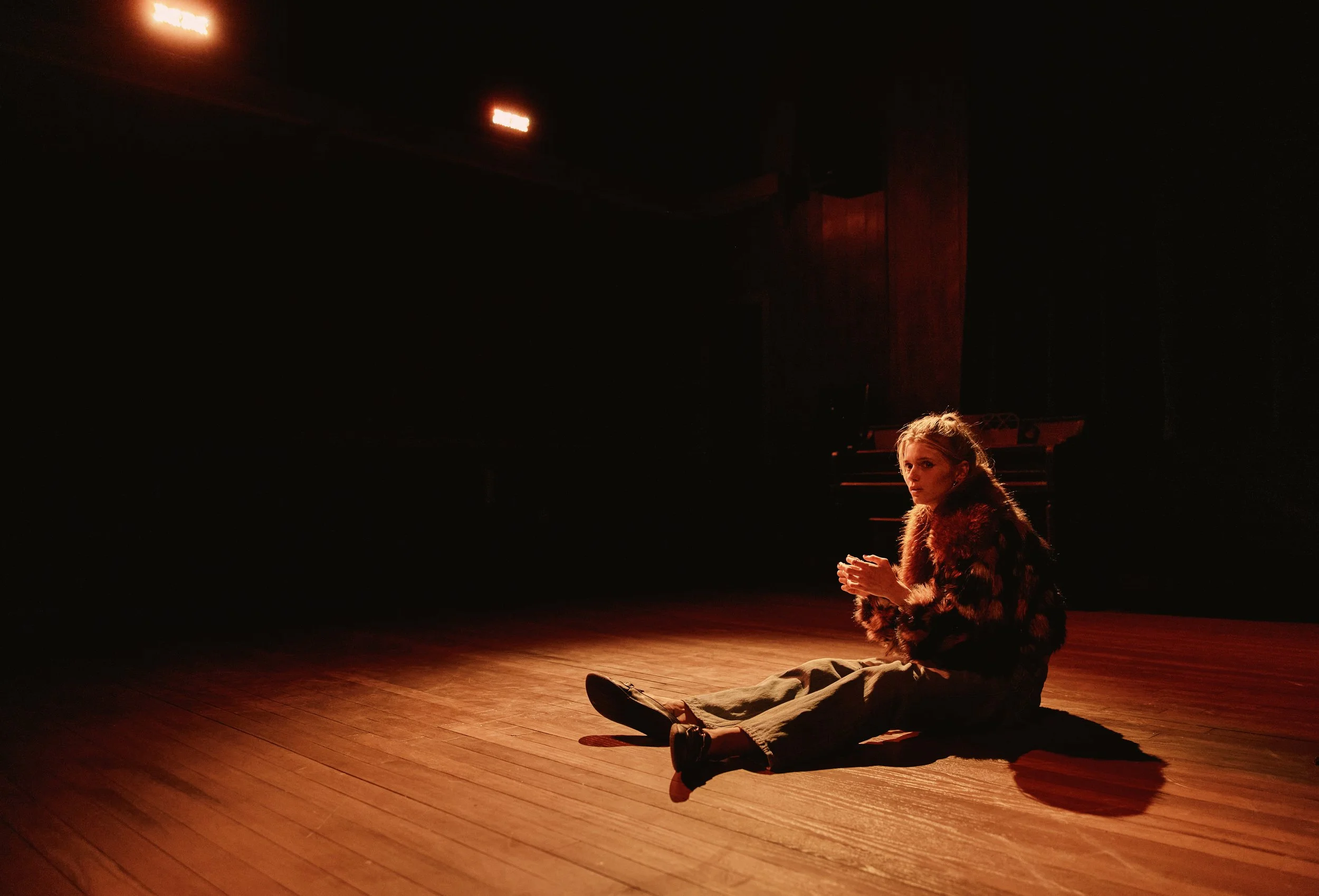
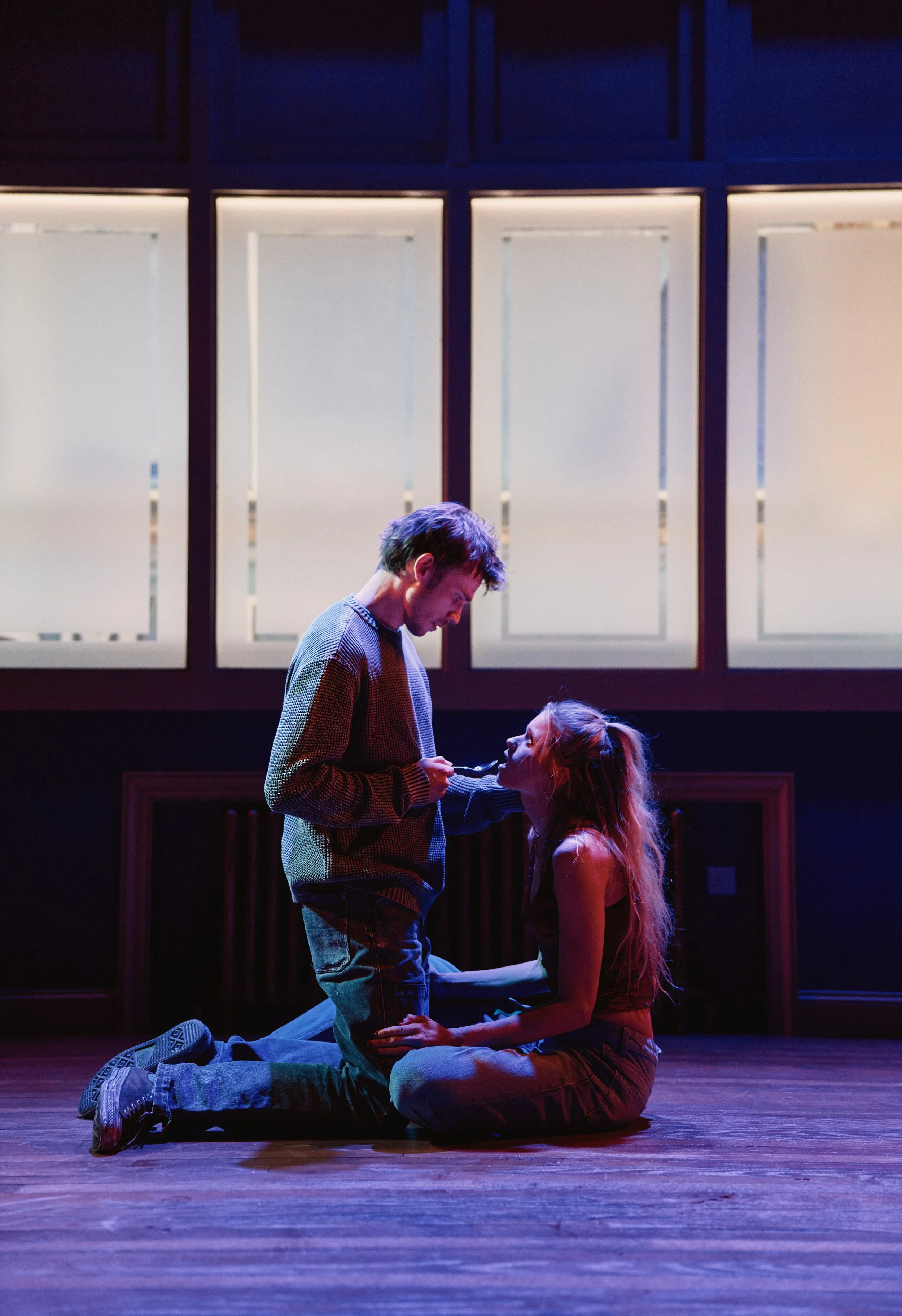
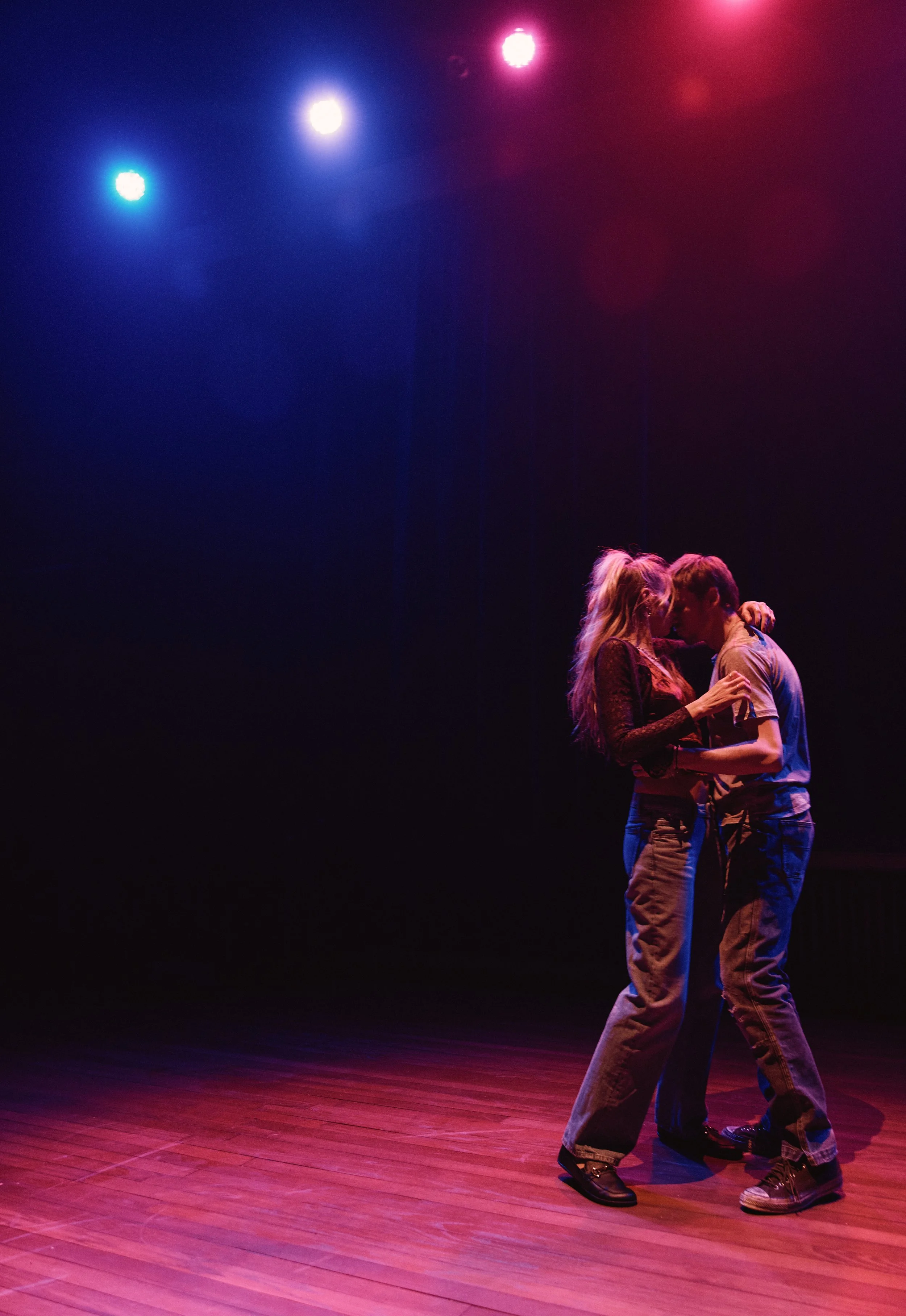
Photo Credit: Emilio Madrid
There is, in Joe White’s grimly lyrical Blackout Songs, less music than the title teasingly promises, but an abundance of amnesia—the emotional, temporal, and moral kind. His 2022 British drama, here receiving its American premiere, traces the romance of two blackout drunks whose primary love affair may be with oblivion itself. Their bond, by turns tender and punishing, is braided from dependency, desire, and the unreliable filament of memory. The one-act unfolds in shards—appropriately, in blackouts—circling the treacherous border where love blurs into need, and where the most fragile currency in a relationship is not trust or fidelity but recollection.
White withholds the characters’ names until late in the evening, introducing them simply as Him and Her. The device is more than coy minimalism; it enacts the estrangement at the heart of addiction, the way a person in its grip becomes both unknowable to others and alien to themselves. Notably, we never see either character drink. The play lives instead in the anticipatory tremor before the sip and in the wreckage after it—bloody noses, sexual entanglements, emotional debris. Cause is elided; effect is unavoidable.
White’s boldest structural gambit is to make the play move as an alcoholic consciousness might: time dilates or contracts without warning; a silence might signify an hour or a year. Dialogue is similarly unmoored from certainty. Do these two speak sincerely, manipulatively, or in the narcotic haze of self-deception? Lines migrate between them, as if authorship itself were slurred—an elegant metaphor for the way couples in crisis lose track of who wounded whom, and when. If the classic memory play relies on recall to generate momentum, this is its negative image: a drama of erasure, slipping sideways rather than advancing, smudging reality until it resembles a thumbed photograph.
For her, amnesia is not a malfunction but a perverse luxury—the mind’s own eraser, capable of scrubbing away shame, regret, and the sediment of old pain. She speaks of memory as something cluttered and burdensome, fantasizing about the relief of a total wipe, as if the past were a hard drive better cleared than curated. Her counterpart, by contrast, treats memory as a dwindling inheritance. He grieves each vanished detail, haunted by the prospect of one day surveying his life and finding the shelves bare. The drama locates a poignant fault line between these impulses: the seduction of forgetting and the terror of being forgotten by one’s own mind. In tracing that divide, the play anatomizes memory as both refuge and torment, a repository of meaning that can just as easily become a weight. The tension is handled with a delicate precision, revealing how remembrance and oblivion are not simple opposites but rival strategies for survival.
Their first encounter pointedly refuses the grammar of the romantic comedy. They meet at an A.A. gathering, loitering by the coffee urn like refugees from their own lives. She is taut with nerves; he trembles, stammers, and sports a neck brace whose origin he cannot remember. Yet attraction flickers. Soon even this meeting feels suspect in the chronology—perhaps they have loved, fought, and relapsed together long before this moment. In White’s universe, sequence is a luxury sobriety affords. Liquor insinuates itself into their intimacy with the stealth of a third partner. “Medicine” becomes their euphemism for alcohol, a private language that signals both complicity and denial. White’s ear for the seductions of drink is chillingly precise.
Blackout Songs resists the modern temptation to launder its characters’ sins through the language of victimhood. White grants them context but not absolution. When Her plaintively asks, “Did you drop me, somewhere along the line?” thequestion hovers with the ache of abandonment, yet the drama has already supplied its quiet rebuttal. He did not drop her; he kept choosing her, again and again, in defiance of reason, recovery, and self-preservation. The cruelty—and the clarity—of the play lies in rendering that choice in high relief. Devotion here is not romanticized as loyalty but exposed as a form of mutual endangerment. By refusing to let either figure off the hook, White turns what might have been a cautionary tale into something more unsettling: a study in how love, when stripped of boundaries, can become an accomplice to ruin. The audience is left not with the comfort of blame neatly assigned, but with the sting of consequences painstakingly, almost mercilessly, observed.
The production moves at a brisk clip, as if aware that repetition is both the subject and the hazard of the piece: the falling off the wagon, the scrambling back on, the inevitable spill. Director Rory McGregor keeps the scenes snapping into place, urging us forward before frustration can curdle into detachment. As Her, Abbey Lee—making a striking American stage debut—locates the shards of humor and fellow-feeling inside a woman half-submerged in fog. Owen Teague’s Him oscillates convincingly between lucid charm and the collapse of will, his sobriety a temporary architecture that addiction repeatedly demolishes.
Lee and Teague approach their roles with a disarming openness, baring their characters’ fractures so plainly that the audience, against its better judgment, begins to invest in the possibility of their salvation as a couple. One finds oneself hoping—not for a fairy-tale rescue, but for some small, improbable equilibrium. The romance is shadowed from the outset by a sense of inevitability. They encounter each other at what feels like spiritual and emotional ground zero, and rather than lifting one another clear, they seem to stir up each other’s sediment—the insecurities, the compulsions, the habits best left dormant. Yet the performances insist on a paradox the play wisely honors: toxicity and tenderness are not mutually exclusive. Him and Her may be corrosive in tandem, but the current that runs between them is real, intimate, and fiercely human. Two opposing truths coexist, and the actors make us feel the cost of both.
Though the script leaves little doubt that these two live in a near-constant state of intoxication, the production shrewdly declines the clichés of slurred speech and theatrical lurching. The actors do not advertise drunkenness with wobbling knees or blurred consonants. Instead, they inhabit a more unsettling register: the functional inebriate, the practiced drinker who experiences impairment as normalcy. We are made to perceive them as they perceive themselves—composed, articulate, more or less in control. The effect is quietly disarming. Their sobriety is subjective, a self-image preserved even as the evidence of disarray accumulates around them. In this choice lies a subtle truth about addiction: its most insidious power is not how it distorts behavior, but how convincingly it edits one’s self-portrait.
There comes a moment where he shows her his paintings at an art show. The two now-estranged lovers circle each other in a weary pas de deux of blame, each trying to locate the moment of fracture. Their shared refrain—“You know, we’re just drinking buddies, don’t you?”—lands like a defensive joke that has calcified into doctrine. Yet the line itself becomes unmoored. Though we watched Him utter it moments before, the production’s slippery logic so destabilizes our sense of sequence that we catch ourselves doubting our own recall, wondering whether the words had, in fact, belonged to her. This is, of course, the point: the play recruits the audience into its fog of uncertainty, making witnesses of us all to the erosion of narrative certainty. Still, for all the bracing, vertiginous pleasure of that disorientation, one occasionally yearns for a firmer handhold—a fleeting beam of clarity amid the beautiful blur. The evening intoxicates; a touch more lucidity might have made the aftertaste sharper.
The production’s design, while modest on its surface, reveals a finely calibrated intelligence. Scott Pask’s set, in its unassuming detail, so persuasively evokes a church basement in the opening moments that one settles in expecting a chamber piece rooted entirely in that drab, communal space. That expectation is quietly upended. Though the physical architecture scarcely changes, it proves remarkably elastic, accommodating the play’s shifting locales as if the geography were psychological rather than literal. Stacey Derosier’s lighting begins in the reassuring grammar of realism—fluorescent, practical, almost prosaic—before imperceptibly loosening its grip on the real. As the drama fractures, so does the illumination, shading into a more expressionistic palette that seems to emanate from the characters’ interior weather rather than any visible source. The transition is so gradual that one registers it emotionally before intellectually.
Brian Hickey’s original music and sound design deepen this duality. In the play’s more naturalistic passages, sound grounds us, thickening the atmosphere with the hums and echoes of lived-in spaces. Yet when the narrative slips into abstraction, the aural landscape follows, adding tonal color and a faint sense of dislocation, as though we were hearing the world through the characters’ altered perception. Avery Reed’s costumes, too, are keenly observed without clamoring for attention. They sketch character with economical wit—the kind of wardrobe that feels discovered rather than designed. A faux-fur vest for Her, at once scrappy and aspirational, becomes a small but telling emblem of personality. Altogether, the design team delivers work that does not announce itself loudly but insinuates itself into the storytelling, shaping our experience from the periphery with quiet assurance.
What lingers after Blackout Songs is not simply the spectacle of self-destruction but the uneasy recognition that identity itself may be a story we tell about what we remember. White’s play asks: if memory is the ledger of love, what happens when the pages keep going blank? In his bleak, bracing portrait, romance is not a meet-cute but a mutual vanishing act.
Click HERE for tickets.
Review by Tony Marinelli.
Published by Theatre Beyond Broadway on February 17th, 2026. All rights reserved.
