
Created by the ensemble, in collaboration with playwrights Damen Scranton and Laura Wickens
The Makers’ Space | 281 North 7th Street, Brooklyn, NY 11211
May 9–17, 2026
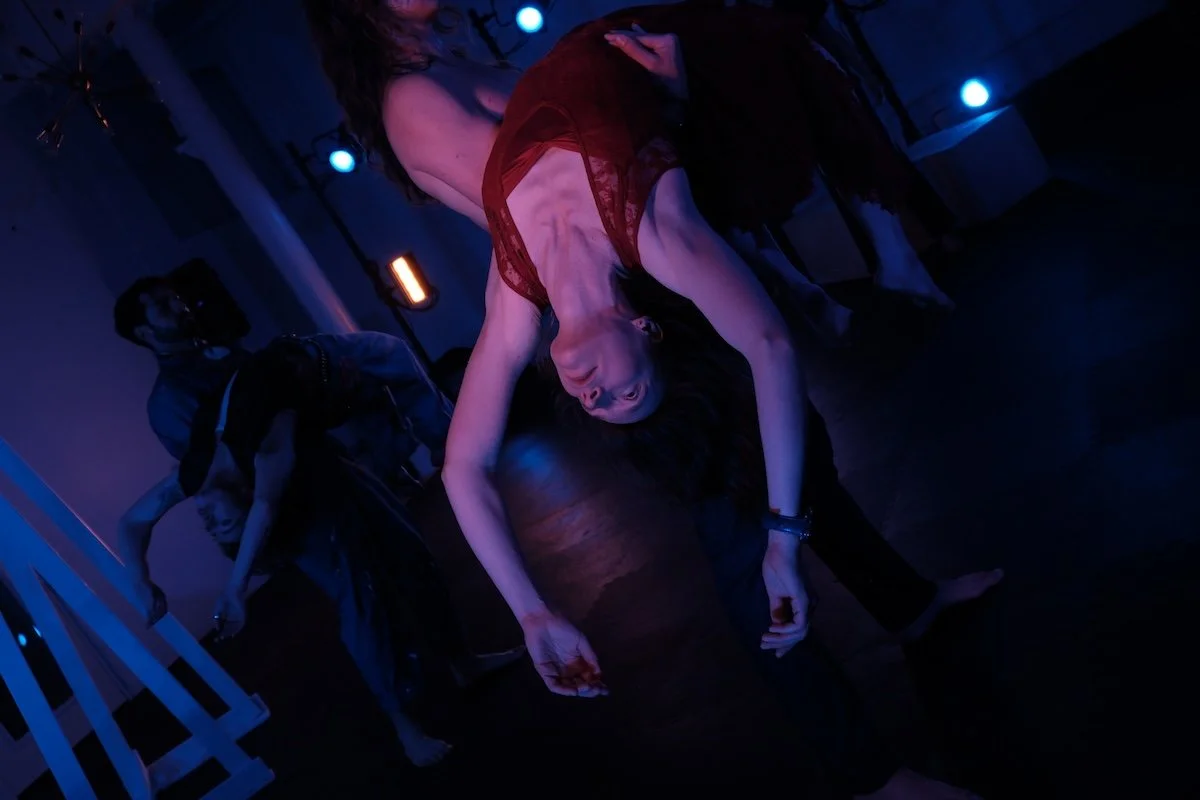
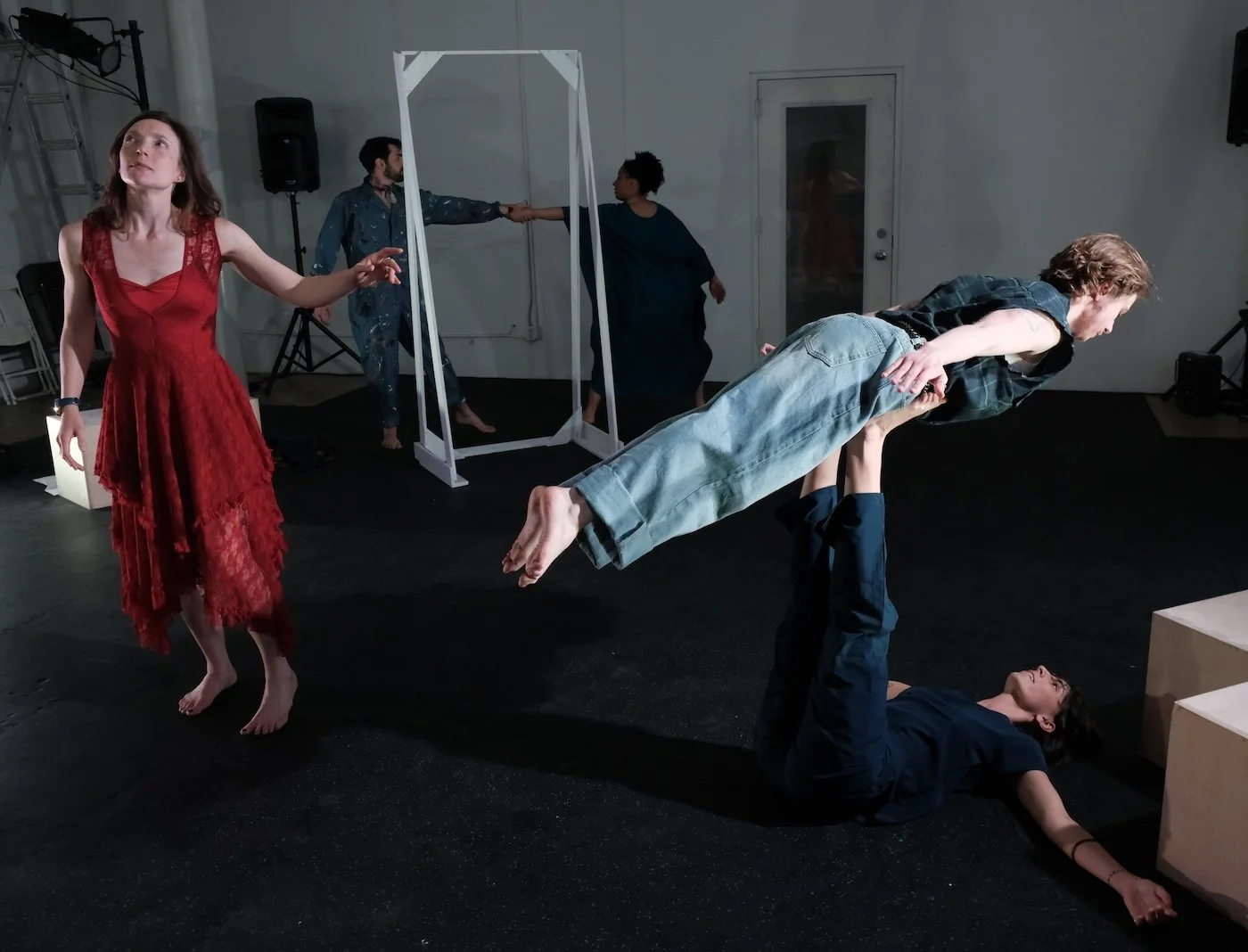
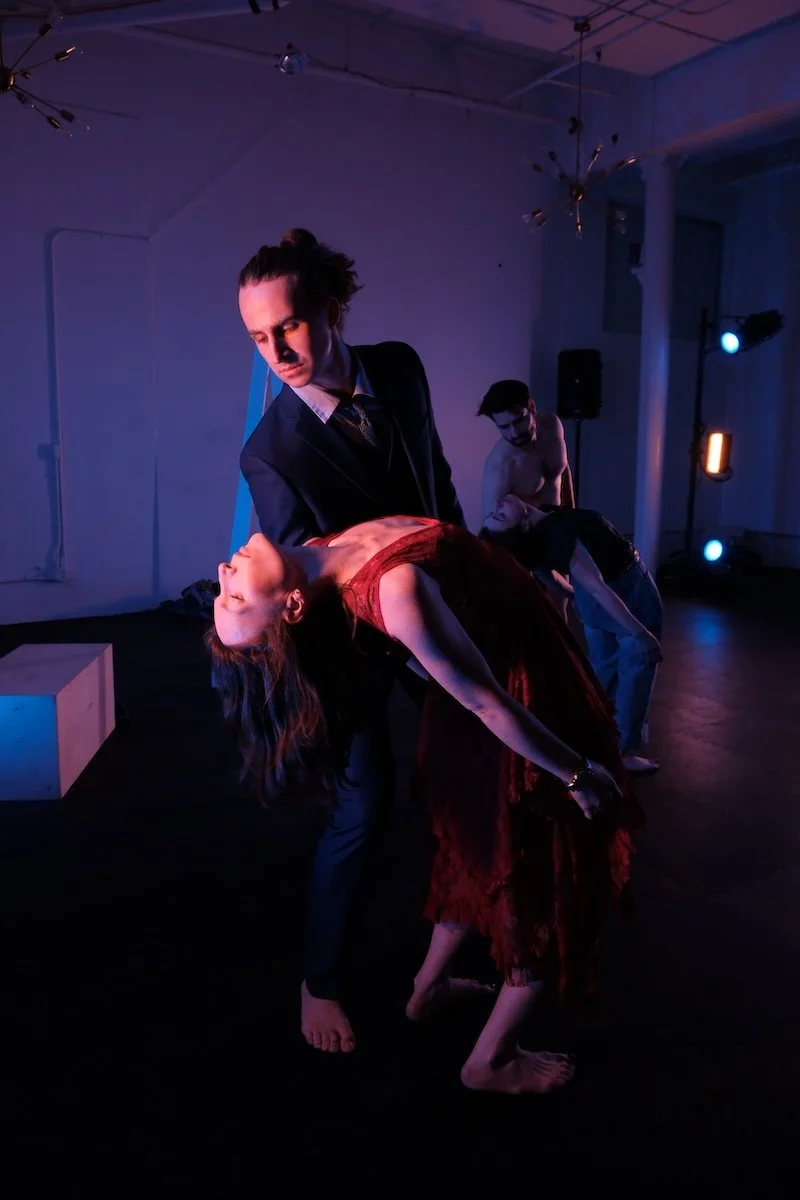
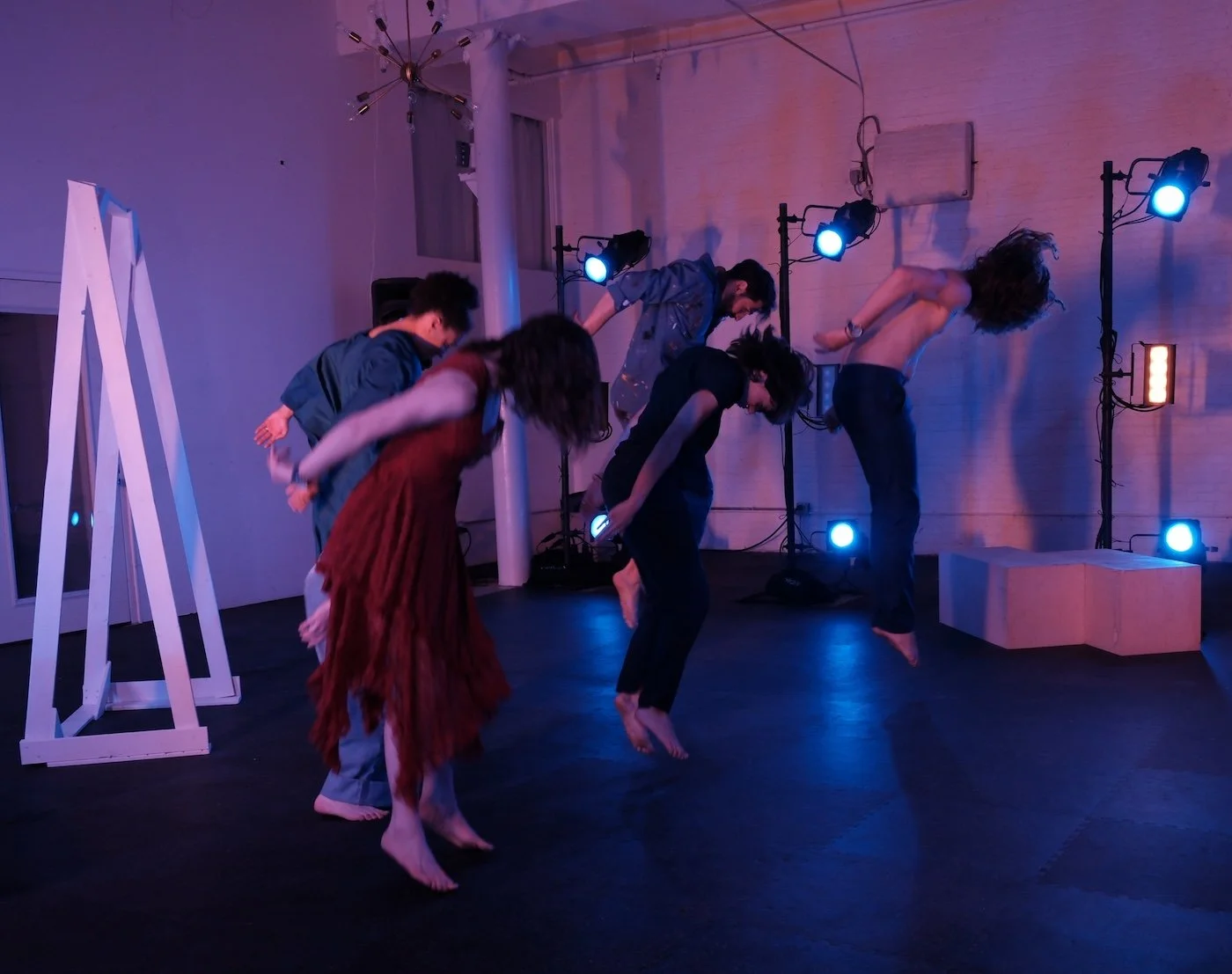
Photo Credit: Media by Emilie
The first thing they take from you is your phone. Not as a courtesy, not buried in the house rules, but as a condition of entry. The show requires your undivided body, as you ask of the six performers about to spend 90 minutes offering theirs. The exchange is declared before a word is spoken.
Before that exchange has a chance to feel abstract, the entire cast is before you: some nude, some not, standing still and looking directly at the audience. They hold it long enough that the self-consciousness in the room peaks and releases, long enough that nudity stops reading as revelation and settles into something simpler. Another costume. Another choice.
Rachael Richman, as Cassie, walks regal, otherworldly in a blazing scarlet-red dress, practically glowing against the purity of the all-white box space. You get there immediately: Red Riding Hood, the wolf, the woods that were never safe. Jack Zipes devoted two books to charting that history: The Trials and Tribulations of Little Red Riding Hood and Fairy Tales and the Art of Subversion. Male writers encoded female desire as the thing that leads the girl into the woods, and the woods as what punishes her for going. The wolf wants what he wants. The girl pays for being there.
Richman’s first speech describes the attack. She delivers it oddly calm. Serene, even. No trembling, no appeal for sympathy. Just the facts of what happened to her body, stated with the composure of someone who has decided the wolf’s story is not the most important thing about her own.
Jessica Burr’s question, which the show asks and re-asks across 90 minutes of physical theater, is: what if we told it differently? What if Little Red Riding Hood’s story were about liberation from restrictive notions of gender and the shame attached to the body, rather than their confirmation? Or what if the wolf’s threat had never defined the terms of what a body is allowed to be?
Henry, played by Can M. Yasar, is a painter. His studio is the container for all four of the show's stories: his subjects are Cal, the surgeon's lover; Len, the grieving brother; and Cassie, the sister herself, before her mysterious death. What Henry is after in each sitting is not the body's surface but the self within it. The unredacted version.
We never see the paintings. In a cheeky nod to Magritte’s “This is Not a Pipe,” the canvas is not the person, only the idea of the person in one frozen moment. Image is not us. It is only the idea of us. Louise Steinmann’s The Knowing Body describes the body as a repository of memory that tells stories through image and repetition rather than plot, and Henry’s empty frame stages exactly that: he can observe, converse, and study his subject through the space where a canvas should be. He cannot capture them. His wife, Helen, played by Hilary Brown-Istrefi, reads palms. Same instinct, different method.
The four stories Henry holds are connected through loss. Jonathon Qualls, as Len, has lost his sister. Jeanette Bednar, as the surgeon, has a different relationship to loss: she has learned to carry every patient she cannot save without letting that weight stop her hands. Bednar plays the paradox with precision, the composure that makes the job possible, and the grief running underneath that makes the composure cost something. Both are most legible in the culminating emergency room scene, where she attempts to treat Helen, who refuses. The refusal lands harder because we have already watched Bednar hold so much.
Her lover Cal, played by trans actor Gagarin, has the production’s most devastating moment. They step to the edge of the stage, inches from the front row, and look directly at the audience. “I can feel your hatred,” Cal says. Sitting in the center of the front row with Gagarin’s eyes on me, I had to ask myself: what do I feel? The line gave me nowhere to hide.
Burr’s choreography works the way songs work in musicals: it arrives when the emotional content exceeds what language can hold. The sequence that returns most insistently places Len holding Helen’s body in a pietà, Helen as sacrifice, lifted and cradled and set down, again and again. The image keeps asking the same question. Why? Why do we make the female body a sacrifice?
The closing choreographic sequence reunites Len with his sister in joy. Positioning him as the huntsman of the original tale, the production uses this reunion to offer what the wolf’s story never could: a glimpse of freedom. What the two of them find together, in movement, is an image of what bodies might be allowed to feel if shame and power were not the organizing principles of the story. The body is a shell, the production insists. Underneath contains multitudes.
What Burr has made is something about bodies that refuse to be redacted at the precise moment the state is actively redacting them: reproductive capacity, gender expression, the right of certain bodies to exist in certain forms in certain spaces. The wolf is an archetype with legislation. The mauled woman’s refusal to name her attacker is not a narrative gap. It is a political position.
Body Unredacted arrives at the reunion of Len and his sister not as a resolution but as a declaration: this is what the story could have been, and still could be. The wolf’s version of events is not the only version. Richman enters in a red dress, and you feel the weight of every story that dress has carried.
For more information, visit: https://www.blessedunrest.org
Review by Ariel Estrada.
Published by Theatre Beyond Broadway on June 4, 2026. All rights reserved.