CRUSHED VELVET
Written by Andrew Trimmer
Directed by Sam Perwin
Presented by the New York City Fringe Festival
wild project, 195 E 3rd St, New York, NY 10009
Sun April 5 at 7pm, Sun April 12 at 2pm, Mon April 13 at 7:40pm & Sat April 18 at 7pm
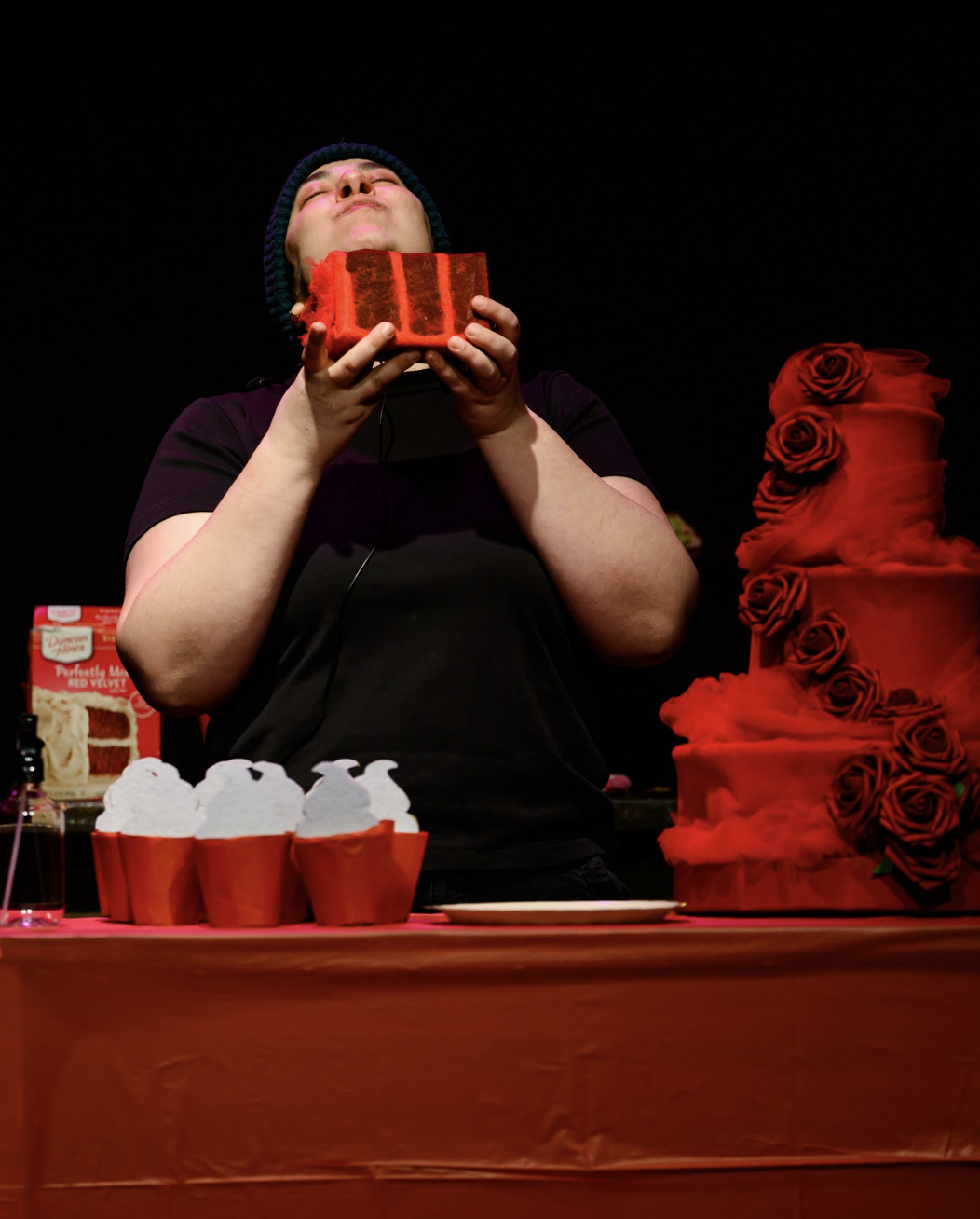
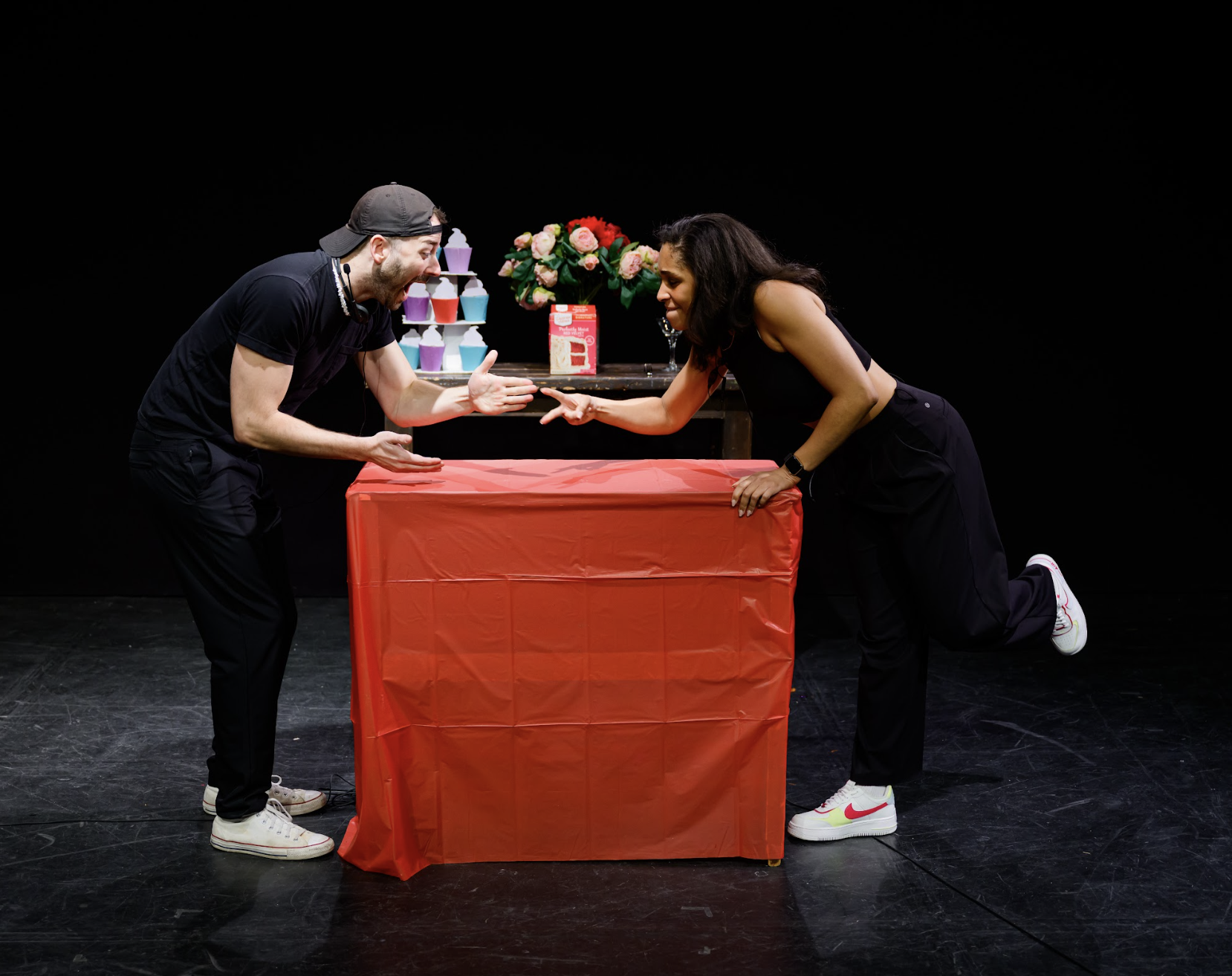
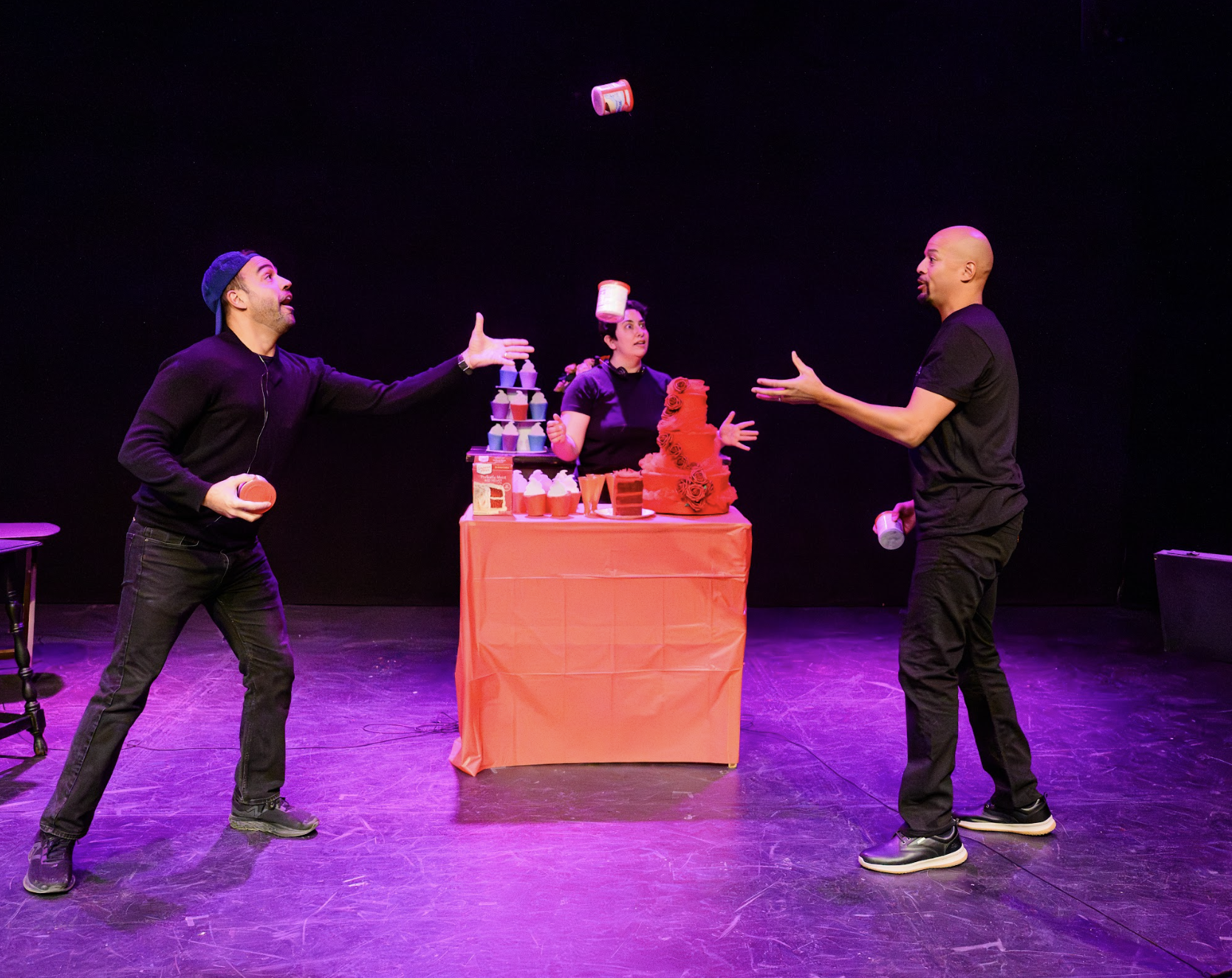
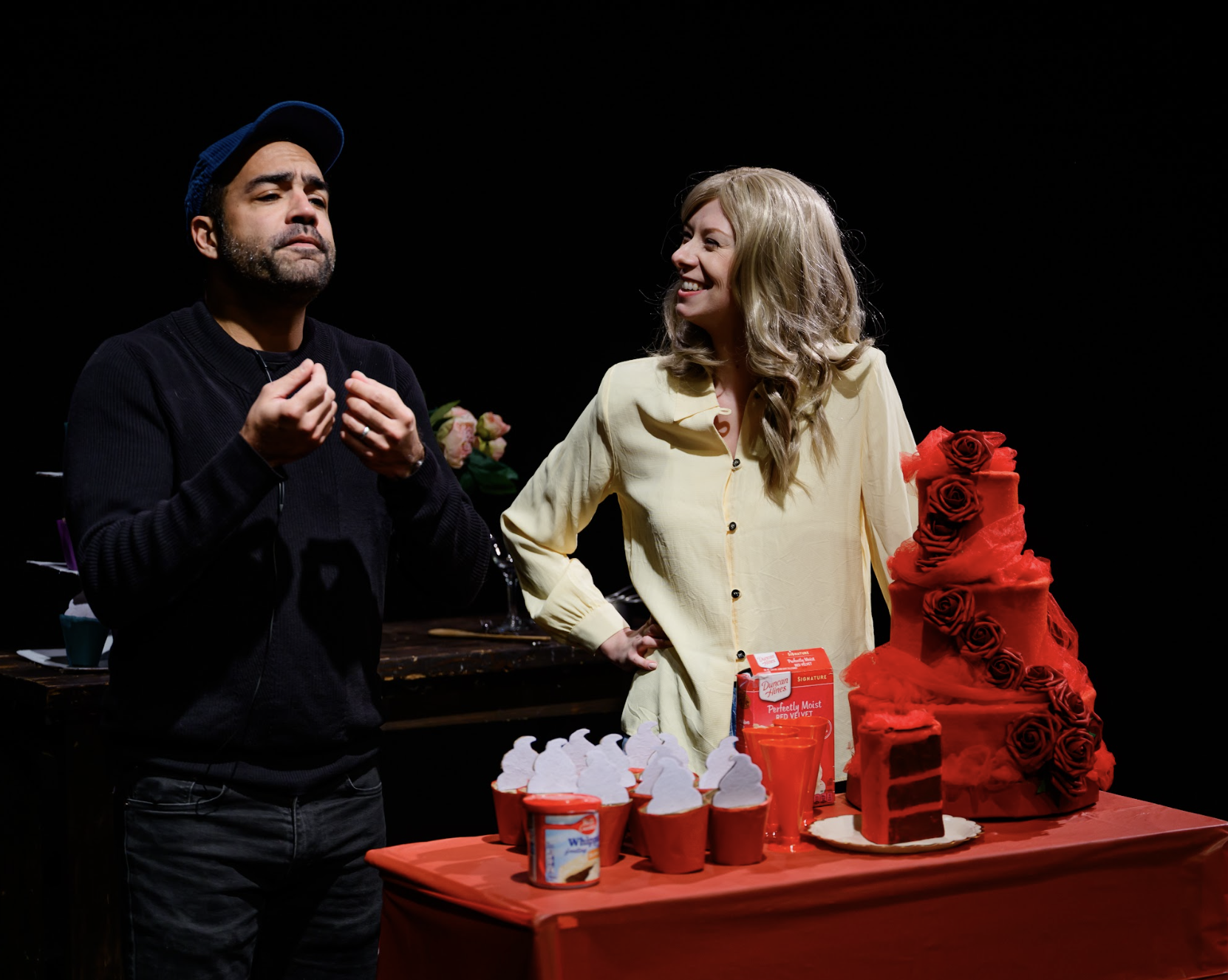
At the wild project, Crushed Velvet invites us to take a bite out of what is a quiet backstage farce unfolding on the meticulously contrived set of Semi-Homemade Cooking with Sandra Lee, where the sheen of domestic perfection proves as fragile—and as performative—as the recipes themselves. Everything in Crushed Velvet arrives with the patina of intention and the faint tremor of instability. The food, gleaming beneath unforgiving studio lights, is immaculate yet curiously untouchable; the kitchen, pristine but curiously unmoored from any sense of lived-in use. Andrew Trimmer’s play, presented as part of the 2026 New York City Fringe Festival, proposes not merely to stage Sandra Lee, that apostle of “semi-homemade” domesticity and former First Lady of New York (when she was former Governor Andrew Cuomo’s domestic partner), but to interrogate the cultural apparatus that produced and devoured her. What results is less a biography than a stylized act of devotion—pathography with a wink, and occasionally, a savage bite.
Trimmer’s formal gambit is both ambitious and, at its best, invigorating. Crushed Velvet refuses the comfort of a single register, instead slipping between behind-the-scenes realism, media lampoon, documentary pastiche, and SNL-like digressions with a restless fluency. The effect is not fragmentation so much as accumulation: a sense that no singular theatrical vocabulary can adequately contain a figure whose life was already so thoroughly mediated. The play asks, with increasing urgency, what it means to represent someone who has already been branded, flattened, and endlessly recirculated. She can never again seem anew.
Its sharpest insights emerge when it locates this inquiry within the machinery of constructing weekly episodes. The action unfolds inside a conspicuously fabricated Food Network studio, where artifice is not merely aesthetic but structural. Here, red velvet—dessert, color, metaphor—becomes a central organizing image: chemically engineered (is it red dye or is it still chocolate?), visually irresistible, and always on the verge of decay. The production suggests, with quiet insistence, that what is made for consumption and what is consumed are ultimately indistinguishable, locked in a mutually reinforcing loop.
Within this loop, Sandra Lee—“Aunt Sandy”—appears as both subject and product. The performance renders her as a carefully calibrated persona, all studied warmth and accessible glamour, while allowing fissures of awareness to flicker beneath the surface. When the familiar refrain, “It’s cocktail time,” arrives, it lands not simply as a catchphrase but as a moment of mutual recognition between performer and audience—a shared acknowledgment of the brand’s peculiar alchemy: intimate yet transactional, authentic in tone if not in substance, and faintly humiliating in its insistence.
Under the direction of Sam Perwin, these tonal pivots are handled with a notable degree of care and precision. Perwin demonstrates a keen instinct for locating the exact moment when laughter has run its course—when the buoyancy of the scene can no longer sustain itself—and allows something harsher, more disquieting to surface. The effect is not jarring so much as clarifying: the comedy does not dissolve, it simply reveals what it has been skirting all along.
Crucially, these interruptions are permitted to unfold in something like real time. The rhythm slackens, the protective cadence of punchlines falls away, and Trimmer’s language is allowed to land with an unguarded directness. There is no anxious rush to the next laugh, no sense of dialogue being held in suspension for the sake of comic payoff. Instead, the text breathes—heard fully, and perhaps more unsettlingly, without the cushioning effect of humor.
The production finds a surprising coherence in its tonal elasticity. Musical interludes, often slyly chosen, sharpen the comedic edge without tipping into parody, while moments of queer-inflected humor land with a crisp, unforced clarity. At this critic’s performance one of the onstage box cameras (completely made out of cardboard on a tripod) collapsed onto itself, requiring some serious design intervention. The actress playing the P.A. actually had to come out as a P.A. to retrieve it and take it backstage to reassemble. Particularly striking are the sequences in which online reviews are spoken aloud, collapsing the distance between anonymous commentary and embodied experience. In these moments, the internet’s ambient cruelty becomes immediate, almost tactile, transforming disembodied critique into something uncomfortably present.
The performances serve as steady anchors amid the play’s formal volatility. As Sandra Lee, Kate Delacruz navigates the role’s delicate balance with precision, reproducing the recognizable cadences and gestures of the public figure while allowing flashes of self-awareness to complicate the surface. Discovering her show is being swept into a less desirable timeslot, the hurt can’t be masked. Delacruz paints her devastation in broad strokes. The costuming, particularly in the construction of “Aunt Sandy,” underscores the production’s fascination with image as both artifice and armor.
Christopher F. Costa, as Cam, is granted one of the evening’s most quietly arresting passages—a moment that briefly stills the production’s otherwise kinetic churn. Alone with his idol, he approaches Sandra with a reverence that borders on the devotional, his admiration spilling out in a rush that is at once guileless and faintly desperate. There is, in his bearing, the acute awareness that this encounter is singular, perhaps unrepeatable, a fleeting proximity to the figure who has loomed so large in his imagination. Opposite him, Sandra receives this outpouring with a composure that proves increasingly difficult to sustain. The praise lands not as mere flattery but as a kind of emotional reckoning, and one senses, almost palpably, the effort required to contain it. She gathers herself with visible strain, fighting to maintain the practiced equilibrium of the persona even as it threatens to give way. In this exchange, the play locates a point of genuine pathos: a convergence of longing and disillusionment, played out at the precise moment when a carefully constructed career appears to be slipping, irretrievably, from its moorings.
Trimmer, doubling as Boomer, offers a portrayal that is both buoyant and quietly exposed, capturing the character’s oscillation between confidence and precarity. Keeping in mind the cultural moment in which the play situates itself, Boomer’s relationship with the deeply closeted Mike—played with an almost studied emotional remove by Maceo Oliver—acquires a peculiar, dissonant resonance when viewed from the vantage point of 2026. What might once have registered as a recognizable, even inevitable configuration of queer intimacy now feels curiously anachronistic, its restraint less a given than a condition to be interrogated. And yet, the production leans into that distance with a kind of quiet rigor. The connection between them is marked not by overt conflict but by what remains unsaid, a muted, suspended longing that never quite finds expression. The poignancy is there, but it lies dormant, embedded in pauses and evasions rather than declarations. In this sense, the relationship becomes less a relic than a refracted artifact—its emotional opacity inviting the audience to consider not only what was possible in that earlier era, but what had to be deferred, concealed, or quietly endured.
Laura King Otazo’s Dee provides a solid counterweight in the room, her measured direct address cutting cleanly through the surrounding theatrical noise. Her offer to Boomer of a promotion and raise to get him away from Mike is icy and heartbreaking all at once. Amy Jean Greenblott, as Pat—and, with sly virtuosity, every permutation of Pat the production can conjure—proves herself a true comedienne in the most classical sense. Her timing is not merely precise; it is architectural, shaping the rhythm of entire scenes with a flicker of pause or a perfectly calibrated interruption. She seems to understand, instinctively, that comedy lives in the space between expectation and delivery, and she stretches that space just enough to let the laugh bloom fully before snapping the moment shut.
Jasmine Michelle Smith’s Greta occupies a lonelier, more watchful register within the production, a presence that seems to stand slightly apart even when fully embedded in the action. It is precisely this remove that allows her to illuminate what the play only intermittently names: the persistent, often unspoken undercurrent of racism that circulates beneath the set’s bright, performative geniality. Where others lean into the rhythms of comedy or the demands of persona, Smith holds her ground in something quieter and more cutting, her stillness registering as both resistance and witness. Her eruption—sparked by the specter of Paula Deen—lands with a force that feels at once specific and uncontained. The moment is not staged as an anomaly but as an inevitability, the logical breaking point of pressures long deferred. What gives it its charge is the recognition that it does not belong solely to this fabricated television kitchen; it could just as easily unfold in any workplace where the language of inclusivity masks deeper, unresolved inequities. In that sense, Greta’s confrontation expands the play’s frame, implicating not just the world it depicts but the one watching it.
What lingers, finally, is the play’s commitment to multiplicity. Crushed Velvet understands that its subject resists linear telling; it must be refracted, replayed, and reassembled through competing frames. In doing so, it gestures toward a broader system—one that elevates, commodifies, and, when convenient, discards the very figures it once celebrated. The production is especially attuned to how certain identities and labors are rendered legible only through stylization, then endlessly circulated until they lose their original shape.
Like the confection it invokes, Crushed Velvet begins as something pristine, almost too carefully arranged to disturb. Yet, over the course of the evening, it is handled, smudged, and gradually undone. What remains is not a neat portrait but a suggestive, unsettled composite: a work that reaches toward synthesis even as it continues to test—and occasionally strain against—the forms that might contain it.
The play proves almost classical in its deployment of humor as a kind of cosmetic glaze, a bright, disarming surface laid carefully over the more unsightly mechanics beneath. The laughter it provokes is genuine, even generous, but it is also strategic—diverting attention just long enough for the production to smuggle in a far harsher critique of an industry that thrives on the manufacture of celebrity. Ratings rise, personalities are polished into palatable brands, and then, with a swiftness that feels both inevitable and merciless, those same figures are discarded the moment another can deliver a more lucrative share of attention.
What lingers is not simply the joke, but the aftertaste: a recognition that the system’s appetite is insatiable, and that its charm offensive—so brightly packaged, so warmly delivered—is inseparable from its capacity for erasure.\
Review by Tony Marinelli.
Published by Theatre Beyond Broadway on April 19, 2026. All rights reserved.
