Falls for Jodie
Written by Eric Micha Holmes; Directed by Terrence I Mosley
The Tank | 312 W 36th St., New York, NY 10018
September 24-October 18, 2026
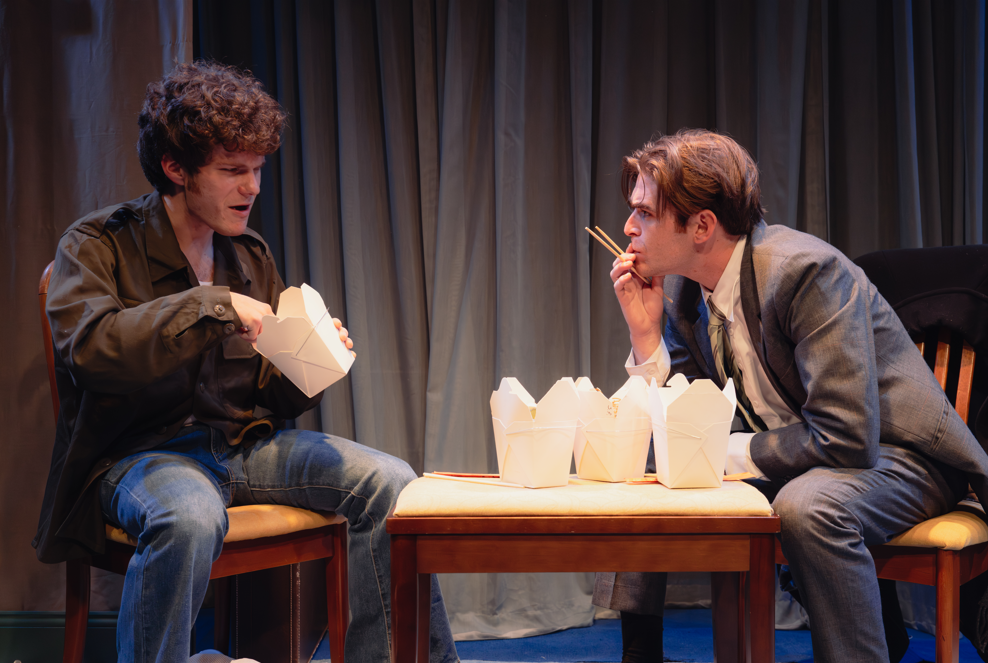
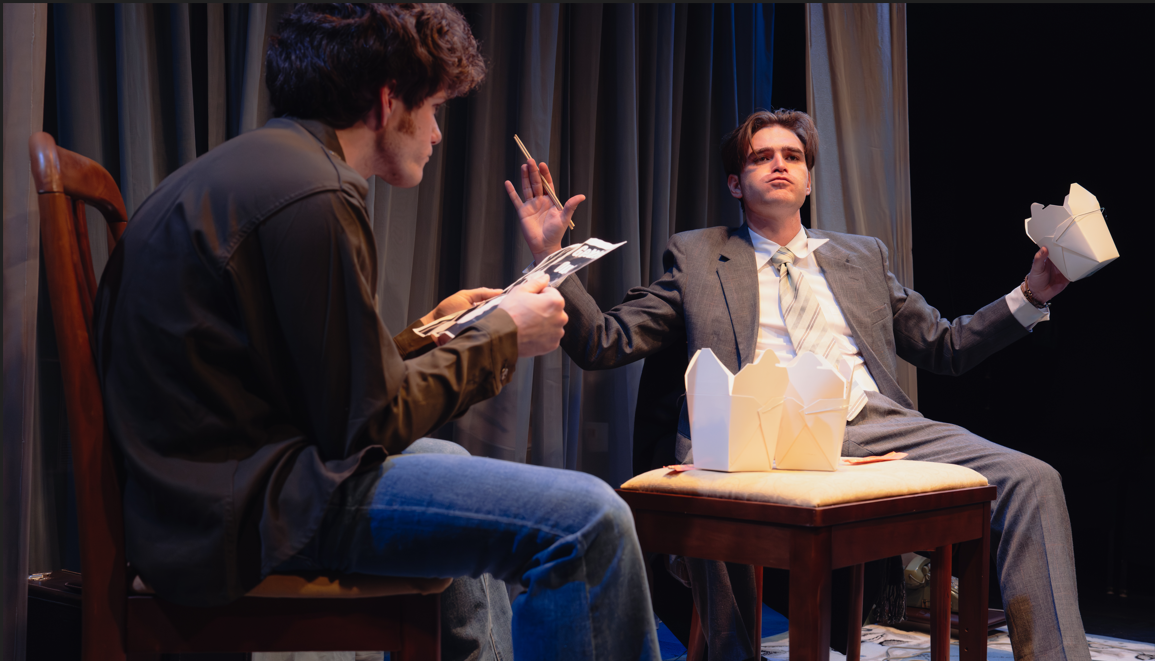
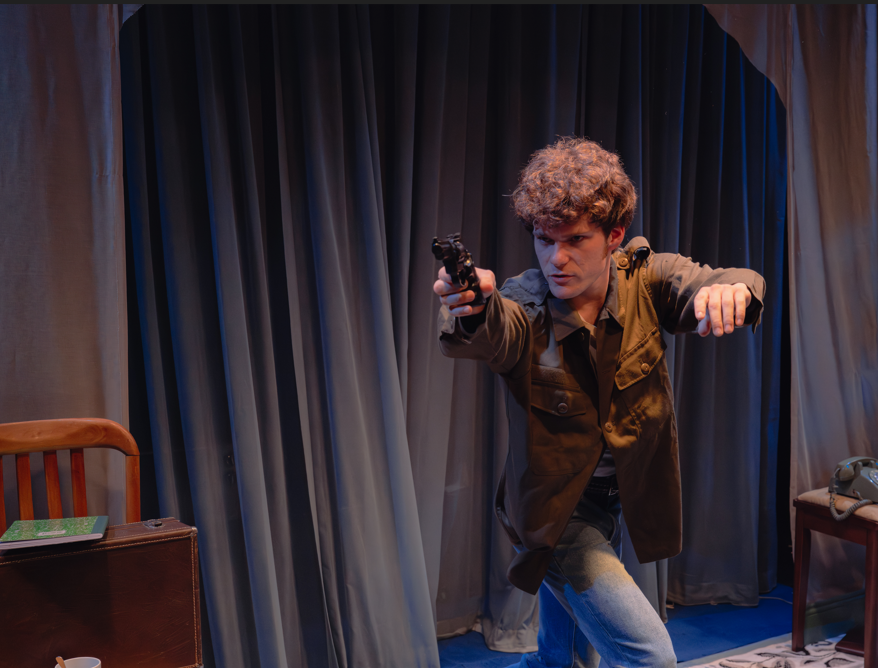
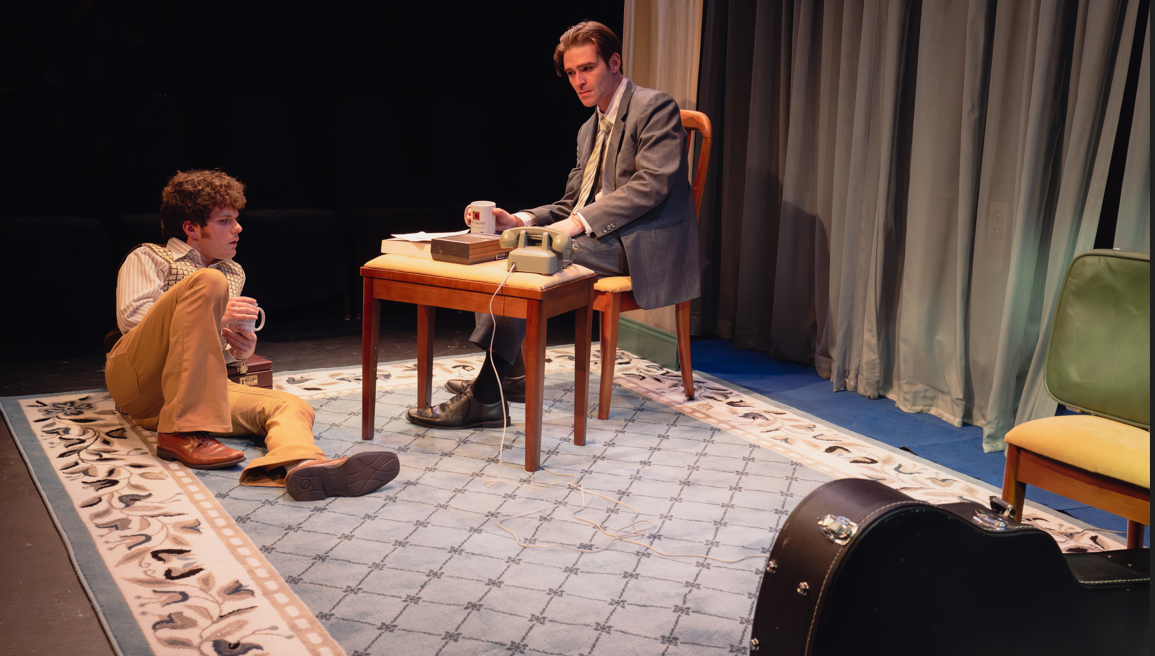
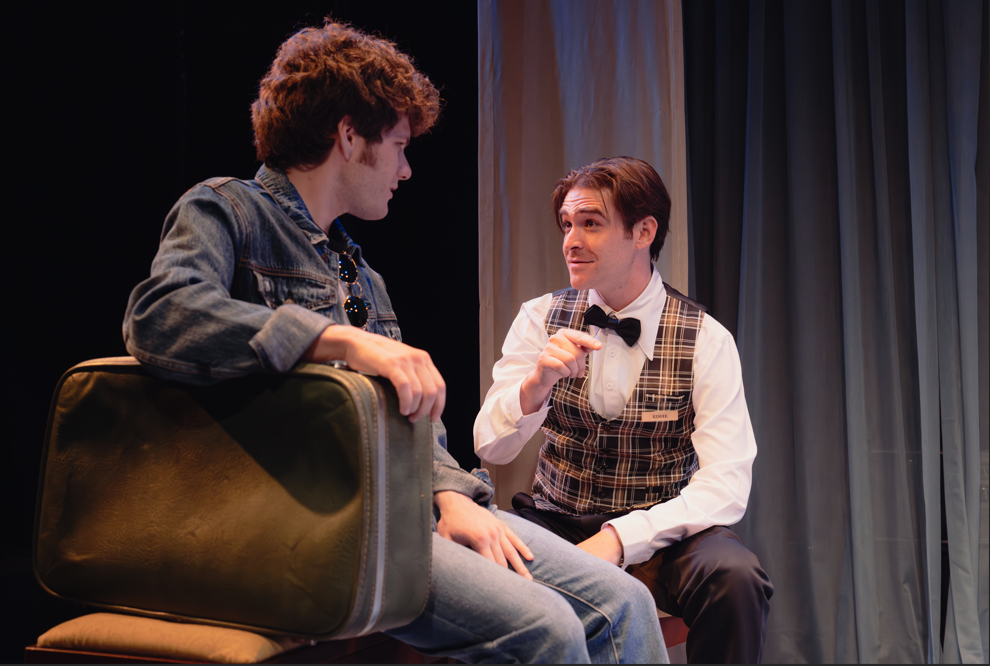
Photo Credit: Cason Doyle
At first glance, Eric Micha Holmes’ Falls for Jodie feels like a darkly comic story about two lonely men in 1980 New Haven, Connecticut, and the unlikely friendship that develops between them. John Hinckley Jr. arrives at the Colony Inn convinced that he is going to make Jodie Foster his girlfriend. Eddie, the hotel's night concierge, sees John as a potential business opportunity. What begins as a low-level scheme involving mail-order catalogs and student directories gradually becomes something much darker as John's obsession with Foster escalates.
The production, directed by Terrence I. Mosley, plays effectively with the distance between the absurdity of the situation and what the audience knows is coming. With a full house and only two actors, Boone Sommers as John Hinckley Jr. and Harry Thornton as Eddie carry the weight of the production beautifully. Both actors fully embody their characters, allowing the audience to watch two very different men discover each other in close proximity, while simultaneously revealing more of themselves with every exchange. Their physical closeness to one another and to the audience creates an intimacy that makes the gradual shift from comedy to discomfort particularly effective.
The set is sparse: a frame, a curtain, a hotel room, two chairs and a bench. Under Mosley's direction, the full space becomes part of the storytelling. Entrances and exits throughout the intimate playing area keep the audience aware of the physical relationship between the two men, while the limited space gives their encounters an increasingly claustrophobic quality. There is nowhere for the tension to hide.
The period details are particularly useful in establishing how different the world was. There are rotary phones, printed student directories and the physical effort required to locate someone who did not want to be found. Jodie Foster was a Yale student after her performance in Taxi Driver, living an ordinary college life while completely unaware of the extent to which John Hinckley had constructed an obsession around her.
That disconnect stayed with me.
The play can be understood as a story about three people: John, Jodie and Eddie. But because Jodie never appears, it can also be understood as a story about one man whose fantasy gradually consumes reality. Foster becomes an idea rather than a person, a projection onto which John places his desires, ambitions and increasingly disturbing worldview.
Eddie initially sees John as an opportunity. He recognizes a potential investor in his mail-order business and begins helping him navigate the practical problem of finding Jodie. But as John reveals more about himself, Eddie begins to understand that this is not simply an eccentric man's romantic pursuit. John's storytelling becomes increasingly troubling. His anger, racism, resentment toward the government and escalating obsession begin to expose something far more dangerous.
There is an important turning point when Eddie realizes that perhaps he should stop helping John find Jodie. He becomes concerned by what he is hearing and seeing. The comedy begins to curdle. What initially looked like an odd business transaction between two strangers becomes a portrait of a man spiraling into obsession and violence.
What kept returning to me throughout the evening, however, was Jodie herself.
She was studying. She was performing. She was living her life. She was, as any college student might be, presumably worrying about classes, friendships, work and whatever else occupied her world. And somewhere nearby, entirely outside her awareness, another person had constructed an elaborate fantasy in which she was the object of his romantic pursuit.
That is one of the most unsettling realities beneath the play's dark comedy: a woman can be living an entirely ordinary life while someone else is constructing an extraordinary fantasy around her.
Jodie Foster had no idea what was happening around her. She did not consent to the role John assigned her in his imagination. Yet her identity becomes the organizing principle of his increasingly distorted reality.
The historical distance of 1980 also makes the story especially fascinating. There was no social media, no Google, no instant messaging and no ability to casually search someone's digital footprint from a phone. The student directory was essentially a physical version of what we might now think of as Facebook. The technology was primitive by today's standards, but the underlying human behavior was not.
Falls for Jodie ultimately asks how an apparently private obsession can become something much larger and more dangerous. Its most compelling territory is not simply John Hinckley's eventual attempt to assassinate President Ronald Reagan, but the gradual progression toward that moment: the fantasy, the entitlement, the rationalization, the escalation and the failure to recognize the danger soon enough.
The play leaves us with an uncomfortable question about where the line exists between fantasy and action, and what happens when a person becomes more committed to the imagined version of another human being than to the reality of that person's existence.
And perhaps that is where the title becomes most disturbing. John didn't simply "fall for" Jodie. He fell for an idea of her that existed almost entirely inside his own mind.
Click HERE for tickets.
Review by Malini Singh McDonald.
Published by Theatre Beyond Broadway on September 30, 2026. All rights reserved.