
Fanny: A Fantasy in G
Written by Tim McGillicuddy. Directed by George Abud.
Presented by Off-Brand Opera
Gural Theatre at A.R.T./New York, 502 W. 53rd Street.
March 26, 2026 - April 12, 2026; extended at the Liederkranz Club, 6 E. 87th Street, April 14 to 19
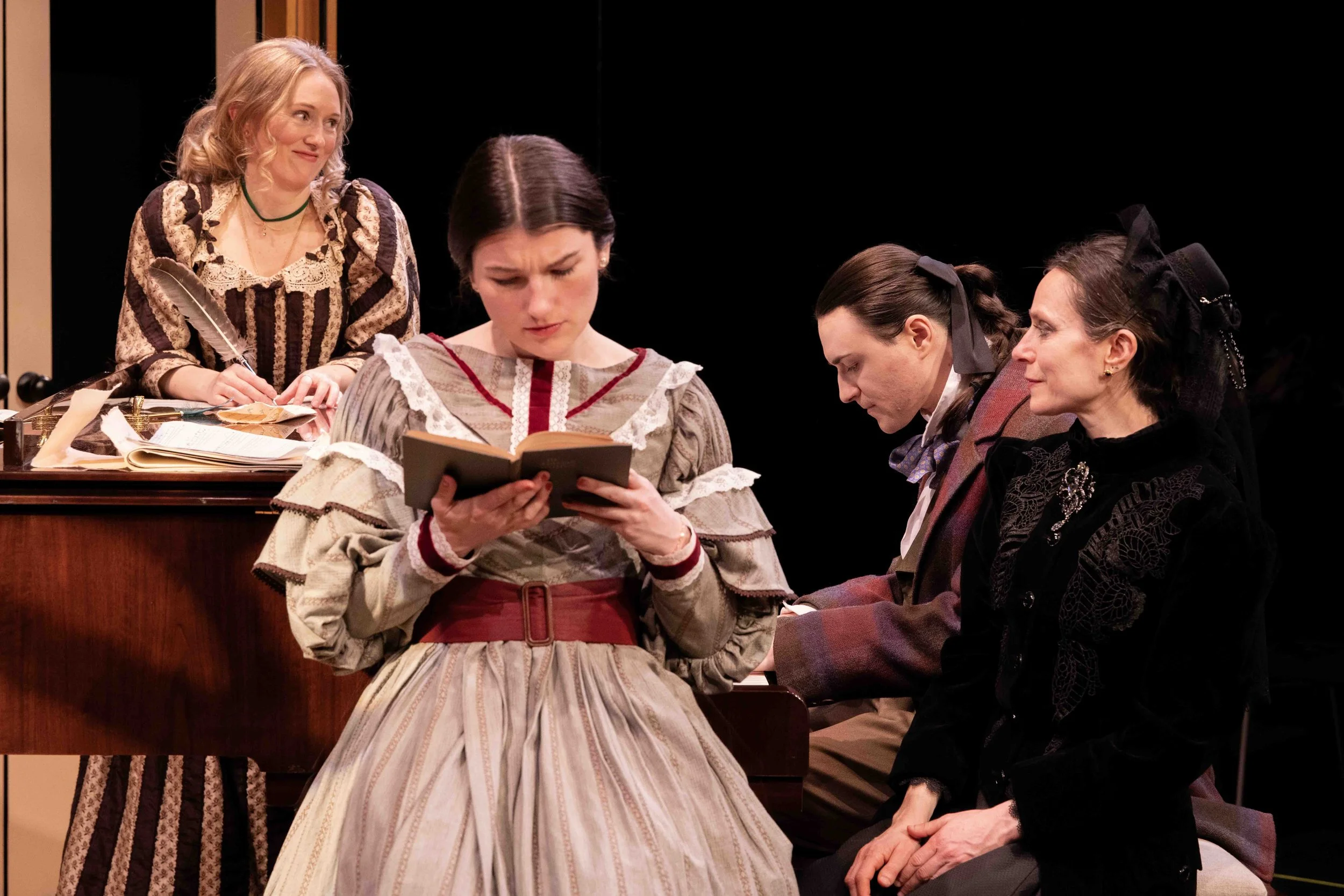

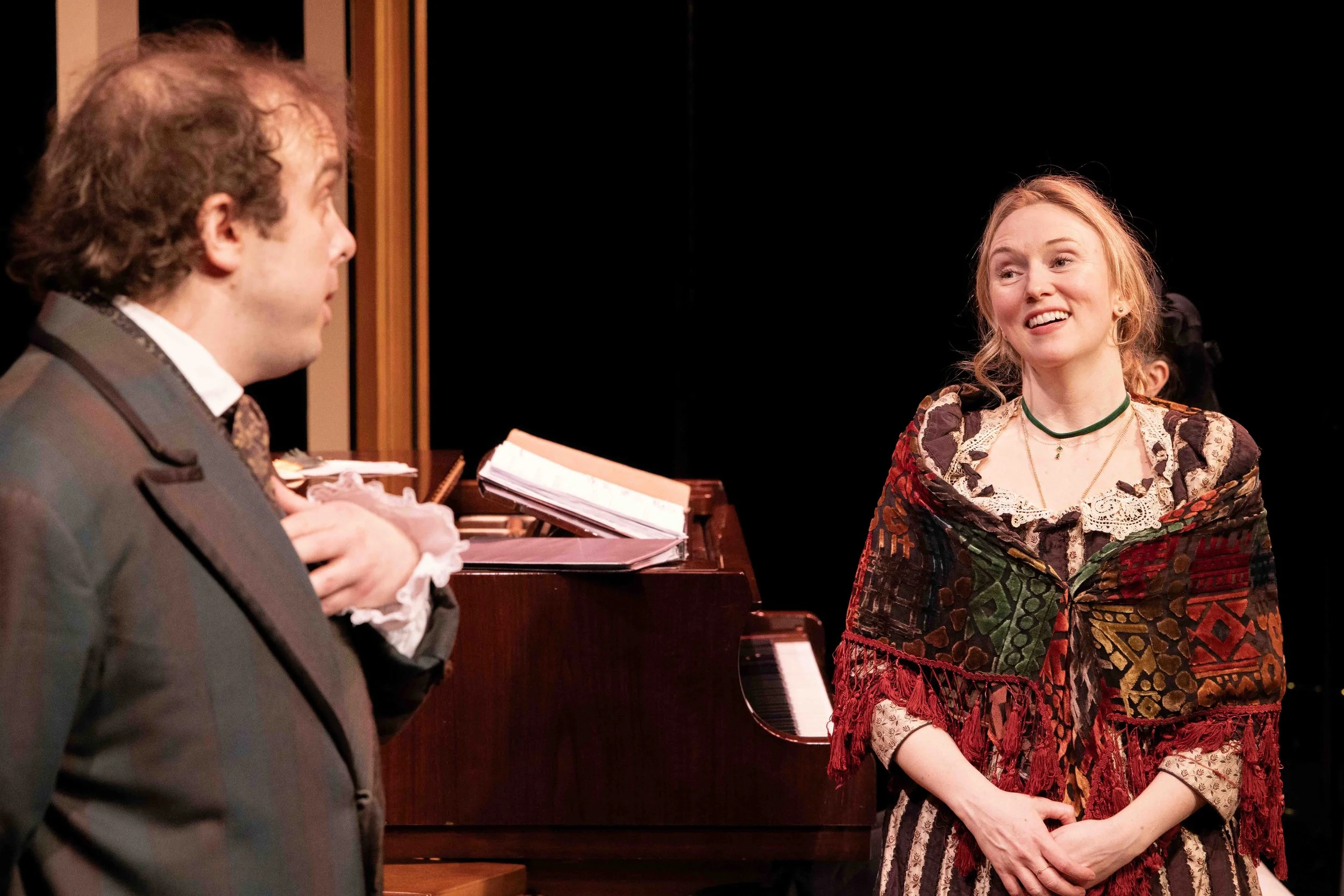
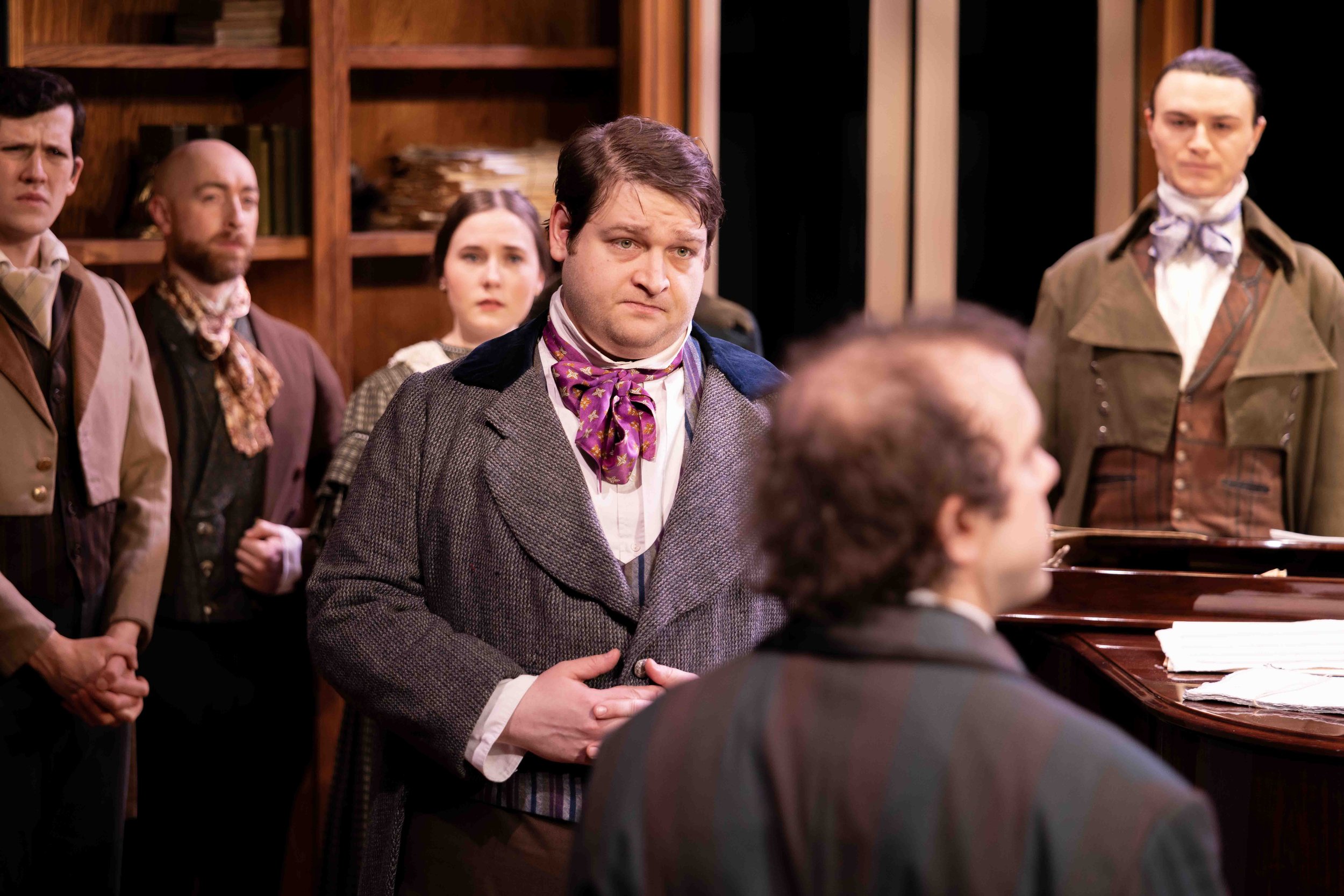
Photo credit by Chase Randall
Fanny Mendelssohn composed approximately 460 pieces of music. Piano works, art songs, a string quartet, cantatas, an orchestral overture. She could play all 24 Bach preludes from memory by the age of fourteen. Her father told her that year that music “can and must be only an ornament” for her, while her brother Felix would make it his profession. She published her first collection under her own name in 1846, at forty-one, after decades of composing in private and performing only at her own Sunday salons in Berlin. She died of a stroke the following year, at the piano, rehearsing one of Felix’s cantatas. For more than a century afterward, nobody wanted her manuscripts. The family kept them for sentimental reasons. Several of her compositions circulated under Felix’s name, including a song that Queen Victoria once requested at Buckingham Palace, only for Felix to confess it was his sister’s. In 2010, musicologist Angela Mace authenticated the Easter Sonata, a work found in a Paris bookstore in 1970 and attributed to Felix for forty years, as Fanny’s, by matching her handwriting to pages missing from a bound volume of her music.
That is one of the great corrective stories in Western classical music, and it contains enough dramatic material for a dozen plays. Tim McGillicuddy’s Fanny: A Fantasy in G, receiving its world premiere from Off-Brand Opera at A.R.T./New York’s Gural Theatre, follows Fanny from 1828 to her death in 1847, staging nearly two decades of that life as a language play full of palace intrigue, familial obligation, and the antisemitism of pre-unification Germany. Off-Brand Opera describes itself as a company dedicated to expanding and blurring “the boundaries of genre and performance practice,” producing cross-disciplinary work in close, non-traditional venues. A conventional history play, written in a high literary register and staged with traditional blocking, is a curious fit for that mission: the production’s most genre-blurring element is the live piano, and even that functions more as underscoring than as a dramaturgical partner in the storytelling.
The ambition, at least in subject matter, is real. The Mendelssohn family’s conversion from Judaism to Lutheranism, the weight of Moses Mendelssohn’s philosophical legacy, the particular cruelty of a society that accepted Jewish wealth while despising Jewish identity: these are combustible materials. The play’s most interesting conflict sits right there, in how antisemitism works when it cannot simply exclude, when the targets are too wealthy, too connected, too culturally central to ignore, and so it degrades instead.
The trouble is that the script doesn’t know what to do with any of it. McGillicuddy writes in an elevated, deliberately poetic register, and the dialogue has the cadence of language that wants to be savored rather than spoken. The result, across two and a half hours, is reams of overwritten text that the cast attacks with commitment but can’t lift off the page. History plays have a chronic problem: they tend to march through events with the dramatic momentum of a well-researched documentary, and Fanny falls squarely into that tradition. The plot meanders. Characters enter, deliver speeches about the state of German society or the nature of artistic genius, and exit without the scene having shifted anything. There is palace intrigue, or at least the suggestion of it, but no sustained tension. We settle back. We wait.
The antisemitism thread illustrates the problem most sharply. Kelsey McClarnon plays Lamond, the play’s racist antagonist, and he is one of the few performers who seems to understand the room he’s in. He underplays the bigotry throughout, letting it land as social reflex rather than operatic villainy, which is exactly the right choice: antisemitism in the Mendelssohn circle was ambient poison, not a dagger drawn at dinner. If only the rest of the production trusted that instinct. But the character simply disappears from the narrative without confrontation, consequence, or resolution. The play sets antisemitism up as its central conflict and then walks away from it. If the play wants bigotry as its engine, it needs to build a structure where we feel the pressure compounding scene by scene. If it wants bigotry as atmosphere, it needs a different engine entirely. It tries for both and lands on neither.
The play’s most productive creative liberty involves Charles Gounod. Historically, the French composer met Fanny in 1839 in Rome, when he was a 21-year-old Prix de Rome winner and she was 34. The historical record of that meeting is suggestive, to say the least: Fanny wrote to a friend about moonlit walks to the Forum and the Colosseum, about Gounod climbing an acacia tree and throwing flowering branches down to their party. Historians note that his feelings “would appear to have gone beyond friendship.” She introduced him to Bach, reshaping his entire musical trajectory. His admiration gave her the confidence to finally publish under her own name.
McGillicuddy takes that charged history and goes further, heavily implying that Fanny and Gounod are lovers with Wilhelm’s blessing. The play never states this outright, which is the right instinct; the three are physically comfortable and openly affectionate with each other, and the arrangement goes unspoken precisely because no one in the room needs it explained. Gounod first appears in the Rome section and then remains a fixture in Fanny’s life, eventually warning her not to trust Lamond with her manuscripts. She ignores him. It is the best thing in the play, and it gives the Lamond plot its clearest stakes: the racist who cannot be confronted becomes the one entrusted with the work, and the lover who sees the danger clearly cannot prevent it.
The manuscript subplot is where the play’s invented history and its antisemitism thread meet, and where both come up short. Fanny entrusts Lamond with her manuscripts despite Gounod’s warnings, and the play suggests they are shipped to Australia, a detail for which no historical basis exists. In reality, Fanny’s manuscripts were dispersed among family members after her death, kept for sentimental reasons while Felix’s were treated as valuable. They landed eventually at the Bodleian Library in Oxford, the Staatsbibliothek in Berlin, the Library of Congress, and the Morgan Library in New York. The most dramatic real-life manuscript story, the Easter Sonata’s discovery in a Paris bookstore in 1970, happened more than a century after her death. A play subtitled “A Fantasy” earns latitude with facts, and the play implies that Fanny dies of heartbreak from the loss, which is a real dramatic idea: the racist you refused to confront destroys your life’s work, and the grief kills you. But the script never builds the weight that ending requires. It arrives as implication rather than devastation. The denouement reaches for the title’s promise, a fantasy in G, the one moment in the play that earns a genuinely fantastical element, and in 19th-century music theory G major was the key of the pastoral, the idyllic, of “calm and satisfied passion” and “tender gratitude for faithful love.” The title is a cruel irony: the peaceful life Fanny never got to have. But the fantasy arrives underdeveloped and anticlimactic, a whisper where the play finally needed to shout.
George Abud, an accomplished performer whose Broadway credits include The Band’s Visit and Lempicka and whose first play The Ruins is currently at the Guthrie Theater, directs here with more energy than control. The acting values across the company are unapologetically big, pitched for a proscenium that the Gural’s intimate three-quarters thrust simply cannot accommodate. Part of the problem is structural: three-quarters thrust is always acoustically punishing, and you will always have your back to at least half the audience. Part of it is the piano underscoring, which runs nearly continuously and pushes the actors to raise their voices to be heard over it. They get louder, appropriately, and then stay there. The shouting becomes the baseline. The play demanded drawing-room drama. What it delivered was summer stock energy at close range.
Annalisa Chamberlin is charming and delightfully chaotic as Fanny, with a penchant for the dramatic that suits the character. The difficulty is that everyone in this play has a penchant for the dramatic, so Chamberlin struggles to distinguish Fanny’s particular fire from the general conflagration. She grows larger and works harder as a consequence, but then the rest of the cast expands along with her, and she pushes again, and they match her again, until the whole company tops out in full old-school Shakespearean declamation with nowhere left to go. Adam LaSalle and McClarnon find some lovely comic moments as Landstreiker and Lamond, though the comedy is heavy-handed enough that the laughs land like elbows.
Alan Kelly as Gounod and Daniel David Stewart as Wilhelm Hensel also find that precarious balance between the vocal projection the staging demands and the subtlety the script requires, landing on an ease of voice and a confidence without force. As Fanny’s love interests, it is easy to see why she falls for both of them: their steady calm and iron discipline belie the bohemian bourgeois lives they lead, and when the three of them share the stage, the play briefly locates the warmth and specificity it needs.
Ava Delaney, as Fanny’s sister Becka, gives the evening’s strongest performance. Becka suffers most directly from the rising antisemitism of pre-war Germany and from Lamond’s increasingly aggressive sexual overtures, and Delaney plays the growing steel and bitterness so that you believe every turn. Her love and devotion for Fanny remain steadfast and touching even as the world closes in around her. Like McClarnon, Delaney finds the balance between the play’s heightened language and something that feels inhabited, allowing the audience to come to her rather than throwing herself at us. It is no accident that the two strongest performances share a quality the production needed more of: trust in the room.
The older actors fare better with the space than the younger ones. Rufus Collins and Úna Clancy, as patriarch Abraham and matriarch Lea, have what the production needed throughout: they know when to hold the room and when to let the room hold them. Even so, a directorial hand that keeps reaching for volume over texture hamstrings them. I sympathize with the cast. The script gives them speeches where it should give them scenes, and the direction asks them to project in a room built for confession.
Henry Pederson’s scenic design gets the evening’s best idea. A light mahogany baby grand piano sits on a rotating platform at center stage, literally dominating the space, and the three-quarters thrust configuration means every scene has to work around it. It is Fanny’s world made physical: the piano is the axis around which everything else orbits, and its presence is beautiful and imposing and slightly in everyone’s way, exactly as Fanny’s talent was in her family’s reckoning. The immersive staging wraps the audience around the action on three sides, close enough that the room itself keeps insisting on the intimacy the direction won’t provide. Melody Fader, credited as the Muse, sits at the piano in a fashionable black period dress that suggests a second reading: the ever-present avatar of Fanny’s too-early death, watching from the instrument that will outlast her. Fader delivers gorgeous piano stylings with a subtlety the rest of the production lacks, and in those passages the evening briefly becomes the show it wants to be. The music breathes. The language stops competing. The room remembers why it came. Which makes the program’s music credits all the more puzzling: of the 27 piano pieces performed over the evening, only five are Fanny’s. Twelve are Felix’s. A play about a woman whose compositions were stolen, suppressed, and misattributed to her brother fills its own score with his music instead of hers.
The rest of the design is less persuasive, though the touring schedule explains some of it. The production moves to the Liederkranz Club during its run, a venue whose gorgeous period interiors need no set at all. The flimsy backdrop and genuinely precarious doors at the Gural read as portable compromise, not aesthetic choice. Which raises the obvious question: why not commit to the Liederkranz entirely? Its ballroom, concert hall, even its lobby would have made the immersion organic rather than forced, and a period salon play performed in an actual period salon aligns far more naturally with Off-Brand Opera’s mission of non-traditional venues than a conventional black-box staging does. If you are going to book a dedicated theatre space with a lighting grid, use the grid. Sunshine de Castro’s lighting barely registers, limited to a few gobos suggesting windows and not much else. In a production that runs two and a half hours and relies on mood and atmosphere, light could have done the emotional work the direction wasn’t providing: marking shifts in time, internal states, the rising pressure of antisemitism closing in. Instead it remains functional. Raul Luna’s costumes are workmanlike, though he scales the class difference between the higher-status Lamond and Landstreiker and the bohemian bourgeois Hensel with enough specificity that you can read the social hierarchy even when the script muddles it.
Fanny Mendelssohn’s story is still waiting for the play it deserves. A woman who composed 460 works and was told by her own father that none of it could be more than decoration. A composer whose brother published her songs under his name and whose Easter Sonata circulated for four decades with the wrong Mendelssohn’s initial on the cover. The real Fanny is funnier, angrier, and more complicated than the character this play allows her to be. She hosted salons that were among the most important musical gatherings in Berlin. She married a man who placed blank manuscript paper on her music stand every morning, a gesture of partnership so specific it tells you more about their marriage than ten pages of dialogue could. The historical record is full of details like that. A play that trusted them might have found the drama this one keeps reaching for and missing.
Click HERE for tickets.
Review by Ariel Estrada.
Published by Theatre Beyond Broadway on April 6, 2026. All rights reserved.
