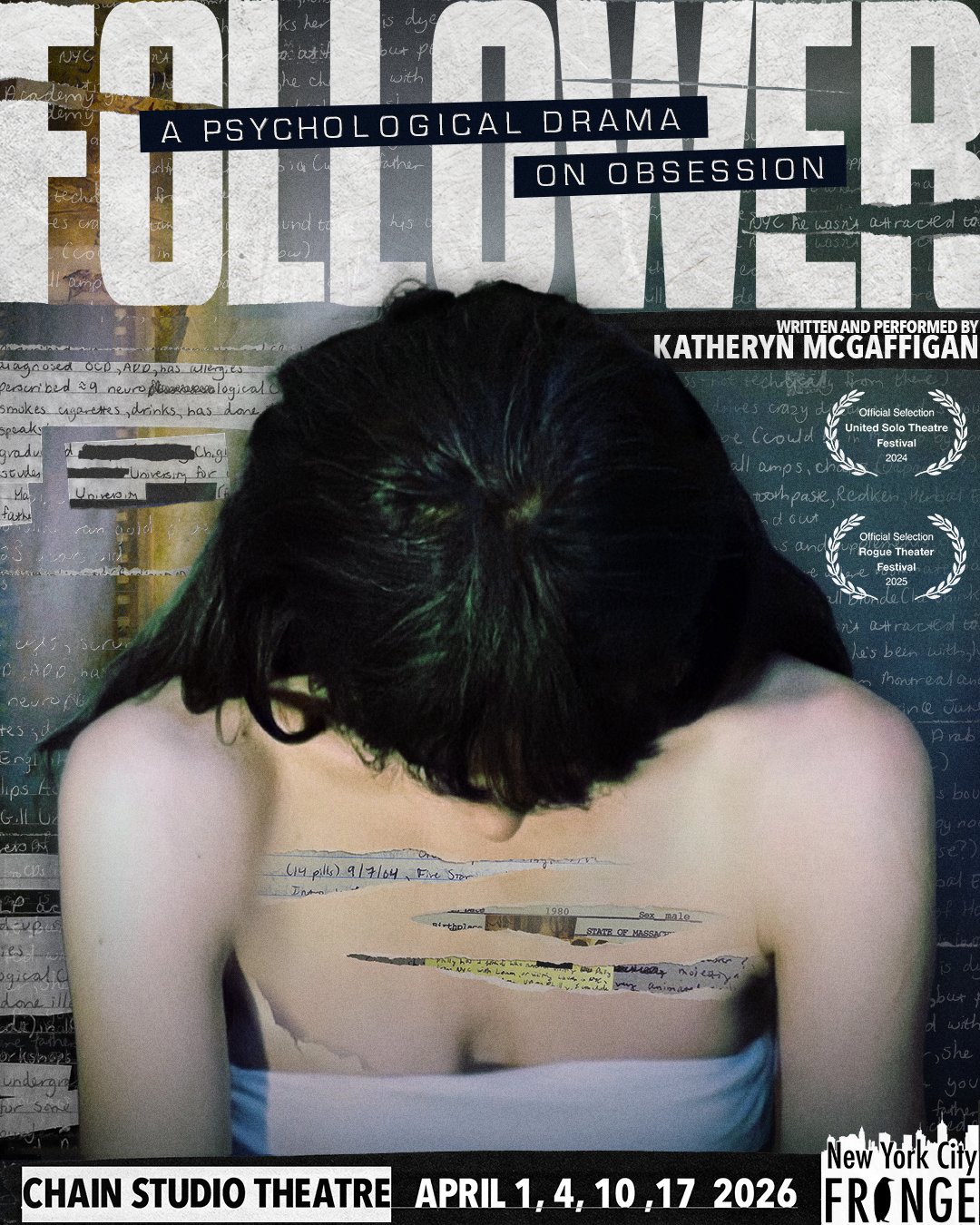
FOLLOWER
Written & Performed by Katheryn McGaffigan
Presented by the New York City Fringe Festival
Performance Dates: April 1, 4, 10 & 17, 2026
Where’s the line between curiosity and obsession?
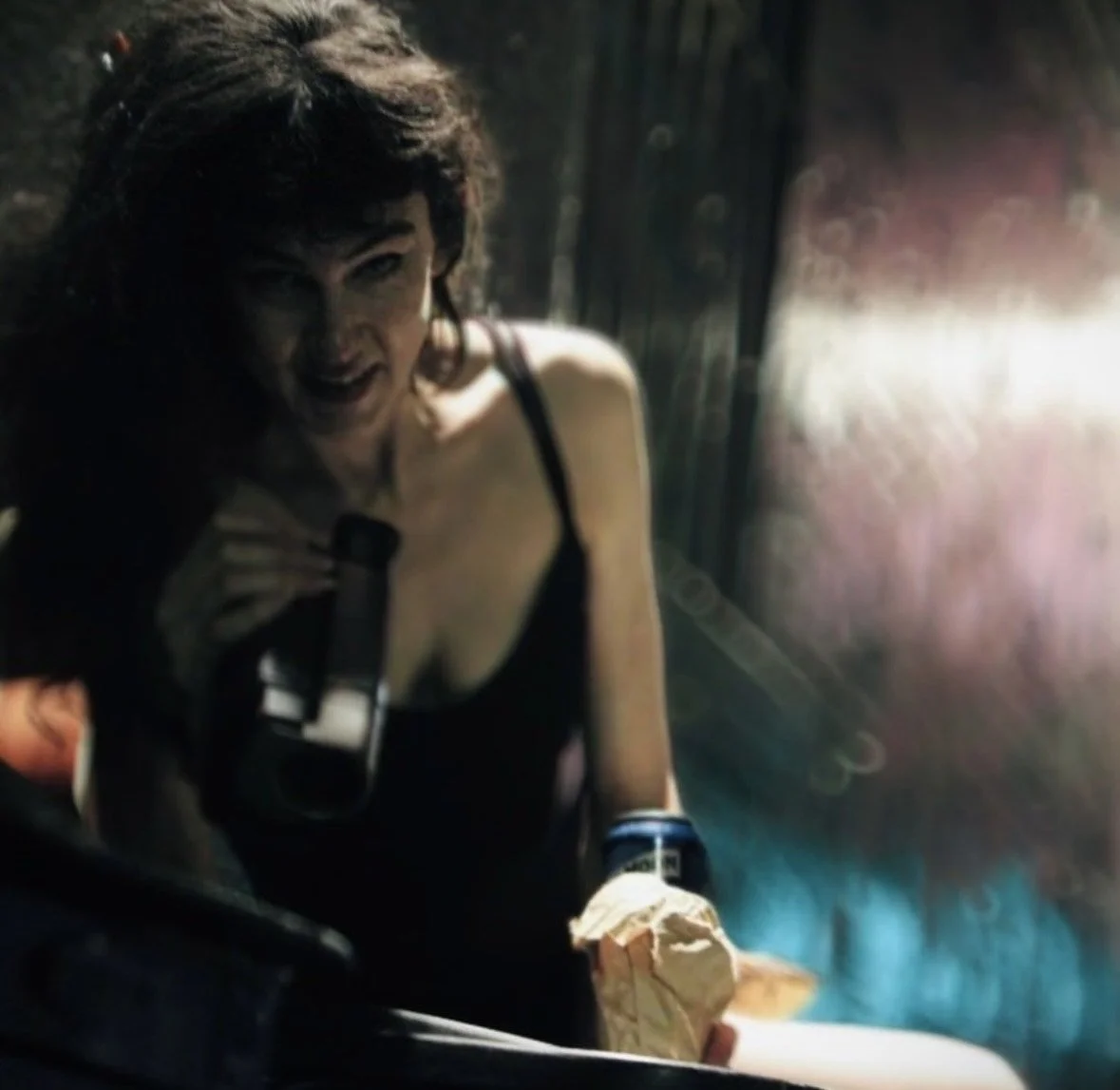
At the Chain Theatre, Follower, written and performed by Katheryn McGaffigan, follows a young woman recounting her fixation on a classmate she stalked over the course of roughly half a decade.
There are moments where the piece is undeniably engaging. Seated at a table with a binder of notes, McGaffigan shares the extensive documentation she’s compiled on her peer—tracking habits, routines, and patterns, even sketching layout plans of his apartment based on outside observation—with projections of these materials displayed for the audience. Her methods are both inventive and bizarre in a way that sustains attention. Rooted in her college years in the early 2000s, that era distinctly colors the piece—early Google searches, DJ Shadow, Daft Punk, even the mention of a Walkman—rendering the audience nostalgic for that specific cultural moment.
The scale of the fixation is striking: she returns to observe him more than a hundred times, even driving up to Canada for eight hours on over fifty occasions, mapping his movements, enlisting friends and boyfriends in the surveillance, and sifting through the remnants of his life—including his trash. Crucially, she not only documents these encounters, but presents the footage directly to the audience—collapsing the distance between observer and participant. As the narrative intensifies, we are drawn into the act of watching alongside her—laughing, reacting, even finding ourselves complicit in the absurdity, caught off guard by how far it goes. The experience begins to feel borderline illicit, even faintly transgressive, as if we are being granted access to something we shouldn’t be witnessing.
The piece often feels less like a performance and more like a conversation. McGaffigan delivers it with a casual, unguarded directness that aligns with the intimacy Fringe theatre can offer. At times, however, that informality borders on looseness, with the material feeling more recounted than theatrically shaped. A more rigorous internal framework might have deepened the impact, allowing the piece to evolve beyond narration into a more cohesive and analytically driven theatrical experience.
Nowhere is this more evident than in the piece’s gender dynamics. As the narrative progresses, it circles the act of stalking without fully interrogating its consequences or articulating the impulse behind this years-long fixation. That omission becomes a defining feature of the work, contributing to its unsettling ambiguity. One of the most compelling dimensions emerges in retrospect: the stark difference in how men and women might respond to being surveilled. As a viewer—and as a woman—I found myself asking: how would this be received if the roles were reversed?
The man—initially identified by name—is gradually reduced to “the subject,” a transition that subtly dehumanizes the object of her observation. As he becomes aware of the surveillance, the dynamic shifts, yet remains largely unexamined. His responses raise further questions about how he processes being watched, and why he reacts in this way rather than seeking distance or pursuing legal action—responses more typically associated with women navigating unwanted surveillance. The piece ultimately stops short of interrogating what this dynamic signifies, instead presenting the material and deferring interpretation to the audience—raising questions about gender, consent, and response without offering a clear framework through which to process them. It also leaves a more immediate question unresolved: does he know this piece exists?
Follower is an experience unlike any other—fascinating, strange, and at times jaw-dropping. If you’re drawn to work that leans into voyeurism and the discomfort of watching, this is one to catch. That said, the piece occupies ethically fraught territory; it does not—and should not—be taken as an endorsement of the behavior it depicts.
I found myself both absorbed and questioning why. That tension defines the piece. There is one final opportunity to catch it at the NYC Fringe on Thursday, April 17 at 9:35 PM—worth seeing for yourself.
Click HERE for tickets.
Review by Penelope Deen.
Published by Theatre Beyond Broadway on April 16, 2026. All rights reserved.