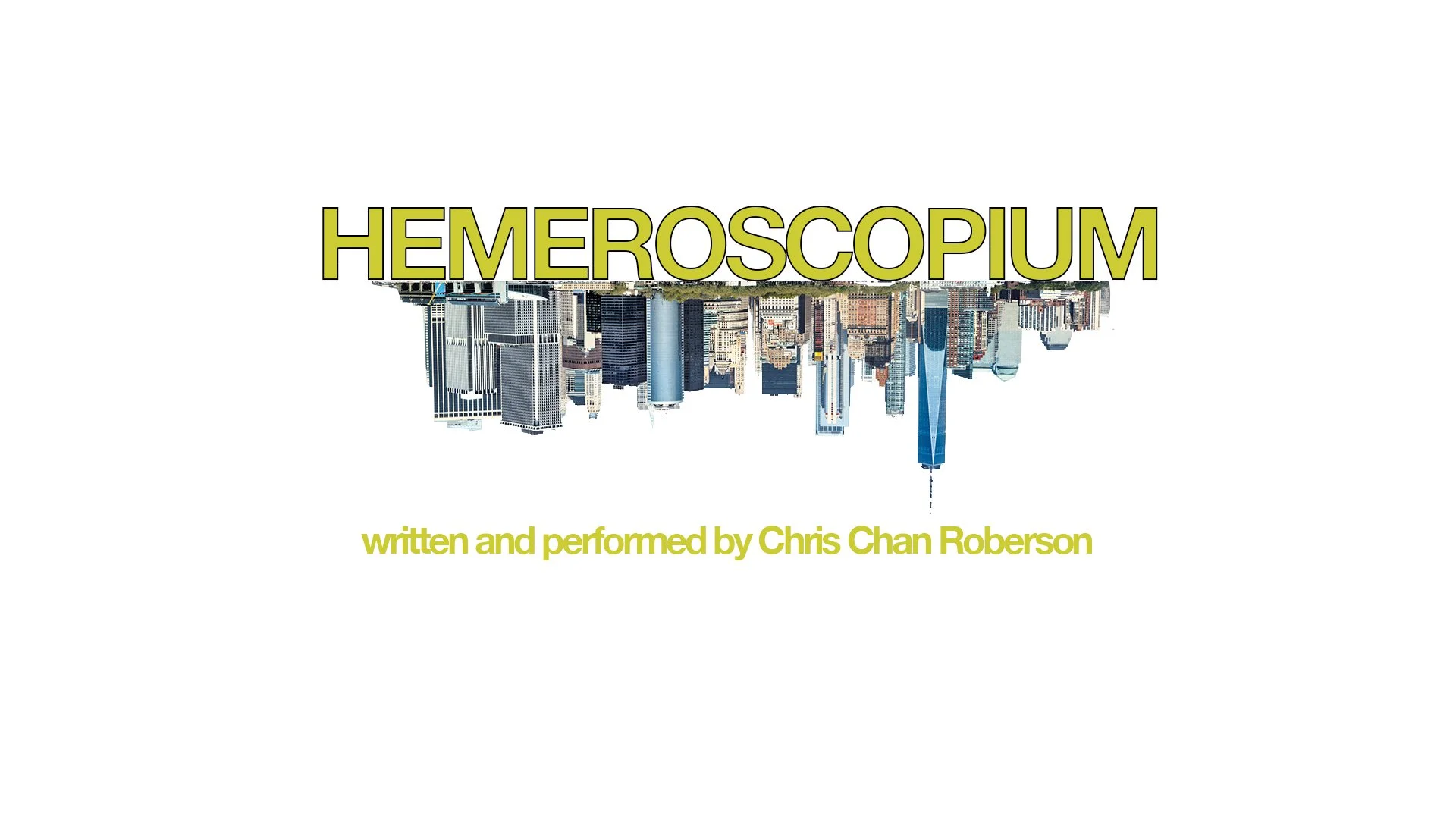
HEMEROSCOPIUM
Written, Directed and Performed by Chris Chan Roberson
Presented by the New York City Fringe Festival
Under St. Mark’s, 94 St. Mark’s Place, New York, NY 10003
Wed April 1 at 9:50pm, Thu April 9 at 6:30pm, Wed April 15 at 6:30pm, & Sat April 18 at 2pm
Over the course of a decade, Chris Chan Roberson moved five times—not a statistic to trouble any record book, but, in his telling, a quietly astonishing itinerary. What accumulates across those relocations is less a tally than a texture: a succession of episodes by turns hilarious, unnerving, and faintly surreal, each inflected with the peculiar logic of upheaval. These are not merely moves between apartments, but passages through states of being, rendered with a storyteller’s eye for the absurdities and small violences that attend a life in motion. This is his story—at once modest in scale and unexpectedly expansive in its reach.
Roberson’s Hemeroscopium, which he has both written and performs with a disarming, almost stealth virtuosity, is that increasingly rare theatrical experience: a work so intellectually agile, so formally assured, that its density feels less like excess than like invitation. To call it “smart” is accurate, though insufficient; the production’s tenacity lies not merely in its ideas but in the way those ideas are staged—through a fluid, non-linear architecture that mirrors the very instability it seeks to interrogate. Video fragments, pop-cultural echoes, and a current of bracing, unvarnished honesty accumulate into a kind of living collage, one that traces the fragile, ever-shifting contours of home.
Roberson situates himself—and, crucially, his child—within a cycle of near-constant displacement, moving through apartments across New York with a rhythm that begins to feel both exhausting and, paradoxically, choreographed. The effect is not simply narrative but experiential: the audience is made to inhabit that precarity, to feel how questions of safety, fear, and self-regard are not abstract concerns but daily negotiations. What emerges is a portrait of parenthood under pressure, rendered with a candor that is as unsettling as it is deeply humane.
Because the piece declines the stabilizing logic of chronology, its vignettes arrive in a kind of associative drift, giving the impression that Roberson is perpetually shuttling between boroughs, as though New York itself were rearranging beneath his feet. What begins as a professed distaste for Brooklyn unfolds into a more ambivalent portrait: his years in Bedford-Stuyvesant (2015–2017) and Crown Heights (2017–2019) emerge not as dismissals but as densely peopled chapters, alive with the friction and peculiar intimacies of those neighborhoods.
Hell’s Kitchen (2019–2021), by contrast, is recalled with a wary affection, its pleasures inseparable from its hazards. Roberson describes, with exquisitely calibrated deadpan, the ritual of readying a baseball bat for late-night encounters with the “houseless” wanderers drifting in from Port Authority and into his building’s lobby—a scenario he distills into a line of comic menace: “You’re visiting your friend in Apartment 10? I live in Apartment 10—and you’re not my friend.” The laugh it provokes is edged, uneasy, and all the more potent for it. And yet, in the alchemy of city living, such vigilance is counterbalanced by delight: the improbable luxury of not one but three one-dollar pizza shops within arm’s reach, a detail he savors with near-reverence.
Subsequent chapters carry him to the Upper East Side (2021–2023), where the rhythms shift yet again, and, most recently, to Harlem (2023–present), where he appears—at least for now—to have achieved a duration that, in the context of his own history, feels almost record-breaking. Across these migrations, the city is less a fixed setting than a mutable partner, its neighborhoods refracted through Roberson’s singular sensibility, each move both a rupture and a continuation in an ongoing, darkly comic search for something resembling home.
The title, drawn from the Greek “hēmeroskopion,” is less a definition than a provocation. Conventionally translated as “watchtower” or “daytime observatory,” it is here reimagined as an interior locus—“the place where the sun sets”—a private psychic terrain in which one’s most intimate reckonings unfold. Roberson’s great insight is to treat this not as metaphor alone but as a lived reality: a mental habitation that persists irrespective of physical address, where identity, memory, and perception are in constant, luminous flux. In this sense, Hemeroscopium proposes a radical reframing of home—not as a fixed site but as a condition of consciousness.
What might, in lesser hands, read as tonal ambiguity instead becomes one of the production’s most exhilarating strengths. Roberson’s performance style—marked by a straight-faced delivery and a deftly calibrated strain of self-deprecating humor—operates on multiple frequencies at once. The jokes, some of which flirt with the esoteric (drawing on mathematics and science with a kind of impish precision), are less about punchlines than about texture; they create a cognitive elasticity, a sense that the audience is being asked not simply to follow but to think alongside him. That a few references may elude immediate comprehension feels not like exclusion but like generosity: the work trusts its viewers to meet it where they can, and to carry the residue of what they cannot yet parse.
Roberson laces his more agitated recollections—the logistical gauntlet of escorting his daughter to school from Crown Heights, a commute requiring a bus to a train to another bus, or the minor bureaucratic indignity of needing to purchase a pen at the DMV to complete a form (a predicament he outwits with quiet triumph by pilfering one of the conveniently placed T.J. Maxx pens meant to entice applicants for a store credit card)—with moments of startling, almost luminous grace.
These counterpoints arrive not as sentimentality but as revelation. He recalls, with a kind of hushed astonishment, a subway car briefly transformed into a site of collective care, where three strangers instinctively rally around a woman in the throes of a panic attack, accompanying her—without fanfare, without hesitation—to her destination. Elsewhere, he conjures the quotidian ritual of purchasing halal chicken from a vendor near NYU, a transaction that, in its repetition, accrues the texture of familiarity—only to be refracted anew when that same vendor, encountered unexpectedly on a train to Brooklyn, greets him not as a customer but as something closer to kin, offering a smile and a deeply felt, “My friend.” In these moments, Roberson reveals his keenest sensibility: an attunement to the fleeting solidarities that flicker through urban life, the small, sustaining gestures that persist amid the city’s relentless churn.
Indeed, the very slipperiness of tone—the moments in which one is unsure whether to laugh, to wince, or to sit in reflective silence—becomes a mode of access rather than a barrier. It mirrors the instability of the subject itself, the difficulty of locating certainty within a life defined by motion. By the evening’s end, any lingering questions about factual precision or narrative reliability seem beside the point; what Roberson offers is not reportage but a deeply felt articulation of experience, filtered through a mind that is restlessly, thrillingly alive.
Hemeroscopium is, at its core, an inquiry into what transforms a dwelling into a home: the interplay of safety and fear, love and obligation, solitude and care. Yet it reaches beyond these material conditions toward something more elusive and, finally, more profound—the notion that one’s truest home may reside within, as a private, ever-evolving landscape of thought and feeling. If the production assumes a certain openness from its audience, a willingness to engage with its conceptual frame, it rewards that openness manifold. One leaves not only moved but expanded, as though granted brief access to another person’s inner observatory—and, in the process, to one’s own.
Click HERE www.frigid.nyc for tickets
Review by Tony Marinelli
Published by Theatre Beyond Broadway on April 16, 2026. All rights reserved.