How Not to Feel
Created and performed by Pete Cheema.
Presented by Creative Agency (British Columbia, Canada).
Presented by the New York City Fringe Festival
April 5 at 3:40 PM, April 7 at 8:10 PM, April 12 at 3:40 PM, April 13 at 9:50 PM, April 15 at 9:50 PM, 2026.
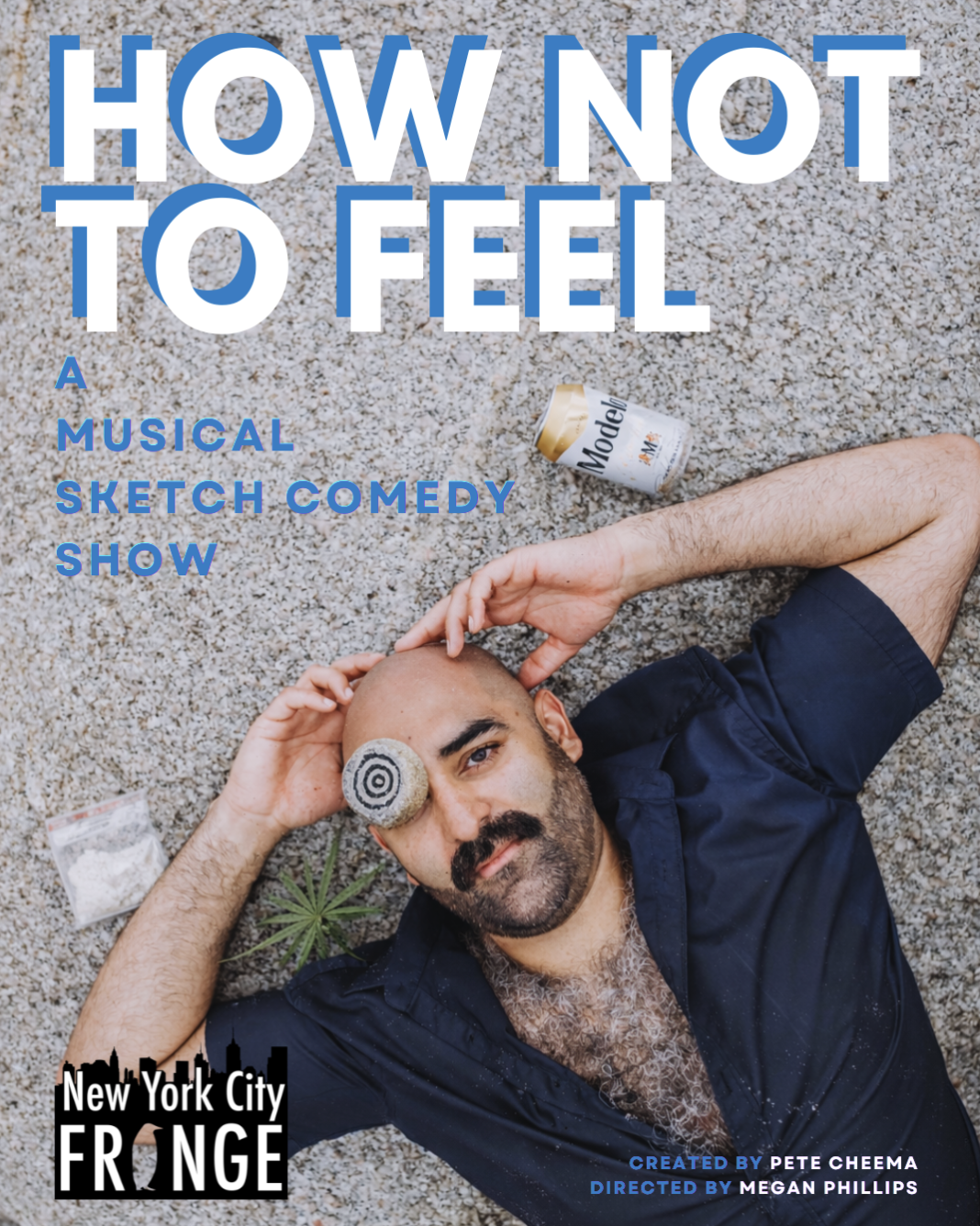
Disclosure upfront: I’m the wrong audience for this solo performance. Not because of Pete Cheema’s South Asian background, which I’d expected might create some common ground, but because the show is built for people who have dated straight men. Cheema is a physically imposing presence: over six feet tall, the build of a beer-drinking rugby player, the kind of man the room full of women who attended that night found immediately charming. The show’s central irony is that this is a man who reads, by every conventional metric, as a catch. He cannot find love. That’s the tragedy. The comedy comes from why.
“How Not to Feel” runs on the comedy of straight male obliviousness: specifically, the variety that knows it’s oblivious and makes a performance of knowing, while remaining oblivious anyway. Cheema is aware enough to know he needs therapy, physical activity, and mindfulness. He is clueless enough to be sophomorically derisive of all three, mocking their difficulty and the inconvenient fact that none of them are quick fixes. Stopping a daily morning weed habit is also on the list, treated with the same comic remove. For a show that bills itself as a tragedy about hitting rock bottom, drugs and alcohol named explicitly in the premise, playing substance dependency for an easy laugh is not self-awareness. It’s the joke your friend makes so he doesn’t have to talk about it. The self-improvement demands arrive via women characters who are portrayed as bitchy and judgmental. For a show playing to an audience of women who laughed and recognized themselves in the material, this is a complicated choice. It sours the self-awareness: the show wants credit for knowing the man needs to change while positioning the women who want him to change as the problem.
The show bills itself as a musical tragedy, though the billing is its own punchline: a wink at the audience that pre-empts any obligation to actually arrive at either register. Irony is a useful escape hatch, and Cheema, a veteran sketch comedian with a substantial online and Canadian stage presence, knows how to use one. The original songs are intentionally funny in their lyrics. The singing is another matter: off-key in ways that read less like a stylistic choice and more like one of the show’s genuinely unintentional cringeworthy moments. There is a difference between performed inadequacy, where the performer is always in control of the joke, and singing that simply isn’t there.
Its strongest material involves the video interaction: specific bits where Cheema works with the screen to satirize the absurdity of trying to make real human connection in an online world that has its own entirely justified suspicion of straight men looking to connect. This is where the show gets specific enough to land. The underwear-on-the-outside superhero gag captures the show’s best register: a man who genuinely believes he is a hero, performing that belief in circumstances that strip it down to its underwear, aware enough to see the image and not yet able to fix it.
South Asian identity surfaces in a character bit involving a Desi uncle, with the joke carried primarily by the accent. Cheema is performing his own cultural heritage rather than lampooning someone else’s, which shifts the calculus slightly. Still, the accent-as-punchline remains a narrow frame for what could be a richer target.
Megan Phillips is an award-winning fringe comedy director whose own musical work won Best of Fringe and the Ed Mirvish Award at Toronto Fringe. Her hand doesn’t show here. The production reads as a haphazard workshop, with some genuinely funny bits and interesting technical choices but no clear through-line that says someone made deliberate decisions about what this show is and what it’s for. The Rat NYC adds its own complication: the room has a coffeehouse intimacy that comedy doesn’t naturally inhabit. Comedy needs a permission structure, an energy that says the room has assembled to laugh. A coffeehouse says something else entirely.
Something real is in here: the failure to connect, the attempt to be a superhero in a world that stopped issuing the costumes, the sadness underneath the charm. These are worth an hour. The ironic tragedy billing signals that Cheema knows it too, knows there’s a genuine story in this material, and has so far chosen the laugh over the risk. A show that wants credit for making fun of straight men while making the women who want them to be better into the punchline is trying to have it both ways. The room full of laughing women is the evidence that it mostly gets away with it. From outside that particular social contract, the accounting looks different.
Click HERE for tickets.
Review by Ariel Estrada.
Published by Theatre Beyond Broadway on April 10, 2026. All rights reserved.
