ZACK
Presented by The Mint Theater Company, Written by Harold Brighouse, Directed by Britt Berke
Theatre Row Theatres, Theatre 4, 410 West 42nd Street, in Manhattan
February 21, 2026 - March 28, 2026
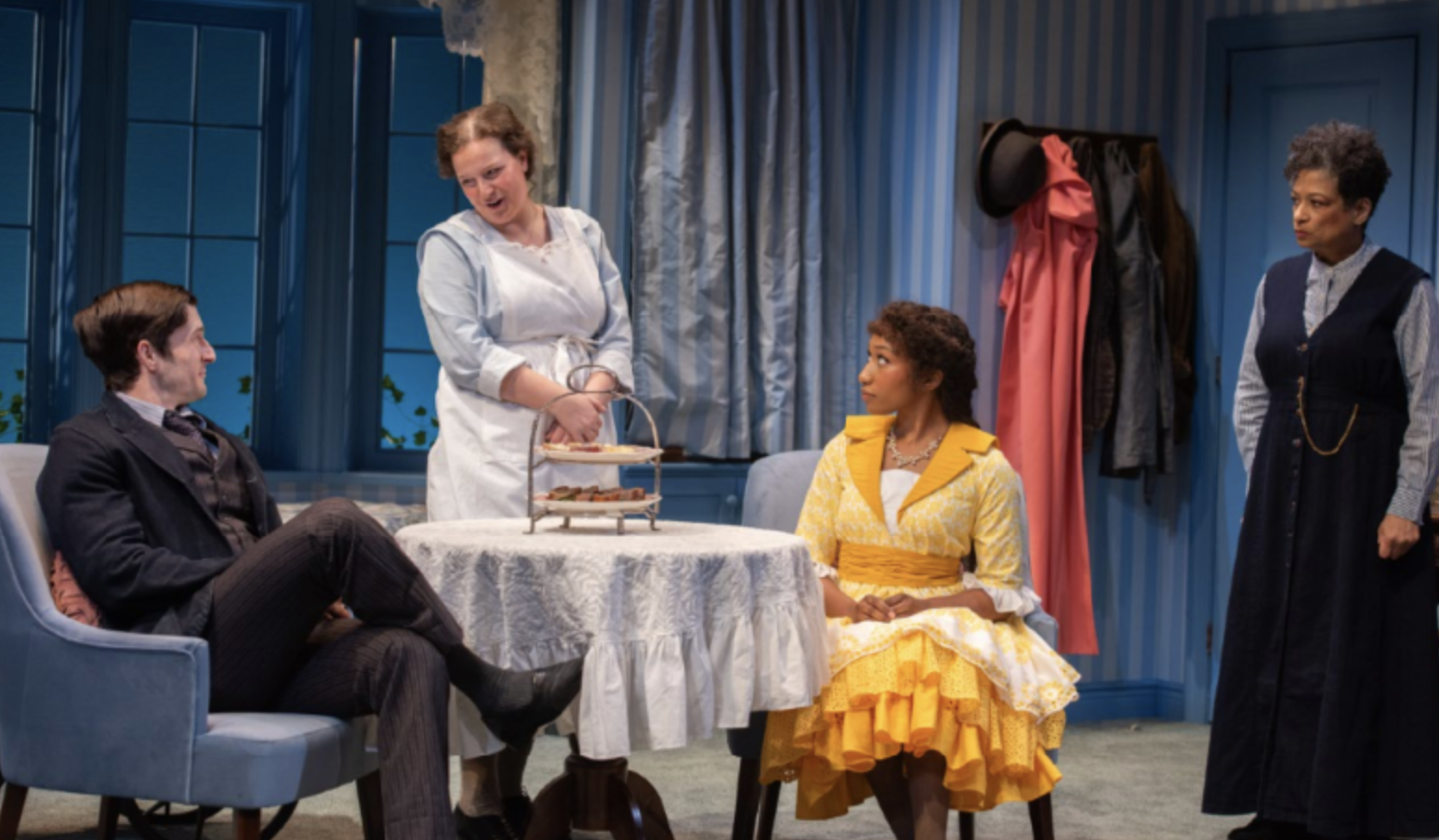
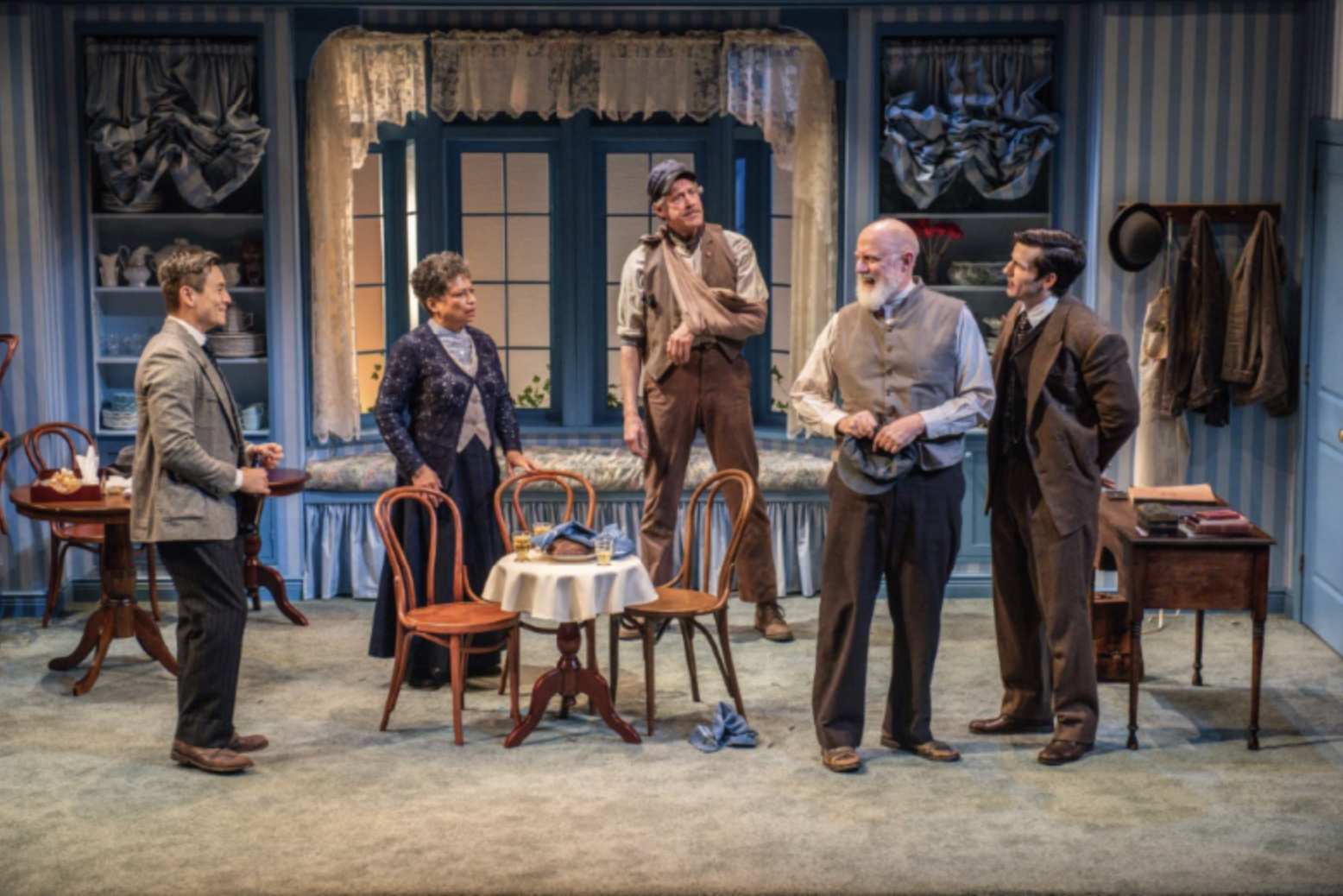
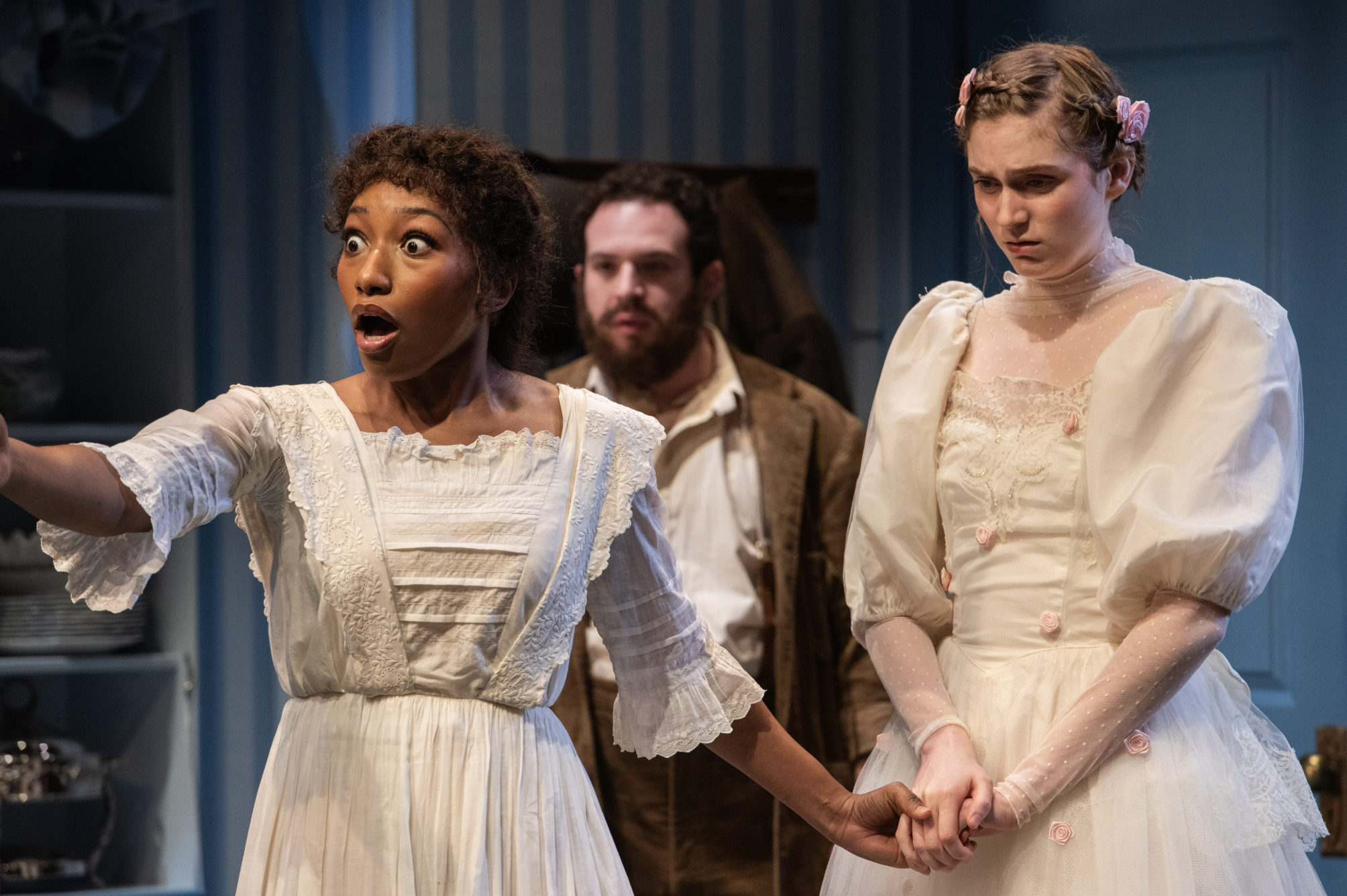
Photo credit by Todd Cerveris
The Mint Theater Company, that indefatigable custodian of theatrical archaeology, turns its discerning eye toward an underdog narrative by one of England’s most quietly formidable pre-war dramatists. Harold Brighouse—remembered, if at all, on this side of the Atlantic for his 1915 success Hobson’s Choice, later reincarnated in the Broadway musical Walking Happy—emerges here in a different, more intimate register. The Mint has, over the years, refined a singular and quietly radical mission: to resurrect plays you did not know you had been missing. Their curatorial instinct—part scholarship, part showmanship—yielded a notable success last season with Brighouse’s Garside’s Career, and they now return to that same well with Zack, a 1916 curiosity that has lingered, largely unperformed in the United States, at the margins of theatrical memory. His one-act Zack, seldom produced and even less frequently discussed, reveals itself as a minor masterpiece: a work of deceptive modesty that distills the playwright’s humane sensibility into a compact yet resonant form. Zack reveals another facet of Brighouse’s dramaturgy: smaller in scale, perhaps, but no less incisive in its social observation.
At its center is Zack himself, a figure of almost disarming gentleness, whose guilelessness renders him perilously susceptible to the machinations of those closest to him. His mother, all calculation beneath a veneer of familial concern, and his brother, driven by a more overt ruthlessness, conspire to leverage Zack’s pliability in pursuit of social advancement, currying favor with a wealthier relation. Yet Brighouse, ever the moralist of quiet conviction, refuses to let cynicism have the final word. What unfolds is not merely a portrait of exploitation but a subtle, deeply felt argument for the endurance of decency. In Zack, kindness is neither weakness nor folly; it is, rather, a fragile but persistent force that, against expectation, asserts its own quiet triumph.
Under the attentive direction of Britt Berke (though with one glaring omission), this Off-Broadway staging feels less like a revival than a reclamation—an act of cultural memory restored to vivid life. The Mint, characteristically, does not treat this revival as a museum piece. But under Berke’s direction, the production curiously sheds the expected trappings of Edwardian naturalism. It is, of course, one thing to render a period work legible to a contemporary audience; it is quite another to so thoroughly sand away its sense of time and place that it is left curiously unmoored, its world signified by little more than costume. In the absence of those finer-grained textures—accent, idiom, the particular social music of its milieu—the production risks flattening what ought to feel like a sharply etched portrait into something more generalized, its historical specificity diluted in the name of immediacy. What remains is agreeable enough, but faintly disembodied, as though the play were occurring in quotation marks rather than in the fully realized world of Little Hulton. The decision made for the Lancashire dialect to be gone, replaced by a more contemporary ease of speech, will make purists upset. One cannot help but pause at the curious dissonance: the entire company speaks in uninflected American accents, a choice that sits uneasily alongside a text so deeply rooted in the gradations of English class. Brighouse’s satire depends, in no small measure, on the audible markers of social position—the clipped aspiration of the striving middle class, the inherited ease of wealth, the regional inflections that betray one’s origins. Stripped of these vocal signifiers, the play’s social architecture feels slightly abstracted, its stakes softened. What is gained in accessibility is, perhaps, lost in specificity; the production gestures toward a world of rigid hierarchies without fully sounding them.
At first glance, Zack presents itself as a compact romantic comedy, populated with the usual assortment of schemers, climbers, and opportunists. Yet at its center stands an anomaly: a genuinely decent man. Zack, played with disarming openness by Jordan Matthew Brown, is less a conventional protagonist than a kind of moral weather system, his innate goodness exposing the pettiness and calculation of those around him. Within the Munning family—presided over by the flinty, perpetually exasperated Mrs. Munning (Melissa Maxwell)—he is regarded as a liability, a “wastrel” son whose absent-mindedness and social awkwardness render him useless in the family’s struggling catering business. His brother Paul (David T. Patterson), all sharp edges and sharper ambitions, regards him with barely concealed contempt. Brown’s performance resists caricature; his Zack is at once perceptive and oblivious, intelligent yet unguarded, a young man whose difference is treated not as a diagnosis but as a condition of being in the world.
If the premise threatens sentimentality, Brighouse sidesteps it with a playwright’s instinct for tonal complexity. The comedy, such as it is, arises not from Zack himself but from the increasingly elaborate deceptions engineered by his family. Mrs. Munning, determined to project an illusion of prosperity, schemes to marry her son Paul to their wealthy cousin Virginia (an exquisitely layered Cassia Thompson), whose arrival catalyzes the play’s action. To sustain the fiction, she hires Sally (Caroline Festa), a local young woman wholly unsuited to domestic service, to impersonate a maid—an arrangement that yields a steady stream of gently absurd mishaps. As additional figures enter, including the blustering sometime cater-waiter for the family business Joe Wrigley (Sean Runnette), the play edges toward farce, though Berke’s direction keeps it from tipping into chaos. Her staging is nimble, attentive to rhythm, and keenly aware of the text’s dual imperatives: to amuse and to admonish.
For beneath its polite Edwardian surface, Zack is unmistakably a work of social critique. Brighouse, a writer attuned to the moral compromises of upward mobility, sketches a world in which financial aspiration routinely eclipses ethical consideration. Mrs. Munning and Paul operate according to a proto-capitalist logic that leaves little room for Zack’s unprofitable virtues. Yet the play complicates its own hierarchy. The women, in particular, reveal reserves of intelligence and agency that disrupt initial impressions; Thompson’s Virginia, introduced as a model of demure affluence, evolves into something far more formidable, her transformation handled with admirable clarity and conviction.
The ensemble, nine strong, performs with a cohesion that speaks to careful direction and mutual trust. Maxwell’s Mrs. Munning sustains a finely calibrated irritation that never curdles into outright villainy; Patterson’s Paul embodies a chilling, almost casual cruelty beneath a veneer of respectability. Festa’s Sally offers a portrait of cheerful incompetence that never feels condescending. Yet it is Brown who anchors the evening. His Zack is unvarnished, even unbecoming at times—he confesses, with blithe honesty, to a lax relationship with soap, and regards his own physicality with a shrugging acceptance—but the performance accrues a quiet emotional force. Brown locates, with remarkable precision, the character’s essential dignity, allowing his kindness to register not as naïveté but as a form of resilience.
Aside from Sally, the overmatched maid, the play’s working-class contingent arrives in the form of Martha (Grace Guichard proves a comic delight, charting with deft assurance a trajectory that is as emotionally precise as it is theatrically buoyant.) and her father, the physically imposing Wrigley (Runnette) who extracts considerable humor from sheer presence, while drawn with a bracing plainness of speech and purpose. Where the Munnings traffic in appearances—forever polishing, arranging, and posturing their way toward respectability—Martha and Joe are animated by the far less ornamental urgency of survival. Yet Brighouse, with his characteristic evenhandedness, grants them no moral exemption: their ambitions, too, are edged with cunning, their calculations no less mercenary for being more transparent. In Wrigley’s rough-hewn moral ledger, a simple gesture—a consoling embrace Zack offers Martha—assumes the weight of irrevocable consequence, tantamount to a proposal of marriage. The distinction between kindness and commitment collapses entirely. And so he storms into the Munnings’ carefully curated parlor armed with a shotgun and a singular sense of purpose, prepared to expedite the proceedings with alarming efficiency. The intrusion detonates the fragile social order of the room, transforming polite pretense into outright panic, and revealing just how precarious that veneer of civility has always been.
J. Abbott (David Lee Huynh) and Harry Shoebridge (Douglas Rees), though afforded only the briefest passage across the stage, register with surprising clarity as emblems of the play’s governing obsession. As prospective clients of Paul’s, they are less characters than instruments—polished, transactional, and faintly impersonal—serving to underscore, with quiet insistence, that in this world money is not merely a goal but a creed. Their fleeting presence sharpens the play’s moral contours, reminding us that for these would-be strivers, every interaction is a negotiation, every relationship a potential ledger entry.
Mrs. Munning’s parlor, a space at once aspirational and faintly anxious, dressed in blue-and-white stripes, lace curtains that filter the light with polite restraint, bentwood chairs arranged with studied propriety, and a quaint bay window whose carefully cushioned seat seems to invite admiration more than repose. Brittany Vasta’s set captures, with almost anthropological precision, the interior life of a British middle-class household determined—perhaps a touch desperately—to appear respectable. Every detail speaks: not of ease, but of effort; not of wealth, but of its performance. Kindall Almond’s costumes do more than merely evoke the period; they seem to breathe it, capturing with tactile immediacy the textures, aspirations, and quiet vanities of the world the play inhabits. There is a persuasive elegance in their construction, a lived-in specificity that grounds the production even at its most heightened. Mary Louise Geiger’s lighting, far from simply illuminating the action, shapes it with a subtle, almost painterly intelligence—guiding the eye, modulating mood, and lending the stage a gentle, expressive atmosphere. Jane Shaw’s sound design, likewise, operates with a refined sensitivity, weaving an aural environment that feels at once unobtrusive and essential, its understated precision deepening the production’s emotional resonance.
Brighouse, ever attuned to the quiet poetry of human connection, saves his most delicate stroke for the play’s closing gambit: a scene of unexpected tenderness between Virginia and Zack. In a gesture at once intimate and symbolic, she relieves him of his unruly beard, as though gently stripping away the outward signs of neglect that have long obscured his inner clarity. What might, in lesser hands, read as mere tidying becomes here a small act of transformation. Virginia, with a patience that borders on reverence, urges Zack to give voice to feelings he scarcely knows how to articulate. Again and again, she directs him toward the mirror, inviting him to confront—not vanity, but recognition. The newly revealed face, suddenly younger, more open, becomes a kind of revelation: not a different man, but the same one, finally seen. In this quiet exchange, Brighouse locates a fragile, luminous hope—that to be loved is, perhaps, to be made visible to oneself.
If Zack occasionally feels dated—its contrivances are visible, its resolutions perhaps too neat—it nonetheless arrives with a certain timeliness. In an era defined by exchange-based relationships and a coarsening of public discourse, the play’s insistence on the value of simple decency lands with unexpected poignancy. The Mint Theater Company, in dusting off this modest artifact, reminds us that the past still has something to say, and that even the most unassuming works can carry a moral weight that resonates across a century.
Click HERE for tickets.
Review by Tony Marinelli.
Published by Theatre Beyond Broadway on April 10, 2026. All rights reserved.
