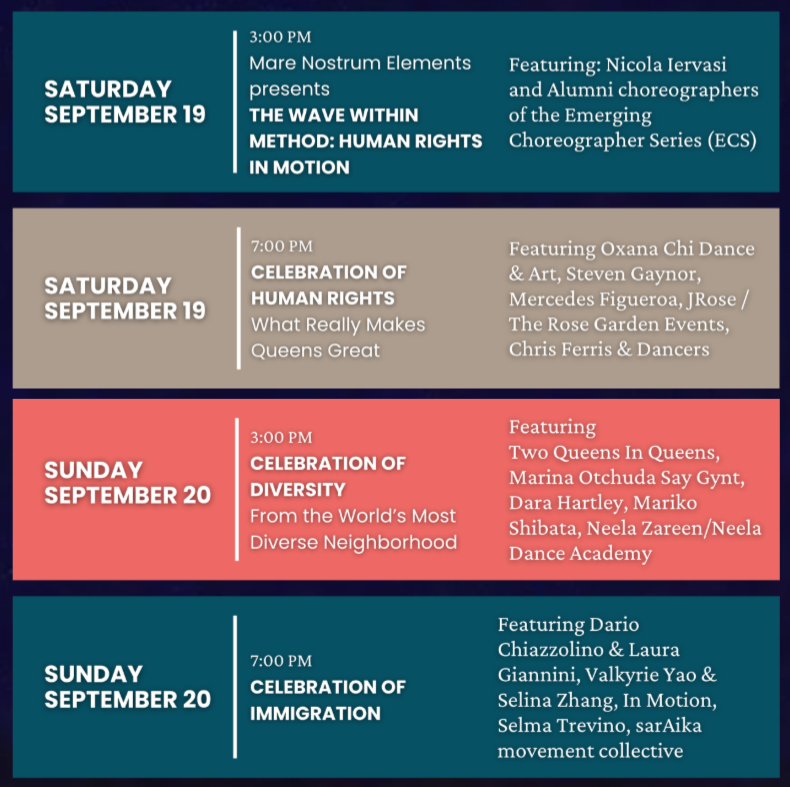
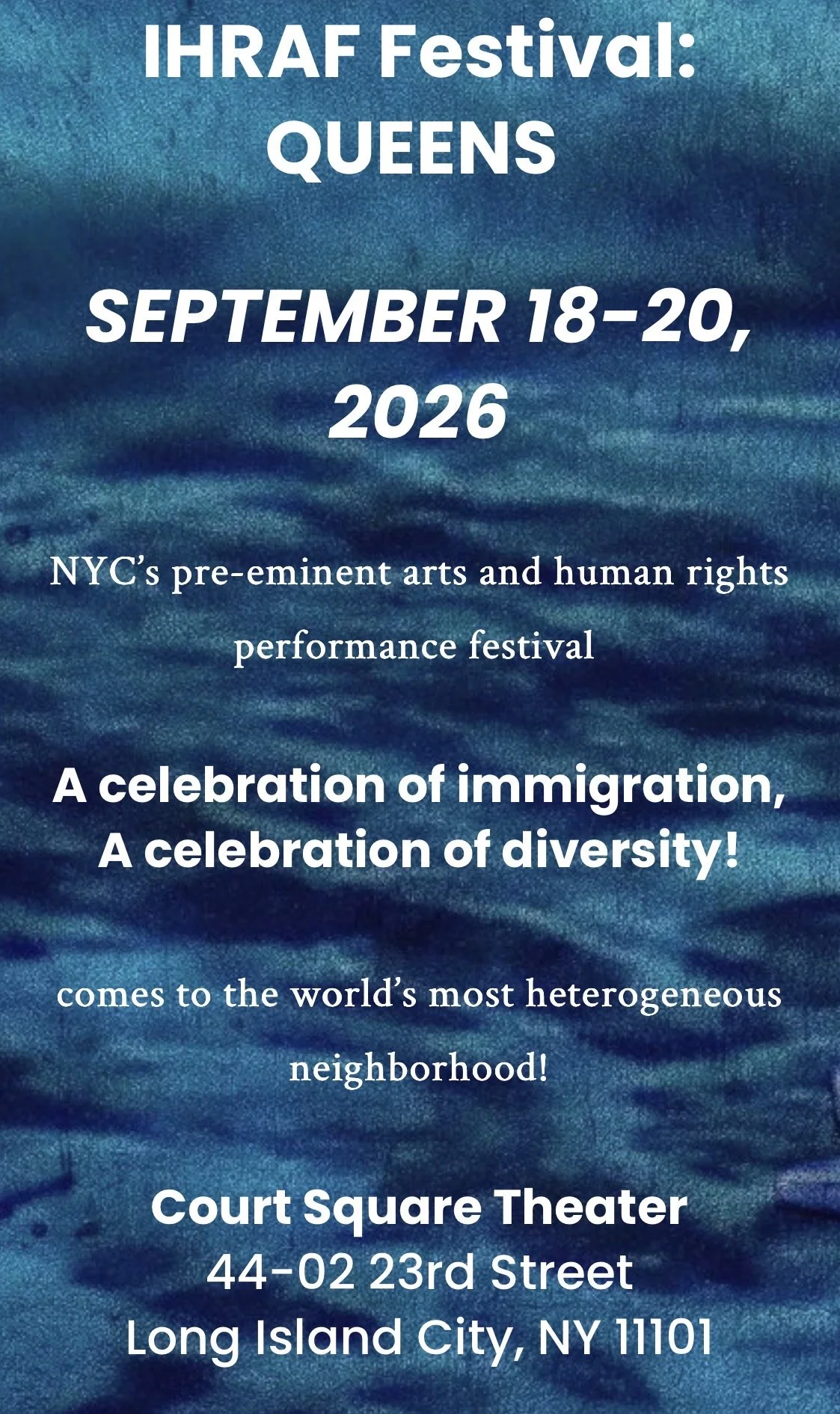
IHRAF Festival: Queens 2026
Art, Activism, and the Right to Create
A bare stage. A keyboard. And a reminder of something we can too easily take for granted: the freedom to create.
In the fall of 2025, the International Human Rights Art Movement Festival gave me the opportunity to present my solo show, Excavating My Family, a deeply personal work about identity, Indo-Caribbean heritage, and the Indian experience of displacement. What the organization offers is more than a space to speak about culture and identity. It is a platform for artists from around the world to inform, educate, and bear witness through an artistic lens.
Producer, artist, and activist Tom Block opened the evening by introducing artists working under extraordinarily difficult circumstances in Uganda, Bangladesh, Cameroon, Afghanistan, and Syria. His words immediately placed the evening within a larger human-rights conversation. In many parts of the world, artists risk punishment simply for expressing an idea, sharing a poem, or making work that challenges the status quo. Here, art becomes more than entertainment. It becomes testimony, resistance, connection, and a way of imagining positive social change.
Block, who created the International Human Rights Art Movement, has made that intersection of creativity and activism central to his work. The evening reflected that mission through performances exploring environmentalism, Indigenous identity, climate change, spirituality, humor, and our enduring need to connect.
The first evening, Listening to the Living World, curated by Holly Hepp-Galvan, Artistic Director of Turtle Star Productions, established a thoughtful and deeply meditative tone. Music, puppetry, theatre, storytelling, and dance became invitations to consider our relationship with the more-than-human world.
But this was not an evening about being told what to think about the environment. It was an invitation to listen.
Hepp-Galvan speaks about the constant stream of information surrounding the climate and the state of our planet. We are continually presented with data, warnings, and lists of what we should or should not be doing. Important as that information may be, she questions whether information alone can bring us closer to the natural world.
“I’ve always believed that we save the things we care about,” she explains, “but lately I’ve been asking how do we get to that caring?”
Her answer is simple: stop and listen.
The evening asked us to put aside, even briefly, the impulse to analyze, fix, or solve and instead become present to the world beyond ourselves. The natural world, Hepp-Galvan suggests, has messages that can be beautiful, terrifying, strange, and magical. We simply have to become quiet enough to hear them.
I did. And I was surprised by how deeply the evening moved me.
The Peace of Heart Choir, led by Robert René Galván, opened with Siyahamba, a traditional South African song, followed by a Land Acknowledgement and Cherokee Morning Song, and Give Us Hope by Jim Papoulis. The singing immediately established a sense of community and spiritual openness. When the choir returned at the end with One Day, the evening felt beautifully bookended.
Skip LaPlante’s environmental dance and music improvisation, with dancers Amiere A. Bell and Cori Kresge, transformed discarded materials and found objects into instruments and movement. Rather than telling us how to care for the earth, the improvisations made me think about the agency we have in choosing how we care. What do I do with what has been given to me? Am I doing Gaia’s work in this lifetime?
The Blessing, written by Kas Hesek with music by Rose Betts, brought Gaia herself into the conversation as she creates her children and confronts the heartache that follows. Spoken word and upcycled fabric panels gave the piece a tactile, intimate quality. Its questions about balance, responsibility, and our relationship to the natural world stayed with me.
René Galván’s Banyan, performed as a reading with musical accompaniment by Madhumita Chatterjee, centered on the Lahaina Banyan Tree, which survived the devastating 2023 wildfires in Hawai‘i. The banyan’s spiritual significance in Indian culture immediately connected with something personal in me. Its survival became more than a story of resilience. It became a reminder of ancestry, memory, loss, and the possibility of regeneration.
Daughter of the Earth by Yenny Sanchez/Baca Theater Colombia reached another part of me, connecting with my Indigenous roots. Through physical theatre, objects, puppetry, and the interplay of Spanish and English, ancestry, ritual, and the sacred were embodied rather than explained. The piece reminded me that cultural memory lives in the body.
Then came Birds, written by Holly Hepp-Galvan, which shifted the evening into an unexpected register. An old woman discovers she can understand the birds around her and realizes they have been observing humanity all along. Part ecological fable, part comedy, the piece invited us to imagine another language and another perspective. It also reminded me how easily communication can be misinterpreted when we assume the world speaks in ways we already understand.
That tonal variety was one of the evening’s greatest strengths. Music gave way to improvisation, spirituality to humor, ancestral memory to environmental storytelling. Nothing felt disconnected. Each piece offered another way of listening.
For Hepp-Galvan, that spirit also reflects what is possible within the independent theatre community. She describes independent artists as doing work that continually makes her think, “I wish everyone could see what I just saw.”
That impulse is central to Turtle Star Productions: bringing independent artists to new audiences while creating opportunities for actors, puppeteers, dancers, musicians, and other artists to develop new work together. Hepp-Galvan hopes to build a community where artists can support one another while exploring eco-theatre in exciting and dynamic ways.
That made Listening to the Living World a fitting beginning to the festival. Before asking audiences to consider what comes next, it asked us to slow down, open ourselves to possibility, and pay attention.
For me, the evening became something more personal.
It made me think about the ways I am connected to the earth through culture, ancestry, spirituality, and choice. It reminded me that caring is not simply an intellectual exercise. It is a relationship. And relationships require attention.
Sometimes the first act of change is not speaking.
It is listening.
A bare stage can hold a remarkable amount of meaning.
Click HERE for tickets.
Review by Malini Singh McDonald.
Published by Theatre Beyond Broadway on September 19, 2026. All rights reserved.