Jack Ferver: My Town
Written, Choreographed, and Performed by Jack Ferver
Jack H. Skirball Center for the Performing Arts, NYU Skirball | 566 LaGuardia Place, New York, NY 10012
November 21 - November 22, 2025
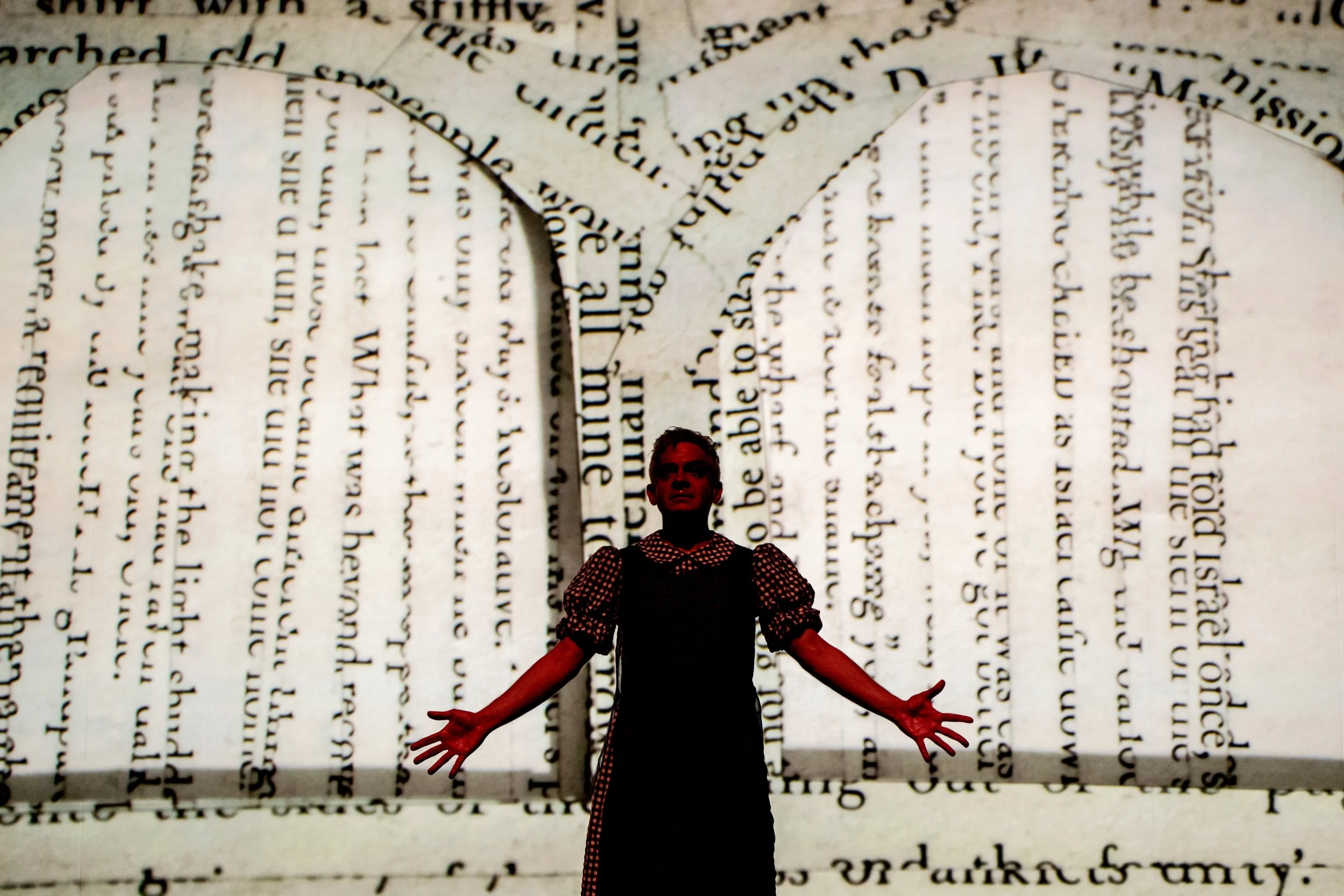
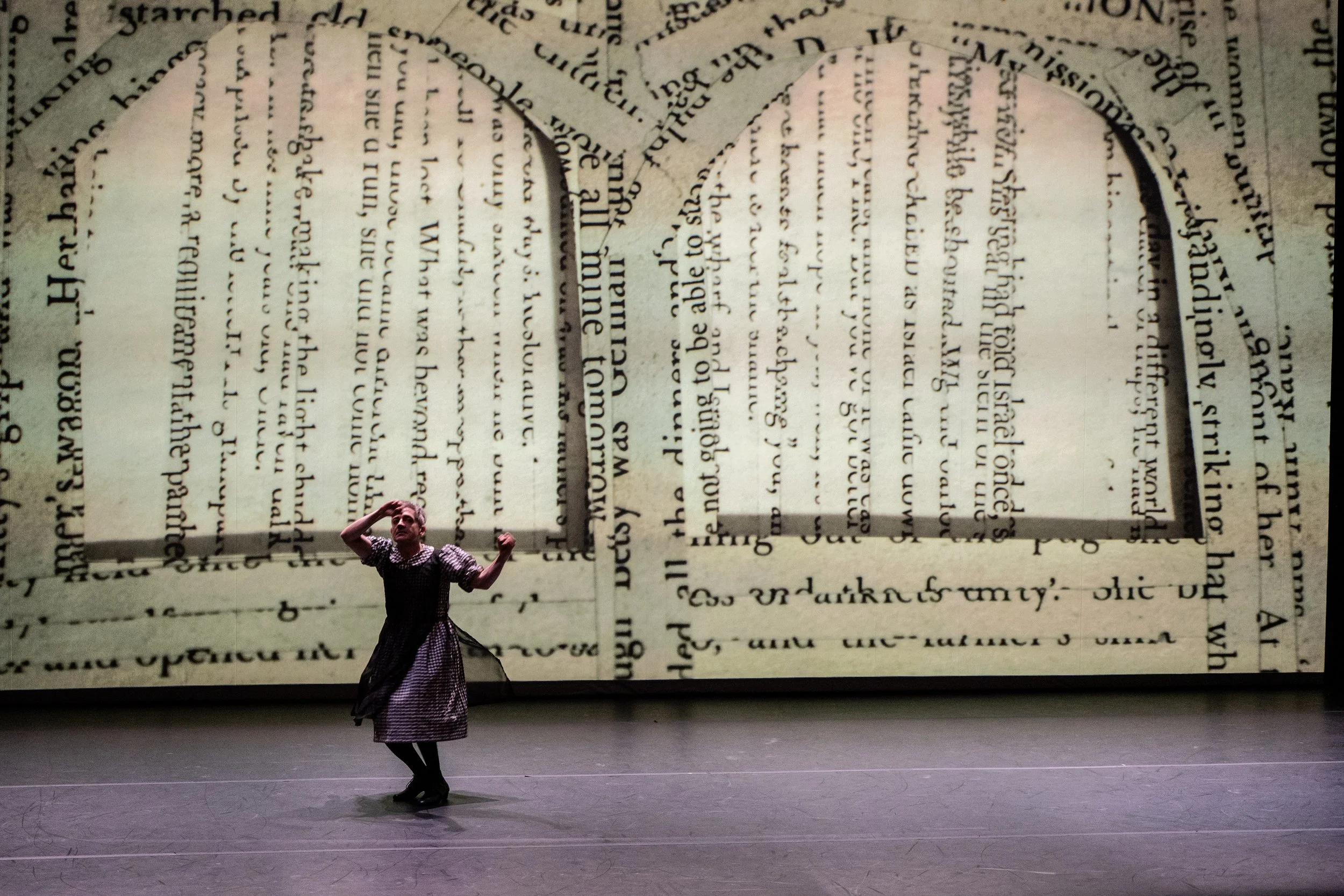
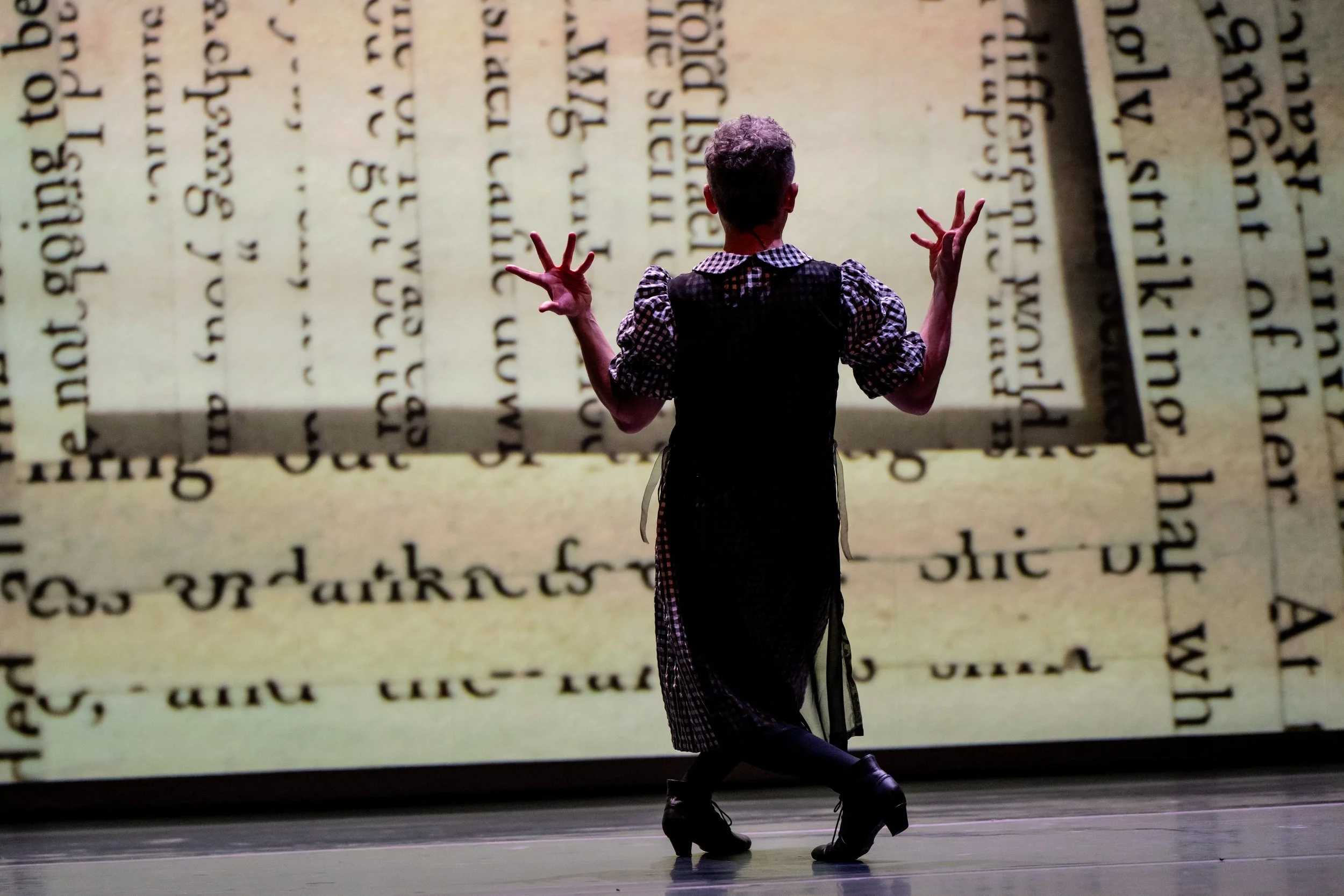
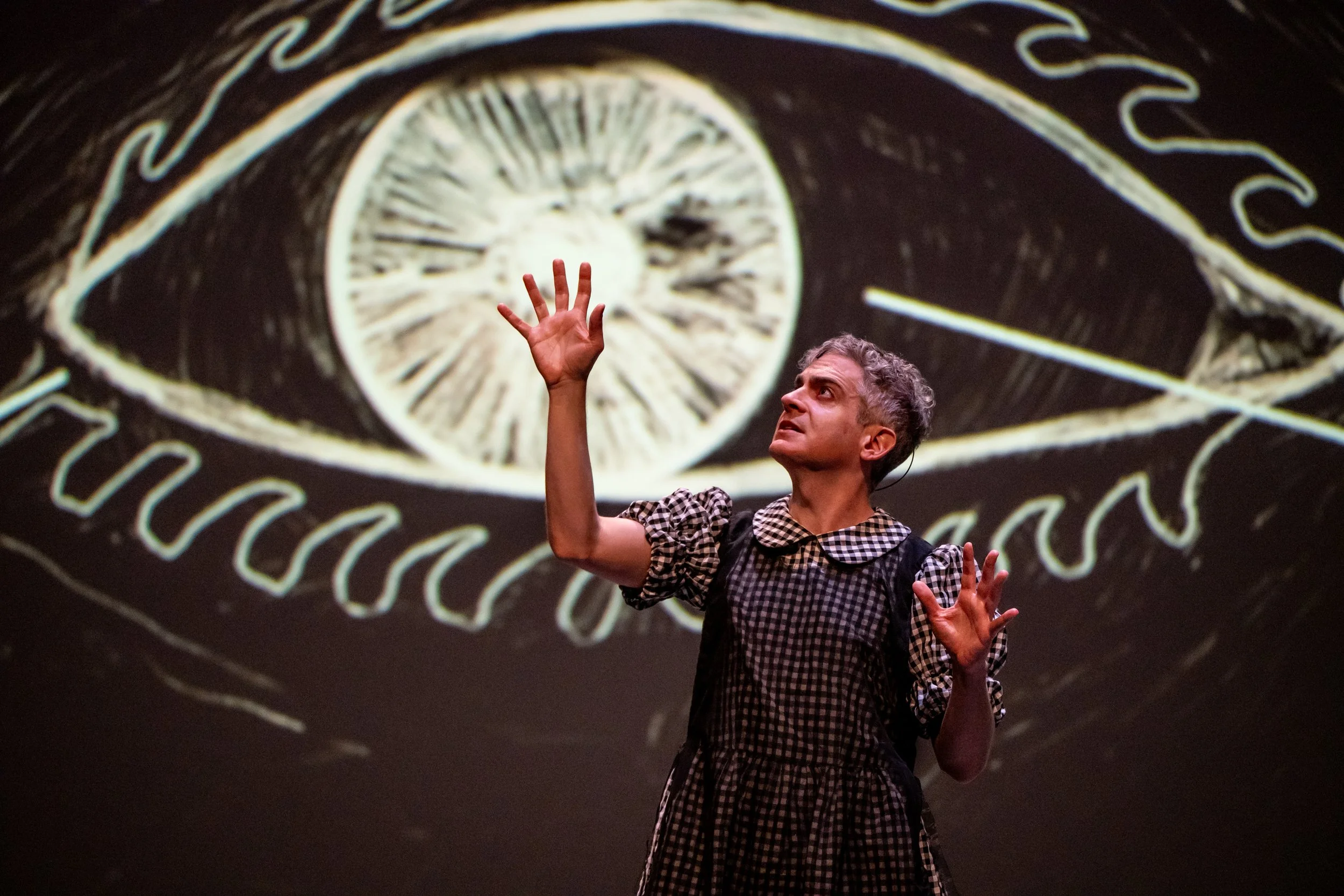

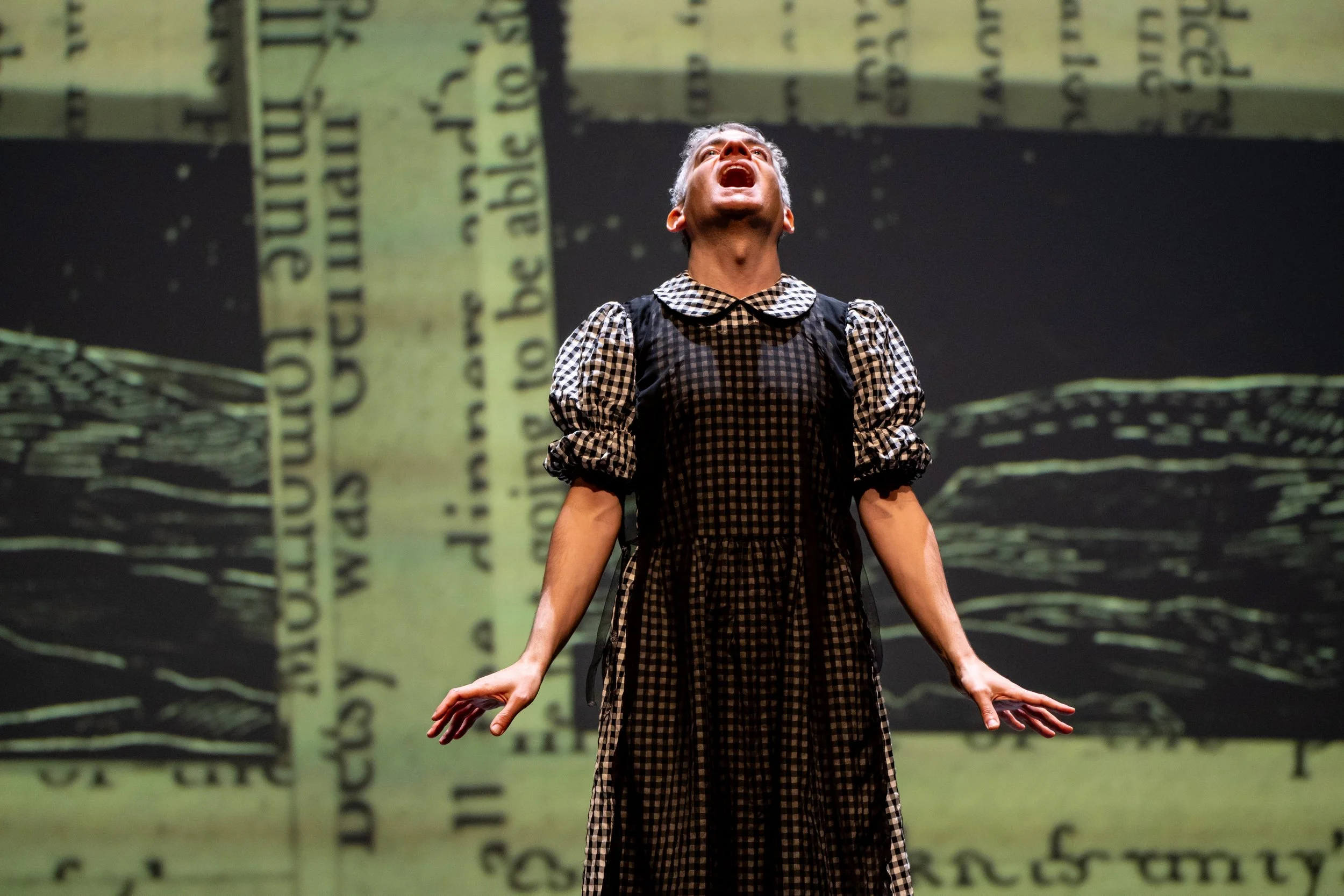
Photos by Greg Kessler
A commission from NYU Skirball, My Town announces itself as a daring, darkly effervescent entry in Jack Ferver’s increasingly singular body of dance-theater — a work that, in typical Ferver fashion, shreds the gauzy scrim of American nostalgia to expose the twitching, uncanny musculature beneath. With the immersive, shape-shifting multimedia of Jeremy Jacob serving as both atmospheric veil and psychic amplifier, Ferver offers a queer reimagining of Thornton Wilder’s Our Town that treats the mythos of small-town Americana not as sentimental refuge but as a site of exquisite strangeness. Ferver, ever the meticulous conjurer of atmospheres, possesses an uncanny ability to set a scene with the same deftness and voltage with which they embody a character. In My Town, these talents intertwine until the distinction between landscape and persona dissolves entirely: the scenic world rises up as a kind of living interlocutor, while the characters’ inner lives unfurl with such granular specificity that they map, almost cartographically, the warped contours of their psychological terrain. Through Ferver’s finely wrought synthesis of text and movement — both written and performed with their signature blend of acerbic precision and raw exposure — and Jacob’s enveloping sound and visual design, the piece coheres into a tense, ghost-lit portrait of trauma and repression nestled within the ostensibly placid borders of small-town America. Here, every gesture is a revelation, every image a crack in the façade, and the town itself becomes a silent witness to the secrets its inhabitants can no longer suppress.
The influence of Wisconsin Death Trip — that infamous compendium of Midwestern doom — murmurs through the piece, as do the spectral textures of Ferver’s own upbringing in rural Wisconsin. It is as though the ghosts of the American heartland, so long presumed benign, have been coaxed into speaking at last. And Ferver listens. What emerges is a wry, serrated form of storytelling that oscillates between the hilariously caustic and the startlingly vulnerable, reminding us that the towns we flee have a way of lodging themselves under the skin, resurfacing in movement, in memory, in the subconscious’s dim corners. The small town, in Ferver’s cosmology, becomes less a mere setting than a permeable portal — a threshold through which one may slip into thornier inquiries about self-fashioning, self-expression, and the uneasy choreography of collective agency. Situated loosely in the mythicized reaches of Upstate New York, My Town turns its gaze toward the queer experience lived beyond the presumed sanctuaries of urban density, interrogating how life at the periphery imprints itself upon the psyche. Here, physical geography does not simply frame the action; it infiltrates it, carving channels through the interior landscapes of the mind, suggesting that the ridgelines, riverbanks, and dimly lit main streets of small-town America echo with emotional topographies all their own.
In the annals of downtown dancemakers who have sought salvation in the pastoral, Ferver’s retreat from New York City to a small Hudson Valley town may sound, at first blush, like the familiar artist’s exodus. But in Ferver’s hands, this shift in geography becomes nothing less than a tectonic reorientation of the body and its expressive capacities. No longer yoked to the bristling electrics of the city nor the months-long ballet of subway transfers en route to Bard College — where Ferver teaches theater and performance — the artist has discovered, to hear them tell it, a luxuriant liberation: “My vagus nerve has changed,” they confess, as though the very wiring of the nervous system had been rewoven by the slower tempo, the emptier studios, the sheer, breathable spaciousness of not-New York.
That visceral broadening is everywhere apparent in My Town, Ferver’s sinuous, queer, one-person fantasia on Thornton Wilder’s Our Town, a work that treats small-town Americana not as a quaint postcard but as a darkling mirror. Here, amid the sepia atmospherics conjured by Jacob’s video and sound design — a feverish scrapbook of sketched townscapes and typed fragments that hover like half-remembered dreams — Ferver pushes Wilder’s existential question (“Are you really paying attention?”) into the realm of spectral unease. Ghosts wander in and out of the piece; the past and the present slip their tethers. The result is a kind of haunted pageant in perpetual motion.
Indeed, perpetual motion is the show’s very engine. Ferver, both author and performer, scarcely stops moving, weaving together text and choreography into a ceaseless churn of embodiment. The second act even begins with a dance traced along the path of a pentagram — a ritualistic, almost occult consecration of the stage, as though to insist that the body can reveal what language cannot.
Across the evening, Ferver shape-shifts with virtuoso elasticity: a schoolteacher with the gentle gravity of a faded daguerreotype; an “important male poet” whose ego gleams like a tarnished trophy; a luminous young woman on the precipice of myth; a Hollywood starlet from the gilded age of glamour. All of them flicker across Ferver’s frame, clad in a gingham dress evocative of The Wizard of Oz’s Dorothy Gale — another voyager between worlds, another small-town wanderer dreaming in technicolor.
Jacob’s video washes the rear of the stage in a sepia glow reminiscent of The Wizard of Oz’s black-and-white prologue. They imagine the set as a sort of cranial diorama with the floor and screen forming the creased opening of a pop-up book, and Ferver the paper figurine sprung from its spine.
The project originated in conversations with Jay Wegman of NYU Skirball, who urged Ferver to tackle Wisconsin Death Trip, Michael Lesy’s cult chronicle of turn-of-the-century Midwestern despair. But Ferver found the book’s bleak reportage leading them instead toward invention. A schoolteacher materialized on the page. A novella began to emerge. The geography of Ferver’s memory began to mingle with the terrain of the Hudson Valley — train tracks, riverbanks, bluffs, Catskills, woods — until past and present folded together like a palimpsest. It is in those woods, in fact, where Ferver first found themselves choreographing outside.
The influence of Martha Graham — with her psychological ferocity and her insistence on the body’s contractions, its resistance — shadows Ferver’s explorations. As curator of an upcoming exhibition on Graham at the New York Public Library for the Performing Arts, they have been thinking about Graham’s Frontier (1935), a meditation on American identity inspired by a train slicing across the continent. In My Town, a skipping sequence marks an invisible track, but the direction is reversed: backward through time, backward through myth. What does it mean to unmake the frontier? To retrace the steel lines that once carved a nation? Ferver has, for as long as one can trace their artistic lineage, been irresistibly magnetized to the formidable gravitational pull of Martha Graham — not merely the icon but the high priestess of psychological revelation through motion. It is Graham’s uncanny ability to excavate the mind’s subterranean chambers with nothing more than a spiraling torso or a breath caught mid-gesture that has long beckoned to Ferver. Equally intoxicating is her technique itself: that rigorously sculpted, sharply punctuated vocabulary of contraction and release, in which the body becomes both instrument and inscription, carving its psychic tremors into space with the precision of an exclamation point delivered in flesh.
Yet for all its historical and symbolic freight, My Town revels in enigma. Ferver laments our dwindling capacity to “withstand mystery and humor” — not the easy, adolescent joke, but the kind of involuntary laughter born from secret recognition, a shuddering sense of being seen. Their metaphor for the artist is service-industry humble. The audience places its order by showing up; the artist’s task is to deliver something both digestible and indigestible, a meal that nourishes even as it unsettles. In My Town, Ferver serves precisely that: a dense, mournful, funny, uncanny banquet — a pop-up book of American ghosts, delivered by a body newly freed, newly spacious, newly wild. With its heady collision of humor, mythology, menace, and corporeal virtuosity, My Town invites audiences into a landscape where the familiar becomes deliciously unsteady — a world in which the past haunts not as a shadow but as a pulse, insistent and unquiet.
My Town is co-commissioned by NYU Skirball and EMPAC - Curtis R. Priem Experimental Media and Performing Arts Center at Rensselaer Polytechnic Institute
Review by Tony Marinelli.
Published by Theatre Beyond Broadway on December 6, 2025. All rights reserved.