
JEROME
Written by John J. Caswell, Jr., Directed by Dustin Wills
Judith O. Rubin Theater at Playwrights Horizons, 416 West 42nd Street, in Manhattan
May 15, 2026 - June 21, 2026
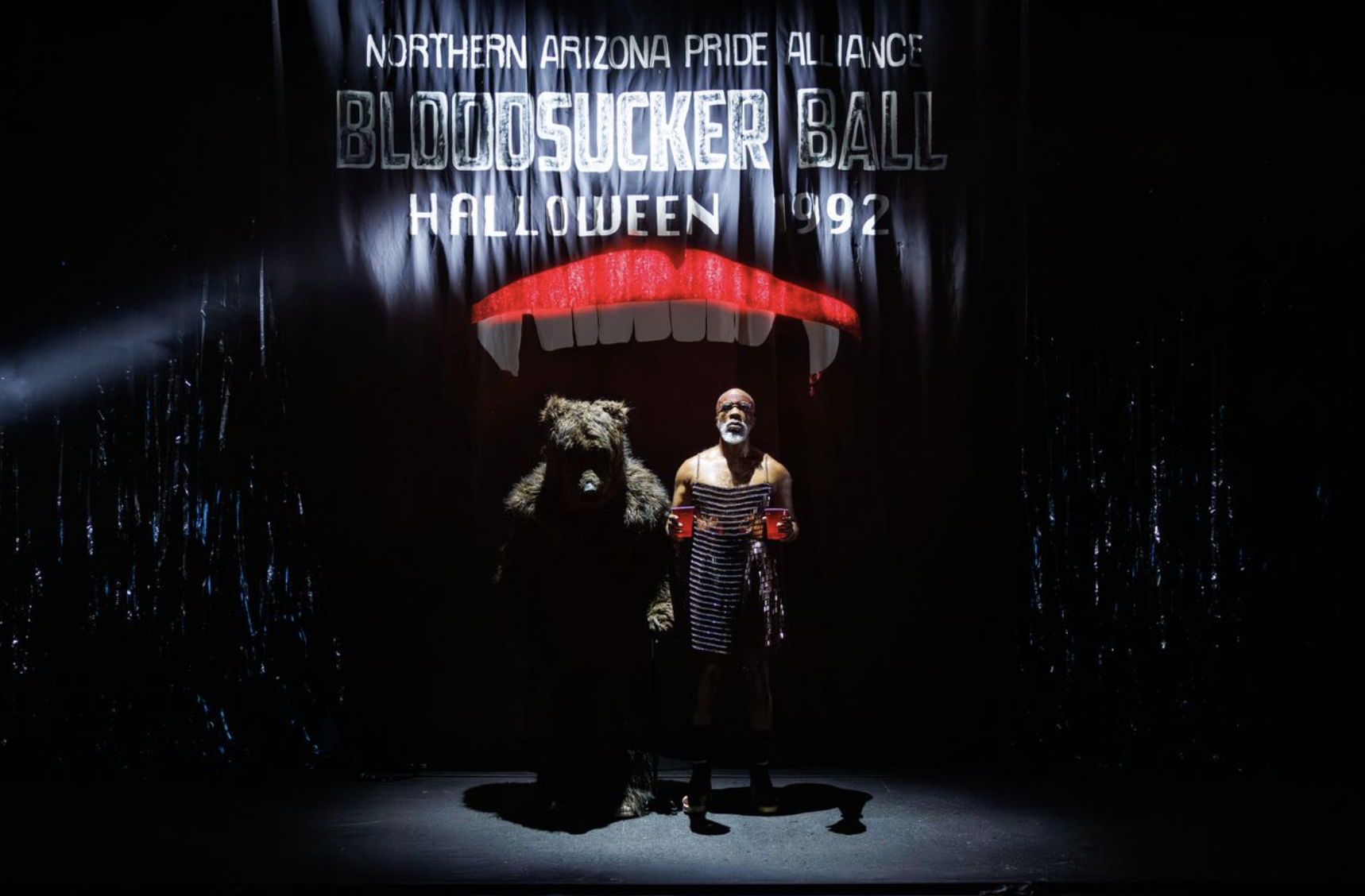
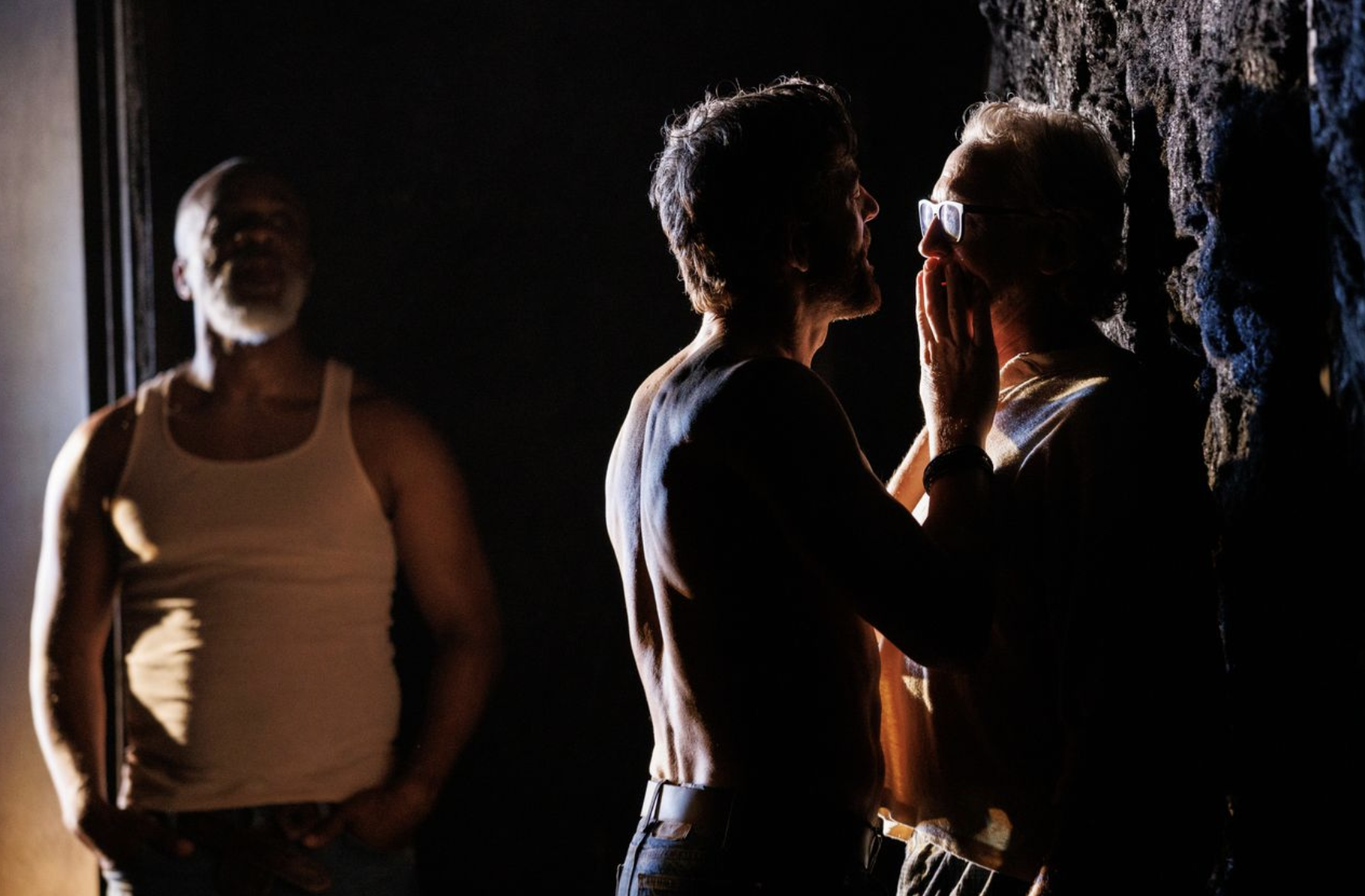
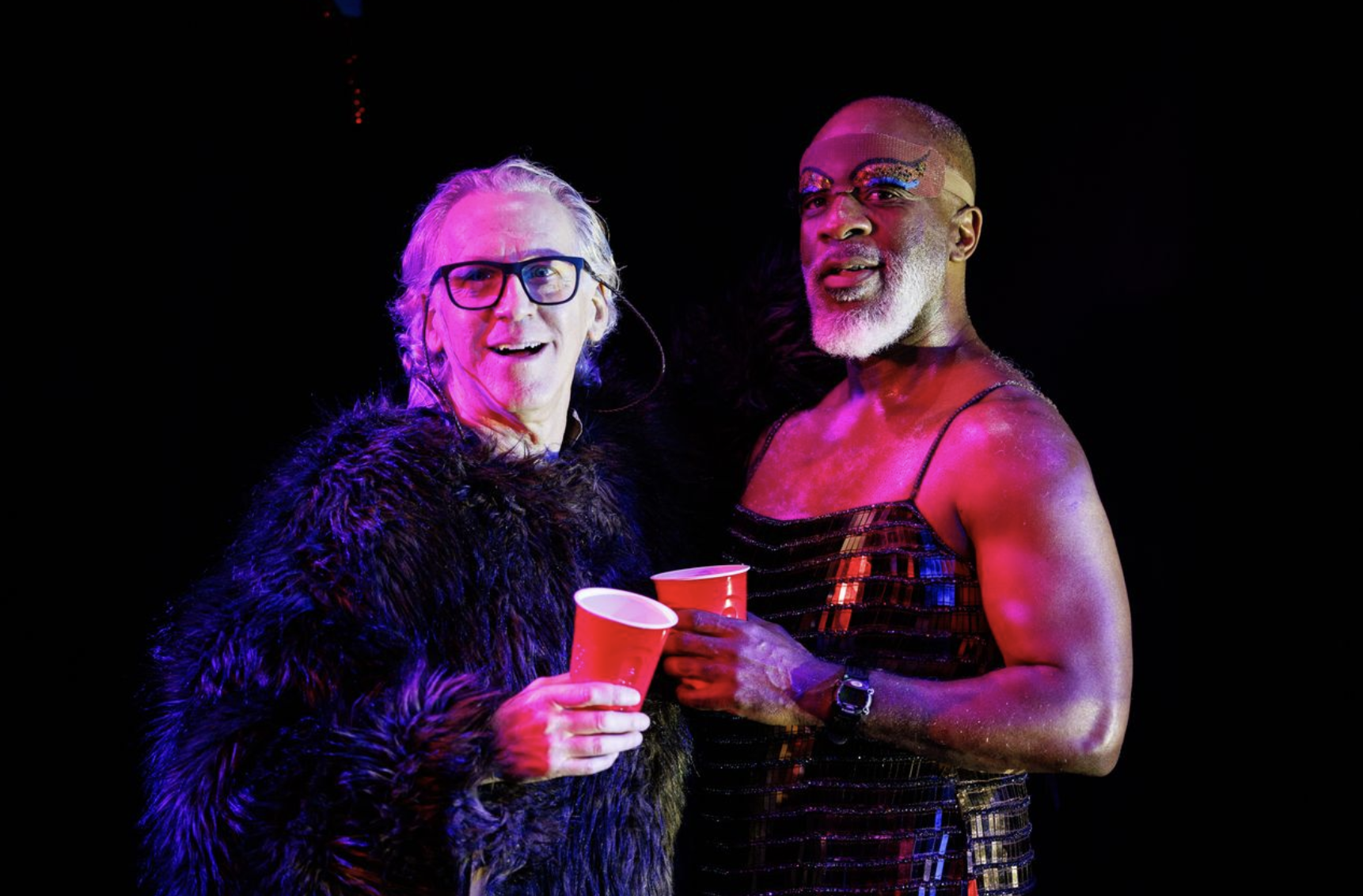
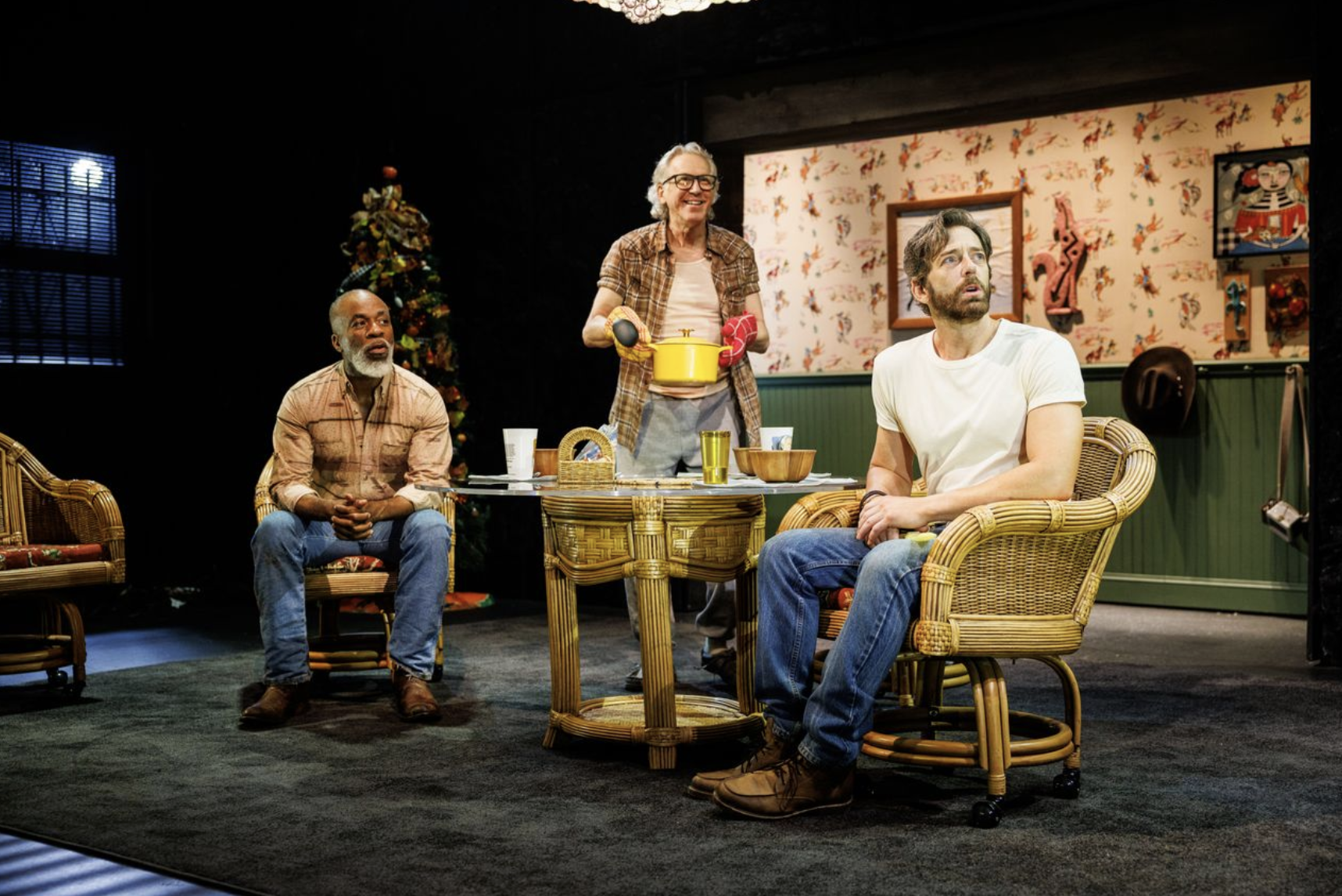
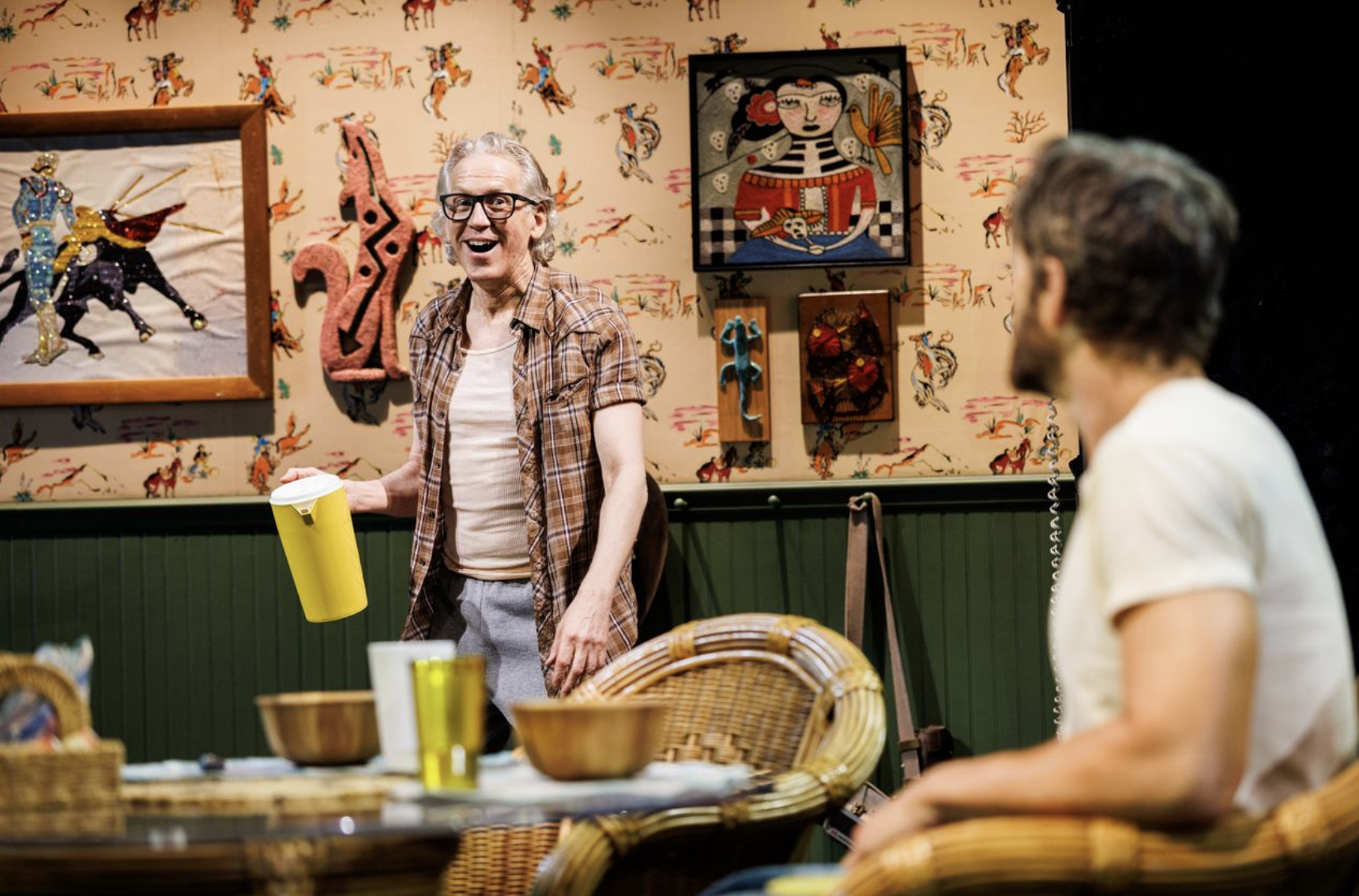
Photo credit by Maria Baranova
The first image in John J. Caswell, Jr.’s Jerome, now receiving its haunting world premiere at Playwrights Horizons, is not a character but a statistic. A sign affixed to the curtain charts the steady decline of the Arizona mining town’s population over the decades until only a handful of residents remain. “Ghost town,” it effectively declares. The phrase resonates far beyond geography, becoming an elegiac refrain for a play haunted by absence, memory, and the people who are no longer here.
Set during the darkest years of the AIDS era, Jerome ostensibly concerns three men living in that remote desert outpost. Yet what lingers long after the curtain falls is something larger and rarer: a meditation on how love prepares itself for loss. Caswell has written a deeply compassionate drama about devotion, aging, mortality, and the unexpected forms family can take when necessity becomes the mother of invention. The result is one of the most moving new American plays in recent memory.
The title refers not to a person but to the former mining town of Jerome, a place suspended between disappearance and survival. It is a fitting setting for a drama populated by men who understand that life is finite and that happiness must be built against the encroaching darkness. Con and Doane, Korean War veterans who have spent 28 years happily together, have fashioned what feels like an entire civilization out of two people. They have built a life of domestic routine and unwavering commitment, far from metropolitan bustle and the demands of larger communities. At the height of the AIDS crisis, retreating into such a sanctuary carried its own logic. Their relationship possesses the accumulated texture of a shared lifetime: private rituals, recurring jokes, old arguments polished smooth by years of repetition, and a tenderness so ingrained it scarcely requires words.
The achievement of the production begins with Stephen Spinella’s extraordinary performance as Con. Spinella remains one of the great stage actors of his generation, and here he gives a master class in theatrical precision. Every line reading arrives with surprising musicality; every gesture reveals character. His Con is hilarious, stubborn, theatrical, frightened, manipulative, generous, and loving, often within the span of a single scene. Watching him work is one of the great pleasures available in the contemporary theater.
Opposite him, Jeorge Bennett Watson provides the production’s emotional anchor. His Doane is sturdy, protective, and quietly romantic, a man who has spent decades caring for the person he loves and cannot imagine a future without him. Watson avoids sentimentality entirely. Instead, he allows devotion to emerge through small details: a glance across the room, a patient correction, a fleeting look of concern. Together, he and Spinella create one of the most convincing long-term relationships currently on a New York stage. Their exchanges crackle with humor, exasperation, and affection. One never doubts the decades that bind them.
The catalyst for Caswell’s drama arrives in the form of hunky Bruin, portrayed with remarkable sensitivity by Ken Barnett. What begins as an anniversary flirtation at a Halloween ball gradually evolves into something far more consequential. (As they survey the dance floor, eyeing the strapping newcomer dressed as a Masters of the Universe warrior, Con sweltering inside an oversized bear costume and Doane shimmering in a mirror-studded Nina Simone-inspired miniskirt, Doane delivers perhaps the evening’s biggest laugh: “I am a little curious to see if his PowerSword makes all the different battle sounds.”) Bruin arrives carrying invisible wounds from a life left behind in San Francisco, and Barnett allows us to see both the allure and the fragility beneath the character’s rugged exterior. As the years pass, the arrangement evolves from a fleeting indulgence into an unconventional family, allowing Caswell to explore the delicate geometry of affection, dependency, and devotion. Barnett’s luminous performance carefully traces a man struggling to outrun grief, only to discover that healing may require staying still.
The play’s central premise—a longtime couple inviting a third person into their relationship—might sound provocative in contemporary cultural terms. Caswell, however, is interested in something far deeper than fashionable discussions of polyamory. What emerges is a profoundly human exploration of caretaking. Con understands that his health is failing. What initially appears to be sexual adventure gradually reveals itself as an act of radical generosity. He is not seeking novelty. He is attempting to ensure that the person he loves will not face the future alone. As Doane’s attachment to Bruin deepens, he remains steadfast in his devotion to Con. Yet as Con’s health requires hospital stays and the connection between Bruin and Doane while they spend time alone grows stronger, the delicate equilibrium binding the three men together begins to fray.
This emotional complexity gives Jerome its uncommon power. Caswell understands that relationships are rarely tidy arrangements of desire. They are negotiations between love, fear, obligation, memory, and hope. The playwright continually uncovers surprising emotional territory, allowing the bonds among the three men to evolve organically over several years. The result feels less like a conventional romantic drama than a study of how people construct fragile shelters against loneliness.
Director Dustin Wills, who also designed the production’s scenic environment, surrounds the story with imagery that is both elemental and dreamlike. The cliffside home occupied by Con and Doane appears carved directly from the earth itself, as though their relationship has become part of the landscape. Wills possesses an unusually cinematic imagination, and he repeatedly transforms the stage into a realm where memory, fantasy, and reality coexist. The first act culminates in a breathtaking theatrical coup that provokes genuine astonishment, one of those increasingly rare moments when an audience collectively gasps.
The production’s visual and sonic elements are equally superb. Aside from the production’s memorable Halloween finery, Rodrigo Muñoz outfits the trio in clothing that feels comfortably worn, deeply personal, and entirely true to their lives. Barbara Samuels’ lighting repeatedly finds startling beauty within darkness, sculpting the actors with shafts of moonlit radiance and transforming ordinary moments into tableaux of startling emotional clarity. Leah Gelpe’s sound design creates an immersive world that shifts effortlessly between realism and dreamscape. Televisions hum, distant vehicles approach, subterranean forces rumble beneath the town, and emotional states acquire almost symphonic dimension. Together, the design team creates a theatrical language that feels simultaneously intimate and epic.
Yet for all its technical sophistication, Jerome remains most affecting in its quietest moments. Caswell has a gift for dialogue that reveals character through humor. Con’s tart observations and perfectly timed one-liners generate laughter not because they are jokes but because they emerge naturally from a lifetime of accumulated personality. The comedy never undercuts the sadness; instead, it illuminates how people survive sadness. These men joke because they must.
What makes Jerome so moving is the way it captures a generation of gay men shaped by historical catastrophe yet determined to continue loving anyway. The AIDS crisis hovers over the play like weather—sometimes distant, sometimes overwhelming, always present. Caswell understands that entire communities were forced to become experts in caregiving, grief, and endurance. Without ever becoming polemical, the play honors that legacy while speaking directly to contemporary audiences.
By its final moments, Jerome reveals itself as a love story of unusual breadth and generosity. It is a play about preparing for absence, about choosing connection over fear, and about the courage required to build a future for someone else when you know you may not be there to see it. Anchored by three magnificent performances and elevated by Dustin Wills’ visionary production, Caswell’s drama achieves something increasingly uncommon: it enlarges the audience’s capacity for empathy. One leaves the theater not merely moved but grateful—to have witnessed these lives, and to be reminded that the deepest expressions of love are often the most selfless.
Click HERE for tickets.
Review by Tony Marinelli.
Published by Theatre Beyond Broadway on June 19, 2026. All rights reserved.
