
Kitty Daddy
Presented by JMTC Theatre as part of 59E59 Theaters’ East to Edinburgh 2026
Written and performed by Bob Brader; Directed by Suzanne Bachner
59E59 Theaters, Theater C, 59 East 59th Street, New York. MU
Thursday July 9 @ 6:30pm Saturday July 11 @ 2:30pm Sunday July 19 @ 4:30pm, 2026
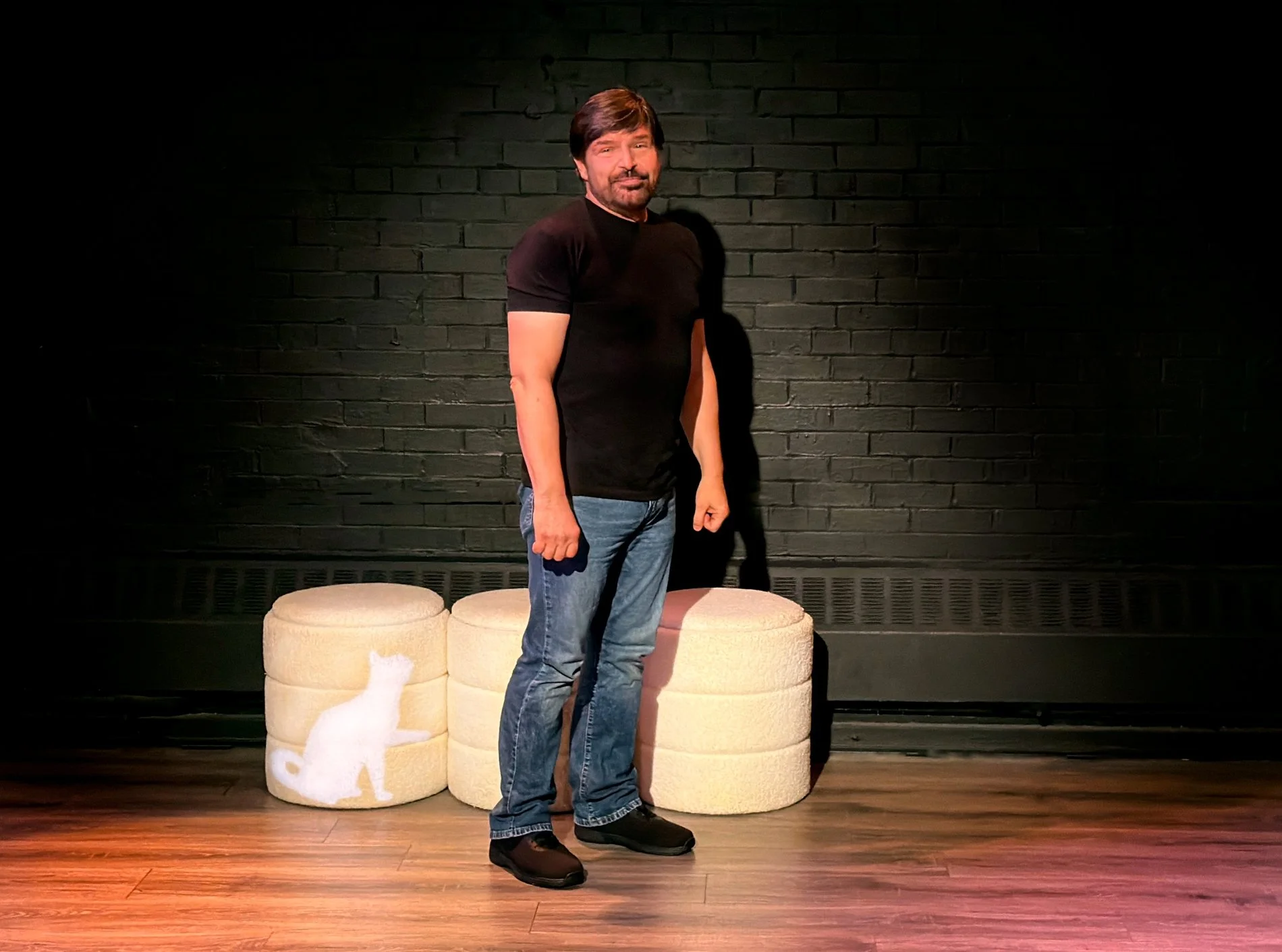
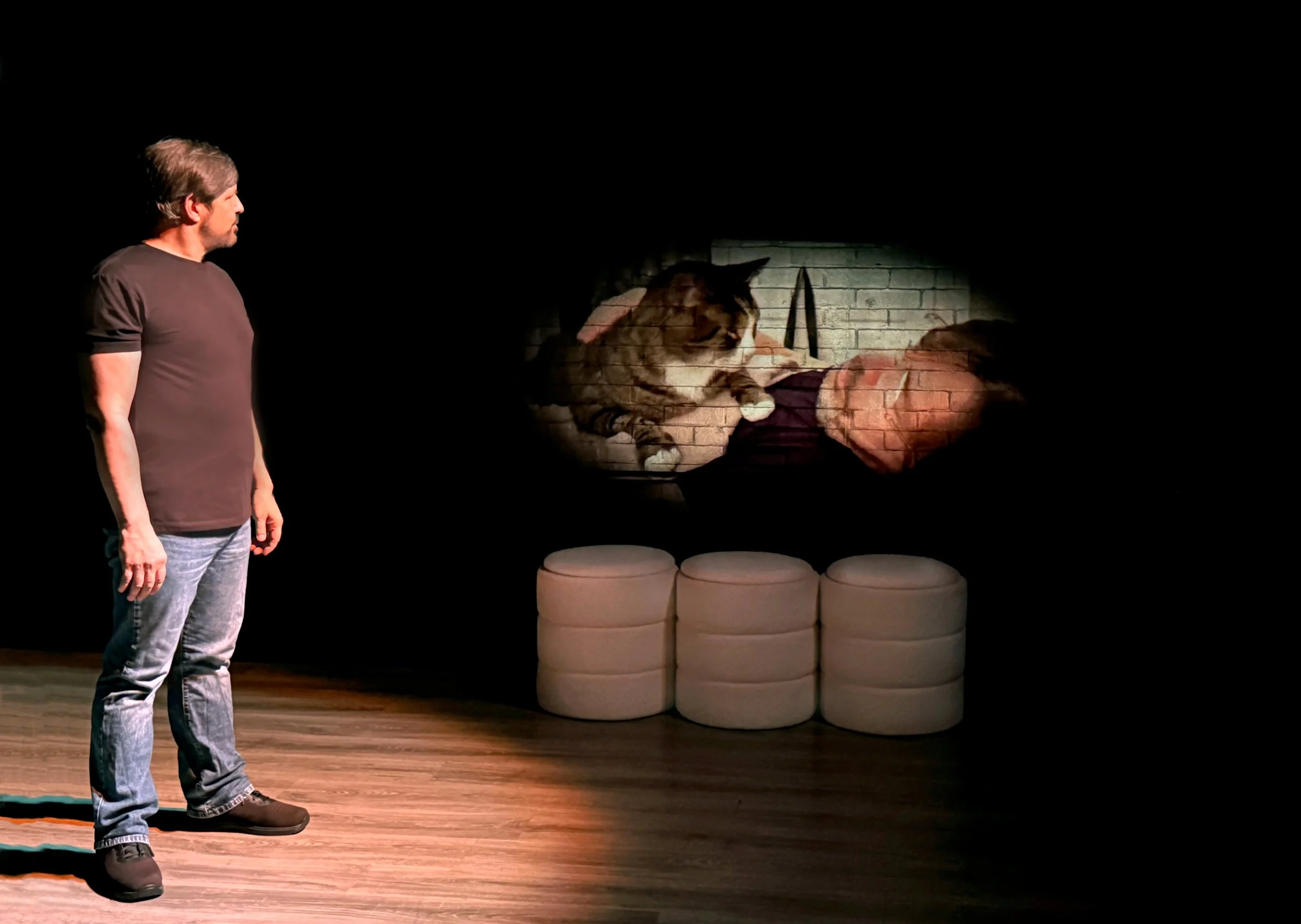
Photo Credit: Alan Rowe Kelly
There are solo shows that announce themselves as memoir, others that masquerade as stand-up, and still others that wrap confession in the reassuring fur of anecdote. Bob Brader's Kitty Daddy accomplishes something rarer. It begins with what sounds like the premise for a genial evening of pet stories—a man reluctantly adopts an unwanted cat—and quietly evolves into a searching meditation on trauma, anger, intimacy, and the mysterious ways healing can arrive disguised as inconvenience. Written and performed by Brader and sensitively directed by his wife Suzanne Bachner, this deceptively modest production proves that the smallest domestic dramas can illuminate the largest emotional truths.
Brader introduces himself as a contentedly solitary man, drifting from one temporary office assignment to another, perfectly comfortable keeping the world at arm's length. His life changes because of an overheard conversation. Learning that his supervisor intends to surrender a troublesome cat named Jade to a kill shelter, he impulsively volunteers to take the animal "just until" a permanent home can be found. It is the sort of decision people make believing it will minimally disrupt their lives. Instead, it dismantles the architecture of one.
The early chapters are irresistibly funny. Jade arrives not as an affectionate companion but as a compact engine of feline fury. For two weeks he barricades himself beneath Brader's bed, hissing and growling with operatic conviction at every overture. Brader lies awake wondering whether the animal is plotting to slit his throat in the middle of the night. His portrait of the bewildered temp worker suddenly sharing an apartment with what appears to be an embittered stray is beautifully observed, and Brader's gift for inhabiting multiple characters—the tearful family surrendering Jade, the anxious child asking why "that bad man" is taking him away, the officemates whose casual conversations alter a life—gives the storytelling theatrical elasticity. Even the running jokes about married life land gracefully, particularly Suzanne's inspired observation that Jade believes he is the wife and Suzanne is merely the household pet.
Yet Kitty Daddy never mistakes charm for substance. As Jade's relentless growling begins to fascinate him, Brader recognizes something disturbingly familiar. The cat's clenched body, forever braced for attack, mirrors emotions Brader has spent a lifetime suppressing. He speaks with remarkable candor about the tidal wave of rage that has always lived inside him, the way he bites his tongue and clenches his fists rather than allow it expression, and how isolation became less a preference than a survival strategy. The frightened animal beneath the bed gradually becomes an external manifestation of wounds Brader himself has never fully examined.
What follows is the evening's quiet revelation. Rather than presenting trauma as a series of sensational disclosures, Brader allows memory to emerge organically, each recollection prompted by the growing trust between man and cat. Childhood flashes surface with devastating clarity: a beloved stuffed cat that became a substitute for stability in an unstable home; a brutal episode of abuse after a household accident; the memory of a father abandoning the family dog by the side of the road; an explosive confrontation with a therapist who dares to name Bob’s father's cruelty for what it was. Brader recounts these moments without self-pity, allowing their cumulative weight to explain decades of emotional withdrawal. One of the evening's most penetrating observations—that depression is often rage turned inward—lands with the force of hard-won wisdom rather than psychological cliché.
The emotional center of the production arrives almost imperceptibly. One evening Jade simply climbs onto the couch, presses his back against Brader's stomach, and begins to purr. It is an action so commonplace to anyone who has lived with a cat that it scarcely seems theatrical, yet Brader transforms it into a profound act of mutual surrender. "Cats do not trust easily," he reflects, before admitting that neither does he. In that simple acknowledgment, the play ceases to be about rescuing an abandoned pet. It becomes the story of two damaged creatures, each teaching the other that vulnerability is not the same as danger. By the time Brader realizes that the good home he had been searching for Jade was his own, the audience understands that the same revelation applies equally to the man telling the story.
The final movement, encompassing the isolation of the pandemic, an unexpectedly joyous reunion after four months apart from his devoted furball, and Jade's heartbreaking battle with a rare cancer, is handled with extraordinary restraint. Brader refuses easy sentiment, making the inevitable farewell all the more overwhelming. His realization that he and Jade are leaving one another exactly as they first met—growling, only now from pain instead of fear—is the sort of emotional symmetry that fiction would hesitate to invent but life occasionally provides. The detail that Brader preserved recordings of Jade's purr and meow, now serving as his cellphone ringtone, could have been cloying in less capable hands. Here it becomes an elegy distilled to its purest essence: grief transformed into a daily reminder of love.
Bachner's direction wisely trusts both the material and the performer, allowing Brader's relaxed storytelling to gather momentum until ordinary recollections accumulate into something quietly profound. If one or two vocal characterizations—particularly Jade himself—occasionally lean a shade too endearing for a cat introduced as a barely contained ball of fury, the observation is minor beside the production's remarkable emotional precision. Kitty Daddy is not ultimately a play about cats, any more than The Velveteen Rabbit is about stuffed animals. It is about learning, often painfully and unexpectedly, that the walls erected to protect us can become prisons, and that salvation sometimes arrives on four paws, growling beneath the bed until we are finally ready to listen.
Review by Tony Marinelli.
Published by Theatre Beyond Broadway on July 22, 2026. All rights reserved.