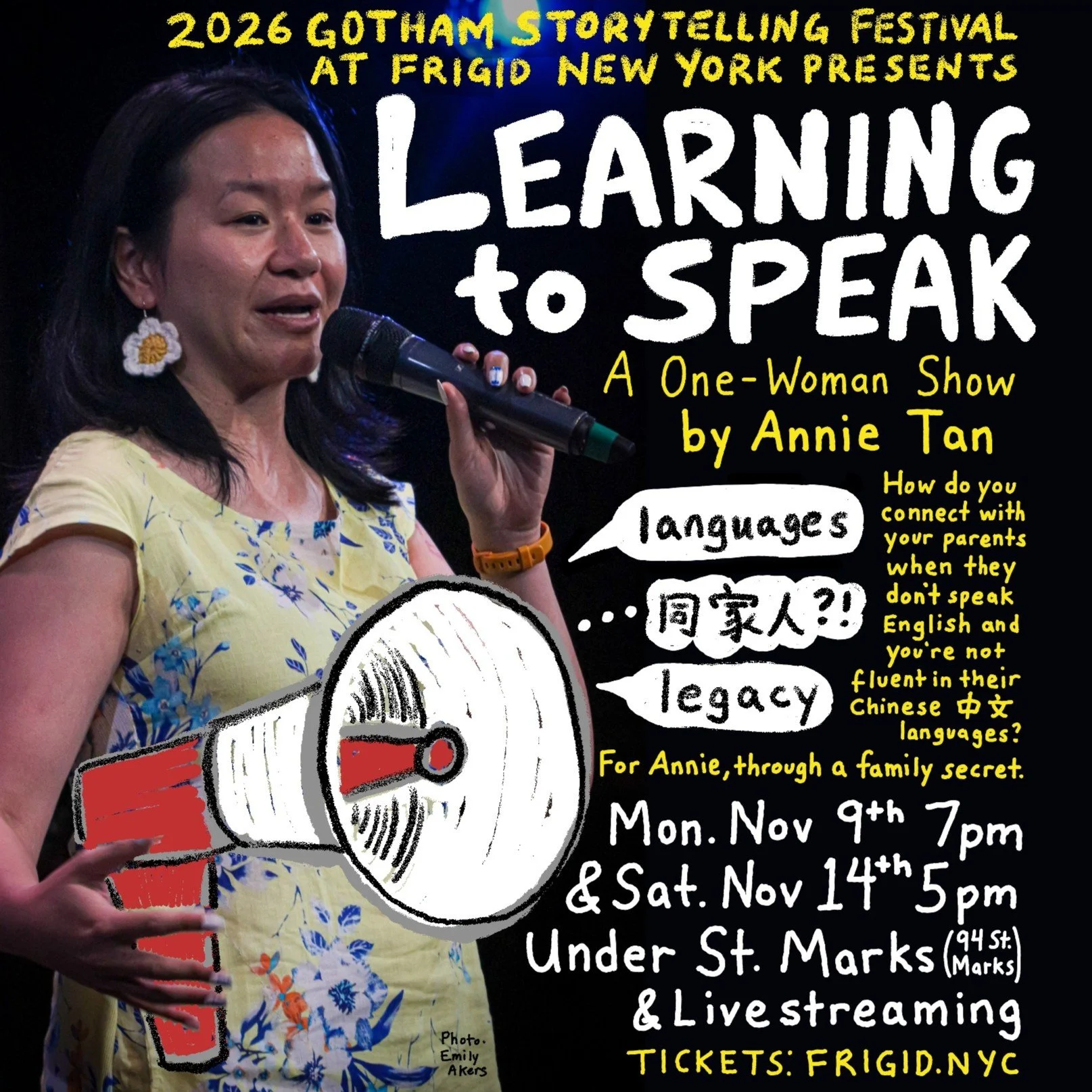
Written and Performed by Annie Tan
Under St Marks | 94 St Marks Pl, New York, NY 10009
November 9th and 14th, 20206
What happens when the language of your heritage is not the language you speak, and the history of your family is something you must discover for yourself? In Learning to Speak, Annie Tan takes audiences on an intimate and deeply personal journey through cultural identity, family secrets, and the complicated pursuit of belonging.
Adapted from her memoir-in-progress, the solo storytelling piece is the culmination of ten years of writing and performance. Tan brings an artful yet poignant approach to her storytelling, balancing personal vulnerability with a larger narrative steeped in activism. With minimal staging, a single chair, a pair of brown shoes, and projected images, she relies primarily on the power of her narrative to carry the audience through decades of personal discovery. Presented in the intimate setting of St. Mark's Place, the performance creates the feeling of being welcomed into her living room. The projections further enrich this intimacy, providing visual context without distracting from the story unfolding before us.
American-born Chinese, Tan explores the disconnect between her upbringing and her cultural inheritance. Although she attended Chinese school to learn Mandarin, it was not the language spoken in her family home. Her parents' limited English and her own unfamiliarity with their home languages, Cantonese and Toisan, created a communication gap that extended beyond words. It also shaped her sense of identity, leaving her questioning what it meant to be Chinese when she felt disconnected from the very culture she was trying to claim.
There are many aspects of the immigrant experience that transcend individual cultures and communities. Yet two elements particularly resonated in Learning to Speak: language and food. Both serve as essential links to the homeland, carrying culture, memory, tradition, and familial identity across generations. They are also languages of love, ways of expressing care and maintaining connection when words may fail. When these connections begin to disappear, the loss is palpable. What is lost is not simply the ability to communicate or the familiarity of a particular cuisine, but a sense of continuity with the people and places from which a family came.
Tan also introduces the concept of mo yung (méiyòng), meaning useless. For immigrant parents raising children in a new country, acclimation is often essential to their children's survival and success. Yet there is an inherent tension between adapting to a new world and preserving the values and cultural identity of the old one. The expectation that children be useful, productive, and capable of navigating their new environment can become another measure of success, while behaviors perceived as mo yung carry their own judgment. But what happens when the pursuit of fitting into one world creates distance from another? Tan explores this delicate balance between assimilation, parental expectations, and the desire to remain connected to one's roots.
A pivotal moment in Tan's journey comes through PBS's Becoming American: The Chinese Experience (2003), a documentary series examining the history and contributions of Chinese Americans. It opens a door to a history Annie had not fully known, ultimately leading her to the story of Vincent Chin, her cousin. What begins as historical curiosity develops into activism when she discovers the personal connection to Chin and the legacy of his murder.
Vincent Chin was a 27-year-old Chinese American man beaten to death with a baseball bat in Detroit in 1982 by two white men amid anti-Asian hostility fueled by resentment toward Japanese auto imports. His murder and the lenient treatment of his assailants galvanized a national Asian American civil rights movement.
There is also the extraordinary legacy of the great-aunties, the women whose strength and determination helped shape the family's history. Vincent's mother, Lily Chin, continued to speak publicly for her son and fight for justice, becoming an enduring voice in the Asian American civil rights movement. Her activism and refusal to let her son's story disappear offer an inspiring connection to Tan's own commitment to advocacy. The women in this family did more than preserve a memory; they gave it a voice and a purpose that continue across generations.
The personal and political begin to intertwine. Through her education at Columbia University, involvement in the Asian American Alliance, and continued research into Chin's murder, Tan finds herself drawn into a history that is both nationally significant and deeply personal. The image of a family member publicly demanding justice for Vincent Chin gives the historical narrative an emotional immediacy that resonates beyond the stage.
Yet the journey is not a straightforward celebration of cultural rediscovery. Tan's experiences in China reveal another layer of alienation. Even in a country connected to her ancestry, she struggles with language and belonging, while observing her father's ease in communicating with family members. The realization that she can feel like an outsider both in America and within the culture of her ancestors becomes one of the piece's central tensions.
Perhaps most compelling is the complicated relationship between advocacy and family. As Tan becomes increasingly invested in preserving and sharing Vincent Chin's legacy, her efforts create tensions with her own family. The desire to honor a family history raises difficult questions about representation, responsibility, and the distinction between telling a story and having the authority to speak for those whose lives it encompasses.
In this respect, Learning to Speak reaches beyond the familiar narrative of discovering one's roots. It examines what happens when the pursuit of identity challenges the very relationships one hopes to strengthen. Food, family memories, technology, and the eventual effort to reconnect through language become alternative pathways toward understanding.
Tan's story reminds us that communication is not simply about mastering vocabulary or finding the right words. It is about listening, making space for another person's experience, and recognizing that belonging is not always something that can be claimed through ancestry alone.
Learning to Speak is ultimately a story about finding one's voice while navigating the silences that families carry across generations. It asks an important question: When we inherit a history, how do we honor it without losing sight of the people who lived it?
Click HERE for tickets.
Review by Malini Singh McDonald.
Published by Theater Beyond Broadway on November 12, 2026. All rights reserved.