NICOLE TRAVOLTA IS DOING ALRIGHT
Presented by Twilight Theatre Co.
Written by Nicole Travolta and Paula Christensen
Directed by Margarett Perry and Paula Christensen
SoHo Playhouse, 15 Vandam Street, in Manhattan
April 1, 2026 - May 10, 2026




There is, in the theater, a particular species of alchemy—rare, volatile, and not a little dangerous—wherein private wreckage is transmuted, before our eyes, into public delight. It is not merely confession, nor quite catharsis, but something more exacting: the shaping of pain into form, the disciplining of chaos into rhythm. In Nicole Travolta Is Doing Alright, Nicole Travolta undertakes precisely this transformation, and with a brio that is as disarming as it is hard-won.
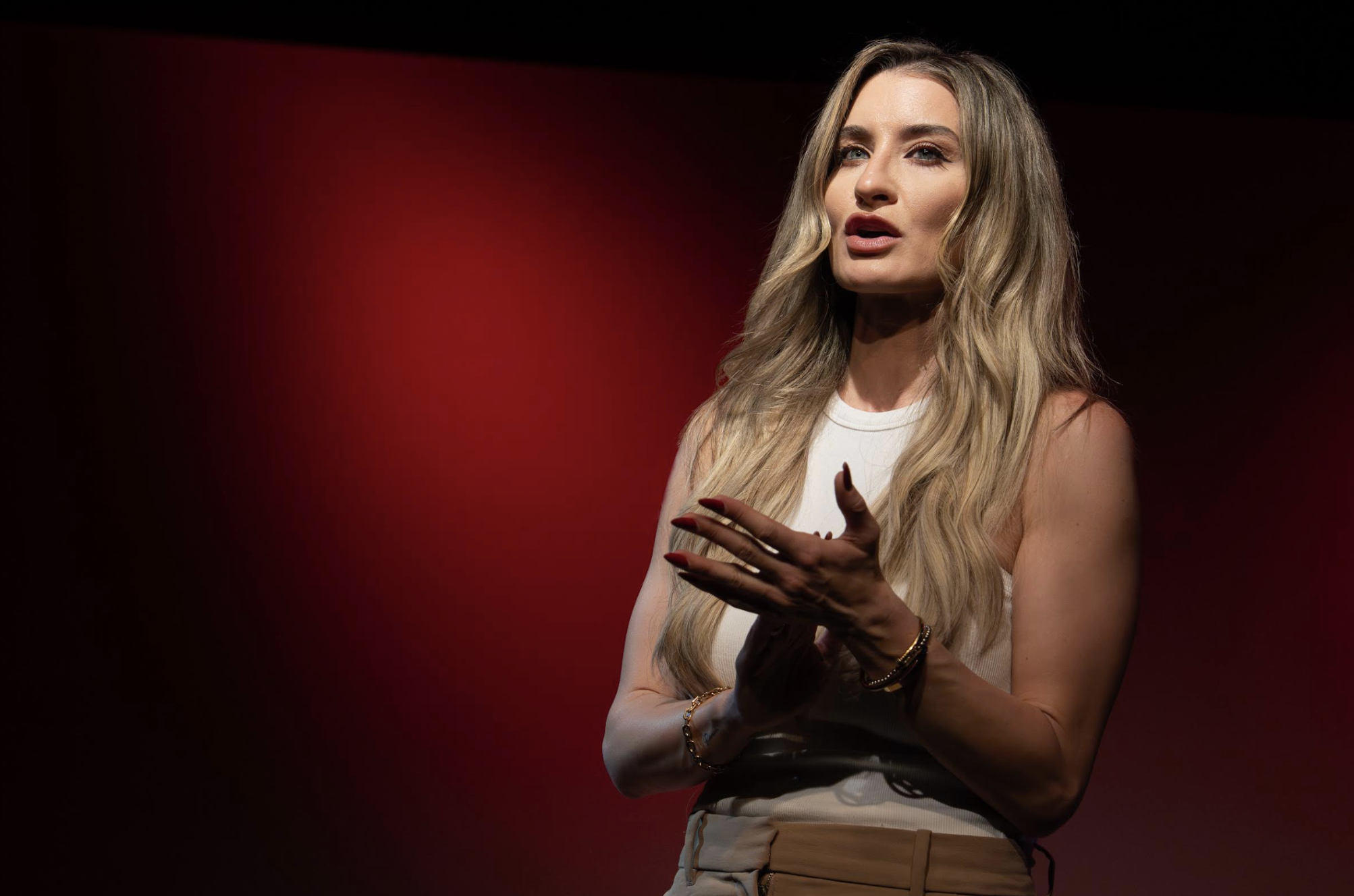
From the outset, Travolta announces herself not as a supplicant to her own past, but as its wry, unsentimental curator. She strides onto the SoHo Playhouse stage with a disarming ease and a comedian’s finely honed sense of self-mockery, situating herself amid a tableau that is at once chic and faintly accusatory: a pristine white couch, flanked by an almost sculptural arrangement of high-end shopping bags, their glossy surfaces gleaming with both aspiration and regret. The image lands before she has said a word. It is a life, distilled into props.
When she does speak, it is with the quick, knowing candor that will come to define the evening. Yes, she concedes, the surname carries its own freight—her uncle is John Travolta—but she wastes no time puncturing any assumptions that might accompany it. “Being a nepo niece,” she quips, with surgical timing, “is not the same as being a nepo baby.” The line, tossed off with a shrug that is equal parts defiance and amusement, does more than earn its laugh; it establishes the terms of engagement. This will not be a story about proximity to fame, but about the distance—emotional, financial, existential—that such proximity does nothing to close. What she offers onstage is refreshingly uninterested in legacy as spectacle. Instead, she gives us something knottier, more human: a chronicle of survival that zigzags through disappointment, reinvention, and the slow, often graceless reclamation of self-worth.
The narrative she assembles is not, by any measure, a gentle one. A fractured upbringing, a marriage that collapses under its own weight, and a descent into compulsive spending that accrues not only debt but a kind of psychic sediment—these are the materials. Yet Travolta refuses the inert heaviness such material might invite. She is, above all, a kinetic performer, and she propels herself through these episodes with a velocity that feels both defensive and deliberate. Shame is not lingered over; it is detonated, repurposed, and released as laughter. The effect is less that of excavation than of combustion.
There is, too, an immediacy to her subject matter that lends the evening a disquieting familiarity. The seductions of easy credit, the quiet fictions we tell ourselves in its wake, the creeping dread of consequences deferred—Travolta sketches these with a brisk, almost offhand precision. One recognizes the contours instantly. That she refuses to sentimentalize them, or to pause for the audience’s moral reassurance, is part of the show’s particular integrity.
If the first movement of the piece is governed by velocity, the second finds its peculiar poetry in absurdity—specifically, in Travolta’s stint as a spray tanner, a profession she renders with a mixture of anthropological curiosity and gleeful vulgarity. These sequences, at once raunchy and strangely tender, are among the evening’s most vivid. They unfold like a series of sunless tableaux, populated by bodies both aspirational and ridiculous, and narrated with a comic sensibility that is unafraid of the lowbrow. It is here that the show sheds whatever residual sheen of Hollywood proximity it might possess and settles into a more grounded, workaday surrealism.
Travolta’s facility with impersonation—she conjures, in quick succession, the recognizable cadences of Carrie Bradshaw, Drew Barrymore, and Jennifer Coolidge—serves not as mere ornament but as extension. These figures flicker in and out of the narrative like cultural ghosts, refracting her own sensibility rather than distracting from it. They are deftly deployed, never overextended, and function as a kind of tonal counterpoint to the more confessional passages.
The production itself, under the co-direction of Margarett Perry and Paula Christensen, maintains a nimble visual and rhythmic vocabulary. Projections glide in and out with a light touch, suggesting rather than insisting, while the staging honors Travolta’s restless momentum. There are moments when the piece threatens to careen—to tip from propulsion into haste—but the underlying structure, though loose, proves resilient.
And beneath it all, threading through the punchlines and digressions, is a quieter, more durable narrative: that of recognition. Of seeing, with increasing clarity, the patterns that ensnare us, and of choosing—haltingly, imperfectly—to resist them. Travolta does not present redemption as a polished arc; she parcels it out in increments, in uneasy realizations, in jokes that land a fraction of a second after they sting.
It helps, of course, that performing is so evidently native to her. With a résumé that spans television comedies and an improvisational pedigree rooted in The Groundlings, Travolta possesses a technical ease that allows her to flirt with disorder without ever fully succumbing to it. The chaos she depicts is, paradoxically, underwritten by control.
What emerges, finally, is a work that resists tidiness in favor of something more bracing: honesty, rendered theatrically. Nicole Travolta Is Doing Alright does not aspire to be pristine. It is jagged, irreverent, intermittently unruly—and all the more alive for it. One watches not for perfection, but for the unmistakable thrill of witnessing someone seize the fragments of a life and, with wit and will, make them cohere.
Nicole Travolta is Doing Alright continues through May 10, 2026
Click HERE for tickets.
Review by Tony Marinelli.
Published by Theatre Beyond Broadway on May 2 , 2026. All rights reserved.
