
TITUS ANDRONICUS
Written by William Shakespeare, Directed by Jesse Berger
Alice Griffin Jewel Box Theatre, The Pershing Square Signature Center, 480 West 42nd Street, New York, NY 10036
March 17, 2026 - May 3, 2026
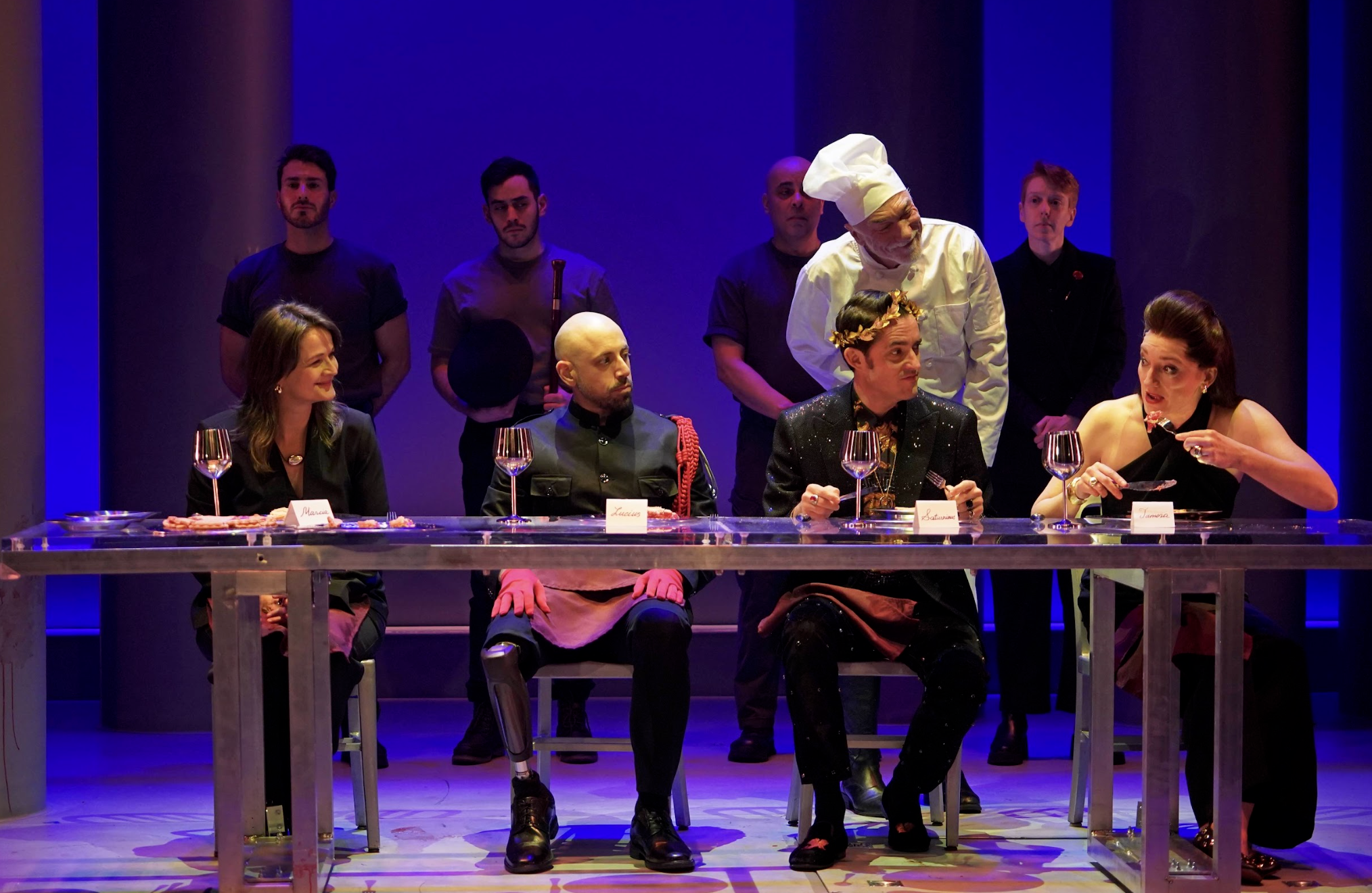
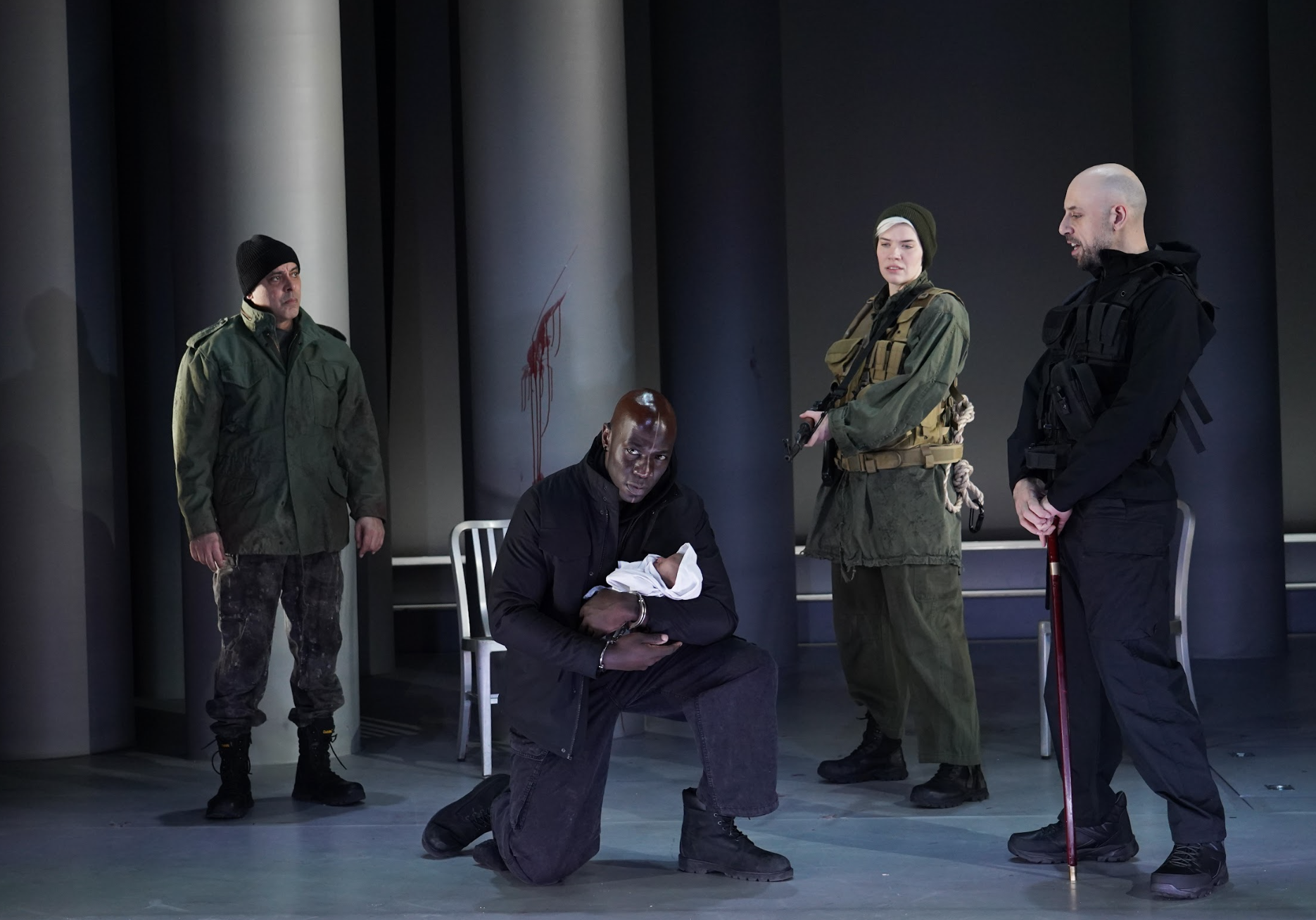
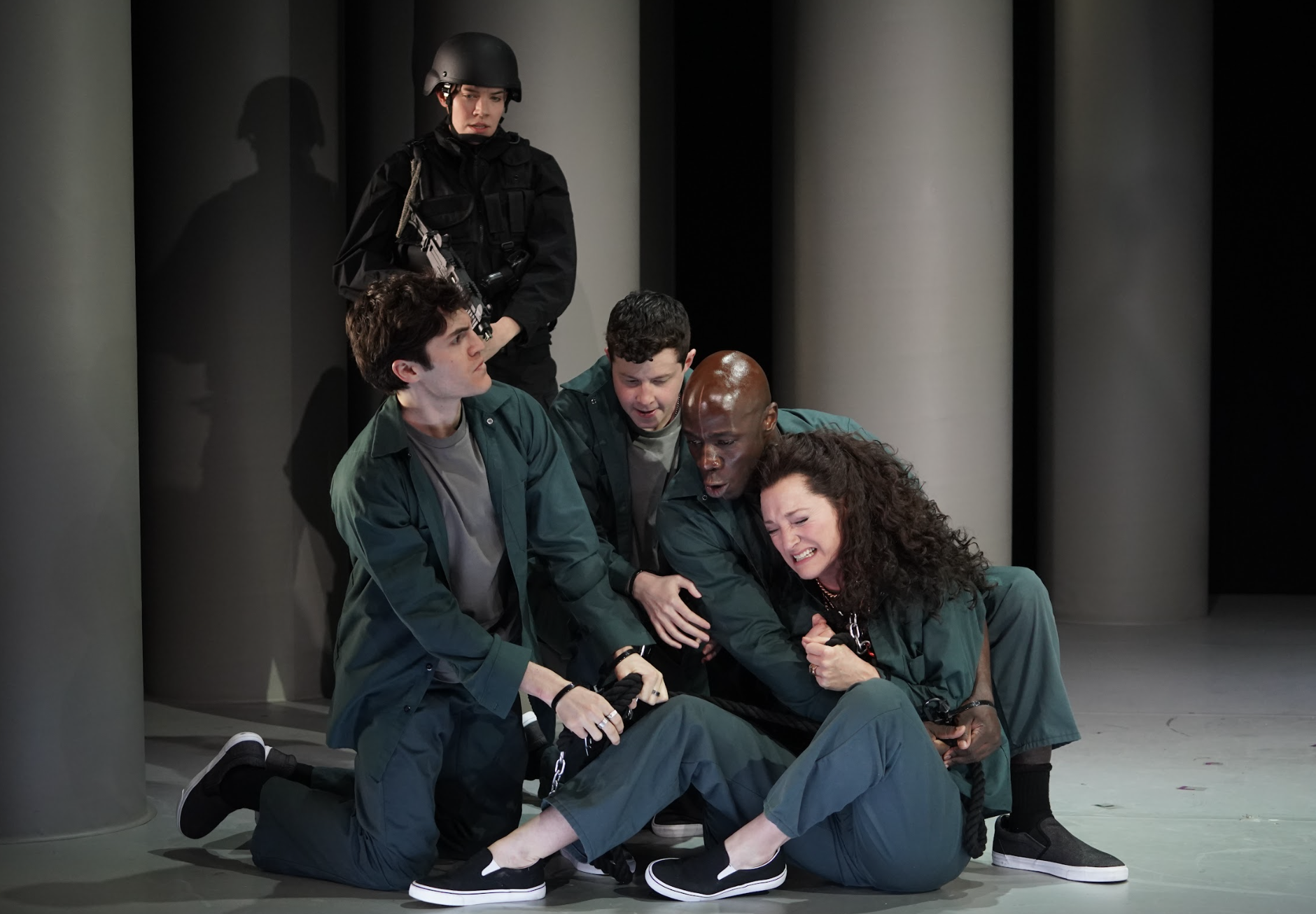
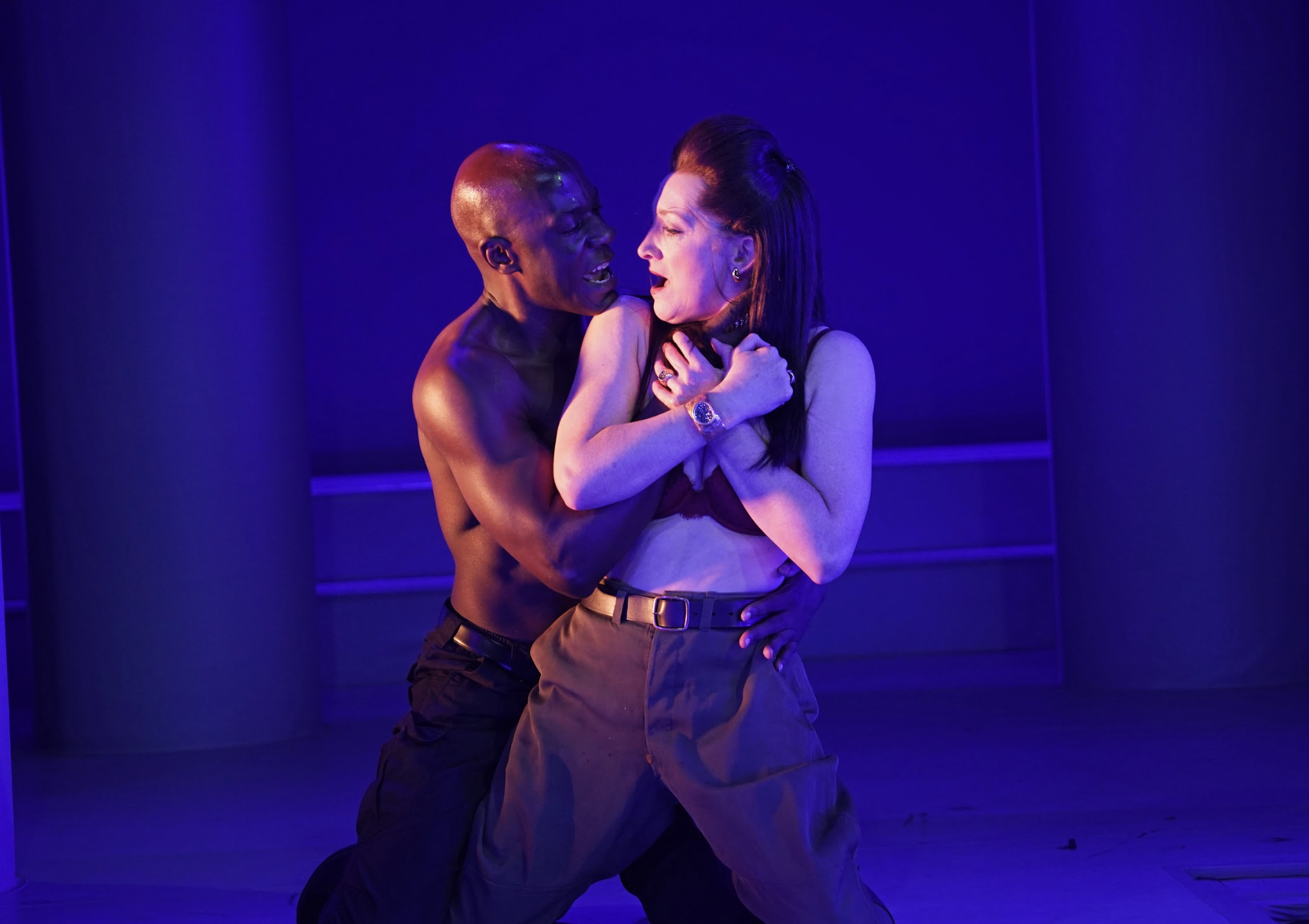
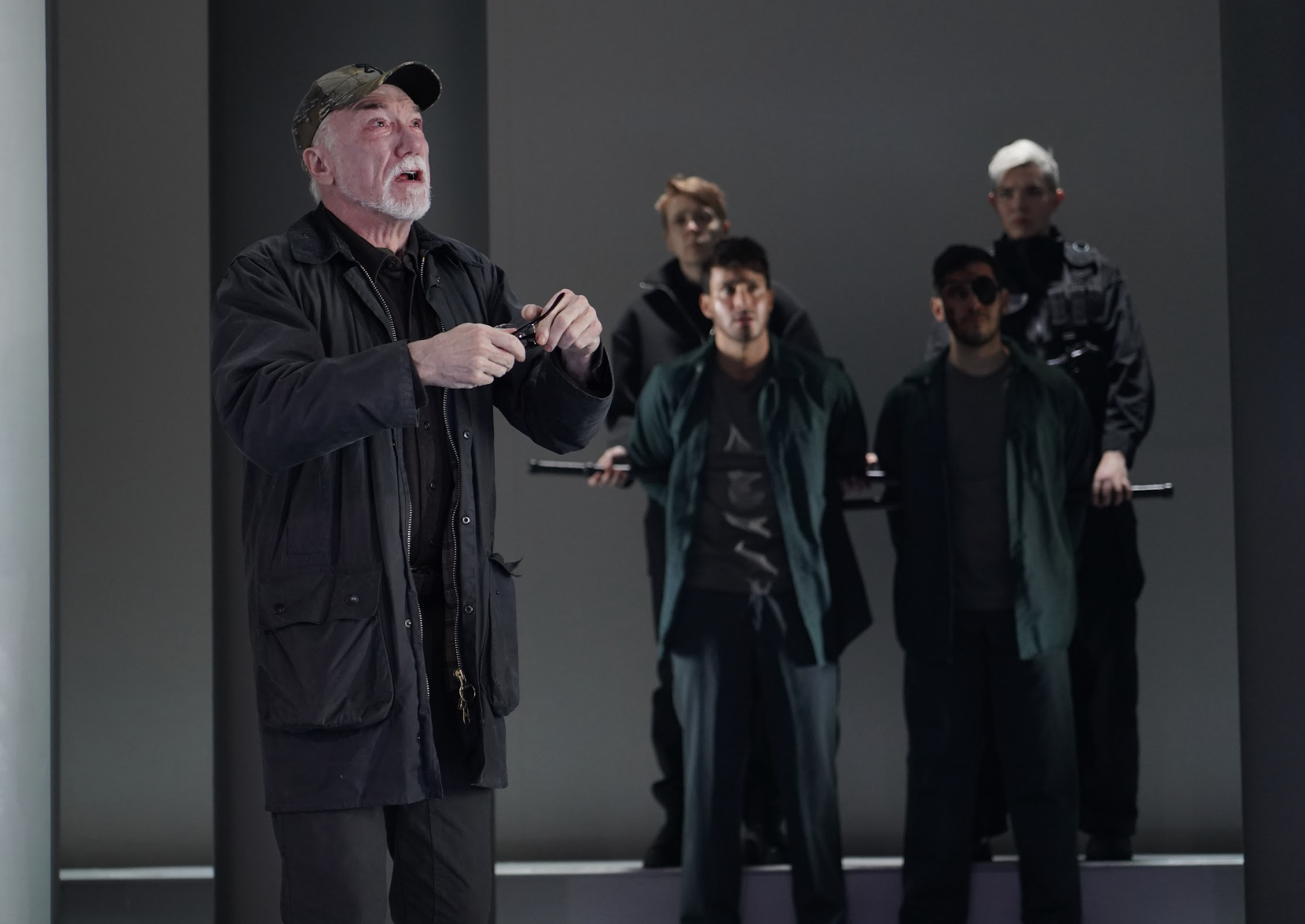
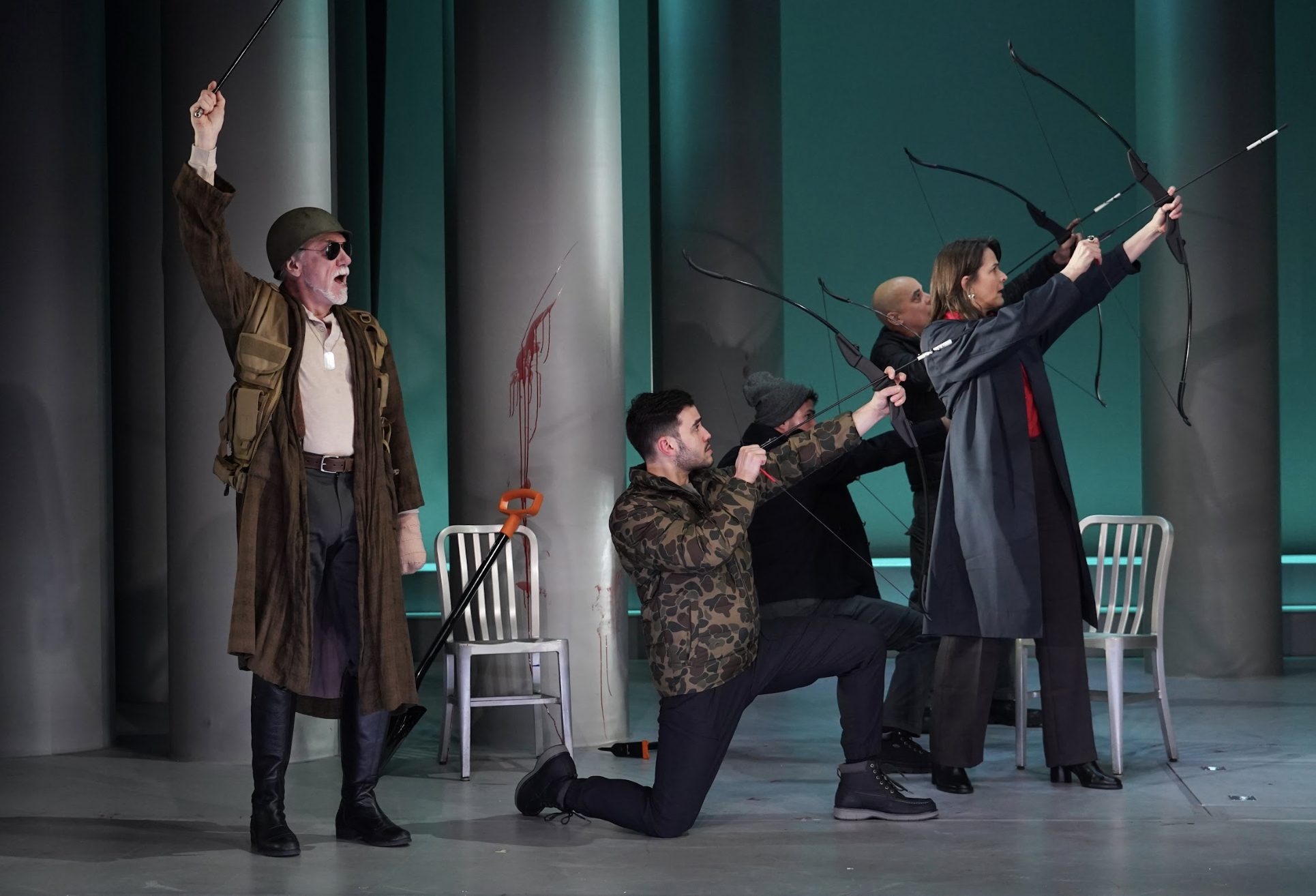
There are productions of Titus Andronicus that treat the play as an endurance test—an exercise in theatrical brinkmanship, daring the audience not to flinch—and there are those, rarer and more persuasive, that locate within its excesses a grim and lucid anatomy of power. Red Bull Theater’s current staging, adapted by Patrick Page and directed with a cool, insinuating intelligence by Jesse Berger, belongs emphatically to the latter category. What emerges is not merely a pageant of cruelty, though it is certainly that, but a work of unnerving coherence: a tragedy in which violence is not an aberration but a language, fluently spoken by rulers and subjects alike.
Written, scholars generally agree, in the early years of Shakespeare’s career, Titus Andronicus has often been dismissed as juvenilia—an overheated experiment in Senecan gore. Yet this production understands that the play’s extremity is its argument. Rome, here, is not a cradle of civilization but a machine for its undoing, a polity so steeped in ritualized vengeance that the boundary between justice and atrocity dissolves almost at once. Titus, returning in triumph from his campaign against the Goths, inaugurates the action with a sacrificial killing of Queen Tamora’s eldest son Alarbus that is both a politically sanctioned ritual and morally catastrophic. From that moment forward, the play proceeds with the inexorability of a curse.
Page, whose instrument—a basso profundo of almost architectural solidity—has long been one of the American theater’s more formidable resources, brings to Titus a grave authority that never tips into self-exoneration. His general is neither madman nor martyr but something more unsettling: a man so thoroughly formed by the logic of retribution that he cannot imagine an existence outside it. When, later, he laughs at his own desolation, it is not the laughter of hysteria but of recognition, a brief, terrible clarity. His climactic act, shades of a vengeful Emeril Lagasse in his crisp whites—serving Tamora her sons baked into a pie—is staged not as grotesque spectacle but as the inevitable culmination of a system that has devoured itself.
Opposite him, Francesca Faridany’s Tamora charts a transformation from captive queen to empress of reprisals with a ferocity that is at once erotic and strategic. Her alliance with the Moor Aaron, played by McKinley Belcher III with a silken, insinuating menace, forms the production’s dark center of gravity. Belcher resists the temptation to inflate Aaron into a figure of grand villainy; instead, he renders him precise, almost clinical in his manipulations, culminating in a confession whose chilling pride—“Ay, that I had not done a thousand more”—lands not as bravado but as credo.
Berger’s most consequential intervention, however, lies in the reimagining of Marcus as Marcia, here portrayed by Enid Graham with a composed, searching intelligence. No mere witness, Marcia becomes the play’s moral countercurrent, a figure who insists—quietly, stubbornly—on the possibility of care within a world that has abandoned it. It is she who discovers her victim niece. Her scenes with Lavinia, an undeniably pitiable Olivia Reis, the violated daughter of Titus, are among the production’s most affecting. When she teaches the mutilated young woman to communicate by guiding a pen with her mouth, the gesture carries a weight disproportionate to its modesty: a fragile reclamation of language in a play otherwise defined by its annihilation.
If Berger occasionally permits moments of tonal dissonance—glimpses of broad comedy in the posturing of Saturninus (Matthew Amendt, delighting in the emperor’s absurdities) or the brutish antics of Tamora’s sons Chiron and Demetrius, played respectively as the personification of evil by Jesse Aaronson and Adam Langdon—these do not so much relieve the horror as refract it. The laughter they provoke is uneasy, even complicit, reminding us how readily cruelty can be trivialized when it is codified as power.
The design, characteristically for Red Bull, situates the action in a liminal temporal space. Beowulf Boritt’s columns evoke antiquity while refusing its weight; they are skeletal, almost provisional, as though Rome itself were a façade. Jiyoun Chang’s lighting floods the stage in lurid purples and greens, punctuated by vertical neon that suggests a future already contaminated by the past. Emily Rebholz’s costumes—military uniforms, contemporary formalwear, the emperor’s gleaming suit—complete the impression of a civilization untethered from any single era, and therefore from the illusion that such violence belongs to one.
Adam Wernick’s and Shannon Slaton’s sound design unfolds as a kind of perverse orchestration of empire, a meticulously layered aural environment in which thunder cracks, armies clash, crowds exult, and ceremonial trumpets announce power with hollow grandeur. The effect is less accompaniment than architecture: a sonic edifice that sustains the production’s atmosphere of ritualized violence and civic decay. Yet the sound designers’ most disquieting gesture arrives not in the expected crescendos of battle, but in a moment of eerie restraint. Just before the play’s final cascade of bloodletting, he introduces a placid, airport lounge instrumental rendering of Louis Armstrong’s “What a Wonderful World.” The choice is at once ironic and insidious, its gentle optimism curdling into something grotesque when set against the imminent carnage. In that uncanny disjunction—between the sentimental promise of harmony and the spectacle of annihilation—the production locates one of its most chilling truths: that the language of beauty and the machinery of brutality are, more often than we care to admit, uncomfortably intertwined.
The production does not stint on brutality. Blood is omnipresent; severed limbs and heads appear with a matter-of-factness that is, paradoxically, more disturbing than extravagance. Yet what lingers is not the spectacle of violence but its banality—the sense that these acts are not eruptions but continuations. Even the final image, with Lucius, a very regal Anthony Michael Lopez, ascending to power after yet another killing, offers no catharsis, only the suggestion of recurrence.
What Red Bull’s Titus Andronicus ultimately proposes is that Shakespeare’s first tragedy is also, in some respects, his most direct. Stripped of the philosophical hesitations that would complicate the later plays, it presents a world in which vengeance is both cause and effect, an endless loop of injury and reprisal. Berger and his company do not soften this vision; they clarify it. One leaves the theater less stunned than sobered, aware that the play’s most unsettling quality is not its distance from us, but its proximity.
Click HERE for tickets.
Review by Tony Marinelli.
Published by Theatre Beyond Broadway on April 29, 2026. All rights reserved.
