
NO SINGING IN THE NAVY
Presented by Playwrights Horizons
Book, Music & Lyrics by Milo Cramer, Directed by Aysan Celik
Peter Jay Sharp Theater, Playwrights Horizons, 416 West 42nd Street, in Manhattan
March 18 - April 26, 2026
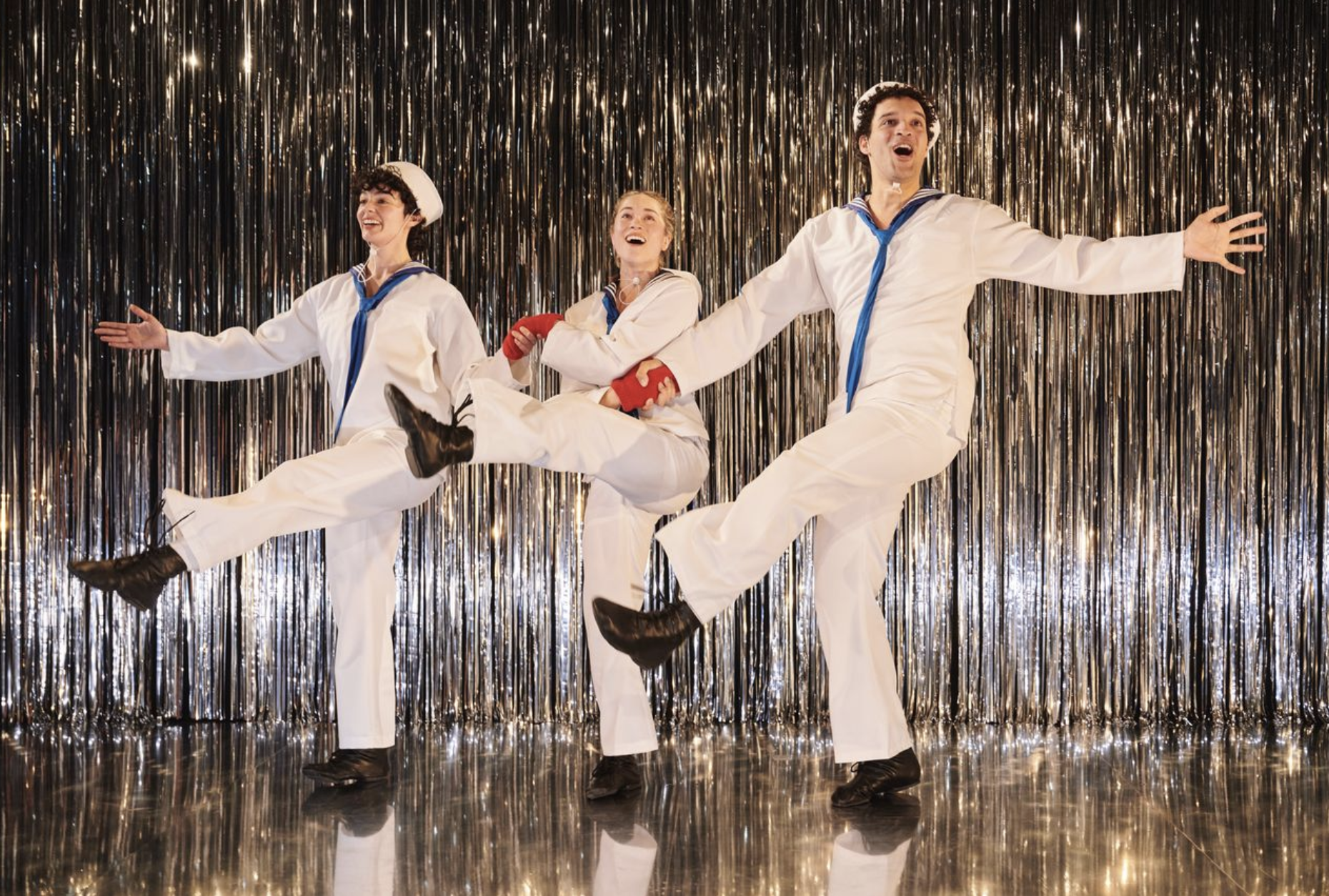
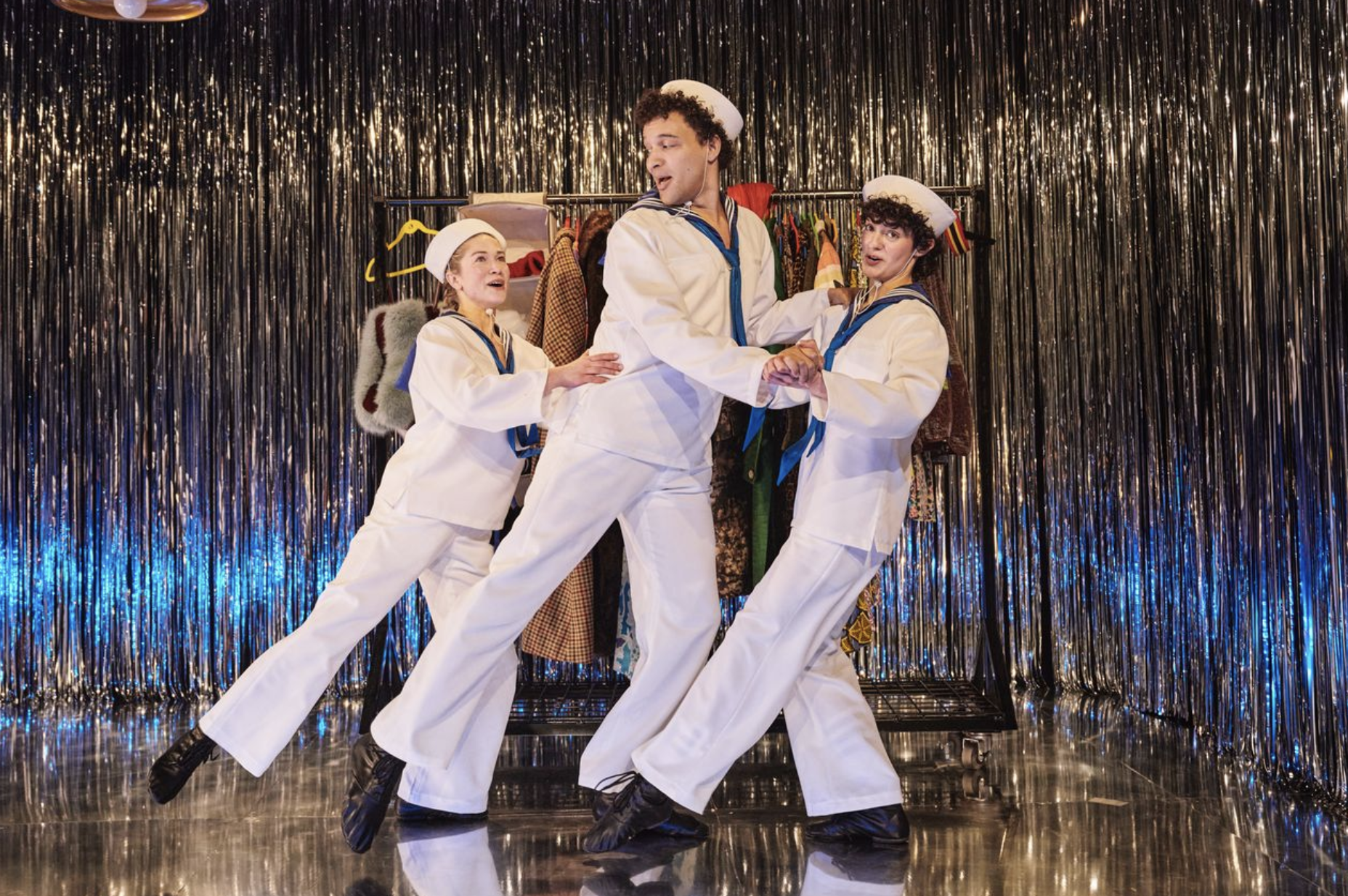
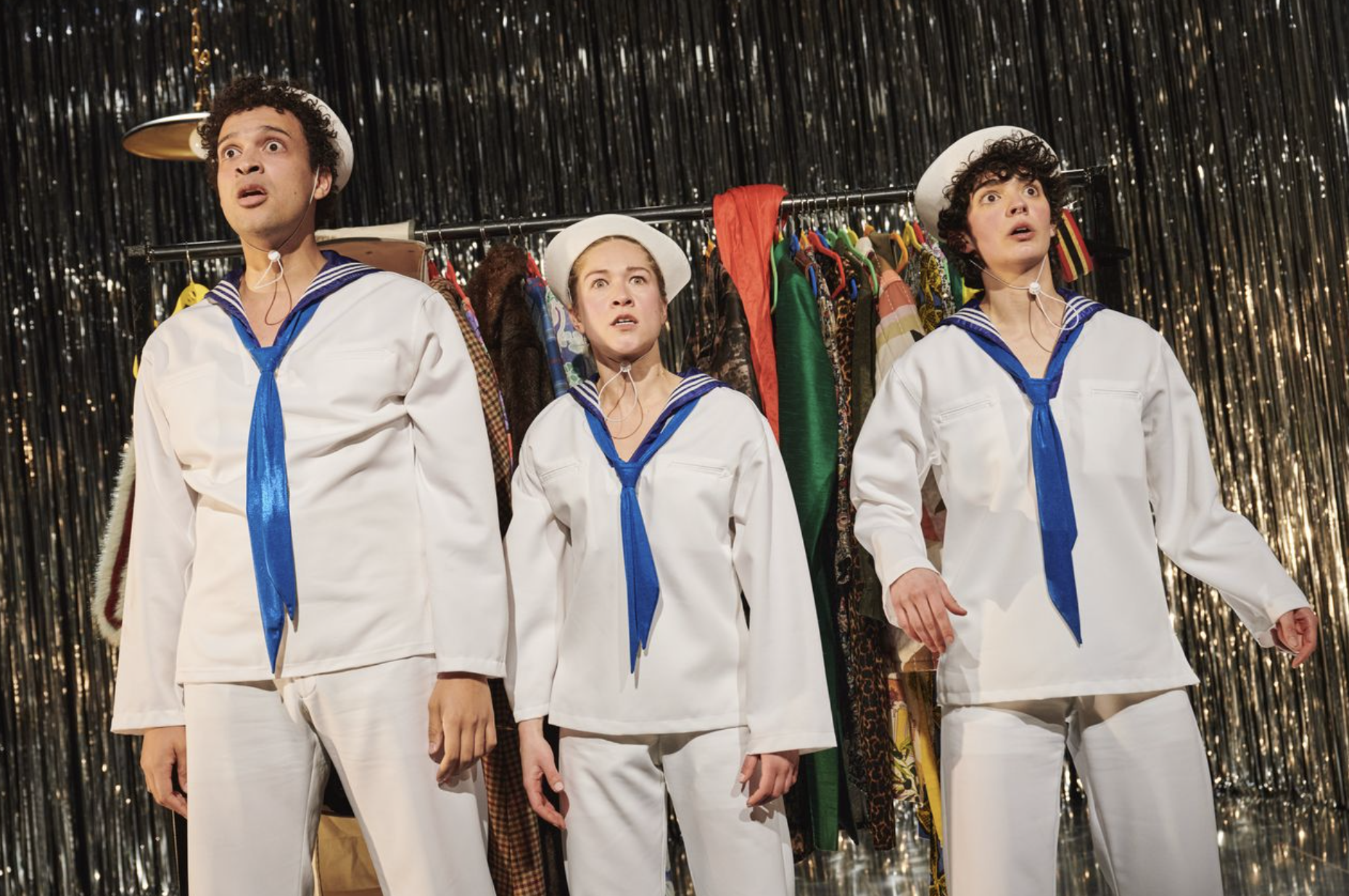
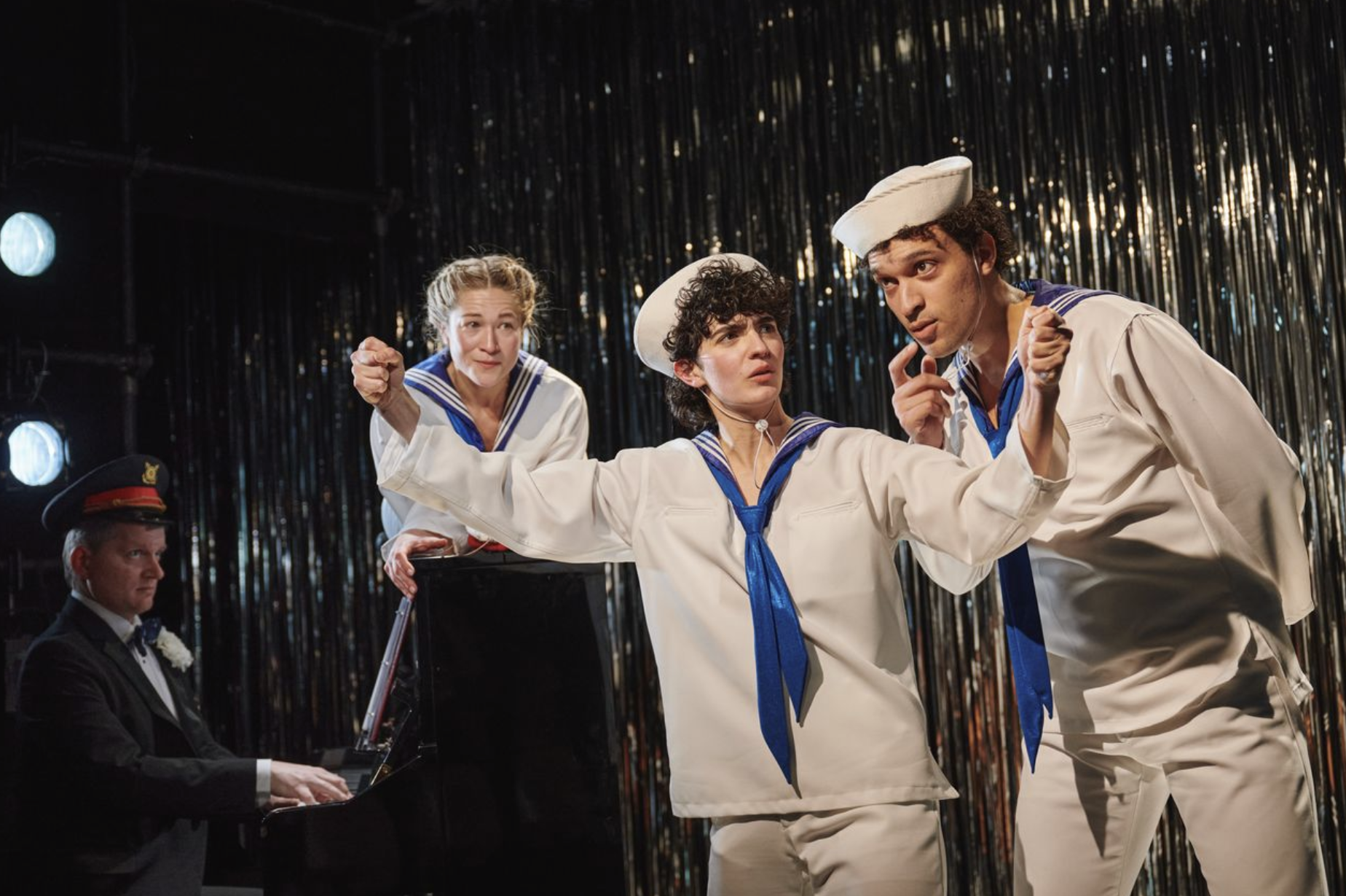
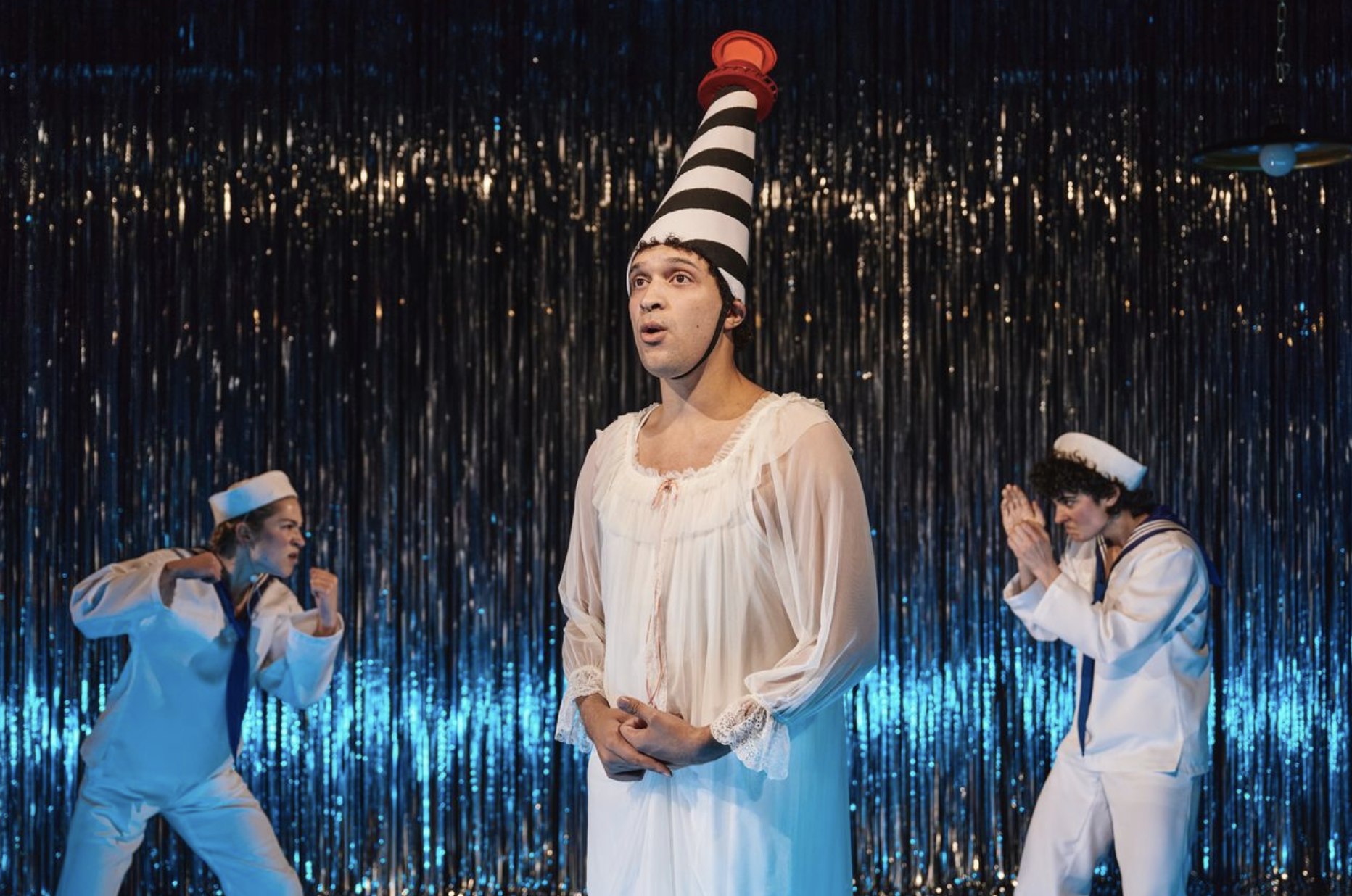
Photo credit by Valerie Terranova
The theater has always trafficked in a kind of sanctioned absurdity, but every so often a work arrives that does not merely acknowledge that condition—it exalts it, turns it inside out, and offers it back to us as both joke and benediction. Such is the peculiar, disarming achievement of No Singing in the Navy, now at Playwrights Horizons, a new musical by Milo Cramer—fresh from an Obie for School Pictures—and directed with a kind of conspiratorial precision by Aysan Celik. What begins as a premise of almost vaudevillian simplicity—three sailors granted a final twenty-four hours on shore, under the Captain’s tyrannical prohibition of song—quickly metastasizes into something stranger, looser, and, ultimately, more affecting than one might reasonably anticipate. The Captain’s rule is, of course, the one injunction the theater itself cannot abide. And so, like their cinematic forebears, they succumb almost immediately to the irrepressible urge to burst into song.
The production announces itself with a ritualistic economy: three performers—Bailey Lee, Elliot Sagay, and Ellen Nikbakht—march forward in unison, self-identifying with an almost Brechtian plainness as Sailors 1, 2, and 3. Yet this declarative gesture is merely the threshold. Within moments, the stage dissolves into a subaqueous fantasia, the actors donning red mittens to incarnate crabs—creatures at once comic and faintly tragic, trapped in a bucket that doubles as both literal container and existential condition.
The heroine crab—embodied with disarming agility by Bailey Lee—emerges, improbably, as one of the musical’s central figures. Introduced in the delightfully perverse “Crab Family Operetta,” she begins as a creature of thwarted ambition, scrambling to escape the confines of her barrel only to be met with a chorus of familial discouragement so insistent it borders on ritual. Her surrender, however, proves premature: in a comic volte-face, her kin abruptly reverse course—“Are you kidding me? You gotta go”—transforming inhibition into propulsion.
From there, the crab’s journey unfolds in a series of increasingly strange and affecting tableaux. She encounters the sailors and, in a gesture that feels at once absurd and faintly mythic, becomes their unlikely vocal tutor, initiating them into the forbidden art of song. Elsewhere, she pauses to marvel at the vastness of the ocean, her wonder rendered with a sincerity that briefly stills the show’s otherwise restless momentum. And later—one of the piece’s more darkly comic turns—she is confronted with the unsettling revelation that sailors, those newfound companions, are also her species’ predators. The moment lands not as a throwaway gag but as a small existential rupture, emblematic of the musical’s peculiar ability to locate genuine feeling within its most outlandish conceits.
From here, the piece proceeds by accumulation rather than escalation, each episode compounding the last with a kind of gleeful disregard for tonal stability. The sailors, newly musical, embark upon a spree of improbable adventures: wagering their naval vessel in a casino, speculating—without apparent irony—on the logistics of swimming to war; infiltrating a theater beneath the dubious camouflage of a single trench coat; and pursuing the elusive figure of the Lighthouse Woman, a spectral beloved rendered with an almost operatic absurdity by Sagay. The effect is less narrative than fugue-like, themes introduced, abandoned, and reconstituted in ever more unlikely configurations.
And yet, for all its anarchic surface, Cramer’s writing is steeped in the deep grammar of the form it so playfully distorts. Characters veer mid-phrase from song into monologue, invoking the humid introspection of Tennessee Williams before slipping back into a patter that recalls the insinuating rhythms of Harold Hill. Elsewhere, a number of roguish ambition conjures the folkloric lilt of Fiddler on the Roof, while a play-within-the-play is delivered with the high tragic solemnity of Hamlet. These are not mere pastiches but affectionate distortions, citations filtered through a sensibility that understands the musical not as a stable genre but as an elastic, ever-mutating language.
The comedy, too, is pursued with a kind of monomaniacal rigor. Gags are not simply executed but exhausted, wrung dry and then, perversely, extended beyond their natural lifespan—an overinsistence that becomes, in itself, the joke. A repeated “perchance” accrues a strange, incantatory force; a vision of the Lighthouse Woman in a diaphanous nightgown, crowned with a glowing beacon, unfolds alongside a background of mimed aquatic torture. One senses throughout a willingness to risk bad taste, even failure, in the pursuit of something more volatile than mere cleverness.
What prevents these excesses from curdling into embarrassment is the unwavering commitment of the performers, who refuse the easy refuge of irony. Lee, Sagay, and Nikbakht inhabit this deranged universe with an almost devotional seriousness, grounding even the most outlandish conceits in a recognizable emotional logic. Their physicality—elastic, grotesque, occasionally bordering on the alarming—is always tethered to a core of sincerity, as though the body itself were straining to keep pace with the unruly demands of the material. Nikbakht takes delight in the Captain’s unexpectedly legible attraction to his sailors—handled with a surprising degree of candor—registers as more than a throwaway provocation. Instead, it becomes a quietly destabilizing detail, complicating what might otherwise be a figure of pure authoritarian cruelty. In allowing these submerged desires to flicker to the surface, the production grants the character a measure of psychological texture, suggesting that even the most rigid enforcers of order are not immune to the unruly pull of longing.
It is this sincerity that permits the work’s most surprising turn: its emergence, almost despite itself, as something tender. Beneath the layers of antic invention lies a recurrent anxiety about mortality and separation, articulated in the haunting refrain, “What if you die first and then I have to miss you?” Even the most ludicrous scenarios—a pair of sea ants veering from cruelty into rapture—resolve into declarations of longing that feel disarmingly direct. Cramer, it becomes clear, is not satirizing the musical’s propensity for emotional overflow but embracing it, insisting that such excess is not a flaw but the form’s animating principle.
To navigate the narrow strait between earnestness and outright silliness requires a particularly steady hand, and while No Singing in the Navy occasionally drifts into more wayward waters, it never quite loses its bearings. What anchors the enterprise—what keeps it from capsizing under the weight of its own absurdity—is the unwavering emotional core at its center, a sincerity that persists even as the surrounding theatrics threaten to spin gloriously out of control.
Presiding over the evening with a kind of wry, old-world formality, Kyle Adam Blair—immaculately turned out in tuxedo and bow tie—renders the entire score from an upright piano, his presence both anchoring and gently puncturing the production’s gleeful absurdity. There is something quietly virtuosic in the way he sustains the musical fabric single-handedly, his playing at once precise and elastic, as if in constant dialogue with the performers’ capricious rhythms. Positioned in full view, he becomes less an accompanist than a conspirator, lending the proceedings an air of intimate, almost conspiratorial theatricality. Under Celik’s guidance, the production maintains a buoyant, almost reckless momentum, its comic inventions unfurling with a rollicking exuberance even as the narrative hurtles—unstoppably—toward its darker conclusions. Celik proves deft at sustaining this tonal double exposure, allowing the frivolity to crest without ever losing sight of the mortal stakes that shadow the sailors’ brief, blazing reprieve.
Krit Robinson’s design, which reduces the stage to little more than an upstage rain curtain, possesses a kind of austere elegance that feels entirely in keeping with the production’s bare-bones ingenuity. Under Masha Tsimring’s hand, that curtain shimmers with an almost hypnotic intensity—so much so that, on occasion, its glittering insistence threatens to rival the performers themselves for our attention. Yet even this slight visual overreach registers less as a misstep than as an extension of the show’s larger aesthetic of excess. By contrast, Enver Chakartash’s sailor costumes offer a welcome note of clarity and precision, grounding the production in a recognizable theatrical vocabulary even as it veers toward the surreal. And Tei Blow’s design—subtle, assured, and unobtrusively supportive—provides the necessary acoustic scaffolding, allowing the evening’s more flamboyant elements to unfold without tipping into chaos.
By the time the sailors arrive at their closing avowal—“I love you a lot, it’s all that I got”—the line lands with an unexpected clarity, stripped of irony, almost embarrassingly plain. It reads as both a character’s confession and an artist’s credo, a statement of faith in a medium predicated on the belief that feeling, at a certain pitch, must spill over into song. One leaves the theater uncertain whether one has witnessed a brilliant folly or a minor revelation, but with the distinct impression of having been addressed, however obliquely, in earnest. And in a theatrical landscape often wary of such naked gestures, that earnestness feels, in its own way, radical.
Click HERE for tickets.
Review by Tony Marinelli.
Published by Theatre Beyond Broadway on April 25, 2026. All rights reserved.
