
OUR HOUSE
Presented by The Other Side of Silence
Written by Barry Boehm, Directed by Mark Finley
The Jeffrey and Paula Gural Theatre at A.R.T./New York Theatres, 502 West 53rd Street, in Manhattan
February 26, 2026 - March 21, 2026
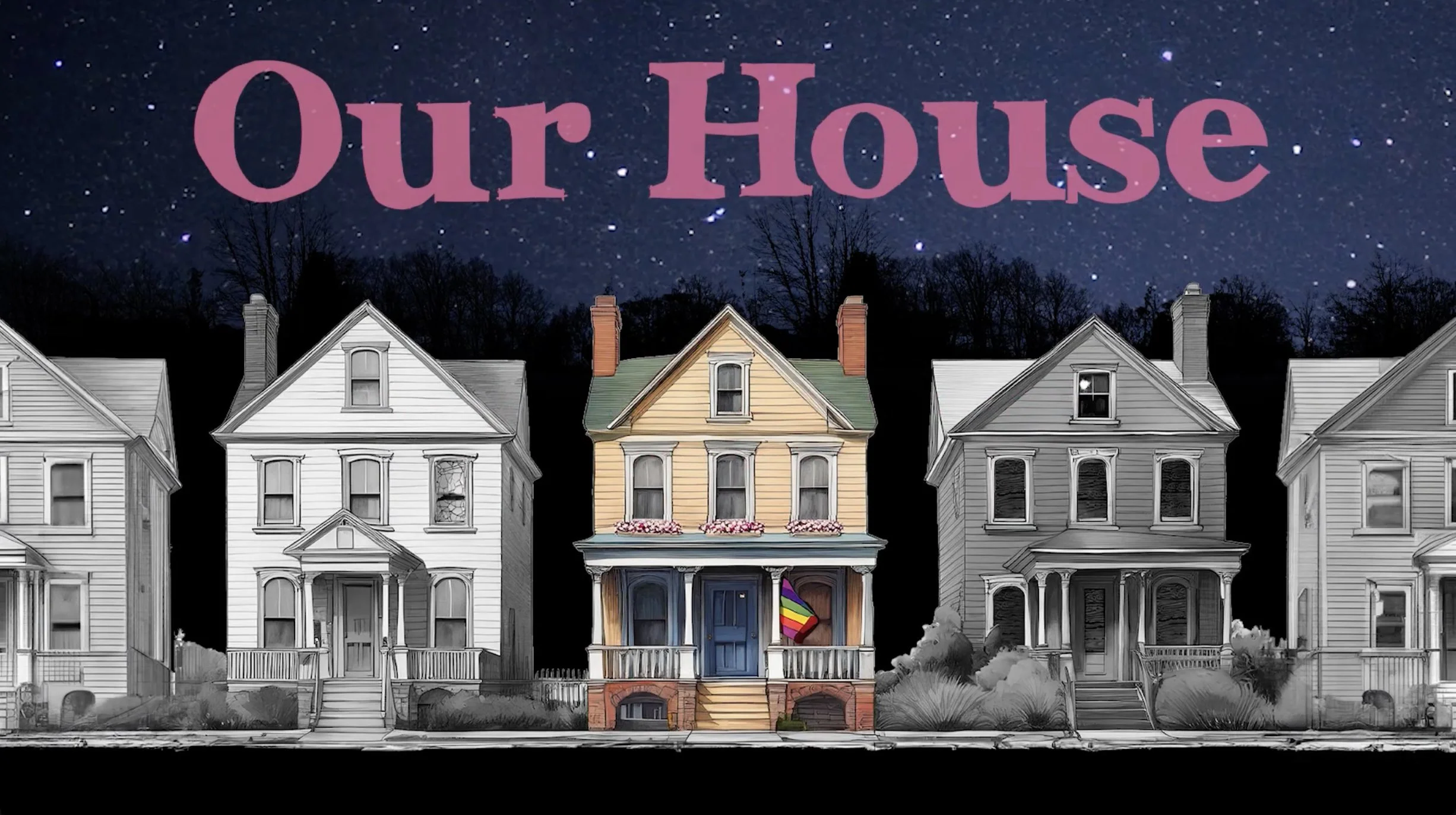
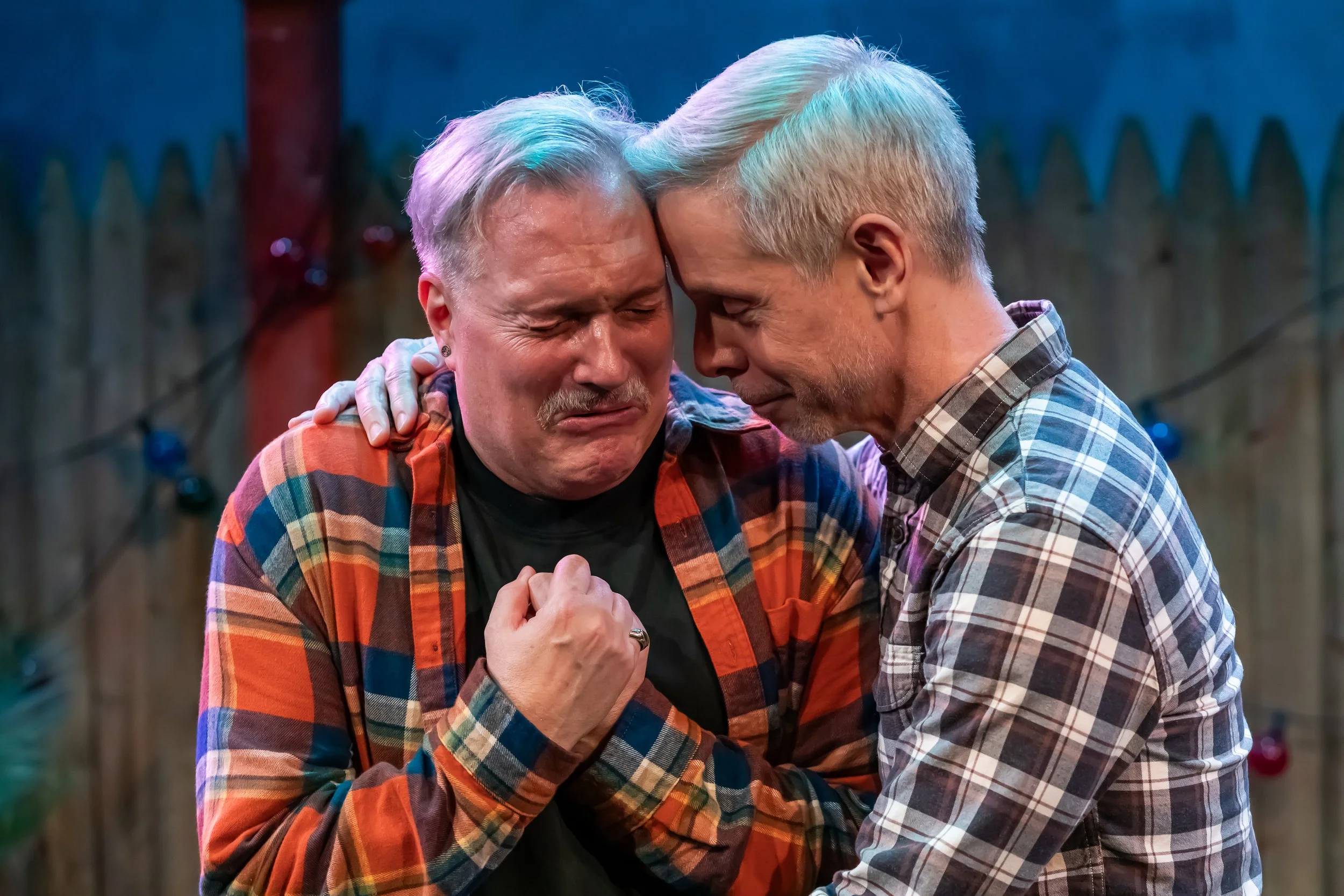

There is, in Barry Boehm’s galvanic and unexpectedly tender new play Our House, a sense of history pressing in from all sides—personal, political, and painfully unfinished. Presented by TOSOS (The Other Side of Silence), that indefatigable steward of queer theatrical memory and invention, the production arrives not merely as a premiere but as an event of quiet consequence, unfolding with a disarming intimacy at the Gural Theatre that belies the sweep of its concerns.
Boehm situates his drama in the backyard of a modest Midwestern home—an Iowa river town, unnamed yet legible in its textures, its silences, its coded hostilities. The space itself becomes a kind of arena, at once domestic and exposed, where the past is neither past nor evenly distributed. Andy (a superbly volatile Christopher Borg) and his husband Stanley (the finely modulated Tim Burke) have returned, or perhaps retreated, from New York to this place of Andy’s origin, bringing with them not only the residue of a shared life in New York City but the psychic sediment of decades spent negotiating visibility, survival, and, now, an uneasy domesticity.
The year is 2014, poised on the cusp of federal marriage equality—a historical threshold that Boehm treats not as triumph but as prelude. Less than a year before the Supreme Court’s ruling in Obergefell v. Hodges affirmed the right of same-sex couples to marry nationwide (marriage equality having already come to Iowa—the Hawkeye State—in 2009), Our House unfolds in the uneasy shadow of a victory not yet secured. Boehm treats that impending decision not as a foregone triumph but as a horizon flickering with uncertainty—a reminder that what is won in law is not always settled in life. (Seen from the vantage of 2026, the ruling’s permanence feels less like bedrock than battleground, its legacy subject to the shifting winds of jurisprudence and politics, and its promise—of stability, of recognition—still, disquietingly, up for negotiation.)
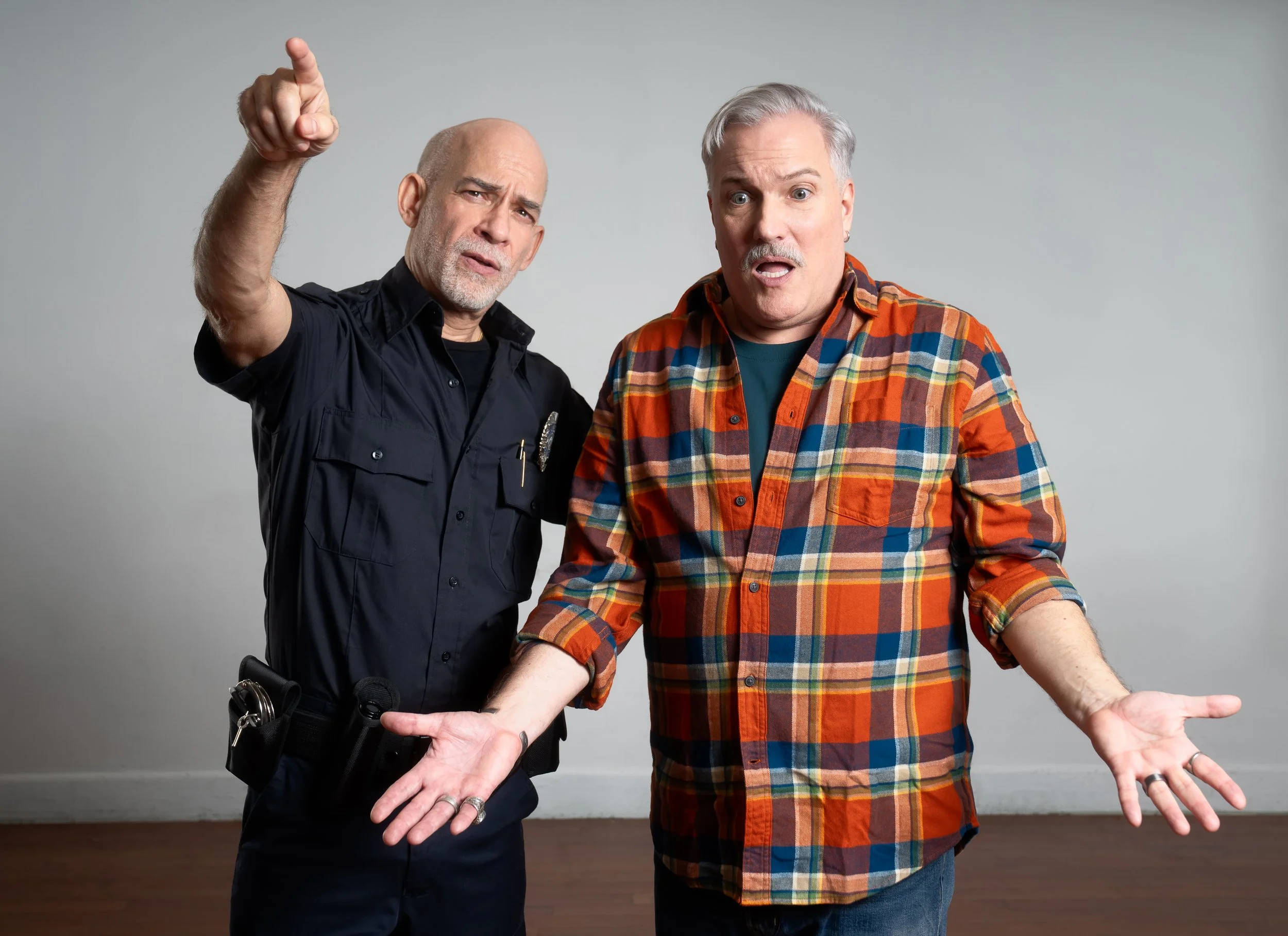
Progress, here in Iowa, is shadowed by backlash; visibility invites scrutiny, if not outright violence. In an early, deceptively casual scene, walnuts hurled by unseen teenagers thud against the couple’s home, aimed, with a blunt and chilling symbolism, at the rainbow flag. The responding police officer (Jon Spano, chilling in his bureaucratic opacity) embodies a familiar and infuriating incomprehension: authority without empathy, presence without protection.
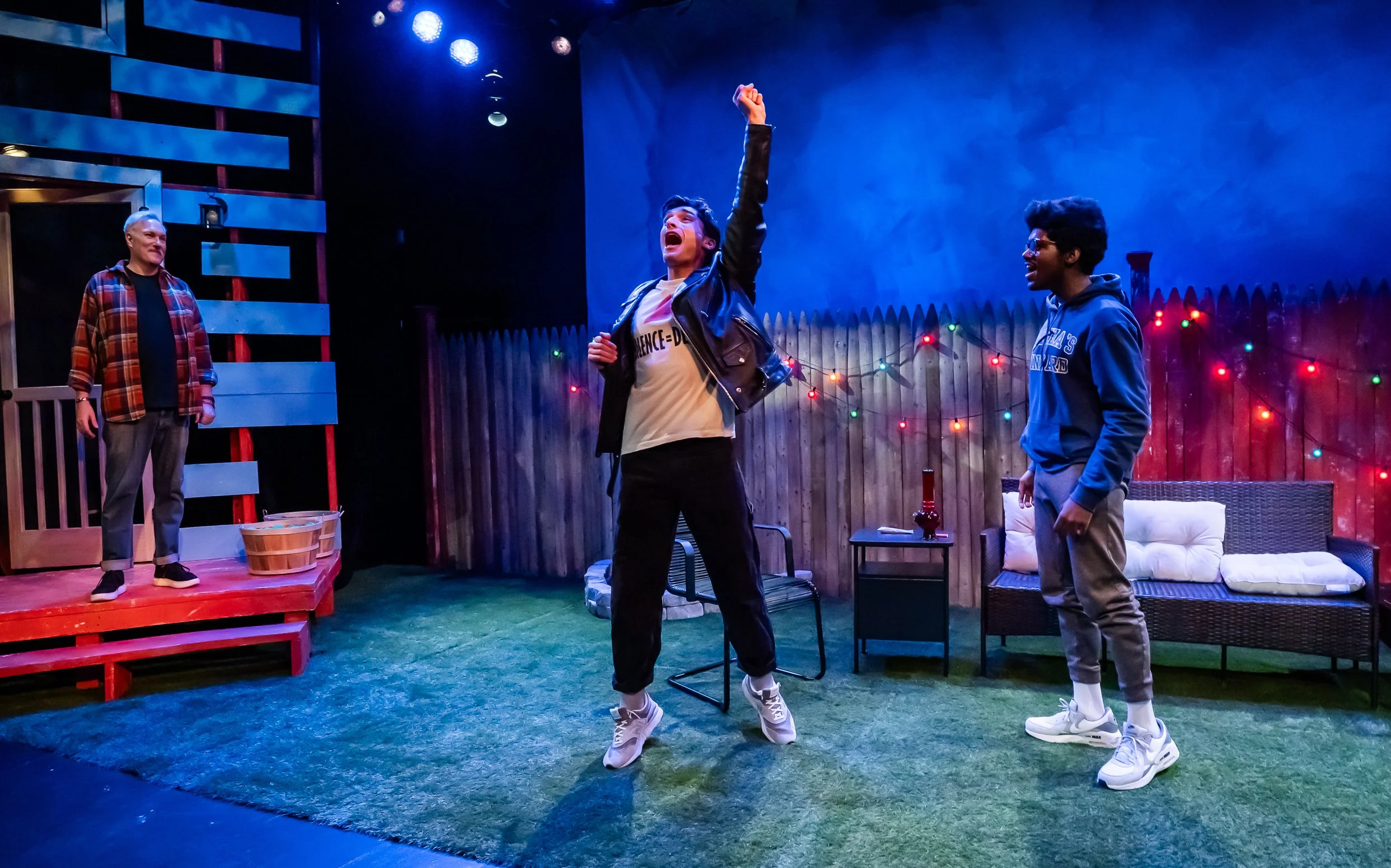
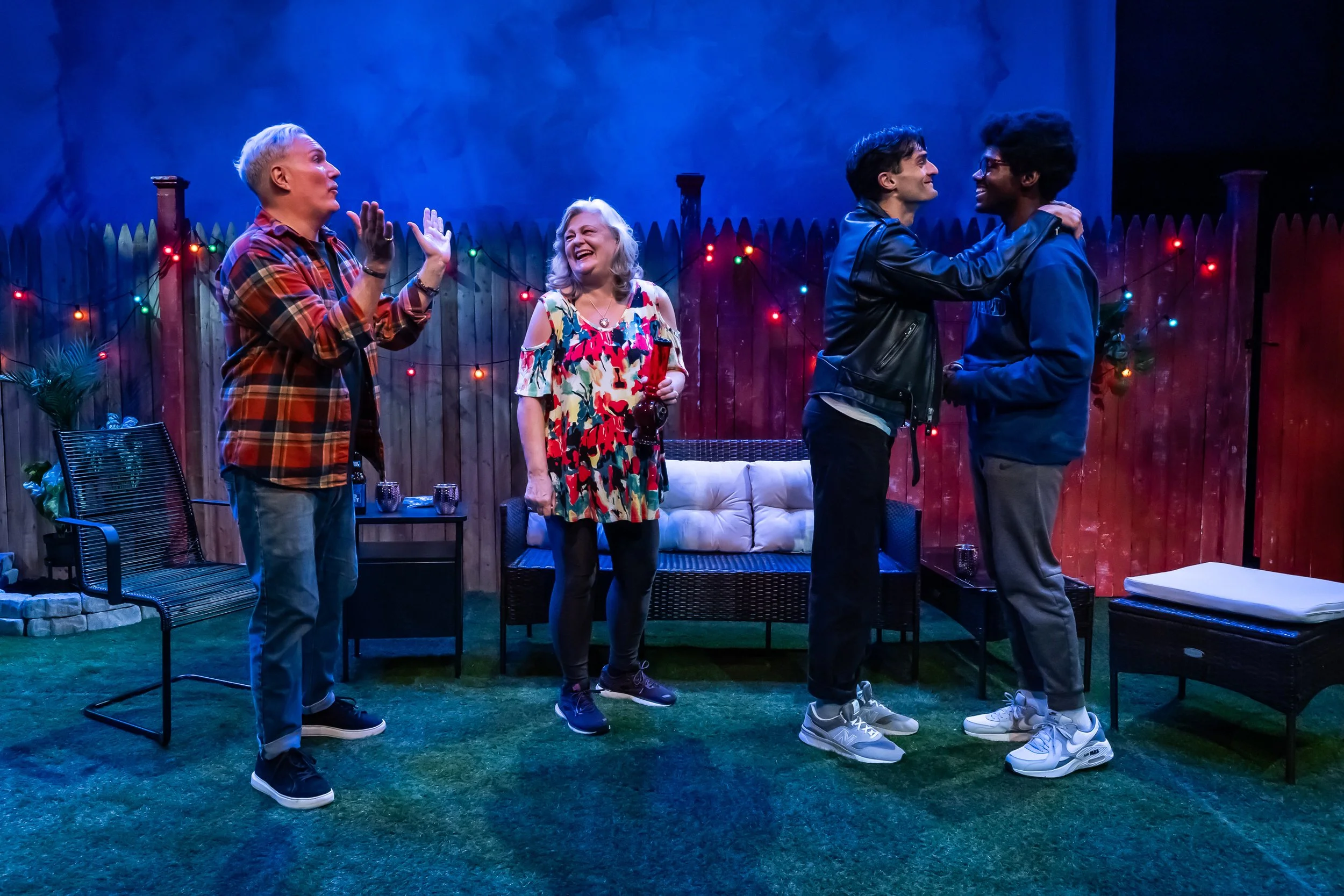
Yet Our House begins, beguilingly, in celebration. Andy and Stanley are hosting a wedding—of Andy’s nephew Brendan (CJ DiOrio, brimming with restless charm) and his partner Eugene (Jalen Ford, whose quiet gravity anchors the play’s moral center). Their banter, bright and unforced, carries the easy rhythms of familial intimacy, laced with a humor that feels earned rather than imposed. In a moment of aching generosity, Andy gifts Brendan relics of his ACT UP past—a “Silence = Death” T-shirt and a weathered leather jacket—objects that function as both inheritance and warning. The gesture collapses time, binding one generation’s militancy to another’s precarious freedoms.
Boehm, whose dramaturgy is as patient as it is purposeful, allows the play’s tonal register to deepen almost imperceptibly. The conviviality of the opening yields to something more fraught with the arrival of Paula (Nancy Slusser, in a performance of formidable amplitude), Brendan’s mother—a woman whose exuberance cannot quite mask the tensions she carries into the space. With a swiftness that feels both shocking and grimly inevitable, the play pivots: The play’s most shattering turn arrives with a simplicity that feels almost cruel. Brendan and Eugene—newly radiant in the anticipatory glow of marriage, their banter still buoyant with champagne logic—volunteer, with an offhand ease, to fetch more vodka from a nearby liquor store. It is the sort of errand that, in another play, would pass without consequence. Here, it becomes a descent. When they return, the air has changed; whatever lightness once animated the backyard has been leeched away, replaced by something brittle, electric, and unspeakably familiar. The walk to the liquor store becomes an act of exposure, and exposure becomes catastrophe. The violence that erupts is not gratuitous but structural, emerging from the intersecting fault lines of homophobia and racism that Boehm has so carefully mapped. They have been set upon in the woods by a pack of teenagers—five boys, emboldened by number and anonymity—who lace their assault with a barrage of homophobic and racial invective, their cruelty finding its most chilling expression not merely in violence, but in the certainty of its righteousness.
What follows is staged with a nerve-shredding precision. The earlier police officer reappears, now bearing not reassurance but accusation: the boys, he reports, have lodged a complaint of their own, alleging that a Black man in a hoodie attacked them with a bat. The grotesque inversion lands with a sickening inevitability. In Boehm’s dramaturgy, truth does not simply fracture—it is actively rewritten, weaponized, made to serve the very structures that produced the violence in the first place. The scene that ensues is nothing short of incendiary. Language falters; voices rise; the fragile architecture of civility collapses under the weight of fear and fury. Andy, who has spent a lifetime honing the disciplines of resistance, comes undone with a ferocity that is as terrifying as it is deeply earned—his hysteria less a loss of control than a long-deferred reckoning. And then, in a gesture that seems to freeze the room in place, a gun is drawn. Its barrel, trained on Eugene, becomes the play’s most devastating image: a condensation of history, prejudice, and the lethal absurdities of misrecognition.
Eugene—dignified, stunned, and suddenly hyper-visible—is taken into custody under the pretense of “setting the facts straight,” a phrase that curdles as soon as it is spoken. Boehm understands, with a clarity that borders on the prophetic, that facts, in such a landscape, are never neutral; they are contingent, negotiated, and all too often aligned with power. The sequence unfolds not merely as plot, but as indictment—a searing exposure of how quickly the promise of safety can give way to its opposite, how swiftly celebration can curdle into crisis, and how perilously thin the line remains between belonging and erasure.
The second act, which traces the reverberations of this occurrence, is where Our House reveals its full emotional and intellectual ambition. Relationships fracture and reconfigure under pressure; long-buried truths surface with destabilizing force. The night has thinned into that eerie, suspended hour just before dawn—around four in the morning—when exhaustion strips away pretense and the truth, however unwelcome, begins to surface. The backyard, once animated by the easy conviviality of a celebration, now feels like a site of aftermath, its earlier warmth replaced by a chill of uncertainty. Eugene is still at the police station, though word comes that he will soon be released, the charges—so hastily, so baselessly imposed—quietly dropped, as if their disappearance could erase the violence that summoned them.
But Boehm is far too incisive a dramatist to allow such a facile restoration. The damage has already been done. The wedding, that emblem of joy and forward motion, lies in ruins—not through any single act, but through the cumulative weight of fear, doubt, and revelation. What had been a gathering in anticipation of union becomes, instead, a crucible in which each relationship is tested, its fault lines exposed under pressure. And yet, from within this wreckage, something unexpectedly galvanizing emerges. Andy—who has spent much of the play wrestling with the ghosts of his activist past, unsure of how (or whether) that former self fits into a life that has, on the surface, achieved a measure of stability—finds, in this moment of crisis, a renewed clarity of purpose. The embers of his ACT UP days, never fully extinguished, flare back into life. His voice, which had veered between wry detachment and simmering anger, sharpens into something urgent, directive, almost prophetic.
In a speech that lands with both the force of exhortation and the intimacy of familial plea, Andy turns to Brendan and demands—not gently, not rhetorically—that he choose courage over comfort. To love, Boehm suggests, is not merely to celebrate when conditions are favorable, but to stand, visibly and insistently, when those conditions turn hostile. Andy urges him to fight—not in abstraction, but concretely, for Eugene, for their shared future, for the right to inhabit a life that is neither diminished nor deferred. It is, in the end, a call to action that reverberates beyond the confines of the play’s world. What had seemed, hours earlier, like a private celebration reveals itself as something far more consequential: a battleground of values, a test of conviction. And in that fragile, flickering space before dawn, Our House locates a hard-won, unsentimental hope—not in the promise that everything will be restored, but in the insistence that something still can be claimed.
Boehm resists easy catharsis, instead allowing each character the space to articulate a deeply personal reckoning. Brendan speaks, with a disquieting clarity, of the alienation of return—the subtle but unmistakable hostility of familiar streets. Stanley recalls the thwarted desire for parenthood, a dream rendered fraught by a culture that questioned the legitimacy of his love. Eugene delivers, in one of the evening’s most searing passages, a meditation on racial difference that refuses the consolations of liberal empathy, insisting instead on the persistence of asymmetry—even within intimacy.
At the center of it all stands Andy, a figure of accumulated fury and fragile grace. Borg renders him with a remarkable emotional transparency, allowing us to see the cost of a life spent in perpetual resistance. His outbursts—sudden, volcanic—are not merely dramatic peaks but expressions of a grief that has never been given sufficient space to settle. The play’s most profound insight may lie here: that the struggle for rights, even when partially won, does not dissolve the psychic toll of the fight.
What is most impressive about Boehm’s writing is its capaciousness. The play engages, without strain, an array of themes—HIV/AIDS stigma, racial inequity, familial estrangement, the slow erosion of Midwestern cities—yet never feels overburdened. Instead, these concerns accumulate, interlock, and resonate, producing a theatrical experience that is at once intellectually rigorous and deeply felt. There is humor here, too—sharp, humanizing, often courtesy of Slusser’s indomitable Paula—but it is a humor that coexists with, rather than deflects, the play’s darker currents.
Our House is, finally, a work about the precariousness of sanctuary: the idea that a home—literal or metaphorical—can be both refuge and battleground. In Boehm’s vision, the backyard becomes a site of confrontation, of memory, of fragile hope. That the play manages to be, in equal measure, provocative, heartbreaking, and unexpectedly buoyant is a testament not only to its author’s craft but to the ensemble’s collective vitality.
Under the stewardship of Mark Finley, TOSOS’s longtime artistic director, Our House receives a staging of admirable fidelity and clear-eyed devotion—one that resists the temptation to sand down the play’s rougher edges in favor of something more decorous. Finley understands, with a director’s humility that is rarer than it ought to be, that Boehm’s script derives its potency not from polish but from friction: from the uneasy collisions of tone, the sudden pivots between humor and hurt, the moments that feel, gloriously, a little too raw to be fully contained. His production leans into these qualities rather than smoothing them over, allowing the play to breathe in all its messy, searching vitality.
Evan Frank’s scenic design renders the backyard with an appealingly straightforward naturalism: a contained, fenced-in space of artificial grass and modest architecture, anchored by the suggestion of the home’s rear entrance. Yet it is the upstage element—a white canvas drop marked by a bold, almost painterly sky-blue splotch—that quietly expands the visual field into something more associative. The image hovers between abstraction and atmosphere, evoking at once an open sky and a kind of emotional weather system, its ambiguity mirroring the play’s own oscillation between the intimate and the expansive. David Castaneda’s lighting design sketches a framework of visibility and shadow. Ben Philipp’s costumes are quietly exacting in their specificity. Each character is rendered with a clarity that feels both economical and deeply considered, none more so than Andy, whose weathered leather jacket and ACT UP T-shirt function as a kind of wearable archive—garments that carry, in their very fabric, the history the play so insistently summons. Morry Campbell’s sound design provides moments of striking effectiveness. The distant rumble of a passing train is rendered with an almost uncanny authenticity, its low, persistent thrum grounding the action in a palpable sense of place.
Finley and his collaborators have crafted a production that honors the play’s emotional and political stakes, embracing its contradictions rather than resolving them. In doing so, they offer a staging that feels not only attentive, but alive—alert to the ways in which theater, like the histories it contains, is always in the process of becoming. One leaves the theater not with a sense of resolution, but with something more enduring: the uneasy recognition that the stories we tell about progress are, at best, incomplete—and that the work of living, and loving, in their aftermath remains as urgent as ever.
Click HERE for tickets.
Review by Tony Marinelli.
Published by Theatre Beyond Broadway on April 2, 2026. All rights reserved.
