PEN PALS
Presented by Lisa Dozier Shacket With Rachel Stange, Joe Trentacosta, Logan Dewitt, Anthony Hazzard & Scott Stolzenberg, Holly Garman, Michael Graf, Cherie Lindley
In Association with NJ Repertory Company, Heiress Productions, Inc. by Michael Griffo
Directed by Suzanne Barabas
DR2 Theatre, 103 East 15th Street, in Manhattan
August 15, 2025 - March 15, 2026
In 1955, in the modest classrooms of Newark and Sheffield, two fourteen-year-old girls—one American, one British—were assigned what must have seemed a routine pedagogical exercise: write to a stranger across the Atlantic. What followed was anything but routine. Bernadette and Margaret sustained their correspondence for nearly half a century, a private epistolary bridge spanning continents and the slow recalibrations of selfhood that accompany a life fully lived. In Pen Pals, now in a return Off-Broadway engagement at DR2 Theatre following its premiere at NJ Repertory Company and a subsequent run at Theatre at St. Clement’s last fall, the playwright Michael Griffo transforms that long exchange—drawn from the real-life letters of his mother, Jean Griffo, and her friend Sheila Bashforth—into a tender theatrical meditation on intimacy without proximity.
The conceit is disarmingly simple. On November 10, 2002, the women, now in late middle age, revisit their decades of correspondence. Under the direction of SuzAnne Barabas, the Founding Artistic Director of NJ Rep, the play unfolds as an embodied act of reading: Bernie and Mags, each clutching the notebooks in which they have preserved the other’s letters, reenact the writing and receiving of their shared history. The stage becomes less a site of action than of recollection, and yet the stillness hums with feeling. What emerges is not merely nostalgia but the slow revelation of how two strangers became, through ink and paper, indispensable to one another.
Their early exchanges are charmingly prosaic. Bernie, from a bustling New Jersey household, and Mags, an only child in Sheffield with a collie named Queenie, catalogue their favorite movie stars, classes, books, and secret irritations. They trade photographs, recipes, programs, and sketches; they compare ambitions—Bernie’s theatrical aspirations, Mags’ devotion to art. As adolescence ripens into adulthood, the letters deepen in candor. Boys give way to men; flirtation to sex; courtship to marriage; pregnancies, children, professional setbacks, illnesses, and grief enter the frame. The correspondence occasionally falters—disagreements flare, silence intrudes—but the women return to one another with the steadiness of those who understand that friendship, like any marriage, requires both pride and humility. The play’s emotional power lies not in melodrama but in accumulation: the quiet recognition that intimacy can be constructed, line by line, across an ocean.
It is, in essence, a discursive undertaking—one that might, in less attentive hands, curdle into bathos. Yet Griffo’s patient accrual of seemingly inconsequential narrative proves quietly shrewd. The offhand references, the adolescent enthusiasms, the minor domestic irritations—these are not decorative trifles but the sediment through which a life is legibly formed. What begins as a gently diverting, mildly amusing exchange of girlish confidences gradually reveals its deeper architecture. The evening ripens into a surprisingly affecting chronicle of a friendship that expands, contracts, frays, and mends—one that survives time, temperament, illness, marriage, distance, and nearly every other trial placed in its path.
At the outset, their correspondence unfolds like a transatlantic commonplace book of adolescent rapture. The envelopes bulge with ardor for Douglas Sirk’s lachrymose romance Magnificent Obsession and the sanctified sufferings of The Song of Bernadette, alongside breathless swooning at the burnished studio glamour of Rock Hudson and Natalie Wood. One senses the girls constructing themselves through the flicker of the screen—trying on poise, tragedy, allure.
The early exchanges traffic in the bright, unfiltered enthusiasms of adolescence, and the production wisely resists the temptation to condescend to them. The girls’ breathless literary discoveries are rendered not as punch lines but as rites of passage. When Bernie, at Mags’ insistence, finally makes her way through Charlotte Brontë’s Jane Eyre and exclaims, in delighted astonishment, “The woman in the attic was Mr. Rochester’s first wife! Jane Eyre is now officially the best book I have ever read,” the moment lands with the unselfconscious ardor of a mind newly blown open. The line earns its laugh, yes, but it also establishes the girls’ shared hunger—for stories, for intensity, for a world larger than the one immediately before them. Thrilled with the response, Mags provides Bernie with an extensive “to-read” list.
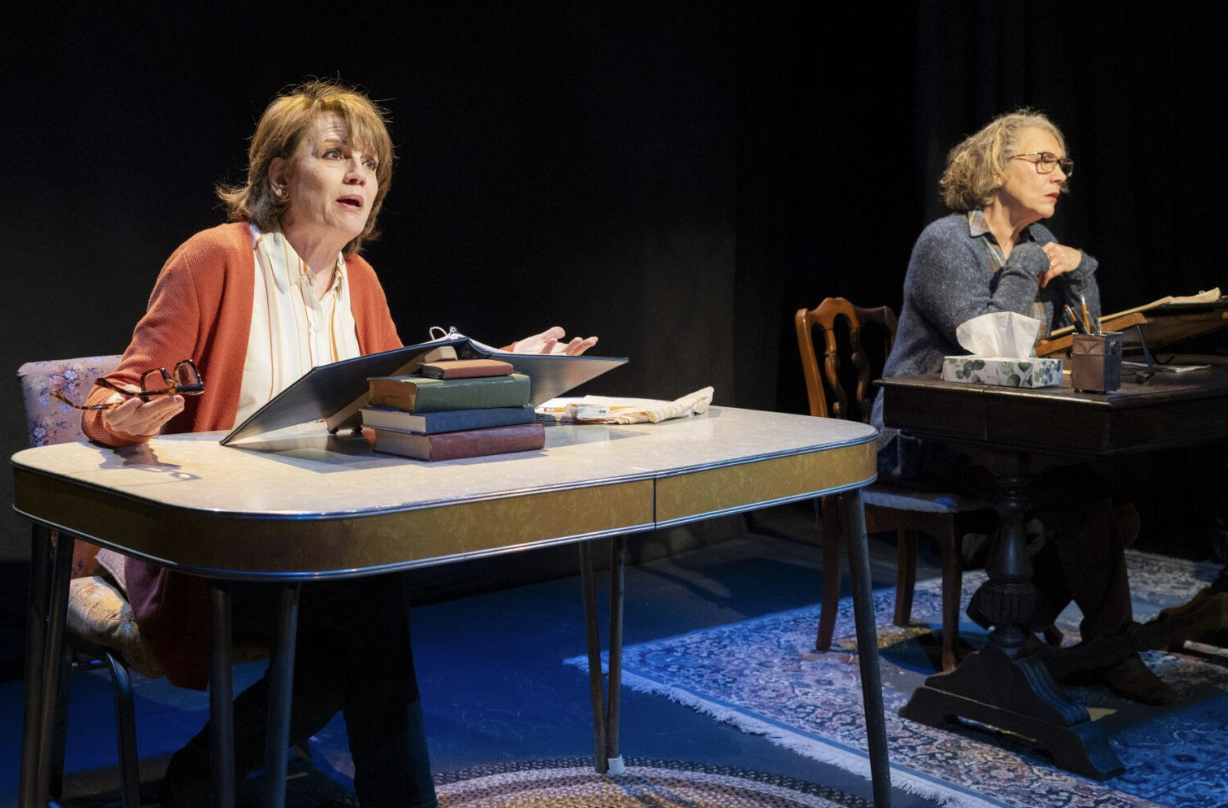
Actress pairings change every two weeks and for the two weeks beginning January 21 through February 1, Tony Award winner Beth Leavel inhabited Bernie with a restless vitality. Her performance was textured with quicksilver shifts—exuberance yielding to dejection, laughter catching in the throat. Opposite her, another Tony Award winner, Randy Graff’s Mags was composed, observant, gently conciliatory; where Bernie bursts, Mags absorbs. The actresses’ native accents, shaped with care, subtly underscore the cultural distinctions that both divide and enrich the friendship. Leavel delivered her reminiscences with a lived-in immediacy, while Graff often read directly from her notebook, as if the act of transcription were itself a ritual of preservation. The emotional states contained in the letters—giddy, wounded, resilient—registered clearly in their faces and posture. With exquisitely modulated shifts in vocal timbre and physical bearing, the actresses chart the long arc of becoming. The high, breathless cadences of adolescence—sentences tumbling over themselves in excitement—gradually deepen into steadier, more measured tones. Bodies alter almost imperceptibly: shoulders that once pitched forward with girlish urgency settle into the grounded composure (and occasional weariness) of experience. What is most affecting is the absence of caricature. There are no abrupt “old-age” affectations, no ostentatious transformations—only the slow accrual of gravity. Before our eyes, the giddy teenagers of 1955 give way to two distinct, seasoned women, tempered by joy and disappointment alike, their differences sharpened by time even as their bond endures.
Leavel preserved in Bernie a vestigial girlishness that proved dramatically astute. She played her as a natural conciliator—an even tempered girl whose theatrical aspirations, gently but decisively quashed by her parents, curdle into a life of accommodation. There is no melodramatic renunciation here; rather, Leavel charted the slow path to marriage and motherhood with a softness that suggests both contentment and the faintest aftertaste of compromise. Opposite her, Graff wielded a formidably crisp British accent like a finely honed instrument. She bit off her lines with relish, as if savoring each syllable like a particularly bracing crumpet. It was an inspired choice for a character inclined toward sweeping, magisterial pronouncements—whether administering a stern dose of tough love to Bernie or, decades later, coolly declaring, “For the life of me, I will never understand the appeal of Paul McCartney.”
Even in those fallow intervals when pride or injury interrupts the flow of envelopes, Bernie and Mags remain, unmistakably, one another’s fixed stars. The correspondence bends, frays, occasionally goes silent—but it never quite breaks. Across decades they contend, in steady succession, with nearly every indignity and upheaval adulthood can devise: sudden deaths that arrive without warning; the uneasy recalibrations of a second marriage; abortion and its private reckonings; sexual harassment endured and parsed; the destabilizing confession of an extramarital affair; the long attrition of caring for ailing parents; Bernie’s own bouts with breast cancer;husbands diminished by multiple sclerosis and early-onset dementia; and the generational tremor of a son introducing his longtime male partner into a family still catching up to its own evolution. What gives the play its tensile strength is not the mere catalogue of crises but the way these events are metabolized through ink. The women do not always see eye to eye—indeed, their disagreements can flare into something bracingly severe, each convinced of her moral vantage point. Yet even in anger, the habit of writing exerts its quiet gravity. They circle back. They explain, apologize, admonish, forgive.
Jessica Parks’s set design bifurcates the stage into two domestic worlds that never quite touch. On Bernie’s side: mid-century modern functionality—a kitchen table and chair, an oval hooked rug, a metal step stool, and lamp arranged atop a light wood buffet. On Mags’: darker woods, upholstered antiques, a floor lamp casting a muted glow over an oriental carpet, a crystal bowl and porcelain cup suggesting inherited refinement. The visual contrast is neither caricature nor cliché; rather, it frames the women’s differing traditions and tastes while affirming the shared rituals of home. Barabas keeps the movement spare—sitting, standing, the occasional exit and return—allowing the spoken word to remain paramount. Jill Nagle’s lighting and Nicholas Simone’s sound gently evoke the passing decades: a school bell, the ambient noises of children, subtle shifts in atmosphere that signal time’s inexorable advance. The production’s sound design functions as an aural scrapbook, stitching the decades together with a kind of emotional underscoring that never overwhelms the text.
Pen Pals is a modest work, but modesty here is a virtue. Griffo resists theatrical pyrotechnics in favor of something rarer—a sustained attention to the incremental construction of trust. The production invites us to consider how friendship can flourish without physical presence, how confession can be safer on paper than in speech, and how two women who never met face-to-face might nevertheless become one another’s most constant witness. In an age of instantaneous communication, the play’s devotion to the deliberate pace of letter writing feels almost radical. Griffo has crafted, with disarming assurance, the chronicle of two lifelong confidantes, steering them toward a final, late-in-life meeting that arrives with the soft inevitability of dusk. The scene is handled without fanfare, yet it lands with unmistakable force; one senses, across the auditorium, the subtle rustle of handbags and the discreet unfurling of tissues. Pen Pals is not a play that clamors for tears—it earns them. It advances quietly, almost modestly, and then, before one quite realizes what has happened, the cumulative weight of decades shared—of secrets entrusted, grievances aired, loyalties reaffirmed—settles in. By the time the lights dim, Bernie and Mags no longer seem like characters at all but like old friends.
Click HERE for tickets.
Review by Tony Marinelli.
Published by Theatre Beyond Broadway on March 2nd, 2026. All rights reserved.
