
Picnic At Hanging Rock
Based on a book by Joan Lindsay; Book and Lyrics by Hilary Bell; Music by Greta Gertler Gold; Directed by Portia Krieger; Choreography by Mayte Natali
Greenwich House Theater, 27 Barrow Street, in Manhattan
December 16, 2025 - January 17, 2026
Photos by Matthew Murphy
Joan Lindsay’s Picnic at Hanging Rock—first published in 1967 and long since absorbed into the bloodstream of Australian cultural life—has always carried its power lightly, even teasingly. Its refusal to explain itself, its serene indifference to narrative closure, have made it a kind of secular mystery: half Edwardian school story, half metaphysical riddle. That this famously elusive novel has inspired Peter Weir’s hallucinatory 1975 film, a glossy 2018 mini-series, and even a choral musical suggests that ambiguity, far from deterring adaptation, may function as a dare. The latest response to that dare, now at Greenwich House Theater, is a full-scale stage musical with a book and lyrics by the Australian librettist Hilary Bell and music and arrangements by the Australian-American composer Greta Gertler Gold. The adaptation is intelligent, serious-minded, and often accomplished—but it never quite escapes the central problem of the source material: how to dramatize an absence without dispelling its spell.
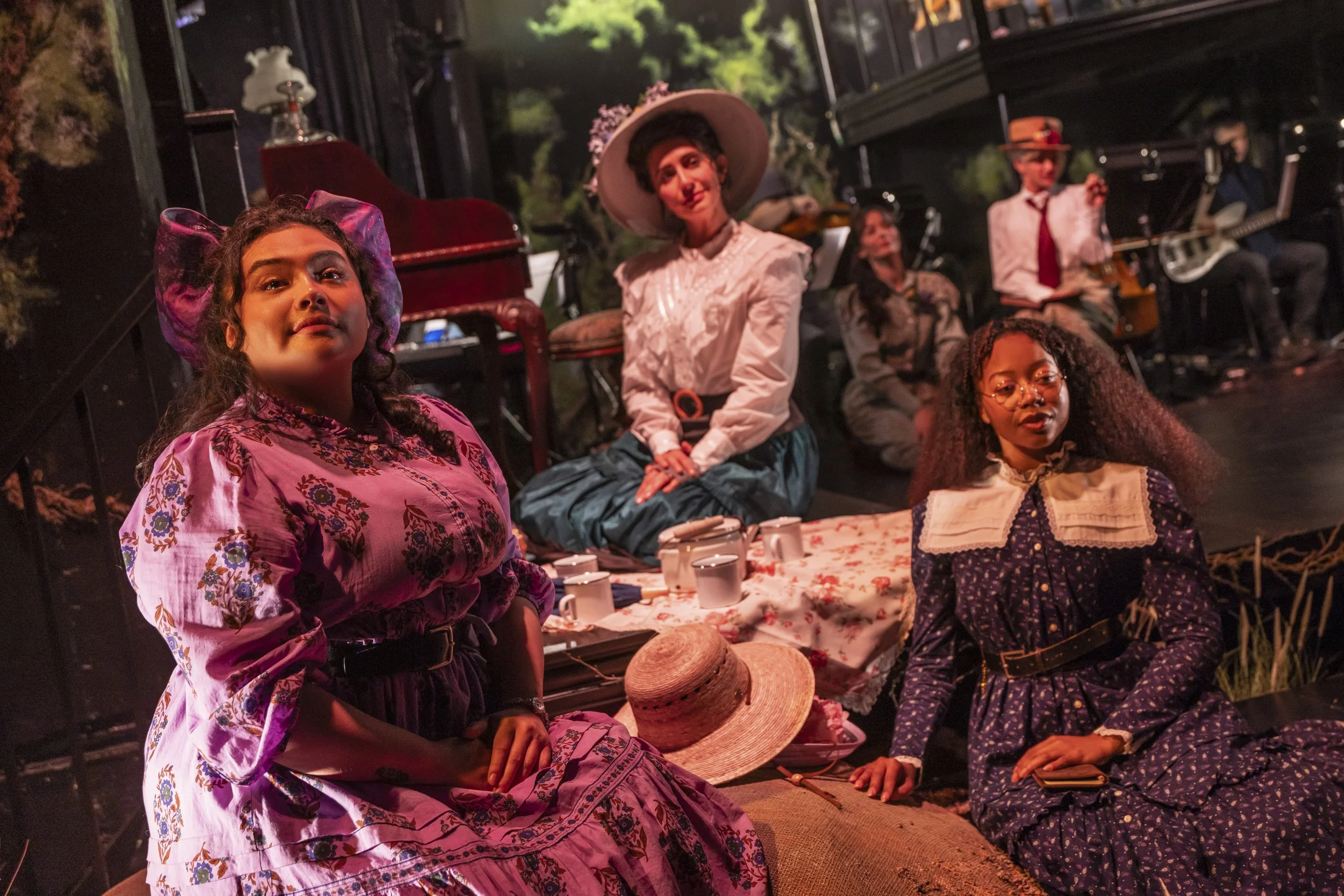
The story, set on St. Valentine’s Day in 1900, unfolds at Appleyard College, a boarding school for young women presided over by the forbidding Mrs. Appleyard, whose authority is as rigid as her corsetry. On a picnic excursion to the volcanic formation known as Hanging Rock—Ngannelong to the Indigenous peoples of the area—three senior girls (Miranda, Irma, and Marion) and a math teacher, Miss McCraw, disappear after wandering into the foothills, accompanied partway by the younger, shrill Edith, who returns screaming but unable to say why. The setup is deceptively placid: lemonade, heart-shaped cake, sun-dazed girls reclining on the grass. Yet from the outset there are fissures in the pastoral calm. Watches stop at noon. The landscape hums with warnings. Miranda, the school’s adored golden girl, tells her roommate, the orphaned Sara, “I won’t be here much longer,” a line that hovers between prophecy and coincidence.
Bell’s libretto follows Lindsay’s plot faithfully, and the first act moves with admirable clarity, establishing the social hierarchies of the school and the charged stillness of the outing. The disappearance itself remains tactfully offstage, observed only through its aftermath: Edith’s hysteria, the panic of the faculty, the arrival of Michael, a young English aristocrat who glimpses Miranda once and is undone by the sight. In the second act, the musical begins to fracture time, returning repeatedly to Hanging Rock in flashbacks that add slivers of information without resolving the mystery. For audiences unfamiliar with the story, this structure may feel disorienting; for those who know it well, the cumulative effect slightly blunts the novel’s austere refusal to explain itself.
What the story withholds, stubbornly and almost perversely, is any account of what actually transpired on the Rock; its true subject is not the disappearance itself but the reverberations it sends through those left standing in its wake. Mrs. Appleyard, suddenly stripped of both pupils and authority, teeters between grief and administrative panic as the future of her school threatens to collapse along with her carefully maintained composure. Sara, already marginal, finds herself doubly exposed—abandoned not only by Miranda’s friendship and guardianship but by a guardian who has failed to pay her fees, leaving her isolation newly institutionalized. Irma, recovered but emptied of memory, is reclaimed by her parents and removed from the scene, while the remaining students simmer with a resentful incredulity that both Irma and Edith have been spared knowledge as well as blame. The mystery, in other words, is less an absence than a contagion, altering each survivor according to the shape of their loss.
Where Weir’s film relied on diaphanous lighting, pan flutes, and the uncanny physical presence of the Rock itself to conjure an atmosphere of pagan menace, the musical must work through song and speech—and here the results are mixed. Gold’s score, rooted in a folk-pop idiom, is pleasing but persistent, with many numbers sharing a similar melodic and rhythmic contour. Bell’s lyrics oscillate between plainspoken narration and elevated verse, but rarely land on an image or phrase that feels truly uncanny. The supernatural, so central to the story’s power, is gestured at rather than summoned.
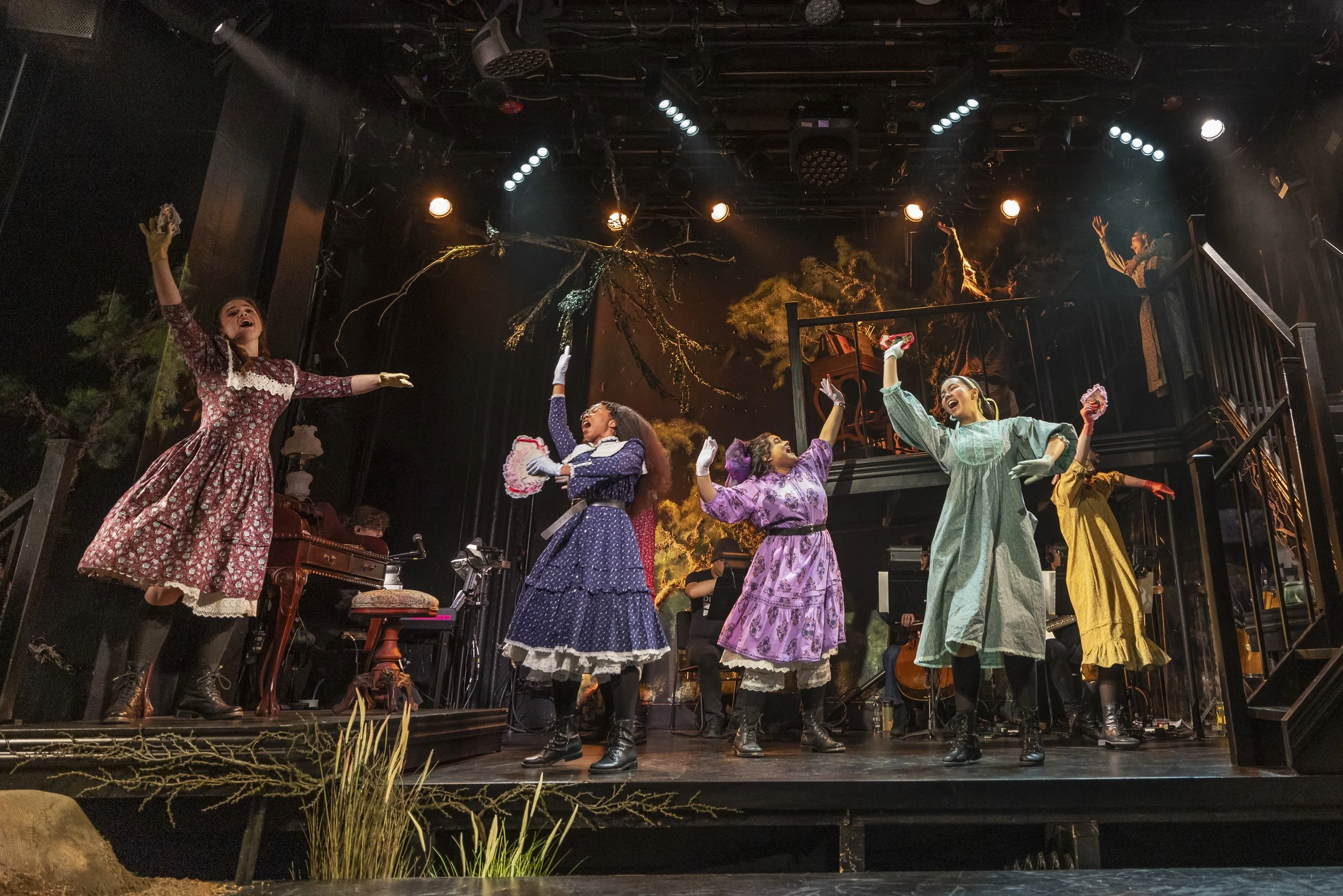
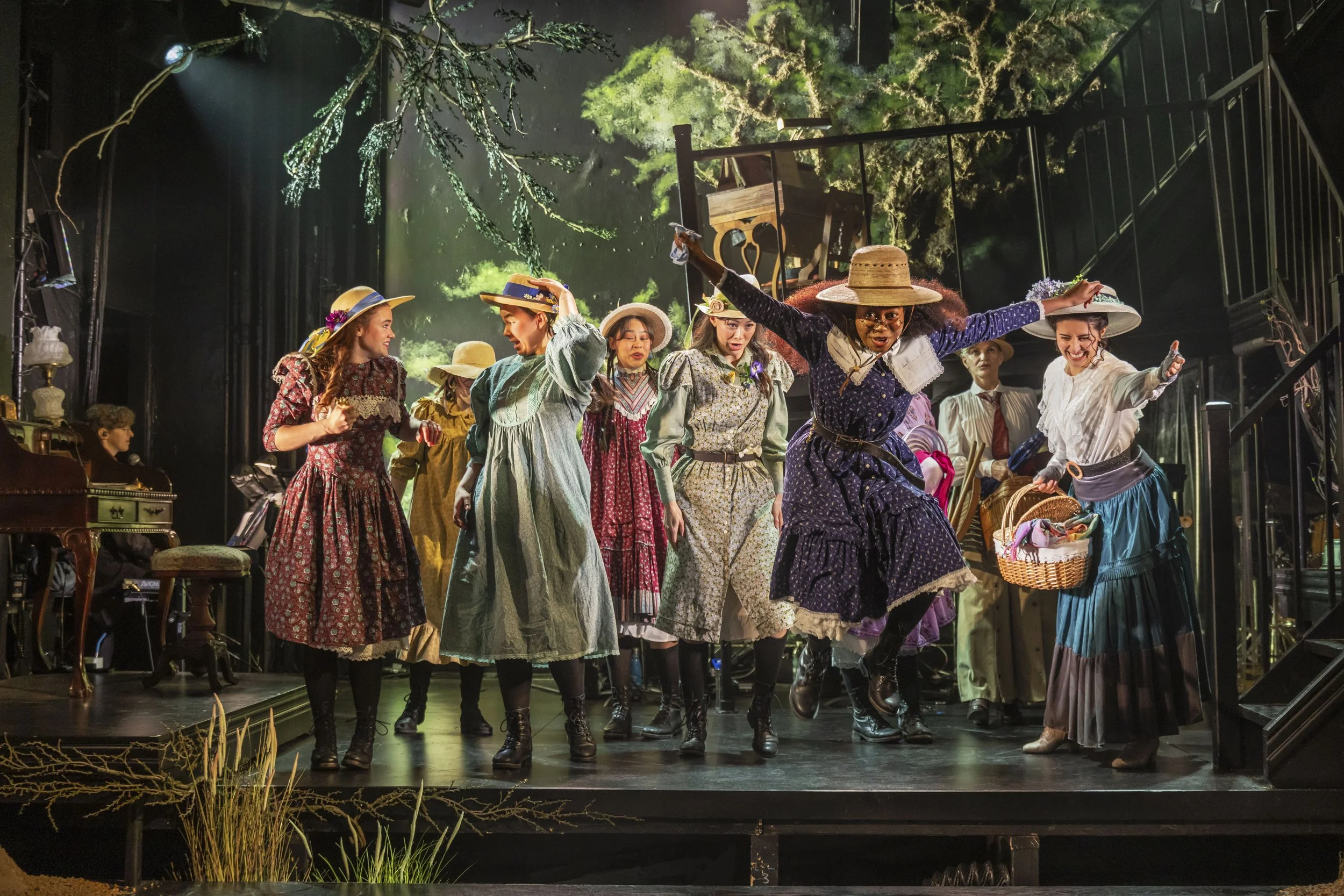
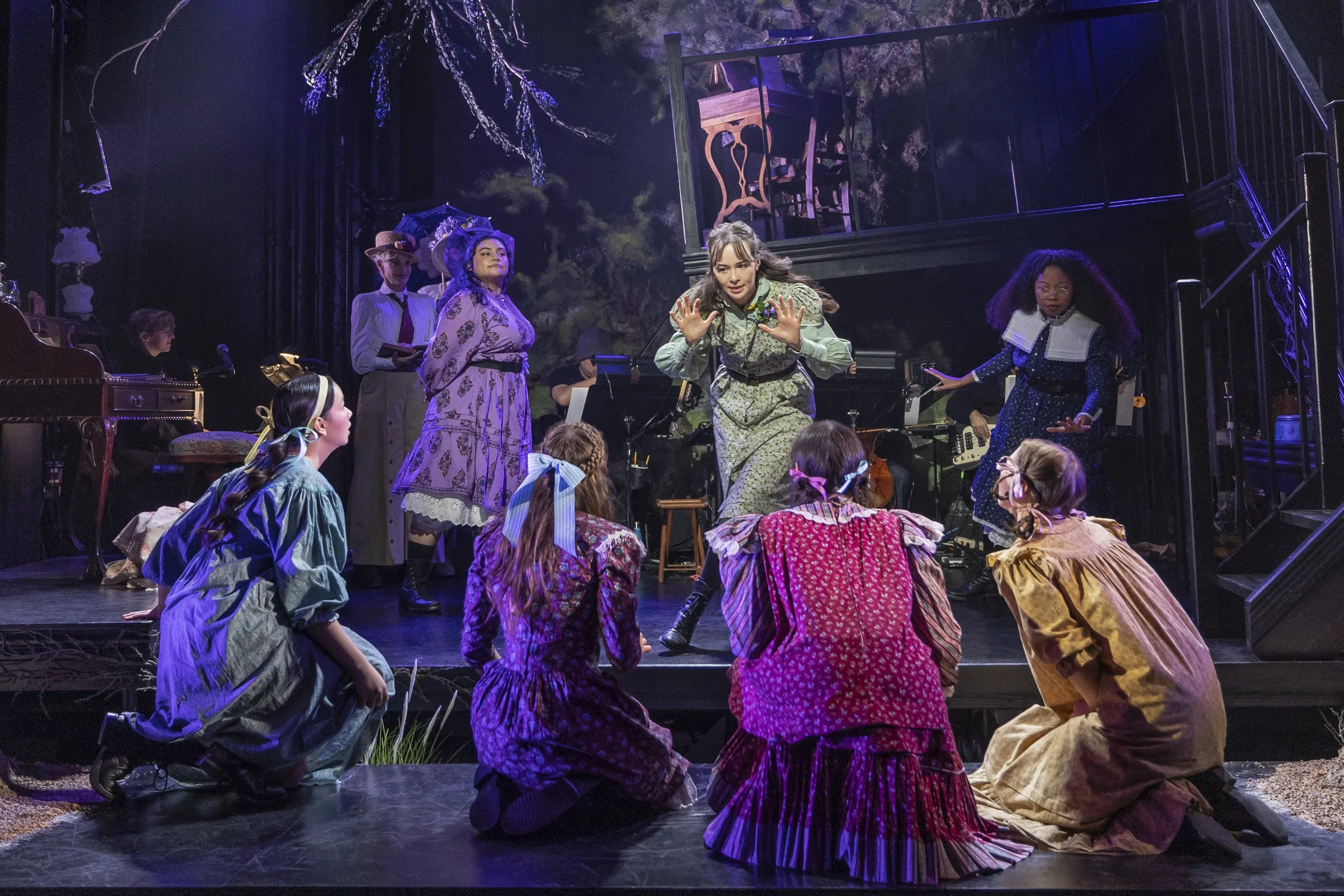
Visually, the production is ambitious to a fault. Daniel Zimmerman’s set attempts to accommodate Appleyard College, its staircases and dormitories, the looming Rock, a stand of trees, and a five-piece orchestra, all within the modest confines of Greenwich House Theater. The result is busy, sometimes oppressively so, with Ásta Bennie Hostetter’s vividly colored costumes for the students competing with the foliage and stone for visual dominance. Barbara Samuels’ lighting often finds the right mood—dusky interiors, ominous shadows—but an overzealous use of red during the picnic scene has the unfortunate effect of making the girls and adults look alarmingly sunburned.
Nick Kourtides’ sound design works like a barely perceptible weather system, insinuating itself into the evening rather than announcing its presence. Wind sighs and gathers with an intelligence that feels almost sentient; wings beat and scatter in the darkness; cicadas pulse with a faintly oppressive insistence. These natural sounds, meticulously layered and artfully timed, suggest not a benign pastoral setting but a landscape quietly alert to human intrusion, a place whose indifference shades into menace. Without ever tipping into overt melodrama, the design gives the impression that the environment itself is listening—and perhaps waiting—casting Hanging Rock less as a backdrop than as an unseen, malevolent participant in the drama.
Director Portia Kreiger proves herself an imaginative and resourceful guide through this thicket. She makes nimble use of the space, placing scenes in the aisles and along the apron, and keeps the storytelling lucid even when the narrative doubles back on itself. Two sequences in the second act are particularly striking: “Blood and Scandal,” a ferocious ensemble number that captures the gossip and moral panic unleashed by the disappearance, and “The Rock,” a sombre meditation in which the surviving characters contemplate how—or whether—to go on. Notably, the production steers away from the homoerotic undercurrents present in Lindsay’s novel and Weir’s film, opting instead for a more restrained emotional palette.
Mayte Natalio’s choreography often erupts in spasms of restless motion, its energy bordering on the frenetic, as if the bodies onstage can no longer be persuaded to obey the decorum imposed upon them. What might initially register as excess gradually reveals itself as a considered response to the story’s psychic collapse: once the students and their teacher vanish, the grammar of authority disintegrates, and the choreography mirrors that unraveling. Limbs flail, formations dissolve, and the once-orderly rhythms of the school give way to something rawer and less containable, suggesting that the loss at Hanging Rock has not only unsettled the narrative but has loosened the very rules by which these bodies—and this society—once moved.
The cast is uniformly strong, led by Erin Davie’s formidable Mrs. Appleyard, whose carefully controlled severity gradually gives way to something brittle and frightened. Rachel White’s wig design becomes an eloquent visual metaphor as Appleyard’s elaborate coiffure loosens along with her authority. Gillian Han brings warmth and poise to Miranda, singing with a clarity that suits the character’s almost mythic serenity, while Lizzy Tucker (replacing Tatianna Córdoba at this critic’s performance) gives Irma a frostily aristocratic sheen. Kate Louissaint is deft as the intellectually superior Marion, managing to suggest brilliance without smugness. Sara, the story’s designated waif, is written as a figure who might easily curdle into unrelieved pathos, yet Sarah Walsh resists that temptation. There are moments when her posture and expression suggest resilience rather than despair—but this choice proves quietly effective. Walsh conveys Sara’s isolation less through overt misery than through a persistent sense of social misalignment: a fractional hesitation before speaking, a watchfulness that implies long practice at being overlooked. The performance makes clear that Sara’s unhappiness is not theatrical but structural, rooted in her perpetual awareness that she exists slightly out of frame, tolerated rather than embraced. Among the adults, Marina Pires lends Mademoiselle a sympathetic irony, and Kaye Tuckerman’s Miss McCraw remains satisfyingly opaque. Reese Sebastian Diaz is amiable as Michael, though the role is necessarily thinner here than in the book and film, and Bradley Lewis’s Albert—the Indigenous tracker whose warnings go largely unheeded—is underwritten, his cultural significance more implied than explored.
In the end, this Picnic at Hanging Rock is a polished and thoughtful piece of musical theatre, one that treats its source with respect and care. It may not resolve the material’s deeper enigmas—or fully translate its eerie hush into song—but it offers a compelling distillation of a story that resists being pinned down. One suspects that a larger physical canvas might better serve Bell and Gold’s ambitions. For now, the Greenwich House production holds the audience in a steady, melancholy grip, reminding us that some mysteries endure not because they are unsolved, but because they are unsolvable.
Click here for tickets.
Review by Tony Marinelli.
Published by Theatre Beyond Broadway on January 4th, 2026. All rights reserved.
