Tartuffe
By Molière: In a new version by Lucas Hnath: Directed by Sarah Benson Choreography by Raja Feather Kelly
New York Theatre Workshop (NYTW) | 79 East 4th Street, New York, NY 10003
November 28, 2025—January 25, 2026


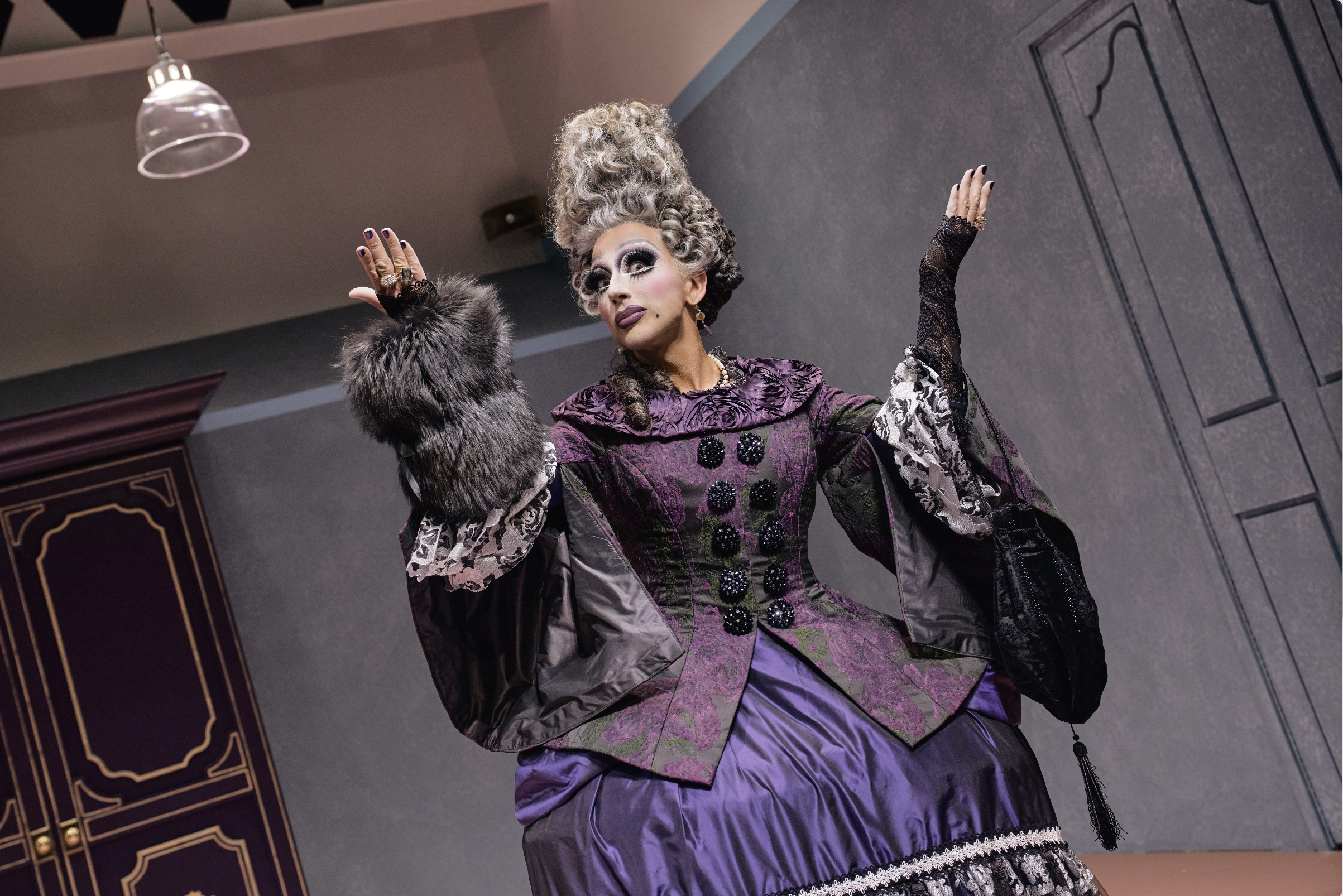
Photo credit by Marc J. Franklin, with the exception of this photo of Bianca Del Rio, credited to Valerie Terranova.
Tartuffe has always carried with it the whiff of danger: a comedy written with a dagger tucked into its sleeve. It was denounced immediately after its first performance in 1664, and then intermittently banned and/or silenced by the Church and State in France. The ban was lifted in 1669, fully five years after Tartuffe first dared to show its face before an audience, and the delay only seemed to sharpen its impact. When Molière’s complete five-act version was finally permitted to be staged, it arrived not as a tentative compromise but as a fully armed work, its satire honed and its targets unmistakable. Freed from official suppression, the play was embraced with extraordinary enthusiasm, its success swift and resounding—a vindication not only of Molière’s theatrical instincts but of comedy’s enduring power to outlast censure, scandal, and the anxious moral guardians of its day.
That it should arrive now, in a sinewy rhyming adaptation by Lucas Hnath and under the alert direction of Sarah Benson, feels less like a revival than a provocation. Receiving its world premiere at New York Theatre Workshop, this Tartuffe does not merely dust off Molière’s satire of sanctimony; it sharpens it, daring us to laugh at how little has changed in the centuries since hypocrisy first learned to quote Scripture for personal gain.
Hnath’s verse, fleet-footed and frequently blue, honors Molière’s structure while refusing to mummify it. The rhymes land with a snap, never precious, often gleefully insolent, and Benson keeps the language airborne by insisting on a “serve and volley” momentum. Played in a brisk slightly-less-than-two hours without intermission, the five acts unfurl like a single, escalating argument, one in which reason is repeatedly outmaneuvered by conviction loudly performed. The result is not just funny—though it often is—but unsettling in its familiarity, as if the play were less a period piece than a cautionary tale scribbled in the margins of the present moment.
Benson’s direction treats the play with the energy level of a Grand Slam final: every entrance is a feint, every speech a calculated return, each character striving in one-upmanship in pursuit of desire, dominance, or self-delusion. Not every volley lands cleanly. There are moments when the ball-in-play drops, when the metaphor threatens to announce itself too broadly, but those moments are negligibly few.
The casting alone announces that this will not be a museum exercise but a consistent delight in contradiction and surprise. At its center is Matthew Broderick as Tartuffe, a choice that proves inspired in its refusal of theatrical grandstanding. Broderick’s Tartuffe is not a roaring villain but a bewitchingly mundane one: bland, insinuating, and quietly reptilian. He slithers himself into the household of Orgon, a wealthy patriarch played with exquisitely calibrated obtuseness by David Cross. Tartuffe’s claim to spiritual poverty—he owns nothing, desires nothing, except God—functions primarily as a convenience, sparing Orgon the inconvenience of sermons or Scripture while flattering his self-image as a man of moral seriousness.
Orgon’s mother, Mme Pernelle, greets this turn toward religion with thunderous support, and Bianca Del Rio’s entrance scene—laying into her family, “tearing into each a new one,” before her abrupt departure—is a masterclass in preeminence. Del Rio gives a domineering performance that is bracingly theatrical without ever tipping into drag caricature. Every breath, every gesture is inhabited with conviction. What registers is not the performer’s persona but a formidable matriarch, drunk on certainty and impervious to contradiction. It is one of the production’s great pleasures to watch such a figure dominate the stage so completely and then vanish, leaving ideological wreckage behind her.
As Tartuffe’s influence grows, the household fractures in predictable but no less painful ways. Mariane’s engagement to Valère is imperiled; Damis is banished; Elmire endures Tartuffe’s oily, repulsive sexual overtures; and Cleante, the lone apostle of reason, finds his counsel repeatedly ignored. Emily Davis gives Mariane a physical eloquence that compensates for her enforced silence, her face registering volumes that propriety forbids her to say aloud. Amber Gray’s Elmire, meanwhile, is a study in restraint, carefully choosing when to intervene and when to allow her husband’s willful blindness to expose itself fully. Francis Jue’s Cleante, genial and grounded, offers wisdom without sanctimony, making his impotence all the more poignant.
Ryan J. Haddad nearly steals the evening as Damis, wringing comic gold from foppish posing and blatant camp delivery. His protracted proclamation that he was hiding “in the closet” is a line reading for the ages, landing as both a joke and a sly historical wink. Lisa Kron’s Dorine, the household maid and its sharpest critic, grounds the play with directness; she speaks plainly because she can afford to, and Kron relishes every unvarnished truth Dorine hurls into the room.
The visual world of the production is as conceptually lucid as it is sensuous. Design collective dots—Santiago Orjuela-Laverde, Andrew Moerdyk, and Kimie Nishikawa—have created a salon imagined as a modest tennis court, complete with taped floor markings and a bowl of balls that occasionally sail into the audience. Enver Chakartash’s costumes dazzle with vivid color combinations and cheeky anachronisms: Dorine’s New Balance sneakers anchor the production firmly in the here-and-now. A series of lightning-fast quick changes for the delightful Ikechukwu Ufomadu (mostly as Valère) late in the evening earns rabid applause, and Robert Pickens’ “skyscraper” wig design completes the picture with painterly precision. Stacey Derosier’s lighting is its own graceful palette, sensitive to the many dynamic colors already on stage.
Raja Feather Kelly’s movement sequences extend the tennis metaphor into choreography, rackets and all, offering moments of unexpected delicacy between scenes of verbal savagery. Peter Mills Weiss’ sound design underscores this conceit with faux baroque punctuated by the sharp electronic buzz of a tennis umpire’s call, marking the end of each “set,” yanking us from the moment to Roland Garros’ Court Philippe-Chatrier minus the red clay.
Molière’s words—channeled through Hnath’s sparkling verse—are allowed to fly, and the effect is exhilarating. This Tartuffe understands that satire endures not because it flatters our sense of progress but because it exposes our recurring weaknesses. Nearly four centuries later, the laughter it provokes is inseparable from recognition, and the chill that follows is the sound of the joke landing exactly where it still hurts.
Click here for tickets.
Review by Tony Marinelli.
Published by Theatre Beyond Broadway on January 4th, 2026. All rights reserved.
