Plan C
Conceived and Directed by Carrie Heitman; Written and Devised by the Ensemble of Hook & Eye Theater
The Tank | 312 W 36 St, NY NY 10018
March 12 - April 12, 2026
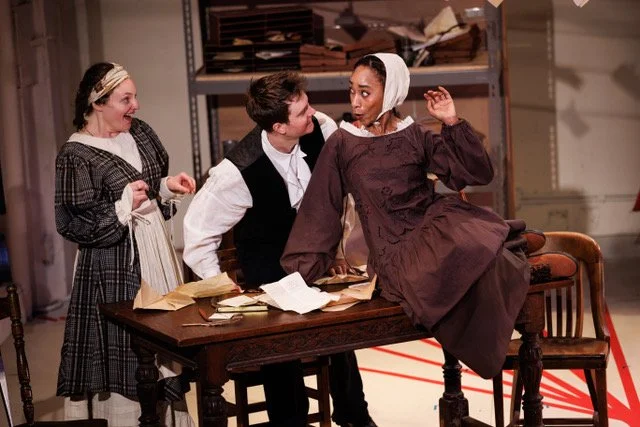
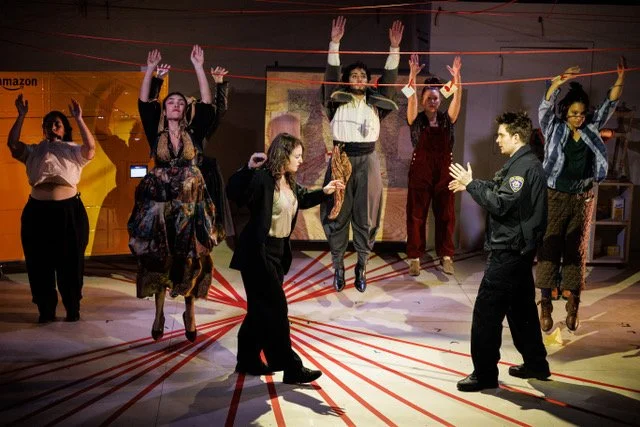
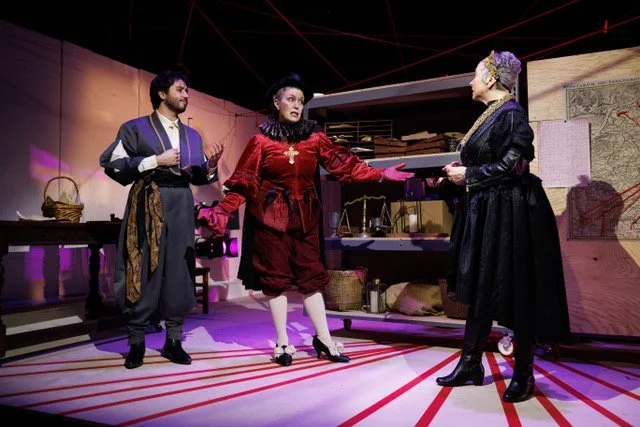
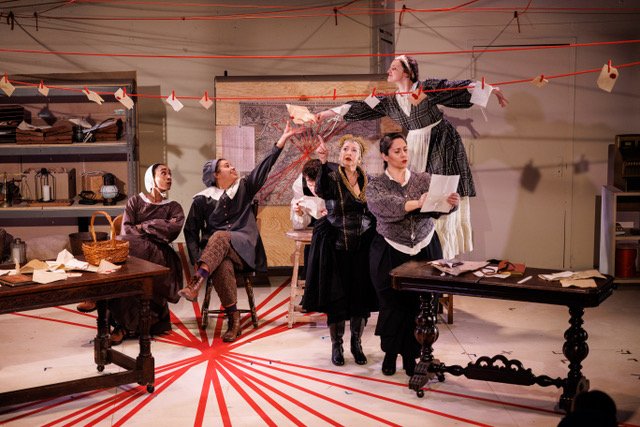
Photo credit: Maria Baranova
Devised theatre often asks audiences to make leaps of imagination, connecting ideas across time, form, and storytelling. Plan C, conceived and directed by Carrie Heitman and written by the ensemble of Hook & Eye Theater, embraces that challenge head-on. The production, presented at The Tank NYC, weaves together two seemingly distant worlds to examine surveillance, communication, and the ways personal choices can become political acts.
The historical thread of the piece reaches back to the era of the Thirty Years’ War (1618–1648), when Central Europe was embroiled in religious and political conflict following the reforms of Martin Luther. Brussels served as an administrative hub during wartime. At the center of the action is a mail sorting shop run by Alexandrine von Taxis, the Imperial General Postmistress of the Holy Roman Empire. Her staff is tasked with processing correspondence, though a smaller operation secretly opens the letters, deciphering them before carefully resealing them. What begins as harmless gossip soon turns into something more dangerous, as private messages are scrutinized and interpreted for hidden meaning. Curiosity evolves into surveillance, and ordinary communication becomes potential evidence.
Running parallel to this historical narrative is a contemporary story set in a small town in Appalachia. There, a general store also handles mail and shipping functions much like an Amazon drop-off location. The shop is run by a mother who has recently lost her husband, while her daughter quietly distributes packages containing abortion pills to women living in a state where terminating a pregnancy has been made illegal. What appears to be a routine shipping service gradually reveals itself as a discreet network of aid and resistance.
Nine performers move between these two timelines, portraying multiple characters across centuries. Parnia Ayari, Cynthia Babak, Vann Dukes, Rina Dutta, Meghan Grover, Jesse B. Koehler, Elizabeth London, Nylda Mark, and Daniel Olguin form a committed ensemble that relies heavily on movement and physical storytelling. Choreography by Leslie Galán Guyton serves as connective tissue between eras, with transitions that rely as much on the actors’ bodies as on dialogue. The result is a production that demands stamina and versatility from its cast. Throughout the ninety-minute performance, which runs without intermission, the actors maintain an impressive physical and emotional pace.
Visually, the production immediately suggests an atmosphere of investigation. Scenic designer Anna Grigo creates a modular environment that shifts fluidly between centuries. Above the stage, red string stretches across maps and letters, evoking the familiar image of investigative boards often seen in crime dramas. The motif continues below, where red tape lines the floor, mirroring the web of connections overhead. Letters sealed with red wax reinforce the idea that communication itself is under scrutiny. The stage becomes something like a living evidence board, suggesting that every message carries consequences.
Thematically, Plan C explores how systems of power monitor and control communication. In the 17th-century storyline, the opening of letters becomes a tool of surveillance during a time of religious persecution. In the modern narrative, the distribution of medication becomes an act that could be interpreted either as compassion or as criminal activity depending on who holds authority. The parallels between the two worlds reveal how institutions can transform private actions into public offenses.
Because the play moves rapidly between timelines and theatrical styles, it can take some time to fully grasp how the two narratives intersect. The historical storyline, rooted in the complex context of the Thirty Years’ War, may require a moment of orientation for audiences unfamiliar with that period. With so much information unfolding in quick succession, the production occasionally feels dense, leaving little space to pause and process before the next shift arrives.
Even so, the ambition behind the piece is undeniable. Heitman’s direction guides a large collaborative effort that reportedly involved more than two dozen artists in the devising process, and that scale of collaboration is evident in the layered storytelling. The performers in particular deserve recognition for the sheer physicality and commitment the piece requires. Contemporary ensemble theatre increasingly asks actors to stretch beyond traditional character work, and the cast of Plan C rises to that challenge with energy and discipline.
While both timelines contribute to the play’s central argument, the contemporary storyline proves especially compelling, offering an immediacy that resonates strongly. Still, the juxtaposition of centuries invites audiences to consider how patterns of surveillance, control, and resistance repeat throughout history.
Plan C is an ambitious devised work that merges history, movement, and political reflection. Even when its threads take time to fully connect, the production’s visual imagination and dedicated ensemble make it an engaging theatrical experiment.
Click HERE for tickets.
Review by Malini Singh McDonald.
Published by Theatre Beyond Broadway on March 17th, 2026. All rights reserved.