PUBLIC CHARGE
Presented by The Public Theater
Written by Julissa Reynoso and Michael J. Chepiga, Directed by Doug Hughes
Newman Theater at The Public Theater, 425 Lafayette Street, in Manhattan
March 12, 2026 - April 12, 2026
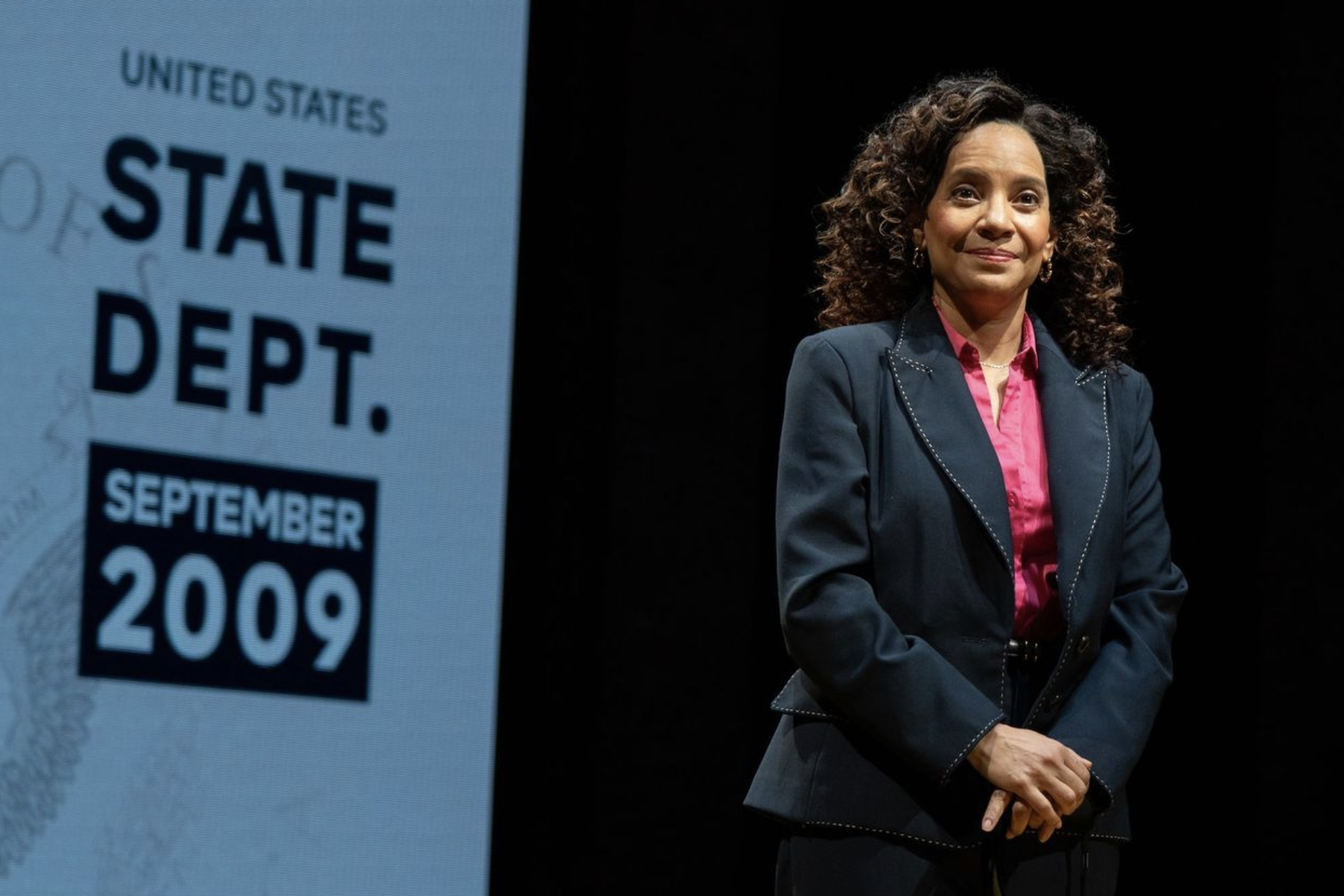
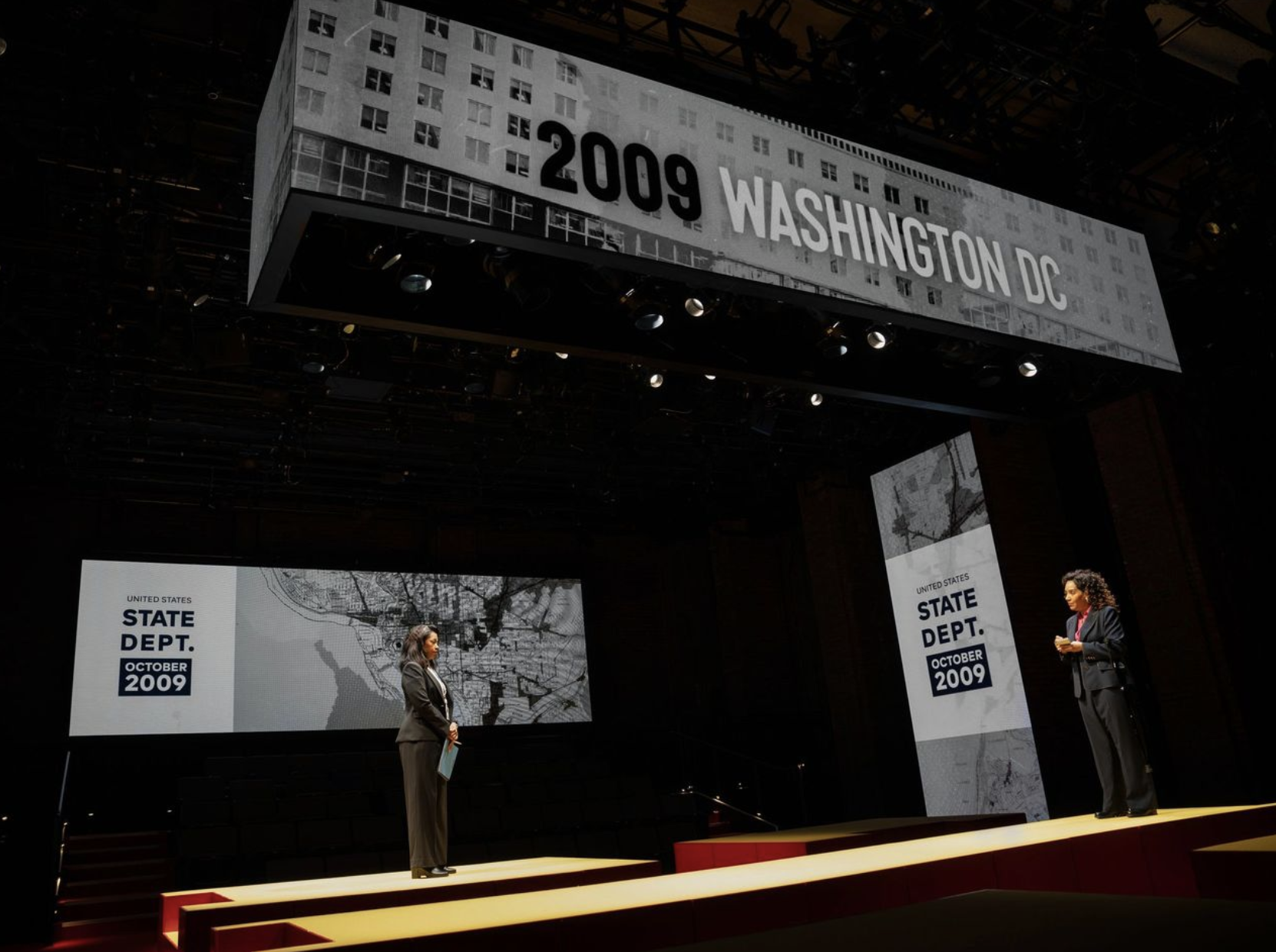
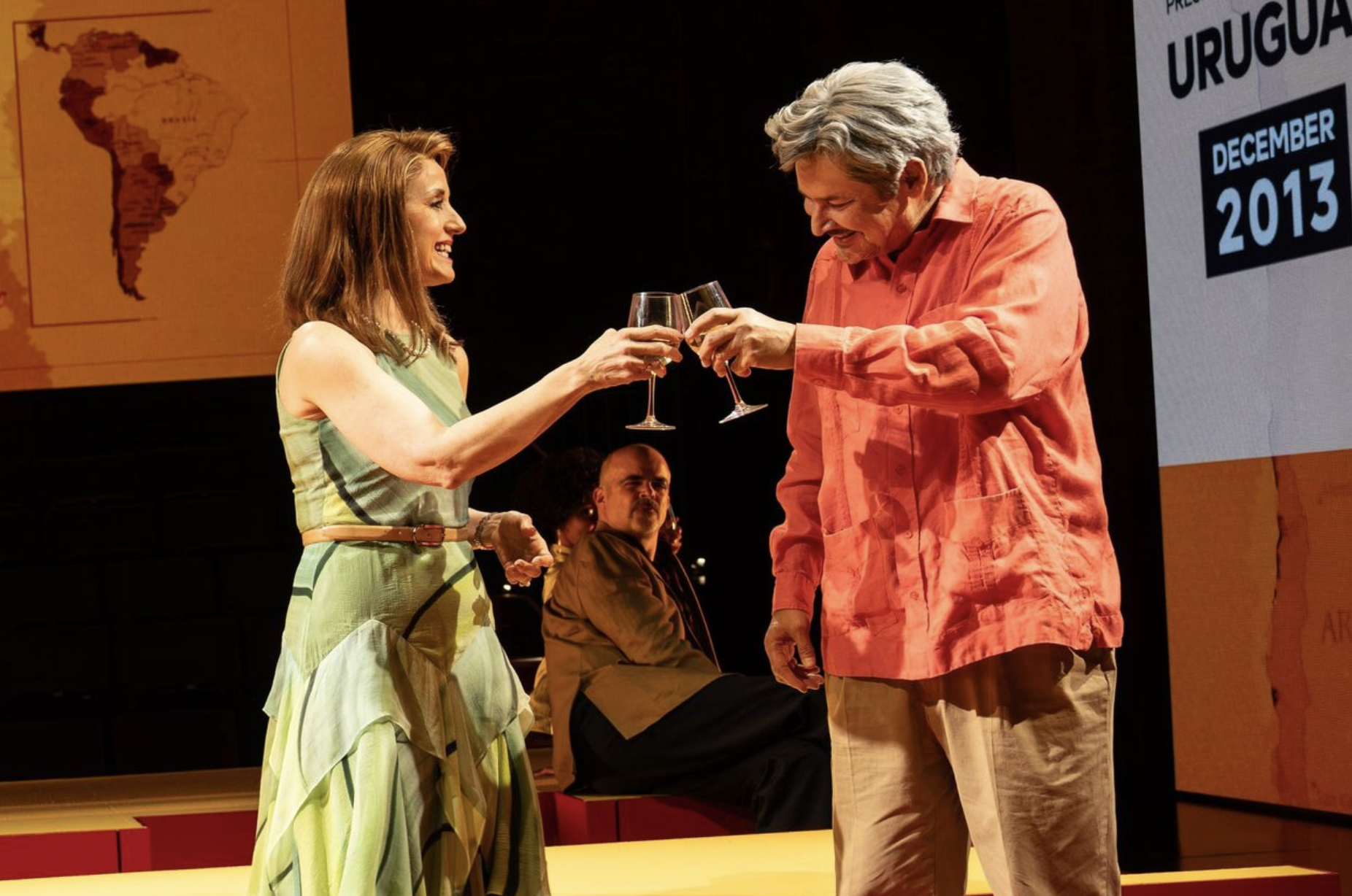
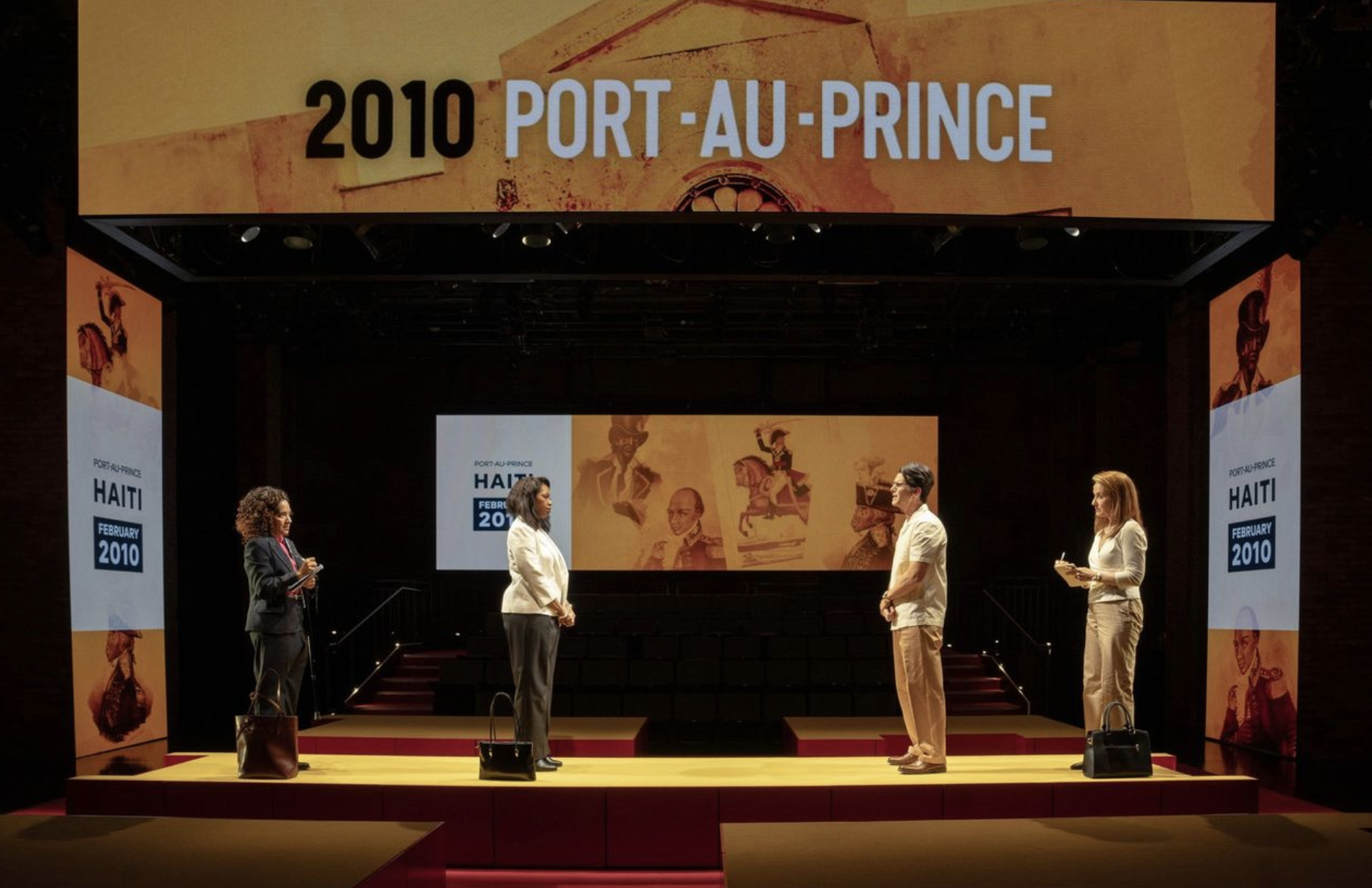
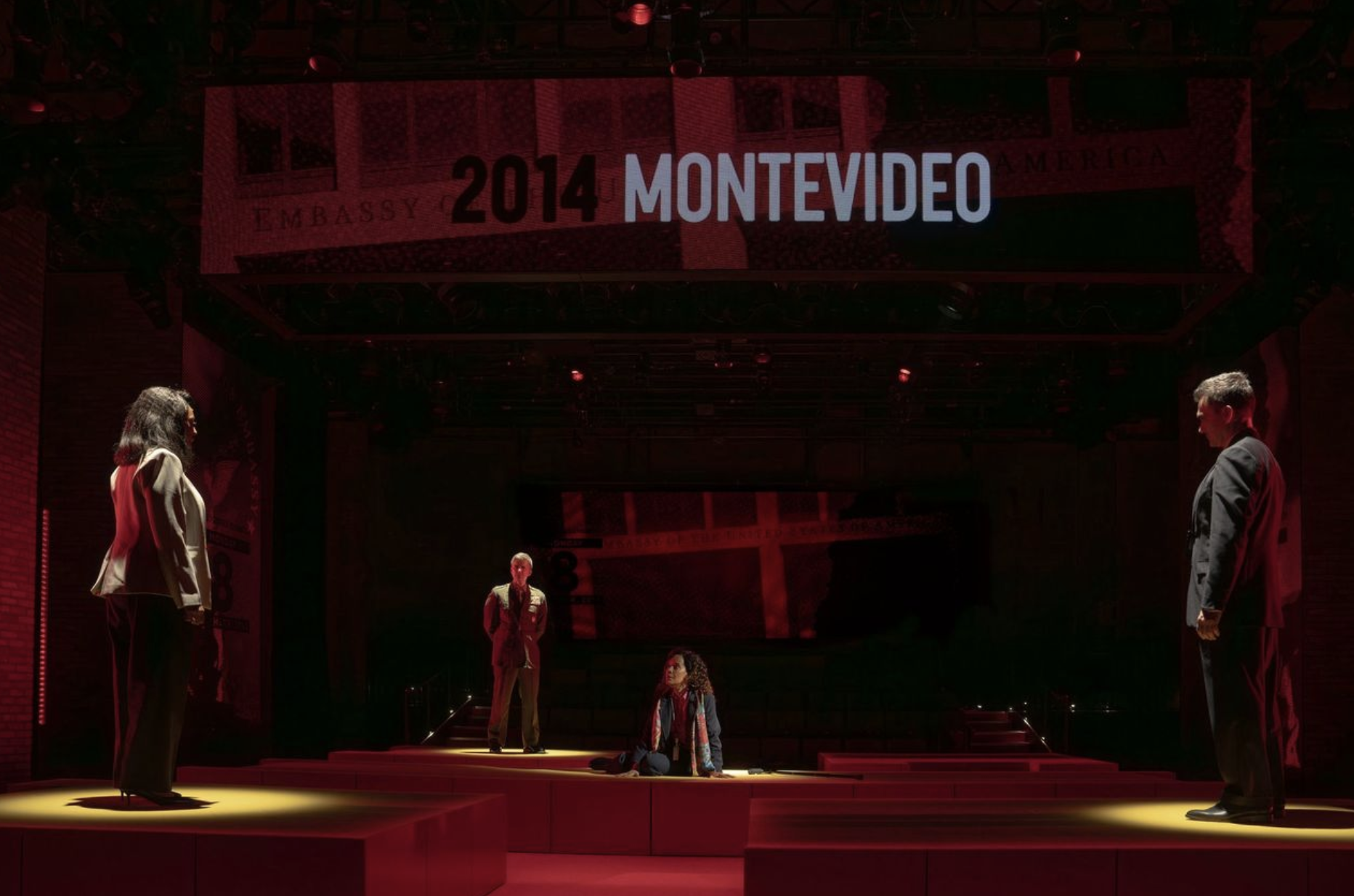
Photo credit by Joan Marcus
In Public Charge, the autobiographical drama by Julissa Reynoso, a deputy assistant secretary of state under Hillary Clinton, and later an ambassador to Uruguay, co-written with Michael J. Chepiga, the theater becomes a site not merely of storytelling but of civic reckoning. Directed by Doug Hughes with a lucidity that not only clarifies but subtly deepens the text, the production finds in its precision a quiet, cumulative power. What unfolds is less a conventional political narrative than an intimate anatomy of how conviction, sharpened by experience, can move through the corridors of power and, on occasion, alter their course. At its center is Reynoso herself, embodied with bracing resolve by Zabryna Guevara, who charts the diplomat’s ascent with a tensile energy that feels both hard-won and quietly revelatory.
The play traces Reynoso’s journey from her childhood immigration from the Dominican Republic to her emergence as a formidable presence within American diplomacy, culminating in her work under Hillary Clinton during the Barack Obama administration. This trajectory is rendered not as a simple arc of achievement but as a series of encounters—personal, political, and moral—that gradually refine her sense of purpose. The production moves with an almost cinematic agility across geographies and crises: the aftermath of the 2010 earthquake in Haiti, the fraught terrain of U.S. immigration policy, the shadowy realm of intelligence work, and the delicate negotiations surrounding Alan Gross, an imprisoned American in Cuba. Each episode, distinct in tone and texture, contributes to a larger portrait of a diplomat forged at the intersection of private memory and global urgency.
The play announces itself with a scene of startling bluntness. It is 1981 in the Dominican Republic, and a six-year-old Julissa stands inside a U.S. Embassy, hoping for passage to the Bronx and to her mother. The encounter that follows—between the child and a consular official who cloaks prejudice in bureaucratic language—unfolds with an almost schematic clarity, its harshness bordering on the archetypal. Yet what might initially register as overdetermined soon reveals itself as a deliberate act of framing: a distillation of the forces that will shape the life to come.
The official’s invocation of “public charge,” that chillingly antiseptic phrase for imagined dependency, lands with particular force, not only as a legal designation but as a moral judgment imposed upon a child. In staging the moment so starkly, Reynoso and Chepiga give us the wound in its most legible form. The language is blunt, even ungenerous, but it is precisely this lack of nuance that allows the scene to reverberate. We are meant to see the machinery of exclusion stripped of its euphemisms. What emerges, retrospectively, is less a rough beginning than a kind of overture. The scene establishes, with almost fable-like directness, the stakes that will animate the play: who is permitted entry, who is deemed worthy, and how such judgments calcify into policy. That Julissa Reynoso will move from the receiving end of that verdict to a position of power within the very system that issued it lends the opening a quiet, retrospective triumph. What begins as exclusion is, over the course of the evening, transformed into agency, the insult metabolized into a lifelong argument with the structures that once sought to define her.
When we next encounter Julissa —now in 2009, interviewing for a post at the State Department—the phrase “public charge” has been quietly, elegantly reimagined. No longer a mark of exclusion, it suggests instead the weight of governance itself: the obligations one assumes in service of the state. Ivy League-educated yet disarmingly unpretentious, Julissa arrives not as an outsider pleading entry but as a figure already moving within the orbit of power, encouraged to apply by Hillary Clinton.
Her introduction to this new terrain is mediated by two figures who at first appear to embody institutional rigidity: Cheryl, her formidable superior, played with composed authority by Marinda Anderson, and Ricardo, the career officer portrayed by Dan Domingues, whose adherence to protocol borders on doctrinal. Yet, under the assured direction of Doug Hughes, these initial impressions prove merely a point of departure. Both characters deepen with gratifying subtlety, their edges softening into humor, their convictions revealing unexpected elasticity. What begins in a register of bureaucratic formality evolves into something far more human: a portrait of colleagues learning, in real time, how to accommodate not only a changing policy landscape but one another.
If the play at times leans into exposition—its dialogue occasionally bearing the weight of the history it seeks to illuminate—this impulse registers less as overstatement than as a kind of principled clarity. Reynoso and Chepiga seem intent on making visible the often-invisible mechanisms of governance, insisting that the audience grapple not only with outcomes but with process: the incremental negotiations, the recalibrations, the moral ambiguities that underwrite policy. In doing so, Public Charge locates its drama not in spectacle but in deliberation, inviting us to witness democracy not as abstraction but as lived, contested practice.
What emerges is a work of unusual earnestness and intellectual ambition, one that asks its audience to consider how personal history can inform public action without reducing one to the other. Guevara’s performance anchors this inquiry, imbuing Reynoso with a fierce, disciplined humanity that resists both sanctification and simplification. The result is a portrait of leadership that feels, at once, deeply individual and broadly emblematic—a reminder that the machinery of state is ultimately animated by those who choose, against inertia and resistance, to make it serve.
With a strikingly spare design by Arnulfo Maldonado, the Newman stage is transformed into an abstract topography of raised traverse stage platforms—no desks, no doors, no diplomatic ornamentation. The effect is bracing. Locations flicker into being—Santo Domingo, the Bronx, Washington, Montevideo—through language and Lucy MacKinnon’s bold projections, evoking the clipped efficiency of cables sent across continents. In this distilled environment, the play’s true subject comes into focus: diplomacy not as spectacle but as process, a patient accumulation of gestures, risks, and recalibrations. Haydee Zelideth’s costumes deepen the production’s sense of authenticity, grounding its globe-spanning narrative in textures and silhouettes that feel lived-in, precise, and quietly revelatory of character. The austerity proves unexpectedly rich, allowing Ben Stanton’s lighting and David Van Tieghem’s focused sound design to sculpt transitions of remarkable fluidity. A nightmarish sequence—in which Julissa imagines the collapse of her strategy spiraling into global chaos—achieves an oneiric intensity that feels earned precisely because so much else is held in reserve.
Guevara’s performance is the production’s beating heart. She traces Julissa’s evolution from diffident outsider—her reflexive “I’m so sorry” a small, devastating refrain—to a figure of calibrated resolve, acutely aware of how little margin she has been afforded and how much she must nonetheless risk. The personal and the political interlock seamlessly: the early wound of familial separation becomes not a sentimental motivator but a disciplined source of purpose. Guevara understands that Julissa’s authority must be built, moment by moment, within structures that were not designed to accommodate her.
Opposite her, Anderson’s Cheryl Mills is a study in controlled force. She moves through the play with a lawyer’s precision and a strategist’s foresight, ever mindful of the stakes surrounding Hillary Clinton. What emerges between Anderson and Guevara is a mentorship of unusual texture—unsentimental, exacting, and deeply sustaining. These are two women who recognize, without needing to say so, the improbability of their position and the necessity of their success.
The supporting cast deepens the play’s intricate moral landscape. Dan Domingues gives Ricardo Zuniga a finely shaded arc from doctrinal rigidity to adaptive intelligence, embodying the slow, often reluctant evolution of institutional thinking. When one considers that Reynoso is hired as his boss, the former Bush hire goes through the motions of performing his role but then gradually appreciates a feel of camaraderie he may have never experienced under the previous regime. It is a fine line to play and Domingues gives it an exquisitely layered performance. Deirdre Madigan brings a fierce, aching humanity to Judy Gross, whose husband, Alan, an American USAID sub-contractor, remains imprisoned in Cuba for years. Madigan allows anger and vulnerability to coexist, transforming what might be a purely symbolic role into something piercingly immediate. Rising deftly to the task of animating the play’s dense political terrain with flashes of personality and wit, Maggie Bofill, as the Cuban diplomat Josefina Vidal, proves especially memorable, allowing a vein of cool, acid self-assurance to flicker just beneath the surface of her composure, lending each exchange a sharpened, quietly exhilarating edge.
If the play is dense with information—its thirty-four scenes braided with the intricacies of the Cuban Five, back-channel negotiations, and the legal thicket of the “public charge” provision—that density becomes, under Hughes’ assured stewardship, a kind of dramaturgical texture rather than a burden. The repetition of key facts begins to feel less like redundancy than insistence: a reminder of how often, in both politics and life, understanding must be earned through reiteration. What might, in another production, register as discursiveness here accrues into rhythm, echoing the recursive nature of diplomacy itself.
After Julissa assumes her post as ambassador to Uruguay, the play opens outward into one of its most quietly affecting threads: the fate of detainees held for years without trial at Guantánamo Bay. What might have been rendered as abstract policy instead becomes, here, a deeply human negotiation. Julissa appeals to the moral imagination of President of Uruguay José “Pepe” Mujica, played with disarming warmth by Al Rodrigo, who agrees in principle but insists on something essential: that the men themselves be asked what they want.
It is a small but profound shift—from diplomacy as transaction to diplomacy as consent—and the production lingers on it with admirable patience. Armando Riesco proves a dramatic hero as Jose “Chacha” Gonzalez, the quietly resolute emissary dispatched to Guantánamo to pose that question. Riesco imbues the role with a grounded, unshowy empathy, turning what could be a procedural errand into one of the play’s most resonant gestures. In these moments, Public Charge locates its moral center not in grand declarations but in the simple, radical act of asking—and listening.
Even the play’s concluding movement, which extends beyond Barack Obama’s 2014 announcement of a restoration of diplomatic ties into a more intimate, forward-looking coda, acquires a quiet resonance. By allowing Julissa a moment of provisional celebration—tinged with hope, shadowed by uncertainty—the production refuses to seal history into a single, declarative gesture. Instead, it acknowledges the fragile afterlife of political achievement, the way triumph continues to reverberate in private spaces long after the cameras have turned away.
What ultimately distinguishes Public Charge is its faith in the slow, unglamorous labor of change. Reynoso and Chepiga resist the temptation to mythologize their protagonists; instead, they show how policy emerges from the interplay of expertise, protection, imagination, and persistence. The “swap that isn’t a swap,” the incremental trust-building, the willingness to risk failure—these become the play’s true dramatic engines.
Seen now, the work carries an added charge. It is both a testament to what becomes possible when those long excluded from power begin to reshape it and a meditation on the delicacy of such gains. Hughes’s lucid, elegantly stripped production does not mourn that fragility; it illuminates it. The machinery of diplomacy stands before us, newly legible in its simplicity and its complexity alike. What Public Charge suggests—quietly, persuasively—is that history is not only made in grand pronouncements but in the patient, precarious work of those who refuse to accept that the way things have been is the way they must remain.
The world has shifted markedly since the moment Public Charge so carefully reconstructs—policy hardening, rhetoric cooling, the fragile apertures of dialogue narrowing once more between the United States and Cuba. And yet, what the play so movingly preserves is the memory of a brief, luminous convergence, when politics and humanitarianism did not merely coexist but actively informed one another. In dramatizing that interval, Reynoso and Chepiga offer not nostalgia but recognition: a reminder that diplomacy, at its most effective, is neither cynical nor abstract, but animated by a belief in human consequence. That such a moment proved fleeting does not diminish its significance. If anything, it renders it more precious. The play asks us to recall—not wistfully, but with clarity—that there was, indeed, a time when the machinery of government bent, however briefly, toward empathy.
Click HERE for tickets.
Review by Tony Marinelli.
Published by Theatre Beyond Broadway on April 18, 2026. All rights reserved.
