
Written by Anne Washburn; Directed by Steve Cosson
Vineyard Theatre, 108 East 15th Street, New York, NY 10003
October 23 - December 7, 2025
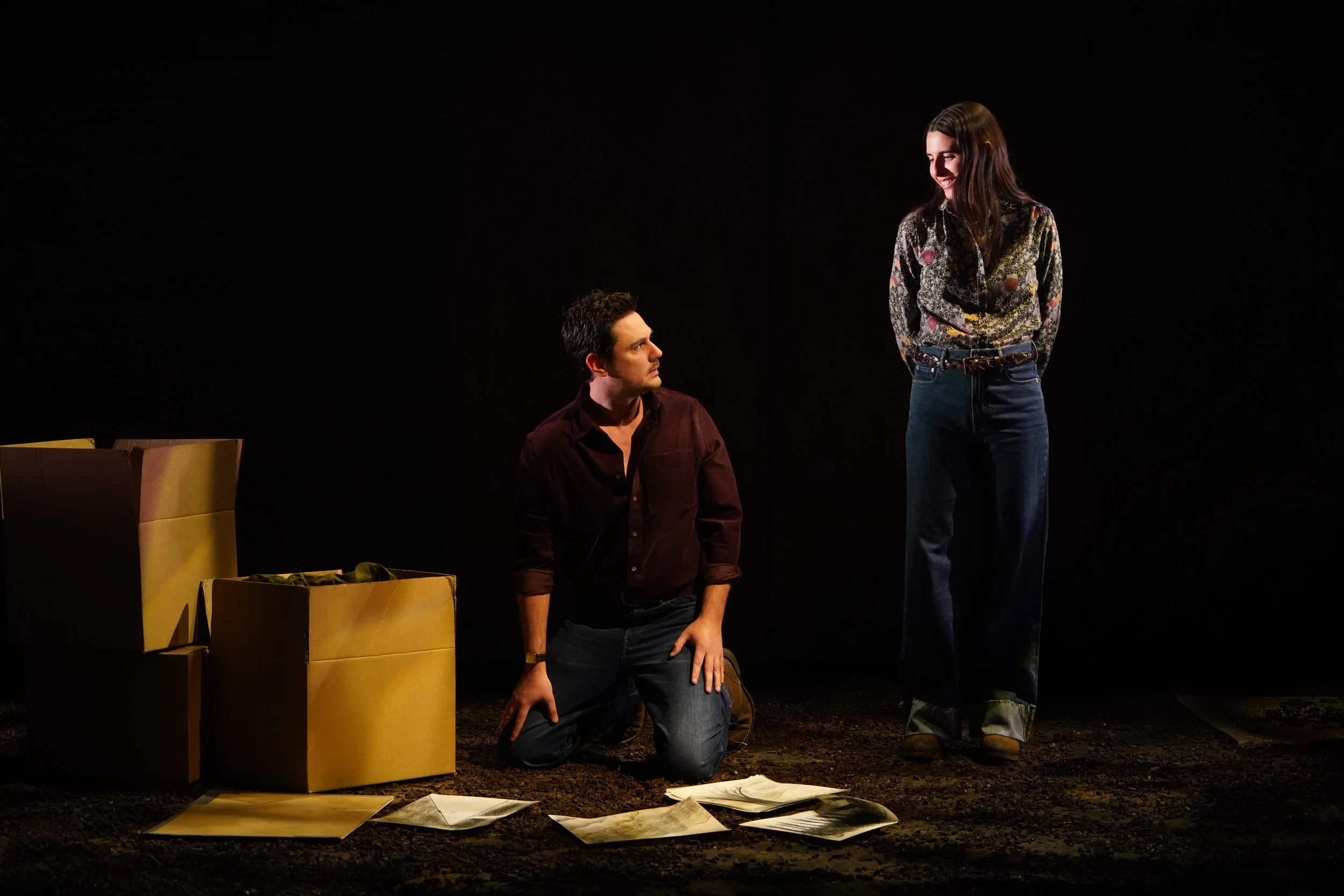


Photo Credit: Carol Rosegg
In the cool glow of retrospect, one can’t help but note that dispatching the dearly departed via an impromptu funeral pyre was, shall we say, a touch impulsive — a theatrical flourish whose consequences might extend well beyond the risk of turning the surrounding hillsides into a blazing tableau. For when the inevitable inquiry arises — “What precisely have you done with the body?” — and the only answer is that its charred relics now repose in a clandestine, unmarked grave, the whole arrangement takes on the unmistakable musk of concealment, the scent of a secret more burdensome than holy.
Such overripe dramatic gestures are, of course, perfectly in keeping with the anti-establishment denizens of Anne Washburn’s darkly beguiling new play, The Burning Cauldron of Fiery Fire. These countercultural disciples, who have carved out their own pastoral utopia on a sunburnt patch of California farmland, scorn the petty tethers of societal expectation with a kind of ecstatic fervor. They live communally, farming and fermenting and philosophizing with the earnestness of those who believe they have transcended the sordid machinery of civilization. And yet — as Washburn deliciously suggests — even paradise can fester. Why this spiritually aspirational tribe responds with such operatic extremity to the passing of Peter, a relative newcomer to their fold, remains one of the play’s many simmering puzzles, a mystery whose vapors curl through every scene.
Enter Thomas, the group’s elder, a man whose sanctimony is so aggressive it practically leaves a welt. He declaims with the solemn grandeur of a self-appointed high priest: “The decision which we made collectively — and we did make it collectively — was made in great emotion and, like a lot of decisions made in great emotion, it was very satisfactory, but um, then there’s a lot of responsibility around it.” In Washburn’s hands, this wavering confession becomes both a comic jewel and a chilling omen — the cracked mirror through which we glimpse the group’s fragile consensus, its porous morality, and its desperate need to believe that even the most dubious act can be sanctified by communal intent.
For what is communal harmony without the ceaseless labor of suppressing inconvenient truths? The group soon discovers that maintaining their pastoral idyll requires far more than harvesting kale and policing the compost heap; it demands keeping their exuberantly unfiltered brood of children from trumpeting Peter’s demise to the outside world. And then there is the matter of crafting a suitably benign fiction for Peter’s family, should any bereaved relations materialize, (and one does, in the body of Peter’s brother Will, played splendidly by Tom Pecinka), hopeful that their hale, spiritually questing scion is still among the quick. Naturally, once the children become convinced — with the crystalline certainty unique to the very young — that Peter has returned in porcine form and must be liberated from his prospective fate as a companion to fried eggs at breakfast, the adults find themselves contending with yet another crisis of ontology and animal husbandry.
Under the meticulous, slyly playful direction of Steve Cosson — Washburn’s longtime collaborator since the synapse-tingling Mr. Burns, a Post-Electric Play electrified Off Broadway in 2013 — this new outing is a subtler but no less potent revelation. The Burning Cauldron of Fiery Fire, in its world premiere at the Vineyard Theatre (a co-production with The Civilians, featuring a dexterous cast of eight), unfurls its mysteries with the patience of a hypnotist: vexingly slow at first, then seductively deliberate, building toward a final section in which playfulness, dread, and a strange, shimmering beauty interlace like threads in a ceremonial tapestry.
Questions proliferate like sparks from a smoldering pyre: How did Peter truly die? Who among these pastoral pilgrims is shading the truth? And — perhaps most tantalizingly — is Peter even dead in the first place? The play generates the rare, intoxicating sensation of exiting the theater ravenous to discuss it all: the canker threaded through society’s institutions, the uneasy dance between mortality and resurrection, and yes, the troublingly conspicuous padlock affixed to that basement door, glinting like a silent accusation.
We catch only the briefest, flickering moment with Peter himself (again a suitably ethereal Tom Pecinka) before his supposed demise — a memory relayed by Milo (the wonderfully sardonic Bobby Moreno), who was six years old at the time and singularly unenchanted by the man. And indeed, Peter — a trust-fund aesthete who regards the mixing of a paint palette as “an act of art unto itself” — exudes a level of pretension that practically begs for satirical immolation. For those who hefted his body toward the flames, especially the increasingly disturbed Thomas (a riveting Bruce McKenzie) and even the ordinarily caring Mari (Marianne Rendón), grief appears to have been, at best, an afterthought. Simon (Jeff Biehl) emerges as the community’s resident realist — or, perhaps more accurately, its reluctant Cassandran accountant of consequences. His pronouncements, delivered with the blunt pragmatism of a man who has long since stopped believing in the redemptive power of group feeling, slice cleanly through the commune’s mists of mysticism and wishful thinking.
Counterbalancing this adult arctic chill is the fervent, heedless devotion of the children, who mount a covert expedition to the pigsty to identify and rescue whichever piglet is — spiritually speaking — Peter reborn. Led by Crystal (Donnetta Lavinia Grays), a nine-year-old with the investigative gravitas of a seasoned litigator, the scene is a marvel of theatricality: adults channeling their inner children, children manifested entirely through performance, and pigs conjured in the imagination alone.
Grays proves equally magnetic in the play’s delectably chaotic play-within-the-play — a fairy-tale pageant devised by Peter and the children, in which she embodies a magnificently malicious monarch presiding over a princess (Cricket Brown) and her beleaguered suitor (Bartley Booz), who withstands the equivalent of a one-man episode of television’s Survivor. Here, amid the cavorting puppet fish and the titular fire-filled cauldron, Washburn indulges in spectacle with gleeful abandon. The design team excels: Andrew Boyce’s rustic farmhouse interior is a small triumph of rustic dramaturgy — a study in scenic restraint that reveals its quiet beauty only upon prolonged contemplation. The space is defined by its deliberately drab, weatherworn walls, the muted palette speaking to years of communal use and spiritual fatigue. Yet, like lichen blooming on old stone, bursts of life intrude in the form of children’s drawings tacked haphazardly about, their exuberant scribbles offering the only chromatic rebellion in an otherwise stoic environment. Above it all, the faint silhouette of mountains implied at the crest of the upstage walls creates a trompe l’oeil of distant grandeur, reminding us that even in this cloistered enclave, the vast and indifferent wilderness waits just beyond the frame. Emily Rebholz’s earth-toned farmers costumes, Amith Chandrashaker’s alchemical lighting, Ryan Gamblin’s atmospheric soundscape, and Monkey Boys Productions’ enchanting puppetry all conspire to create a world both homespun and mythic.
In this peculiarly resourceful enclave—one that purports to subsist in off-the-grid austerity, eking out an existence more akin to a commune than a community—the dramaturgical contradictions are positively delicious. Though the lone telephone is ignominiously imprisoned in what appears to be a repurposed gerbil habitat, the residents nonetheless conjure an improbably lavish theatrical apparatus: an electronic keyboard that hums with unsuspected sophistication, wardrobes bursting with elaborately wrought costumes, sleek microphones that would not be out of place in a midtown concert hall, scenic effects limited only by the feverish imagination of their creators, and puppets so monumental and meticulously engineered they seem to have wandered in from a well-funded Metropolitan Opera spectacle. One effect, alas, remains tantalizingly unrealized: a much-promised feat of levitation. “We’re still figuring out the winch system,” Simon confesses with a shrug both sheepish and proud—an admission that only heightens the production’s endearing blend of scrappy ambition and quixotic theatrical bravado.
The ninth “actor” in this cast, an enormous dragon, amber-eyed and perpetually disgruntled, looms into the narrative with the gravitas of a creature that surely knows more than it lets on. Is this puppet a sentinel, symbol, or something more sinister? Washburn, ever the conjurer, declines to answer. Instead, she invites us — with a sphinxlike smile — to sift through the ashes and divine meaning for ourselves.
Review by Tony Marinelli.
Published by Theatre Beyond Broadway on December 12, 2025. All rights reserved.