
Presented by Playwrights Horizons, Written by Jacob Perkins, Directed by Les Waters
Judith O. Rubin Theater, Playwrights Horizons | 416 West 42nd Street, New York, NY 10036
February 4, 2026 - March 8, 2026
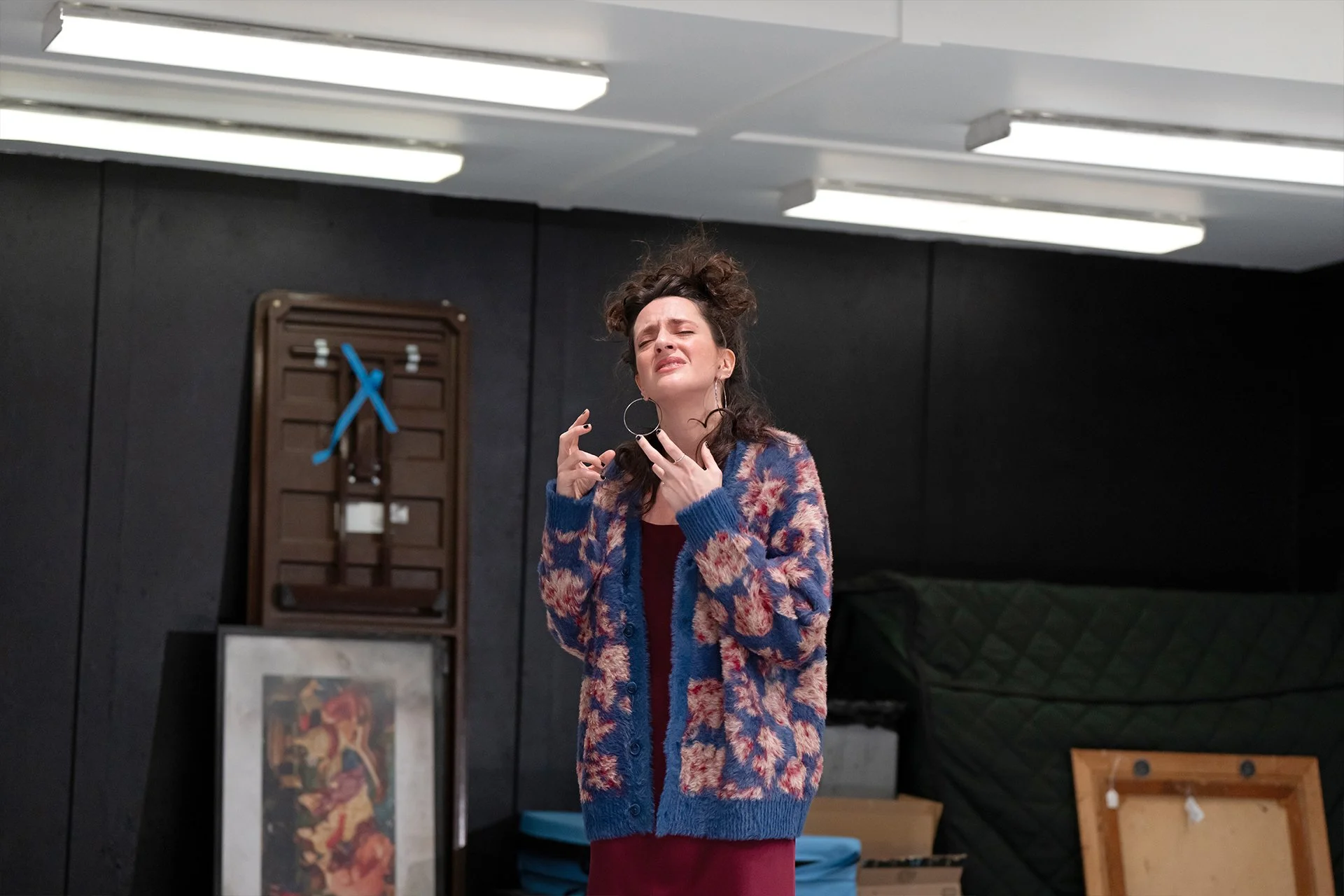
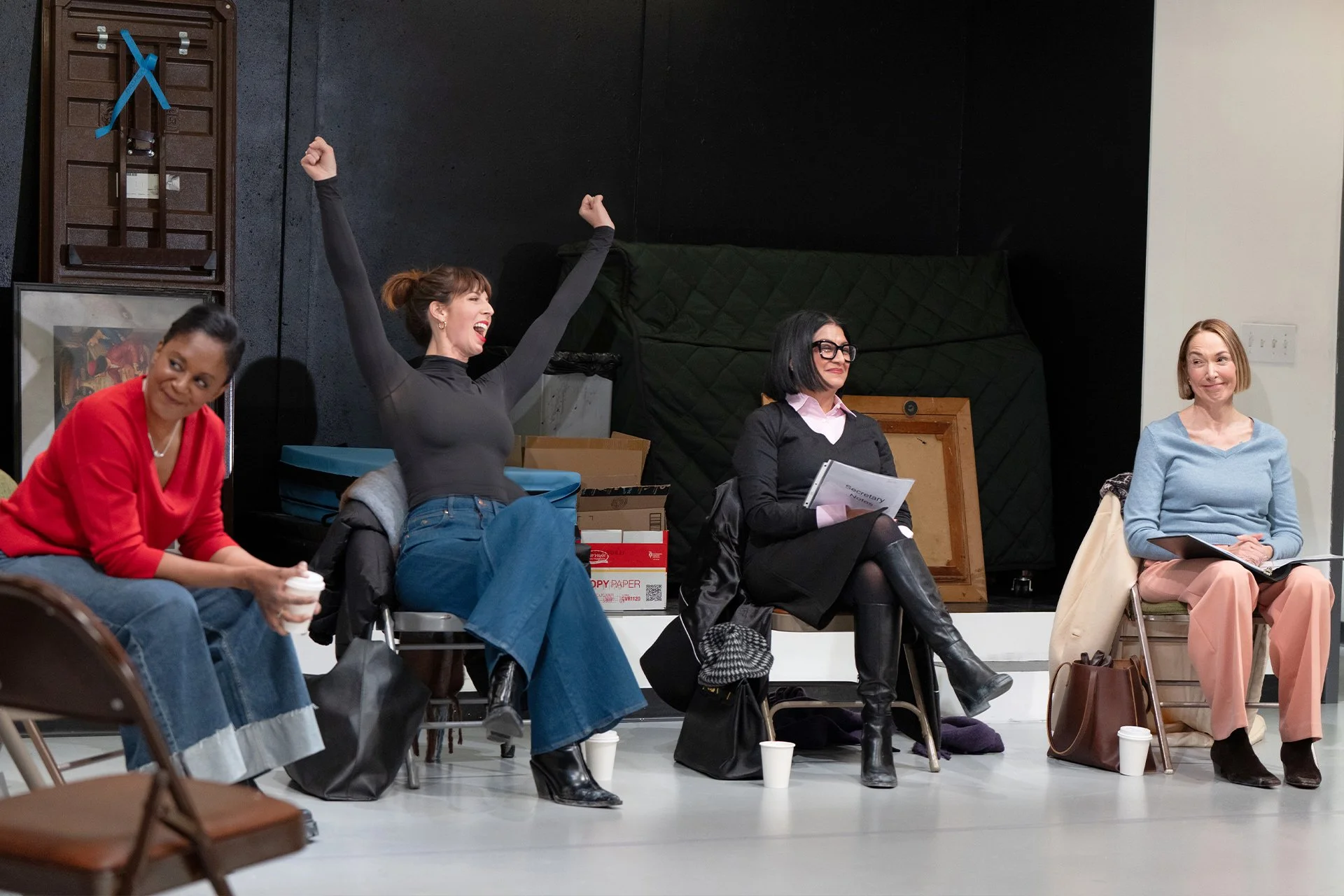
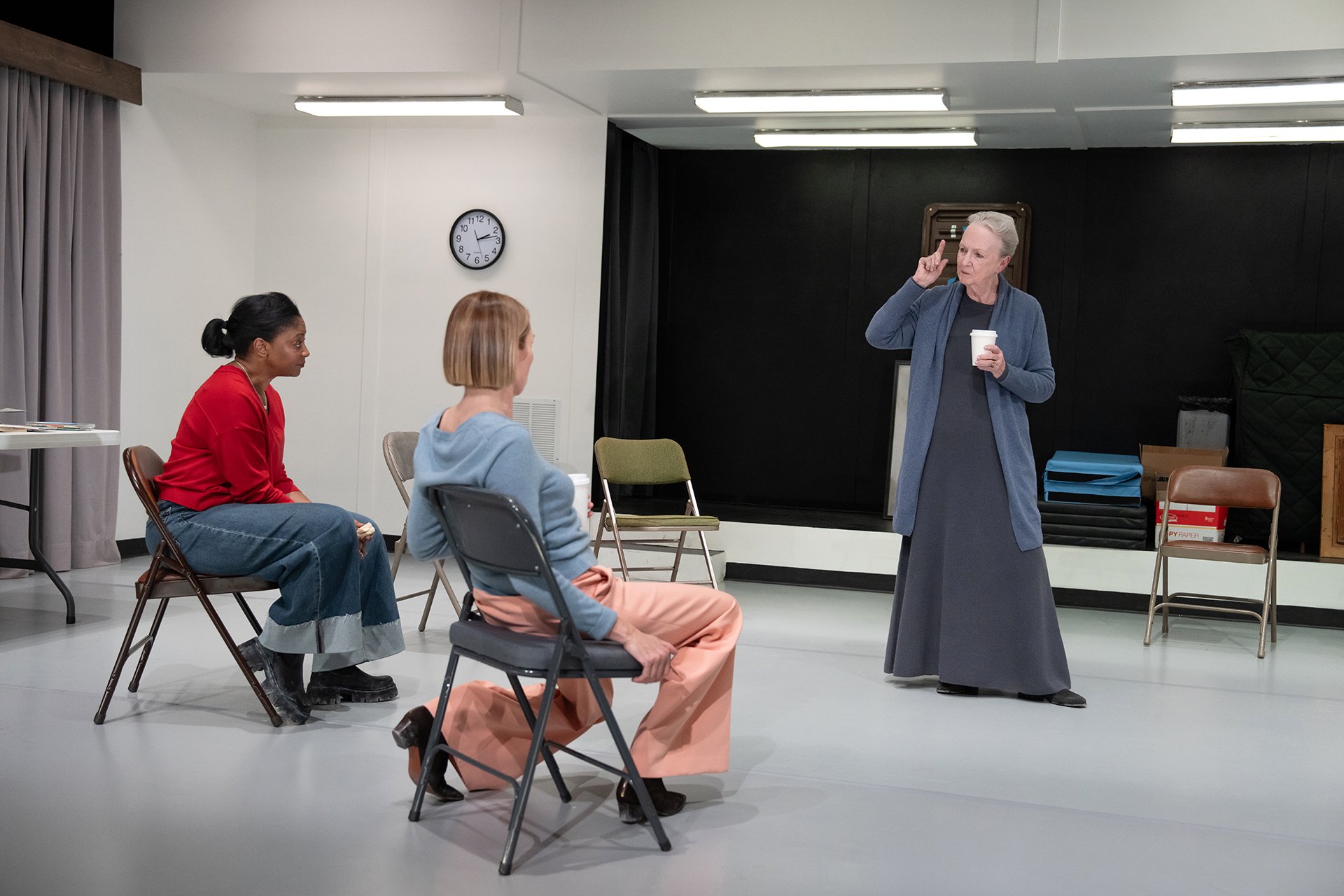
Photo Credit: Julieta Cervantes
In The Dinosaurs, the quietly mesmerizing drama by Jacob Perkins, a group of women gathers in a modest multipurpose room for what they call a “Saturday Survivors” meeting. The setting is, designed by scenic design collective dots, deliberately unremarkable—a space that might, depending on the hour, host a dance rehearsal, a yoga class, or a church committee—but on this particular morning it becomes something rarer: a sanctuary of shared reckoning. The women assembled here are alcoholics, each navigating a different stage of recovery, yet what binds them is not merely the struggle against addiction but the fragile, sustaining community they have built around it.
At first glance, Perkins’ play appears to concern only the modest span of a single meeting. The women pull out folding chairs, exchange greetings that carry the warmth of long familiarity, and begin the ritual of storytelling that lies at the heart of the fellowship. Yet as the play unfolds, small and almost imperceptible shifts begin to ripple through the room. Through brief, subtle slips in time—moments that feel less like jumps than like gentle folds in the fabric of memory—the gathering gradually reveals itself to be something larger than a solitary afternoon. The effect is quietly uncanny. What begins as one meeting begins to feel like many meetings, layered atop one another like palimpsests. The women seem to inhabit not merely the present moment but the accumulated history of every Saturday they have spent together. In Perkins’ conception, time behaves less like a line than like a tide: it advances, recedes, and returns, carrying echoes of past confessions and future revelations.
Soon the room itself acquires a mythic dimension. These women seem less like temporary occupants than like fixtures of the space—as if their voices have seeped into its walls. One begins to imagine them gathered here before the room was ever constructed, folding chairs into place in some earlier version of the same communal shelter. And one senses they will persist long after the building has vanished, their fellowship migrating elsewhere but the ritual unchanged. The meeting, in this sense, becomes almost geological: a recurring formation in the landscape of human care. Perkins thus transforms the modest architecture of a recovery meeting into something approaching the eternal. The room is temporary, the chairs collapsible, the coffee lukewarm—but the act of gathering, of speaking and listening in turn, seems older than the building itself and destined to outlast it. In The Dinosaurs, community becomes a form of time travel: a ritual repeated so often that it begins to feel outside of time altogether.
In The Dinosaurs, Perkins accomplishes something that theatre so rarely attempts and even more rarely achieves: he makes stillness dramatic. To describe the action of the play—a single, hourlong meeting of a women-focused Alcoholics Anonymous fellowship—might sound deceptively modest. Yet from this premise emerges a work of piercing attentiveness and quiet radiance. At Playwrights Horizons, the production exerts such a spell that one becomes newly aware of the fragile acoustics of a theatre itself; at moments, the audience grows so absorbed that the silence feels architectural. You could hear a pin drop.
Under the exquisitely patient direction of Les Waters, the play unfolds with the delicate confidence of something being remembered rather than performed. Waters places us not at the beginning of a story but squarely in its middle. The women drift into the meeting already mid-conversation, as though continuing threads from weeks, months, perhaps even years before we arrived. Their entrances—casual, affectionate, teasing—reveal character through posture and rhythm rather than exposition, as does their clothing, designed by Oana Botez. Botez’s costumes function almost like marginal notes in the script, gently suggesting personality, history, and self-presentation before a single word is spoken.
The members of the group—Jane (April Matthis), Joan (Elizabeth Marvel), Janet (Mallory Portnoy), Joane (Maria Elena Ramirez), and Jolly (Kathleen Chalfant)—possess a gentle comic symmetry. Their lightly alliterative names suggest a fellowship forged through years of repetition, shared ritual, and mutual care. They speak in rhythms familiar to anyone who has spent time among old friends: finishing each other’s words, repeating a phrase simultaneously, delighting in inside jokes. At one point an attendee affectionately refers to Joan and Joane collectively as “the Joans,” a throwaway quip that carries the warmth of long familiarity. These small synchronicities become a language of belonging.
Into this choreography of comfort wanders the tentative newcomer Buddy—or Rayna, depending on who is speaking—played with wonderfully restless uncertainty by Keilly McQuail. She hovers at the edges of the room, physically and emotionally, never quite settling into the circle of folding chairs. The staging quietly emphasizes this liminality; for much of the play, Buddy/Rayna remains literally unseated. Yet Perkins writes her with tender acuity as someone groping for a vocabulary of meaning. In a conversation with Jane that begins innocently enough—about baked goods of all things—she suddenly arrives at a strange but heartfelt revelation: once she realized that a cupcake was simply “a cake in a cup,” her relationship to it changed entirely. The remark is funny, but also oddly profound, an improvised metaphor for the human urge to reframe the ordinary in order to regain a sense of control.
The women’s stories surface gradually, like objects glimpsed beneath calm water. Janet’s first account carries the charged ambiguity of metaphor—are we hearing allegory or confession?—yet the group receives it with the generous assumption of truth. Joane, meanwhile, eventually complicates an earlier moment of maternal pride with a confession that deepens our understanding of her life beyond the room. Perkins resists the theatrical instinct toward climactic rupture. Time here exerts a gentler but more poignant pressure. The meeting’s designated “spiritual timekeeper” eventually calls out, “One minute,” and the effect lands with surprising emotional force. Stories do not conclude; they simply stop, or they continue somewhere or sometime other. The ache lies precisely in that interruption.
Time itself becomes the play’s quiet ground underneath. What initially appears to be a single meeting gradually reveals itself as a kind of temporal collage—an accumulation of many Saturdays folded into one theatrical hour. The shifts are subtle, almost subliminal. Lighting designer Yuki Link allows the room’s fluorescent wash to alternately cool and warm, creating the sensation that months or years might be passing invisibly through the air. The effect is less a matter of conventional “time jumps” than a gentle folding in of past and future into a single, ongoing present—suggesting that recovery, like memory, exists on a continuum rather than a timeline.A clock hangs on the wall, its face fixed in a permanent standstill, yet time unmistakably moves through the room. In The Dinosaurs, this small visual paradox quietly encapsulates the experience of recovery itself. Minutes may be measured, meetings may begin and end, but the deeper work continues without pause. For those gathered in this fellowship of AA, the daily struggle does not obey the tidy mechanics of the clock. It is ongoing, cyclical, and lived moment by moment—an endurance that persists long after the hands have stopped moving.
Sound designer Palmer Hefferan gives the dialogue a crystalline clarity that allows even the smallest pauses to resonate. Silence at points is deafening. Mundane rituals acquire a kind of choreography: folding chairs are assembled, donuts arranged, coffee poured. Someone’s errant cellphone is silenced. These gestures unfold with a patient realism that feels almost devotional. Rather than filler, they become the breathing spaces between moments of connection.
Not everyone in this circle speaks fully. Some participants offer only fragments—a whispered aside, a fleeting admission, a revealing gesture. And though Matthis brings her expected emotional depth to Jane—the woman who reliably arrives first, as if guarding the ritual before the others drift in—she is, in a sense, the character most poignantly shortchanged by Perkins’ design. In The Dinosaurs, the group quite literally runs out of time before Jane has the chance to share. The meeting’s structure, with its strict allotment of minutes, closes around her just as the possibility of revelation begins to flicker. What remains instead are the traces: those extraordinary flashes of untilled sorrow that cross Matthis’ face like weather over a landscape. She listens, nods, tends to the small rituals of the gathering—but whatever history presses behind her composure remains tantalizingly withheld. It is a quietly devastating theatrical choice. In a play devoted to testimony, Jane becomes the keeper of the untold story, her silence lingering in the room long after the meeting adjourns. Where a less confident play might rush to fill such gaps, Perkins leaves them intact. The result is a drama defined not only by what is spoken but by what remains suspended in the air when the meeting ends.
Indeed, the brilliance of The Dinosaurs lies in its embrace of incompletion. The play understands that healing rarely arrives with theatrical neatness. Instead, it accumulates through listening, through patience, through the quiet courage of returning to the same room week after week.
Watching these “Saturday Survivors,” one cannot help but feel that Perkins has created something rare: a theatrical space where compassion itself becomes contagious. Alcoholism may be the disease at the center of the room, but kindness proves equally transmissible. The play suggests, with remarkable gentleness, that survival—like storytelling—is rarely a solitary act.
The women in The Dinosaurs do not noticeably age before our eyes, nor do they evolve along the tidy trajectories that conventional dramaturgy tends to demand. There is no obvious narrative arc, no climactic turn that gathers their stories into a single, decisive revelation. Instead, Perkins offers something both subtler and, in its way, more moving: a portrait of continuity. What emerges over the course of the play is the quiet durability of community itself—a sense that these women return to this room, again and again, across months and years, creating through repetition a kind of refuge. The rhythms of recovery rarely announce themselves with theatrical flourish. One woman may relapse, disappear, and then reappear weeks later with the same mixture of humor and self-reproach. Another may falter repeatedly before discovering, almost by surprise, that she has remained sober for thirteen years. Joan, for instance, seems caught in precisely this paradoxical dance between setback and perseverance, her story less a straight line than a series of circles that gradually widen.
What the play suggests, with a gentle but persistent wisdom, is that transformation does not always look like change from the outside. Sometimes it resembles persistence: the act of showing up, sitting down, listening, and trying again. In that sense, the fellowship becomes a place where perception itself can shift. Just as one character once discovers that a cupcake is, after all, simply a cake in a cup, the women here slowly learn to see themselves differently. The revelation is small, almost comically literal—and yet it carries the quiet promise that, given enough time, even the most familiar self might be understood in a new light.
What this fellowship shares, and what it withholds, becomes a moving meditation on time, community, and the fragile architecture of human care. In the end, The Dinosaurs leaves us with a sensation not of closure but of continuation: as though, somewhere just beyond the theatre walls, the meeting is still quietly in progress.
Click HERE for tickets.
Review by Tony Marinelli.
Published by Theatre Beyond Broadway on March 7th, 2026. All rights reserved.
