Dear John
Created and Performed by Rachel Lin; Directed by Tara Elliott
HERE Arts Center | 145 6th Ave, New York, NY 10013
March 6 - 19, 2026
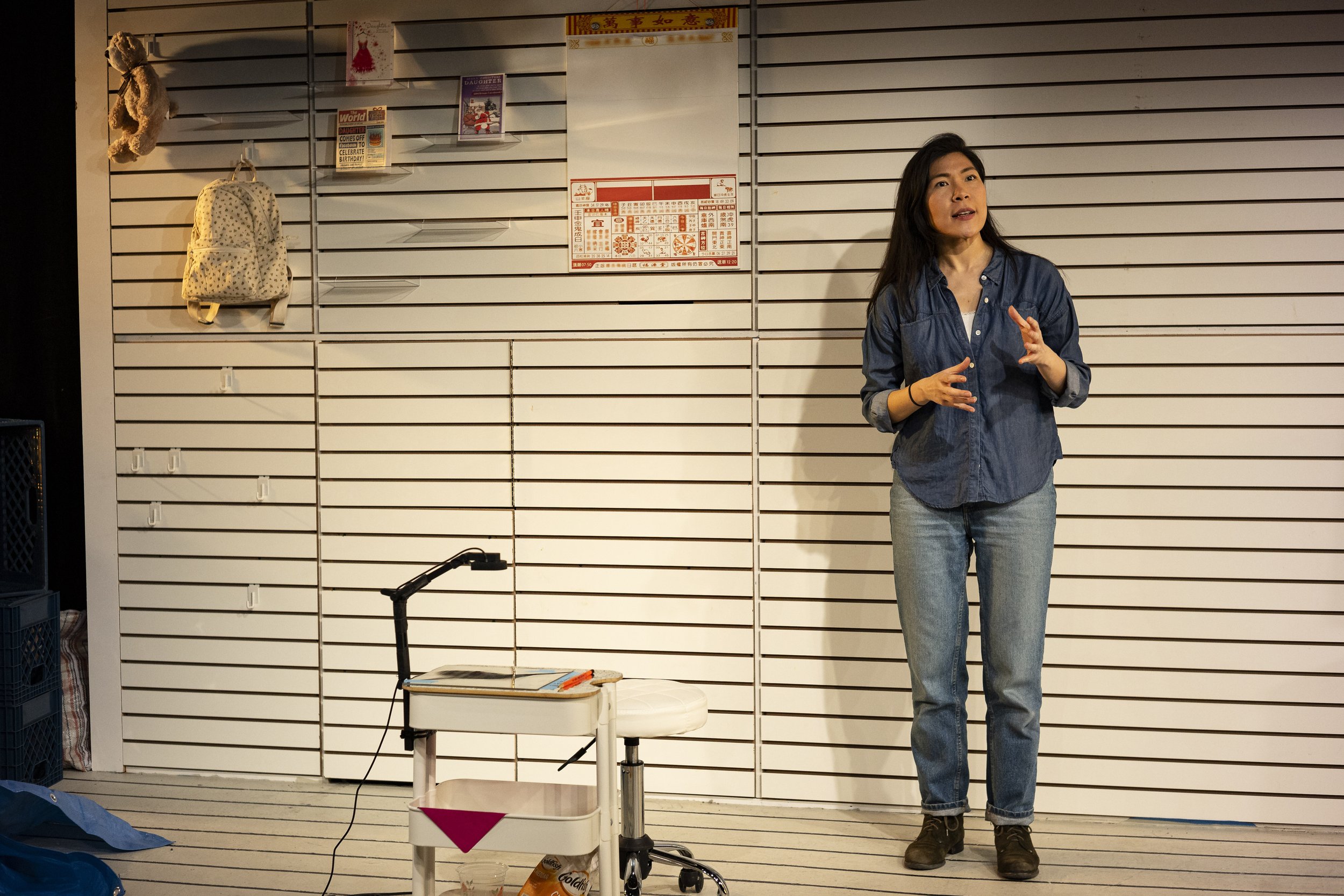
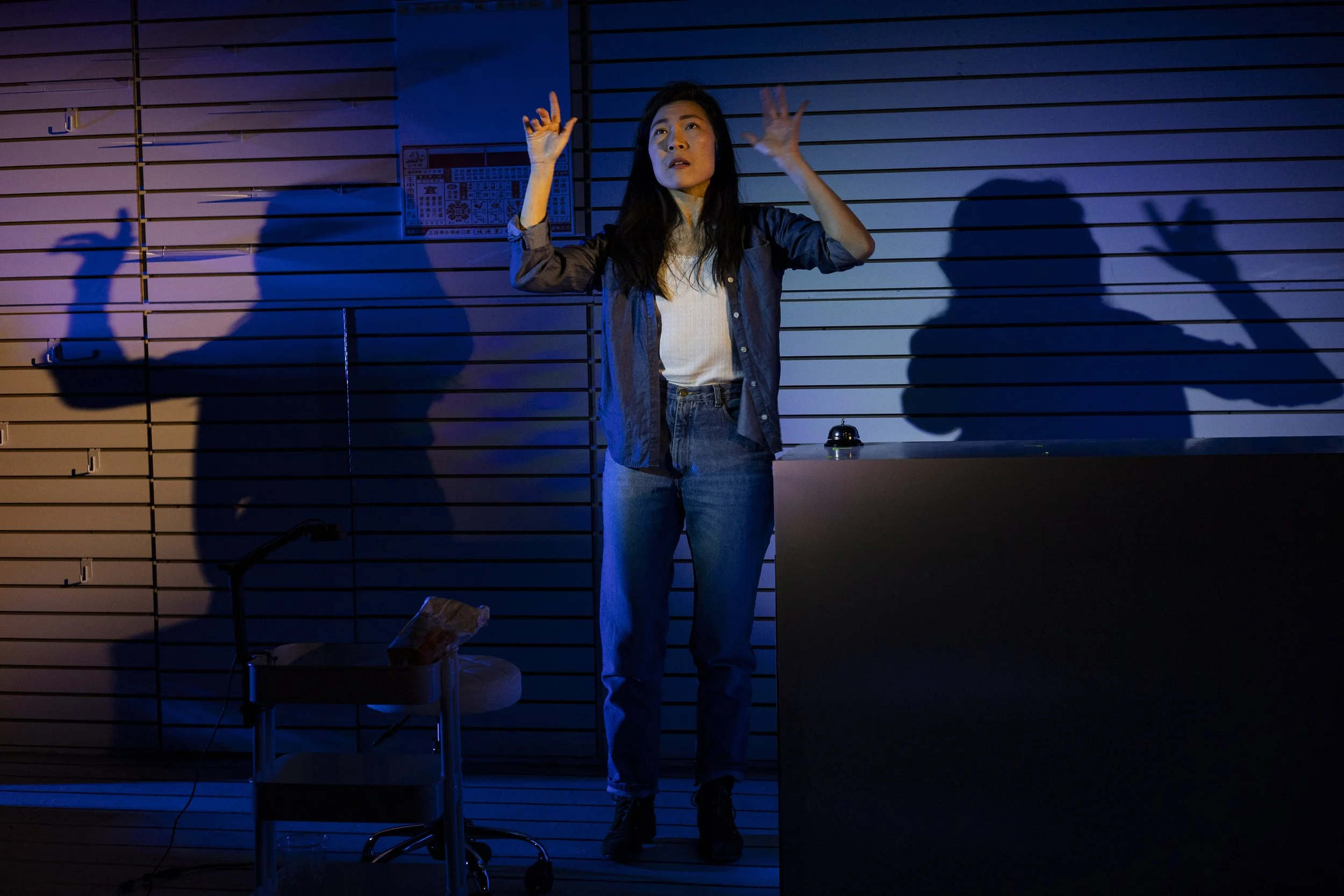
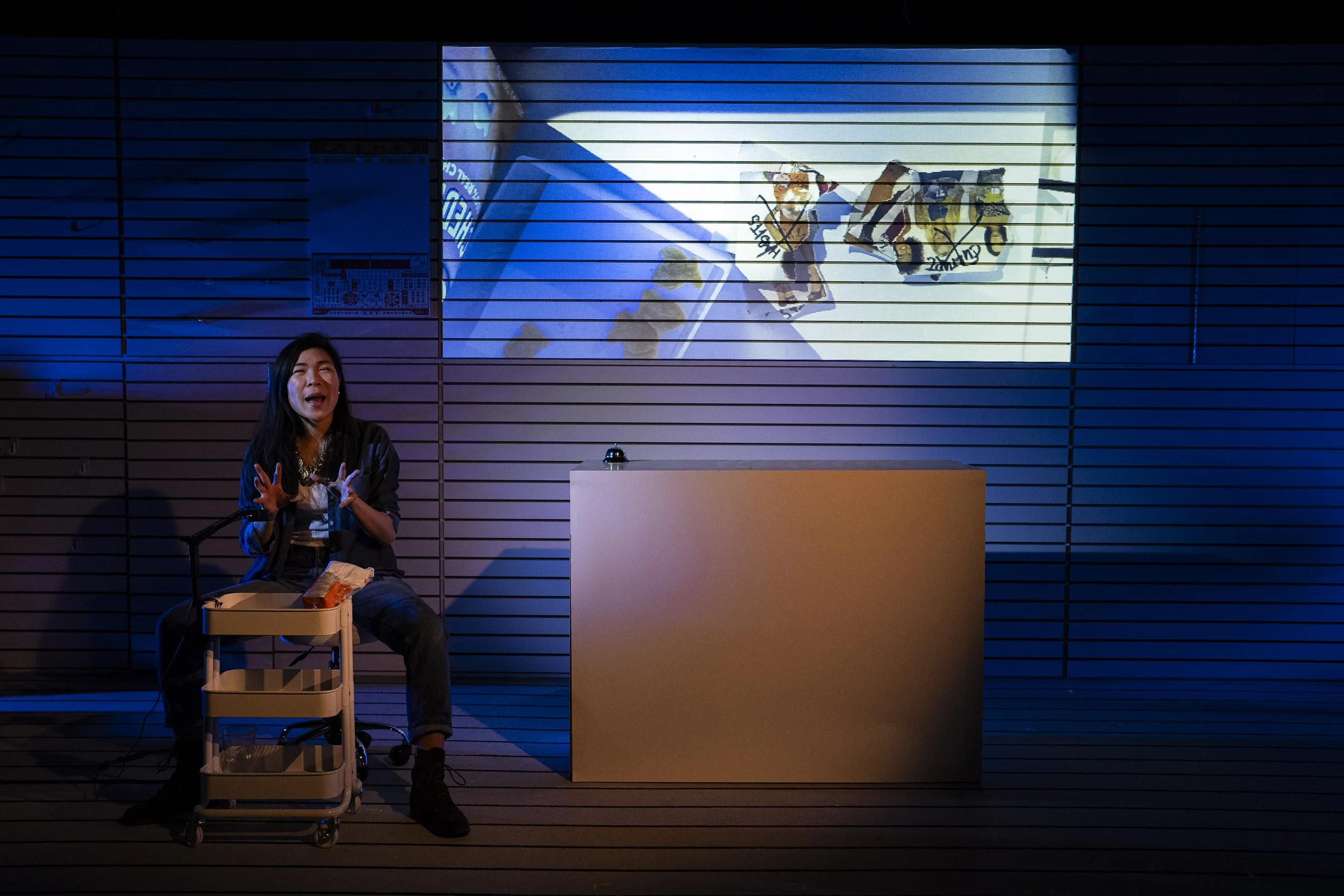
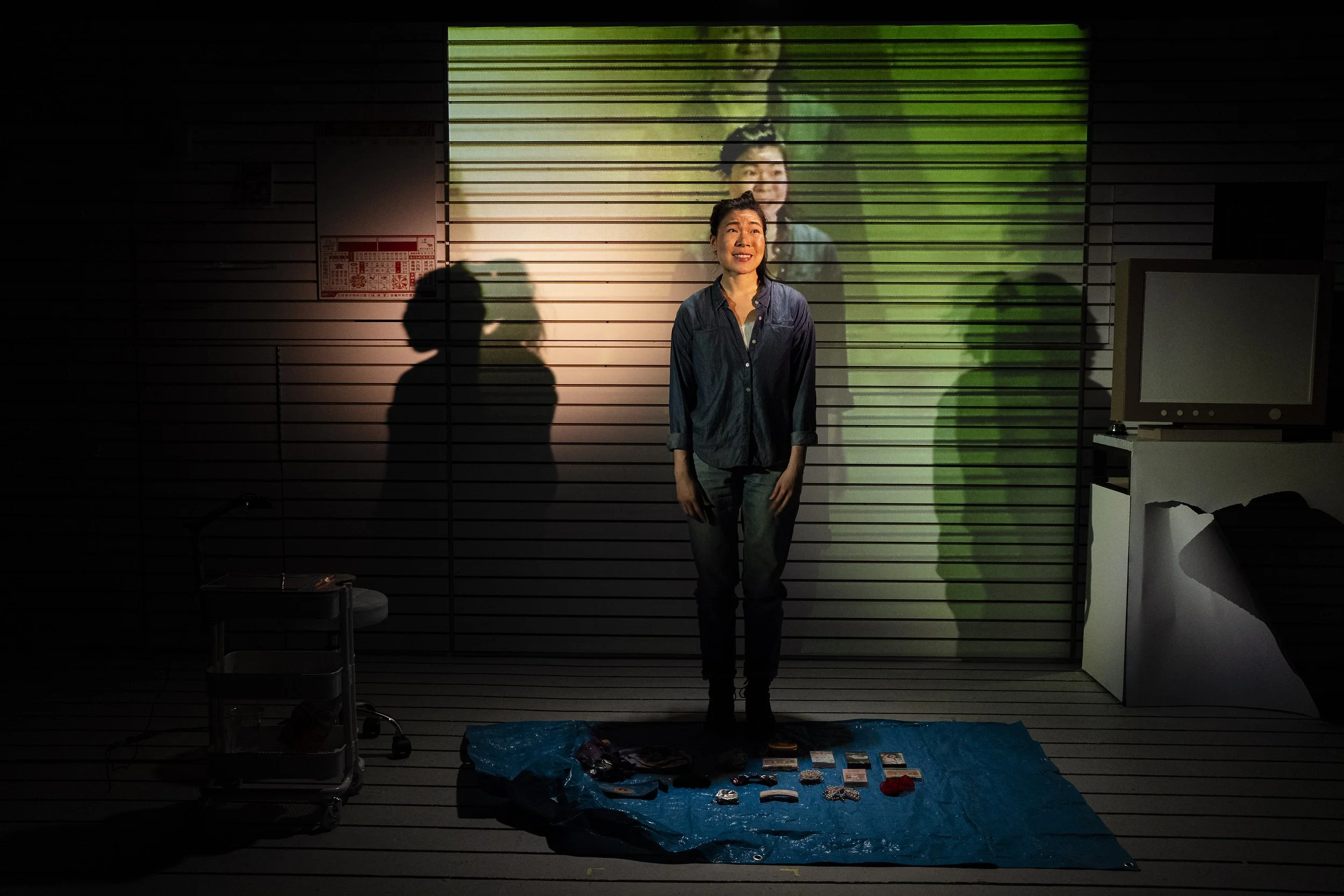
Photo Credit: Marcus Middleton
A full, boisterous house is always a promising sign. The audience arrives ready to love the performer, and on this Friday night they certainly did.
Before the show even began, I had the chance to chat briefly with the producer, Emily Kleypas, and the assistant stage manager, Raine Higa, about growing with this project and producing it at HERE Arts Center. There was a palpable excitement in the room about bringing Rachel Lin’s Dear John, directed by Tara Elliott, to this venue, and that energy carried into the performance itself.
The set immediately situates us in a world that feels both functional and slightly sterile: a white slatwall seen in retail stores, with a multi-functional counter, banker’s boxes, file cabinets, an office chair, crates, and scattered lighting equipment. It looks almost like a storage room for memories waiting to be unpacked.
This was the first preview, and the evening had the feeling of an experiment unfolding in real time. Rachel Lin excitedly stepped onto the stage and told us plainly: “This show is about getting messages you don’t want to get, at times you don’t want to get them.” That simple statement opened the door to a deeply personal story told in a stylized theatrical form.
We quickly learn that the story begins in 2010: Obama is president, the release of the first iPad, and Betty White finally hosts Saturday Night Live. It was a different time. Lin had just graduated from NYU’s Tisch School of the Arts with a BFA in Drama and was working at a retail store in SoHo when she received a mysterious message on Facebook.
Once upon a time, Facebook still felt like a semi-private neighborhood rather than the sprawling public square it is today. Back then, people didn’t readily respond to strangers online, especially accounts without profile photos. Social media was smaller, more cautious, and largely made up of people you already knew.
Against this backdrop, Rachel receives messages from someone claiming to be her father.
At first, she ignores them. Understandably so. A stranger without a profile photo reaching out online raises immediate questions. But the persistence of these messages slowly opens a door, beginning a journey into the possibility of a relationship with a father, John, who had long been absent from her life.
The story unfolds through a clever mix of theatrical devices. Letters become a central storytelling mechanism, sometimes read by audience members themselves, turning the audience into willing collaborators in reconstructing this complicated family history. On a Friday night, many happily stepped into that role.
As the letters reveal more, we learn that John begins inserting himself into Rachel’s life through correspondence. Money is sent. Expectations are expressed. Information about an extensive family appears, including half-siblings she had never known.
In a remarkably short amount of stage time, the audience absorbs a great deal of emotional and narrative information. Yet alongside curiosity and hope, there is also a quiet unease. The relationship, built almost entirely through letters and digital communication, carries an unsettling edge. Something about the dynamic feels slightly off, especially when we begin to hear Rachel’s mother’s perspective through her own voice.
The production employs several effective storytelling tools. The performer frequently steps out of the narrative to guide the audience directly, welcoming them into the unfolding investigation of her own past. Under the direction of Tara Elliott, the piece maintains a lively rhythm that keeps the audience deeply engaged, an especially important feat in the intimate setting of HERE Arts Center. Elliott’s staging embraces the closeness of the room, allowing the audience to feel less like observers and more like participants in the story’s unfolding.
The scenic and props design by Zhuosi “Joyce” He proves both practical and inventive. The environment feels intentionally utilitarian while still playful in its functionality, with everyday objects transforming into storytelling tools. The set’s elements are used in surprising ways, reinforcing the sense that memories and discoveries are being unpacked in real time.
Props and projections are used with intention rather than as decorative elements. Pre-recorded audio, including voiceovers and conversations with her mother, adds texture and perspective to the story. Rachel also portrays her father as she imagines him to look and sound: an Englishman brought to life through her own interpretation.
The projections, designed by Ein Kim, are particularly inventive. Instead of relying on a single projection surface, Kim’s design expands across the environment: traditional projections, overhead imagery, and visuals cast onto everyday surfaces such as the slatted wall, cabinets, and even props. The effect transforms the entire set into a storytelling canvas.
Lighting designer Yang Yu complements this visual language beautifully. Color is used to heighten moments of audience participation, while darkness frames the more intimate segments, particularly when we hear her mother’s voice. In contrast, brighter washes accompany Rachel’s narrative passages, guiding the audience through the emotional and temporal shifts of the piece.
By the end, the central question lingers: what does connection really mean?
Even if the person reaching out truly is Rachel’s father, how strong can that bond be when it has been built almost entirely through letters? How well can we know someone we have never truly shared life with?
The piece touches on several resonant themes: immigration, cultural assimilation across two different countries, and the complicated search for familial connection. There is also a subtle exploration of how cultural expectations may shape how family relationships are understood and navigated.
While watching, I was reminded of Daughters of Shandong by Eve J. Chung, which chronicles the author’s grandmother and the courageous women in her family who escaped their homes during the Communist rebellion to reach Tokyo before eventually rebuilding their lives elsewhere. That history helped illuminate why Rachel’s mother might have moved to Manchester to create a new life while others sought opportunity in New York City. It underscores how family histories travel across borders, generations, and silences. Rachel and her mother do eventually move to Brooklyn to begin a new life yet again. Though we are not quite sure what really happened between her parents, we know that her mother did what she needed to do.
Dear John ultimately becomes more than a story about a father reaching out online. It explores the fragile and sometimes uncomfortable process of discovering where we come from, and deciding what to do with that knowledge once it arrives. Lin’s story reminds us that identity is rarely a neat inheritance. It is assembled piece by piece through memories, letters, cultural histories, and the questions we dare to ask about our past. In the end, Dear John is not only about reconnecting with a parent, but about the complicated act of choosing how, or whether, to claim the connections that shape us.
Click HERE for tickets.
Review by Malini Singh McDonald.
Published by Theatre Beyond Broadway on March 8th, 2026. All rights reserved.