
THE DISAPPEAR
Written and Directed by Erica Schmidt
Audible’s Minetta Lane Theatre |18 Minetta Lane, New York, NY 10012
January 8, 2026 - February 22, 2026
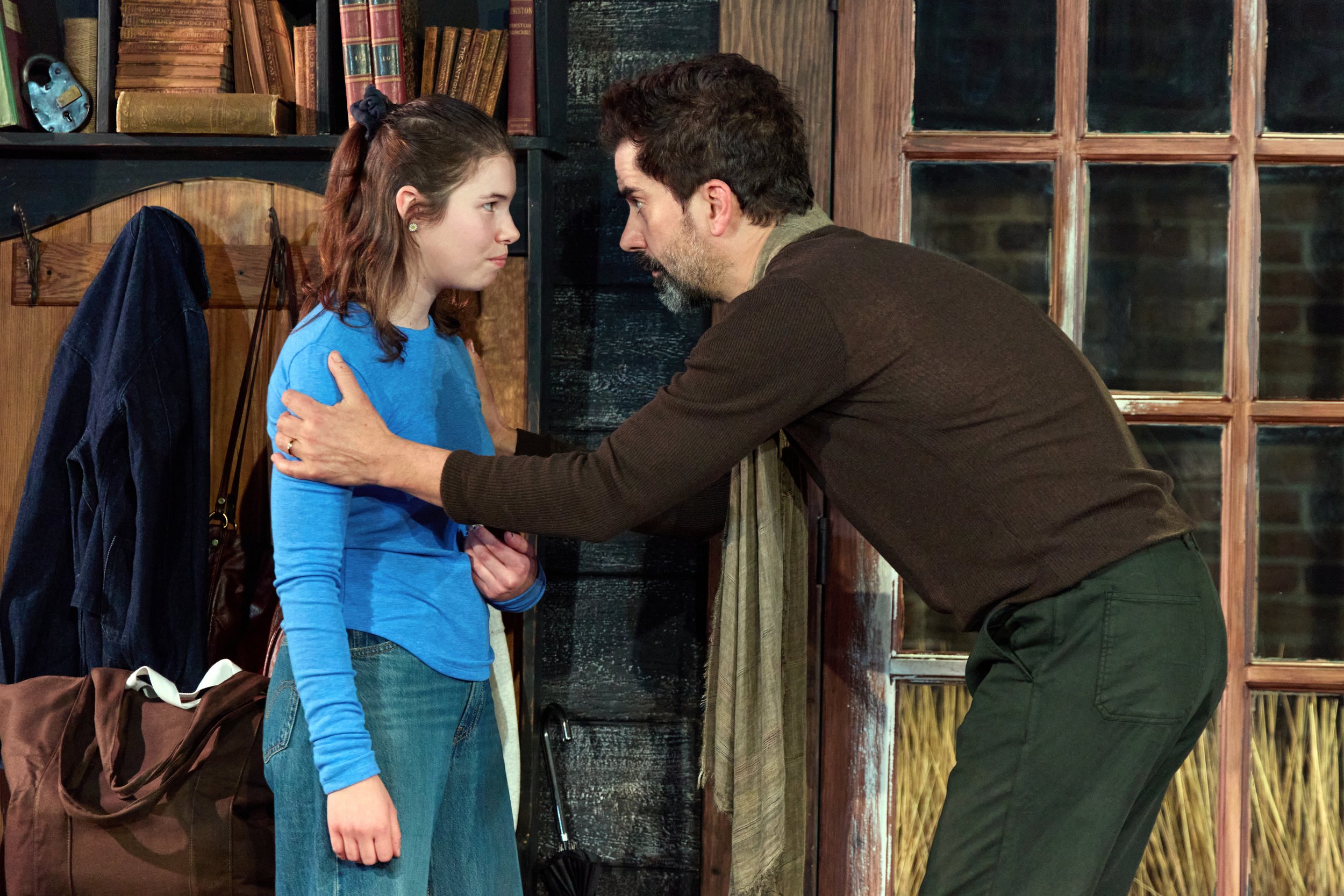
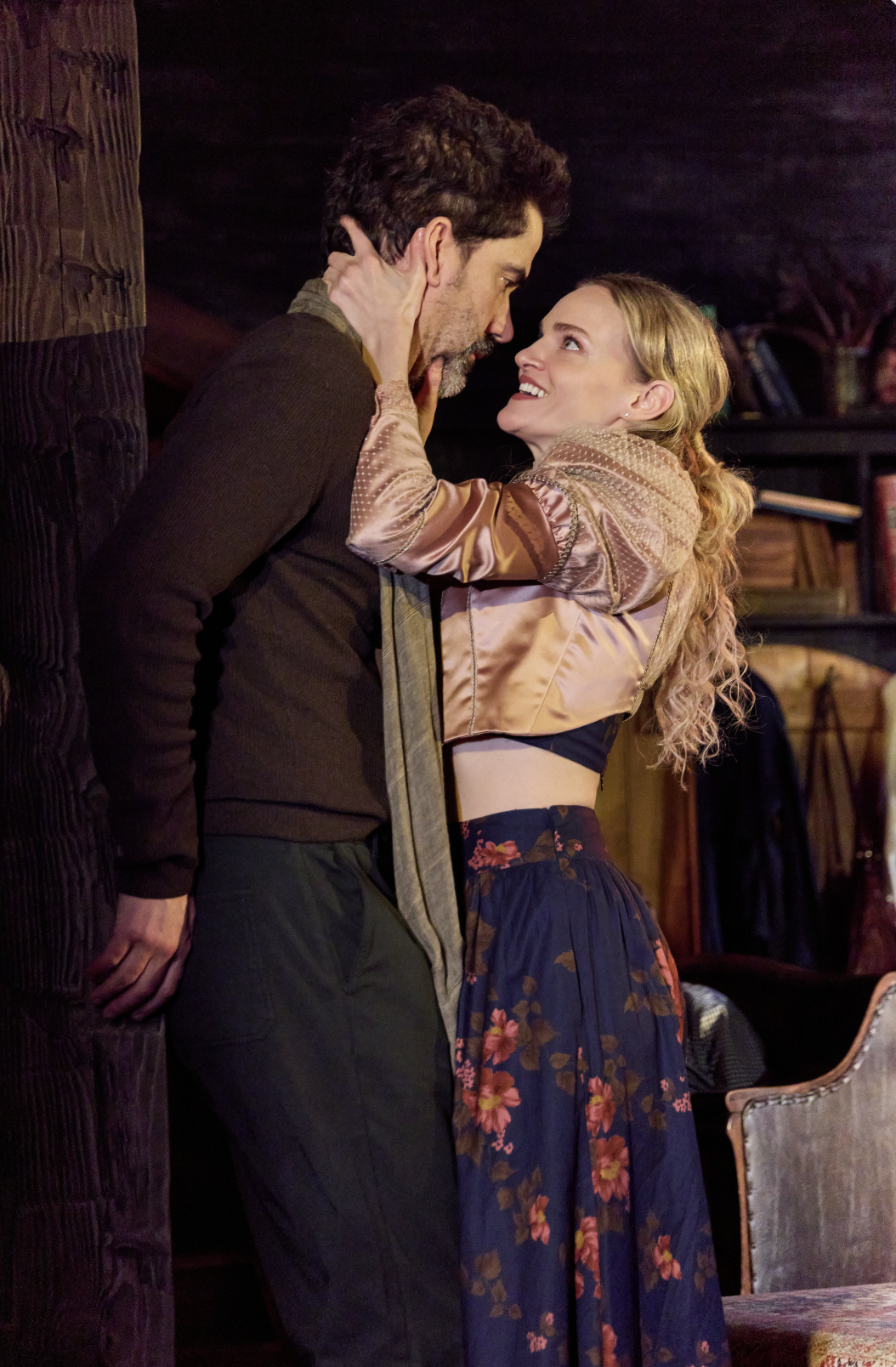


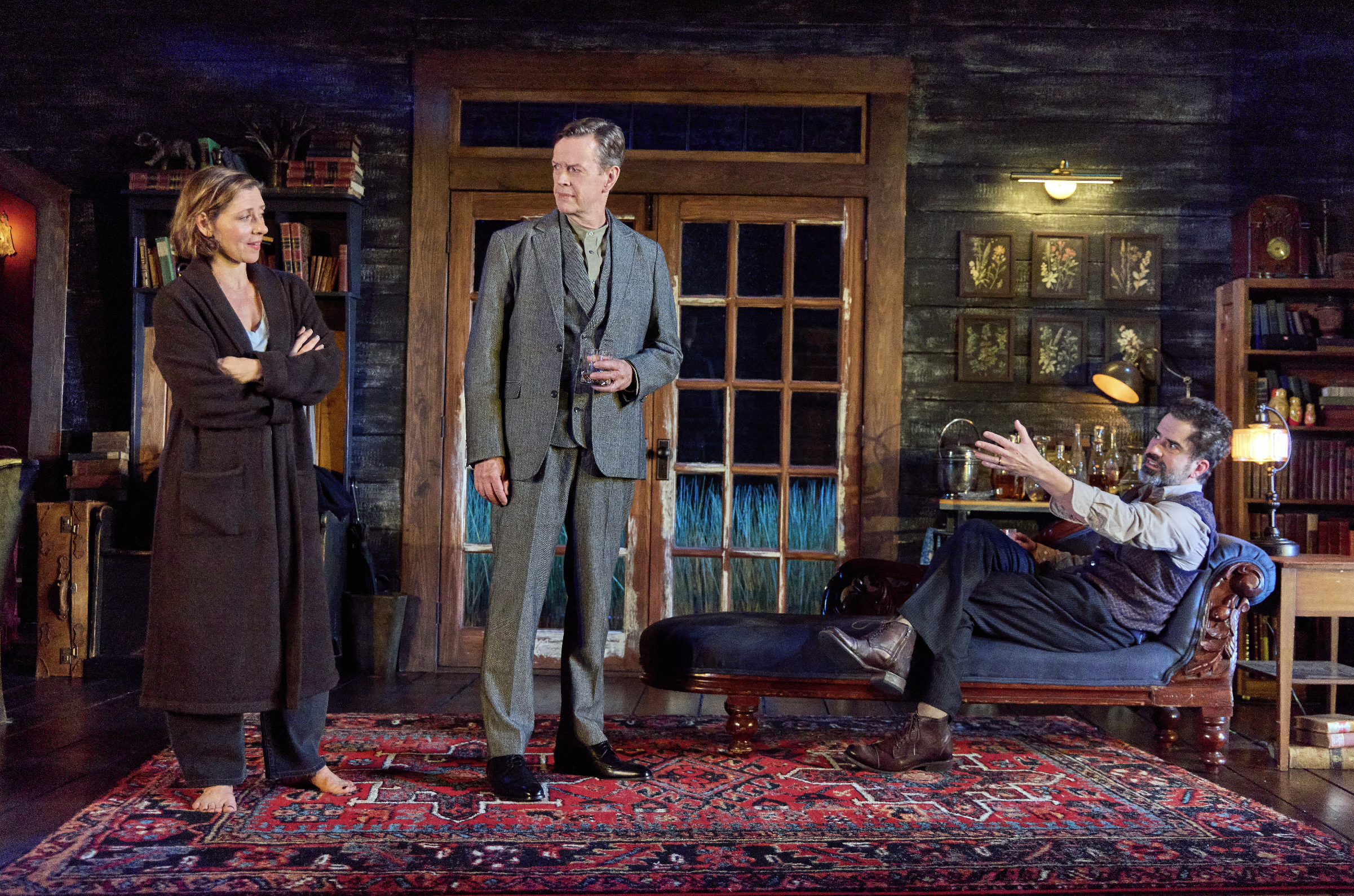
Photo Credit: Jeremy Daniel
Erica Schmidt’s The Disappear unfolds in the well-appointed yet faintly airless domestic sphere of Benjamin Braxton, a film director stalled in one of those arid stretches that the industry politely terms a “development period” and everyone else recognizes as creative drought. Hamish Linklater plays him with a jittery, self-lacerating restlessness, as a man whose mind keeps generating projects faster than his spirit can sustain them. His wife, the celebrated novelist Mira Blair—rendered with luminous intelligence by Miriam Silverman—has, by contrast, ascended to the enviable plateau of literary success. If Ben’s career is defined by its fits and starts, Mira’s has the smooth inevitability of a bestseller sliding onto the front table at a bookstore.
Their marriage, once animated by erotic and artistic fervor, has cooled into something at once companionable and faintly melancholy. They speak of their lost romance with the tone of people discussing a former neighborhood they no longer visit. Mira, with a novelist’s gift for the precisely turned phrase, describes Ben as her “best friend,” a designation that lands with both tenderness and a whiff of resignation. Yet the two remain deeply entangled: they workshop each other’s drafts, trade barbs with the ease of long practice, and maintain a household whose chief unifying principle may be their mutual fascination with language. Their sixteen-year-old daughter, Dolly (Anna Mirodin), a pint-sized Cassandra of the climate age, issues grave pronouncements—“Climate trauma is real!”—with the fervor of a teenager who has inherited a planet and found the warranty expired.
The title of the play is drawn from Ben’s latest pitch: a macabre thriller in which a husband, in a moment of idle cruelty, wishes his wife dead, only to be haunted when she obligingly disappears and returns as a psychological specter. The conceit is glib in the way of many high-concept thrillers, yet it proves uncomfortably porous. As the evening progresses, Ben’s own life begins to rhyme with his scenario, as though his imagination were a curse that cannot distinguish between storyboards and reality.
Complicating matters is Julie Wells (Madeline Brewer), a minor actress of major self-invention, who arrives trailing the faint perfume of delusion and ambition. She toggles inexplicably into a spotty British accent, favors Victorian blouses and ribboned bonnets right out of Pride and Prejudice (if it had a catalogue), and projects the gamine eccentricity of someone who has assembled her persona from period dramas and publicity interviews. Against the better judgment of Ben’s long-suffering producer, Michael Bloom (a dryly hilarious Dylan Baker), Julie becomes both the presumptive star of Ben’s film and, more perilously, his muse and paramour. Brewer gives her a comic opacity—you’re never entirely sure where the performance ends and the person begins.
The emotional geometry grows still more intricate with the arrival of Raf Night (Kelvin Harrison, Jr.), a rising Hollywood luminary and ardent admirer of Mira’s fiction. Raf bears the unstudied ease of a performer who knows precisely the effect of his own magnetism and has no need to press it. He exudes a sleek confidence—professional, social, and faintly flirtatious—that makes his admiration for Mira feel both flattering and faintly perilous. In his presence, appreciation shades into allure. By dangling a decisive ultimatum—that he will commit to the project only if Mira herself takes on the screenplay, thereby setting up a creative partnership between husband and wife, potentially turning the film into a crucible for their unresolved tensions—he transforms a business proposition into a personal gambit. The offer carries the glint of opportunity and the charge of temptation, introducing yet another destabilizing element into a marriage already creaking under the weight of its compromises. One senses that this union may have drifted past its natural expiration date, and Raf’s intervention merely hastens a reckoning that was long in the making. Professional envy, erotic intrigue, and artistic pride swirl together, threatening to swamp the production before a single frame is shot.
Schmidt, who also directs, steers the play through a series of tonal switchbacks: from brittle screwball to insider-Hollywood satire to something approaching apocalyptic parable. The shifts can be disorienting, though not always unproductive. In their brightest scenes, Ben and Mira seem to have wandered in from a rehearsal of Noël Coward’s Private Lives. The dialogue crackles. When Mira charges Ben with “always lying—just a little bit,” and he counters dismissively “At least I’m honest about it,” the line lands with the clean snap of a well-thrown dart.
Linklater leans into Ben’s volatility stupendously—his manic enthusiasm and sudden sulks—sketching a man in the throes of a midlife crisis that edges close to caricature. Linklater proves, as ever, an actor of abundant and easy charm, deftly locating the comedy in Ben’s fleeting, almost anthropological awareness of his own narcissism. He exploits his rangy height and loose-limbed physicality with a vaudevillian instinct, folding himself into furniture, pacing in aggrieved spirals, and generally treating his body as an instrument of wry self-exposure, a head-banging-on-the-floor tantrum just waiting to happen. Yet for all the performer’s charisma, the character resists the halo the script tries to place upon him. This Ben, petulant and grandiose by turns, seems governed less by genius than by appetite and grievance. One searches in vain for the animating evidence of brilliance that would justify the indulgence he is granted. What emerges instead is a portrait of a man stalled somewhere short of adulthood, mistaking volatility for depth and self-importance for insight. Creatives know that other creatives should never behave this way…it doesn’t really work for Presidents either.
Mira may, in her more exasperated moments, look as though she could happily dispatch him with the nearest carving knife, yet the volatile temperature of their marriage can pivot in an instant. Let Ben redirect even the faintest glimmer of erotic regard her way, and their hostilities dissolve into a sudden, almost comic reconnection—an impulsive tumble onto the couch that speaks to the stubborn physical grammar still underwriting their union. Silverman, meanwhile, performs a minor miracle of calibration. Her Mira is warm without being soft, taut without turning brittle, and plausibly susceptible to the flattery of a very attractive devotee. She makes you understand how a woman can be, simultaneously, a literary lion, a weary spouse, and a flirt testing the boundaries of her own narrative.
The supporting players—Baker, Brewer, and Harrison—deliver shrewd comic sketches of Hollywood types, sending up the industry’s vanities and self-mythologies. Yet these satirical notes sometimes clash with the play’s more ominous undercurrents. References to climate catastrophe—Los Angeles fires, ecological precarity, the vulnerability of the Hudson River home in which the action unfolds—press in from the margins (mostly from the young daughter’s soapboxing), suggesting a world where personal melodrama is a luxury afforded on borrowed time.
The Disappear is not just narrative, but overwhelms us architecturally too. One enters the house before one enters the play. Brett J. Banakis’ scenic design presents a living room so meticulously realized that it feels less like a set than a preserved habitat: thick, dark-wood beams stretch overhead; the furniture bears the patina of long use and discreet expense; every object seems to have inherited its place. It is the kind of studied rusticity that signals generational wealth—the curated simplicity of people who can afford authenticity.
Though the script situates us in the Hudson River Valley (close enough to New York City, so why pay for outrageous digs on the upper East side when this kind of property gets passed down to you), the visual vocabulary points further east, toward the melancholic provinces of Chekhov. One half-expects a trio of sisters to wander in, lamenting Moscow. The house carries that distinctly Russian aura of cultivated gloom: beauty shadowed by inertia, comfort edged with spiritual claustrophobia. Encroaching weeds and out-of-control tall grasses (sorry, no cherry orchard anywhere) press in around the structure, as if nature itself were mounting a slow siege. The effect is quietly ominous.
The production’s most persuasive storytelling occurs through its design elements. Cha See’s lighting drapes the room in a palette of creeping dusk and uneasy glow, suggesting emotional weather as much as time of day. Jennifer Moeller and Miriam Kelleher’s costumes, wry and character-revealing, supply flashes of humor and social insight that the dialogue does not always match. Together, these elements create a tactile, atmospheric envelope that invites the audience to read the space as closely as the text. One leaves with the sense that The Disappear is, in part, about disappearance itself.
By the final moments, the play gestures toward forces larger and darker than marital drift or stalled careers. The closing images imply that the true horror may not be the ghosts we conjure in our art or relationships, but the planetary reckoning we keep relegating to the background. It is an ambitious reach, if not always a fully integrated one, and it leaves the audience with the uneasy sense that the domestic comedy we’ve been watching floats atop a rising tide.
Click HERE for tickets.
Review by Tony Marinelli.
Published by Theatre Beyond Broadway on February 17th, 2026. All rights reserved.
