The Ford/Hill Project
Created by Elizabeth Marvel and Lee Sunday Evans
LaMaMa, 66 East 4th Street, New York, New York 10003
January 7, 2026 - January 11, 2026
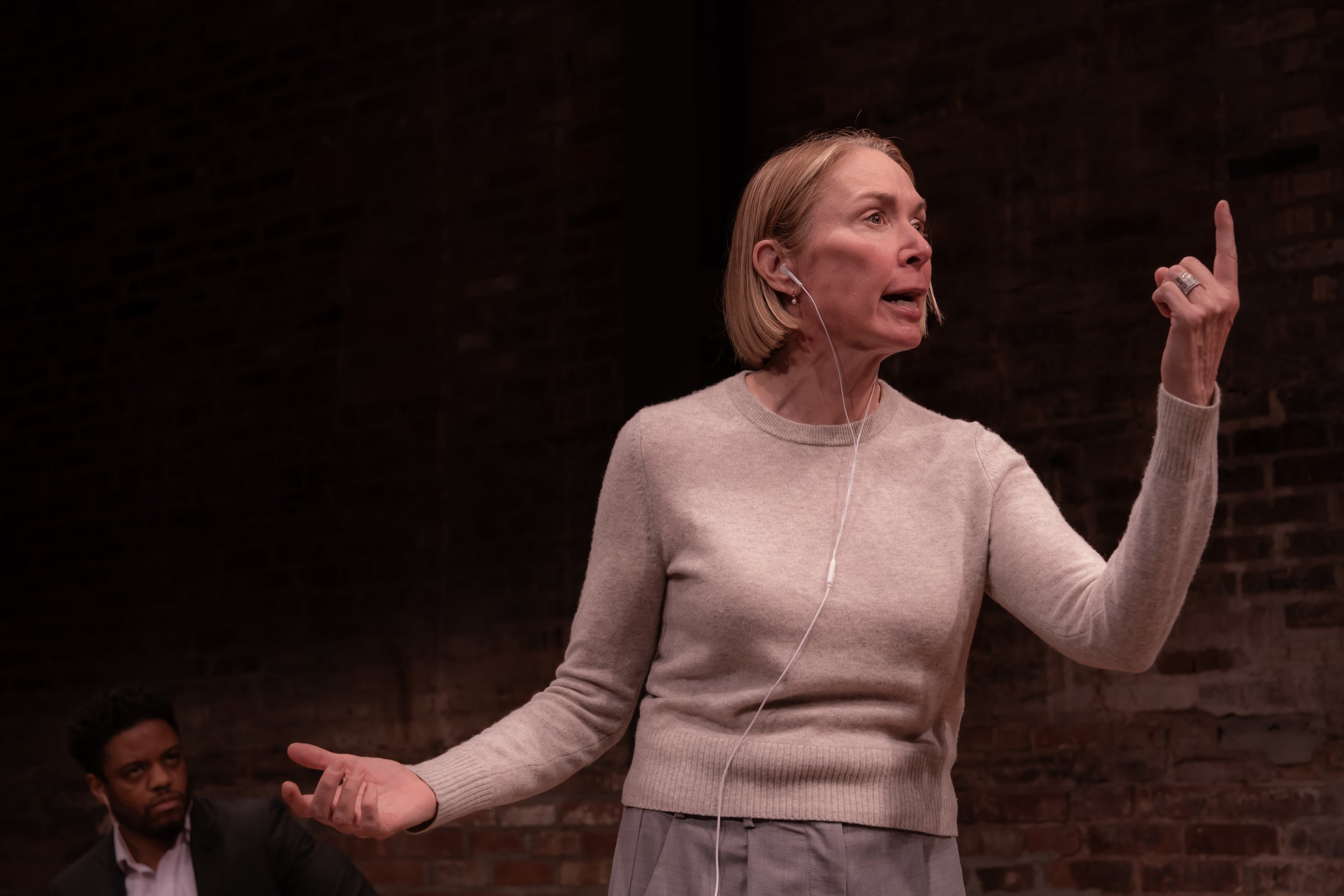
The premise is at once audacious and exacting: to place, within a single theatrical frame, the sworn Senate testimonies of Anita Hill and Christine Blasey Ford—two women who described, with scrupulous restraint, private violations committed by men who would soon be elevated to the most permanent perch in American public life. Set beside one another, these accounts read less like isolated scandals than like parallel prophecies. Each woman, in her own era, appeared before a committee structurally inclined to doubt her and culturally primed to dismiss her, and each offered a clear-eyed forecast of the moral temper of a nominee—Clarence Thomas, in Hill’s case; Brett Kavanaugh, in Ford’s—whose subsequent jurisprudence would bear out her warnings with grim fidelity.
This act of historical braiding is the animating gesture behind The Ford/Hill Project, devised by Lee Sunday Evans and Elizabeth Marvel and directed by Evans. The production after a sold-out limited run at The Public Theater in October 2024 returns to New York for another all-too-brief run, now at La MaMa as part of this year’s Under The Radar Festival. The performance again resists the consolations of hindsight. Instead, it reopens these confirmation hearings as if they were still undecided, still trembling with possibility, reminding us how narrowly—and how willfully—the nation chose not to listen.
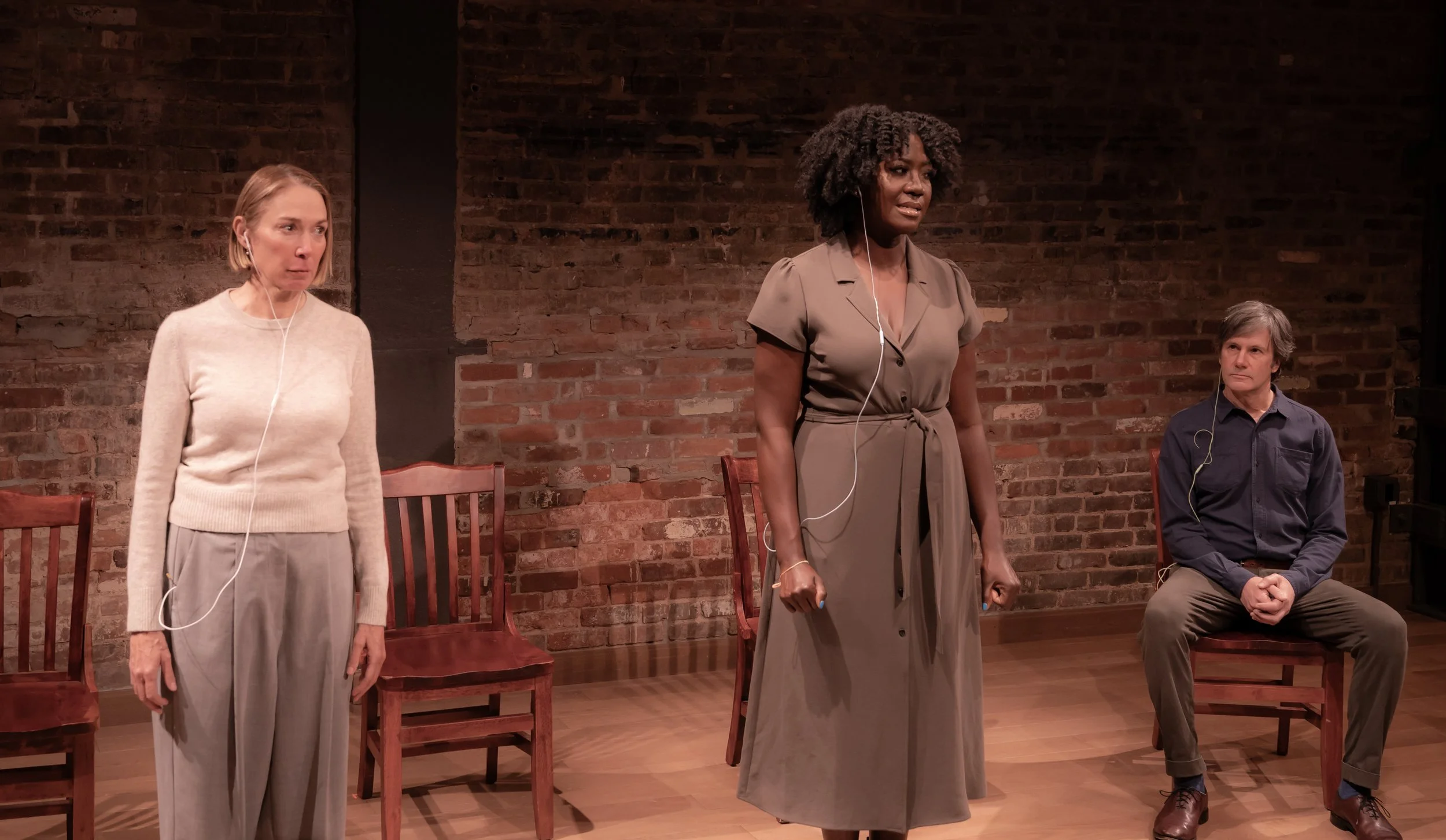
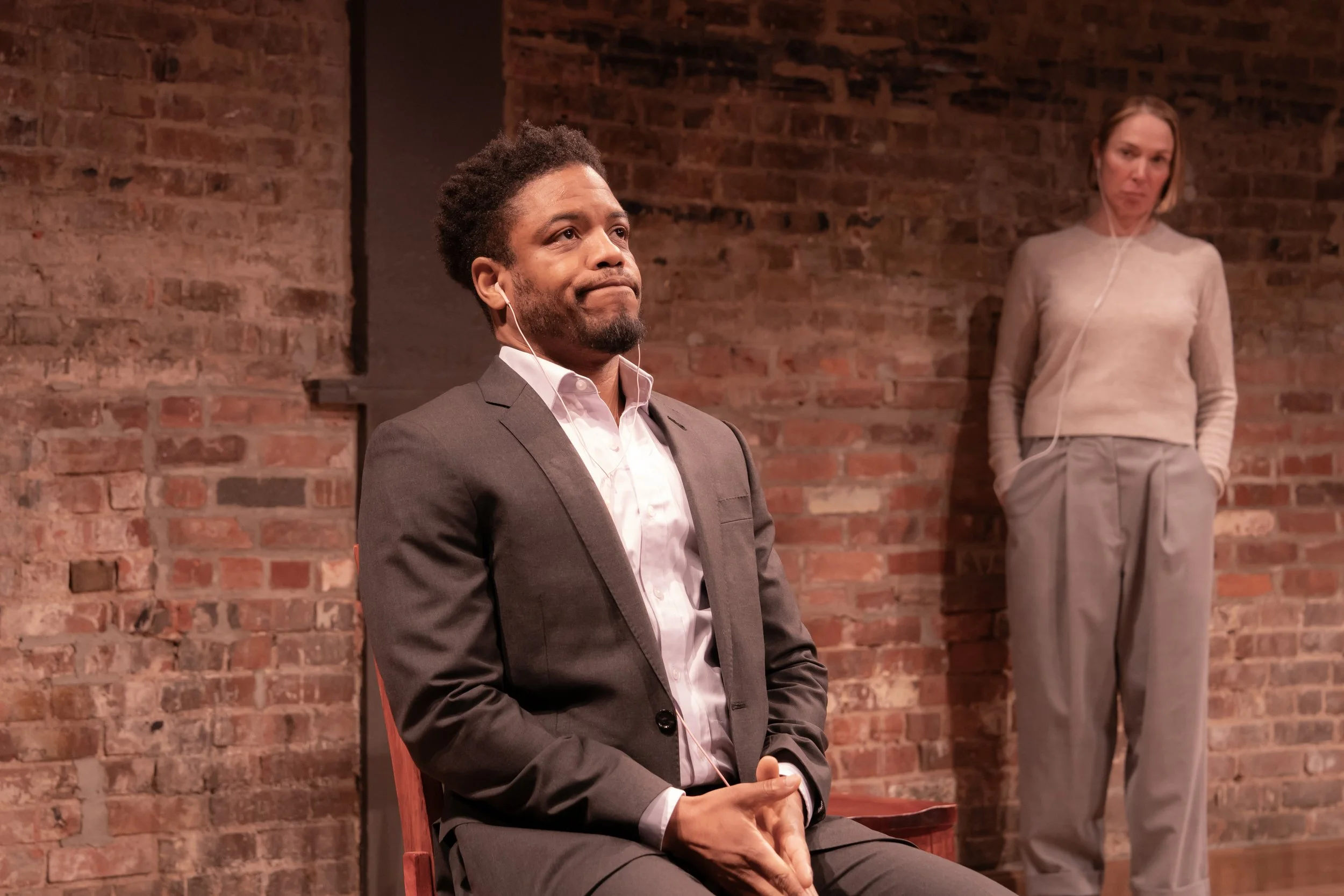
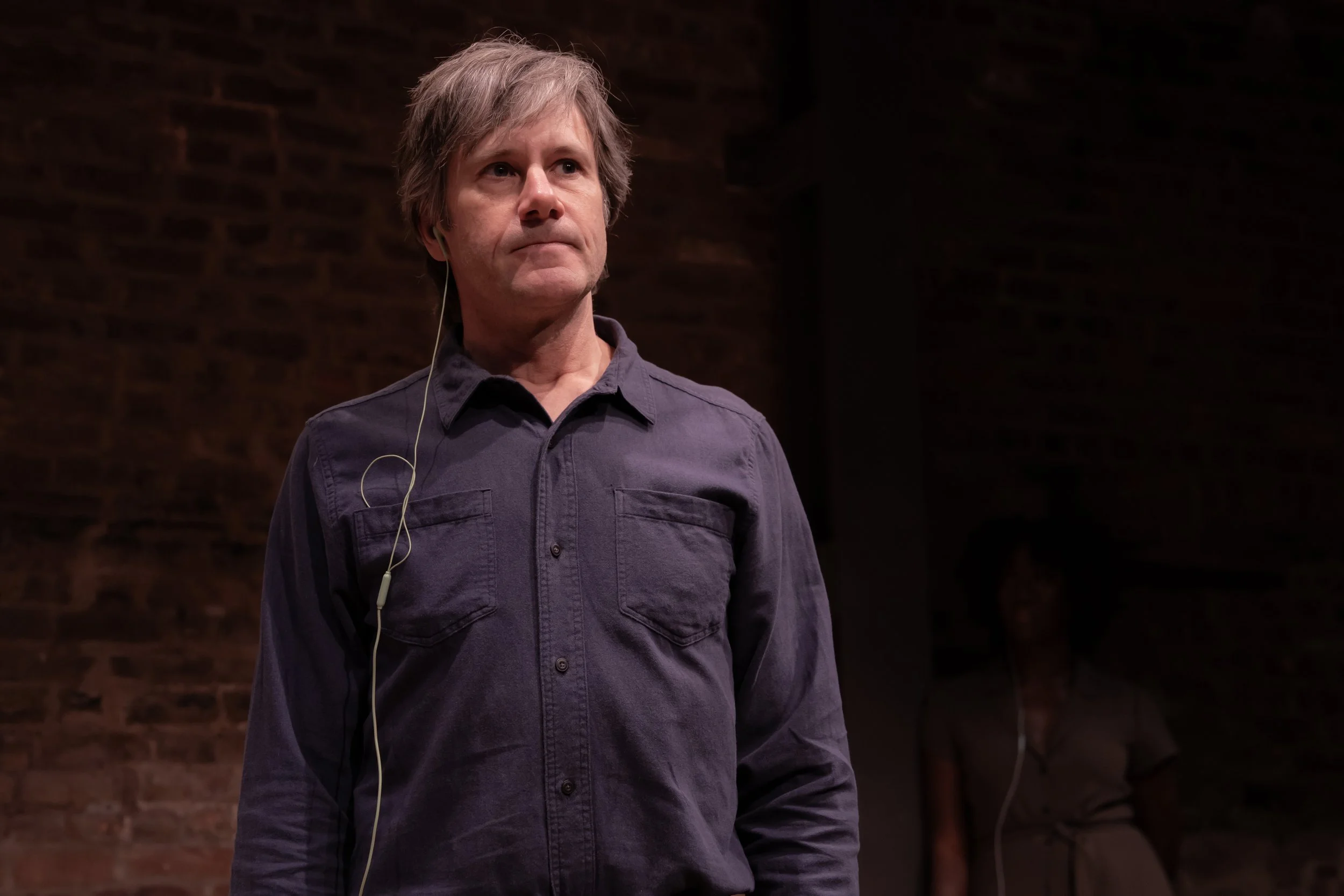
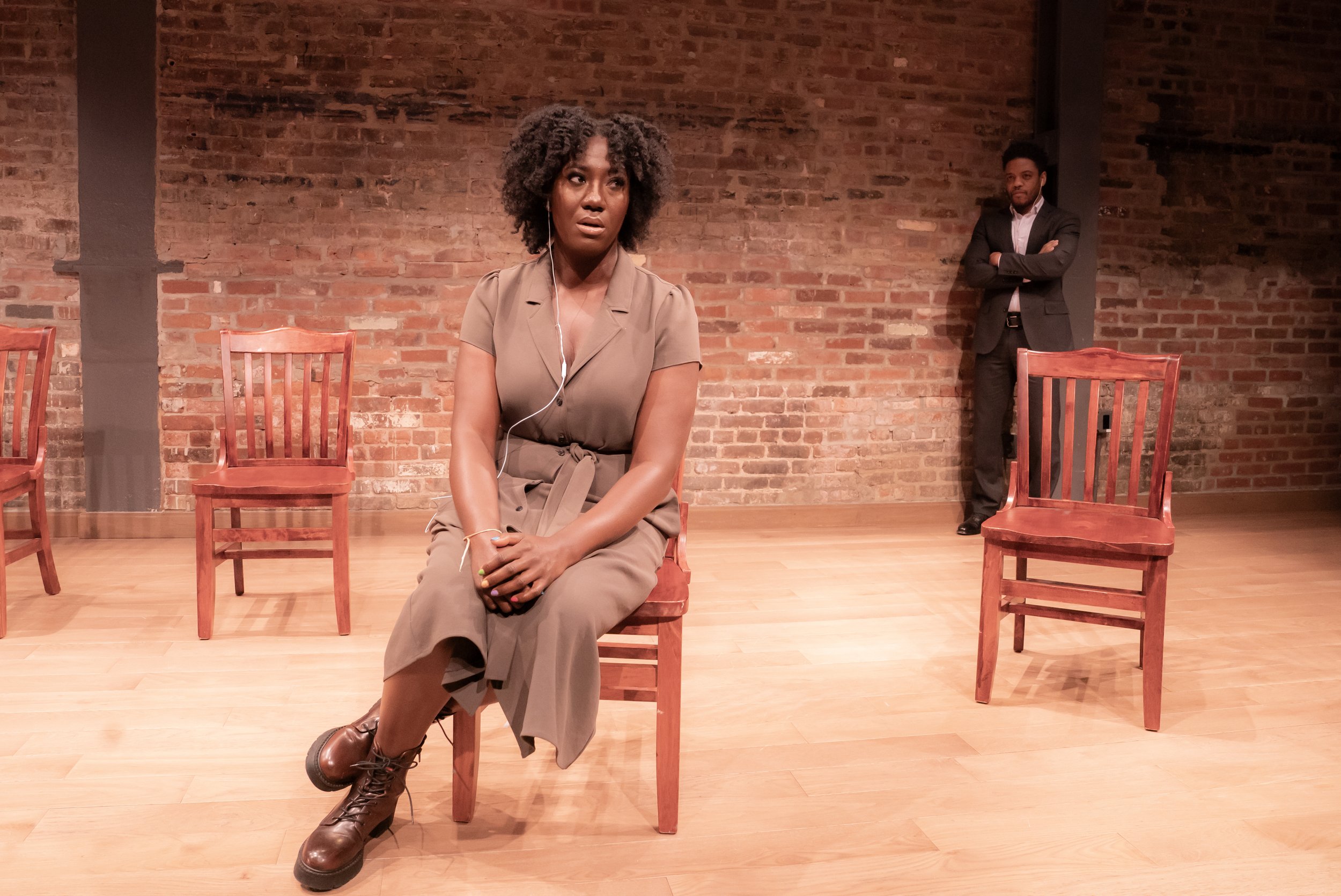
The script, assembled entirely from hearing transcripts, is edited with a dramatist’s ear for pressure and release. Its language is not embellished, but sharpened through juxtaposition. Delivered by a quartet of performers—Amber Iman, Elizabeth Marvel, Jon Michael Hill, and Josh Hamilton—the words arrive filtered through in-ear monitors, fed directly from edited archival recordings. What results is something stranger and more unsettling than documentary reenactment: an unedited audio possession, in which the actors’ bodies seem briefly overtaken by the cadences, hesitations, and emphases of the original speakers. The effect is bracing. One hears not interpretation but transmission, and the performance acquires the nervous energy of live resistance.
Ford’s account of a high-school assault by a drunken Kavanaugh—her fear, her thwarted attempts to call for help, her terror that she might be killed—lands with particular force precisely because of its plainness. Hill’s recollection of Thomas, then her supervisor, describing pornographic scenarios with relish and persistence, carries a different but equally corrosive weight: the slow violence of an authority abusing proximity, the exhaustion of repeatedly saying no. Intercut with the women’s testimony are the voices of senators, probing and posturing, and the nominees themselves, whose responses range from icy deflection to incandescent outrage. The rapid alternation creates a rhythm that steadily accelerates, building not toward resolution but toward recognition.
Marvel’s rendering of Ford is finely strung, alert, and painstakingly precise: her voice carries a tremor of nerves, yet she clings to scientific exactitude, explaining the mechanics of memory and brain chemistry as if intellect might provide a narrow bridge over an abyss of feeling. This disciplined rationality becomes a survival strategy, a way of holding emotion at arm’s length long enough to complete the ordeal of speaking. In sharp counterpoint, Marvel’s turn as Lindsey Graham explodes with theatrical bluster—chest out, voice booming, indignation weaponized—as she extols Kavanaugh’s supposed decency while the nominee himself retreats into small, carefully muted replies.
Iman, by contrast, inhabits Anita Hill with a composed, almost austere clarity. Her performance is measured and exact, yet threaded with fleeting hesitations—stammers, pauses, aborted sentences—that betray the strain beneath the surface. These minor fissures in her calm do more than any overt display of distress to register how punishing the hearing is, how much effort it takes simply to remain present and coherent under such relentless scrutiny.
The portrait of Kavanaugh, all bluster checked by unease, might easily have tipped into farce, but Hamilton exercises a welcome restraint, keeping the performance tethered to a recognizable, discomfiting reality. He resists the easy laugh, shaping the nominee’s awkwardness and defensiveness into something smaller, tighter, and ultimately more revealing than caricature. We find that he likes beer. He likes beer a whole lot. One senses a man perpetually off balance, scrambling to maintain authority without ever quite achieving it.
As Clarence Thomas, Hill registers less vividly, though this feels less a shortcoming of performance than of dramaturgical allotment. The role is written as a wall rather than a psyche: Thomas’s unwavering denial that any of Anita Hill’s account occurred is delivered with a studied blankness, a refusal so absolute it is intentionally devoid of shading. That flatness reads as a choice, a dramatization of impenetrability itself. Hill’s impact sharpens considerably in other guises. Most striking is a senator who initially coaxes Hill forward with a show of empathy, only to pivot abruptly into accusation, coolly invoking the years she remained silent as evidence against her. The turn is chilling, and Hill lands it with surgical precision, exposing how easily institutional tenderness curdles into cruelty.
The staging is austere: a black box, a half-moon of wooden chairs—nine of them, an unsubtle but effective allusion to the bench awaiting the men at the center of the storm. Roles are generally fixed—Iman as Hill, Marvel as Ford, Hill as Thomas, Hamilton as Kavanaugh—but at one pivotal juncture the configuration shifts. The male actors take on the women’s words, while the female actors assume the interrogative bluster of male senators. The reversal briefly disorients the moral geometry of the piece, softening its otherwise steely indictment of patriarchal power. Yet it also introduces a rare theatrical proposition: that identification, rather than domination, might be learned, embodied, even rehearsed.
The same acuity governs Evans’ direction, which repeatedly aligns figures in quiet visual rhyme—placing them side by side at charged junctures—only to separate them again, like lines briefly converging before resuming their own trajectories. The staging never underlines these correspondences with a heavy marker; instead, it trusts the audience to register the echoes and divergences for itself. What emerges is a choreography of proximity and distance, delicately calibrated, that invites comparison without coercion and forges meaning through restraint rather than insistence.
What becomes unmistakable is that neither Thomas nor Kavanaugh ever truly engaged with the substance of the accusations against them. The record reveals no attempt at imaginative entry into another’s experience, no gesture toward accountability or contrition. Instead, their testimonies are marked by fury at the very notion of scrutiny, by a sense of entitlement so complete that apology appears inconceivable. The Ford/Hill Project does not editorialize this posture; it simply centers it, allowing its chill to register fully.
In doing so, the production fulfills one of theater’s oldest civic obligations: to make character legible, and to insist that personal conduct is not incidental to public power. What emerges is a portrait of a particular mode of masculinity—aggrieved, domineering, impermeable to shame—that has not only survived exposure but been rewarded by the political system. Seen in this light, the play is less a historical reckoning than a warning flare, illuminating how such traits have come to be normalized, even celebrated, in national leadership.
The evening’s most piercing moment contains no text at all. After speaking across decades directly to the audience, Iman and Marvel turn toward one another and meet each other’s gaze. The silence stretches. In that look passes an unspoken recognition: of courage offered and ignored, of truth delayed but not erased. It is a brief, almost private exchange, yet it reverberates outward, collapsing time and insisting—quietly, insistently—that history, though slow, has a way of confirming what was known all along.
The production pointedly withholds the procedural conclusion of the hearings—the roll call of confirmation votes that would formalize the outcome. In its place, Evans offers a more damning theatrical image. The men don their judicial robes and turn their backs to the audience, a gesture at once literal and symbolic, before embarking on a slow, almost ceremonial circuit of the space, a grim parody of a victory lap. Power here is not argued or justified; it is simply assumed and displayed. Meanwhile, the women remain motionless, their faces still charged with the emotional residue of their testimony—shock, exhaustion, resolve, grief—unaltered by the pageantry unfolding around them. The contrast is devastating. History advances, clothed in authority and self-congratulation, while the cost of that advance is written plainly on the bodies left behind.
Click here for tickets.
Review by Tony Marinelli.
Published by Theatre Beyond Broadway on January 16th, 2026. All rights reserved.
