
THE RESERVOIR
Presented by Atlantic Theater Company Ensemble Studio Theatre Alfred P. Sloan Foundation
Written by Jake Brasch, Directed by Shelley Butler
Linda Gross Theater, Atlantic Theater Company, 336 West 20th Street, in Manhattan
February 5, 2026 - March 22, 2026
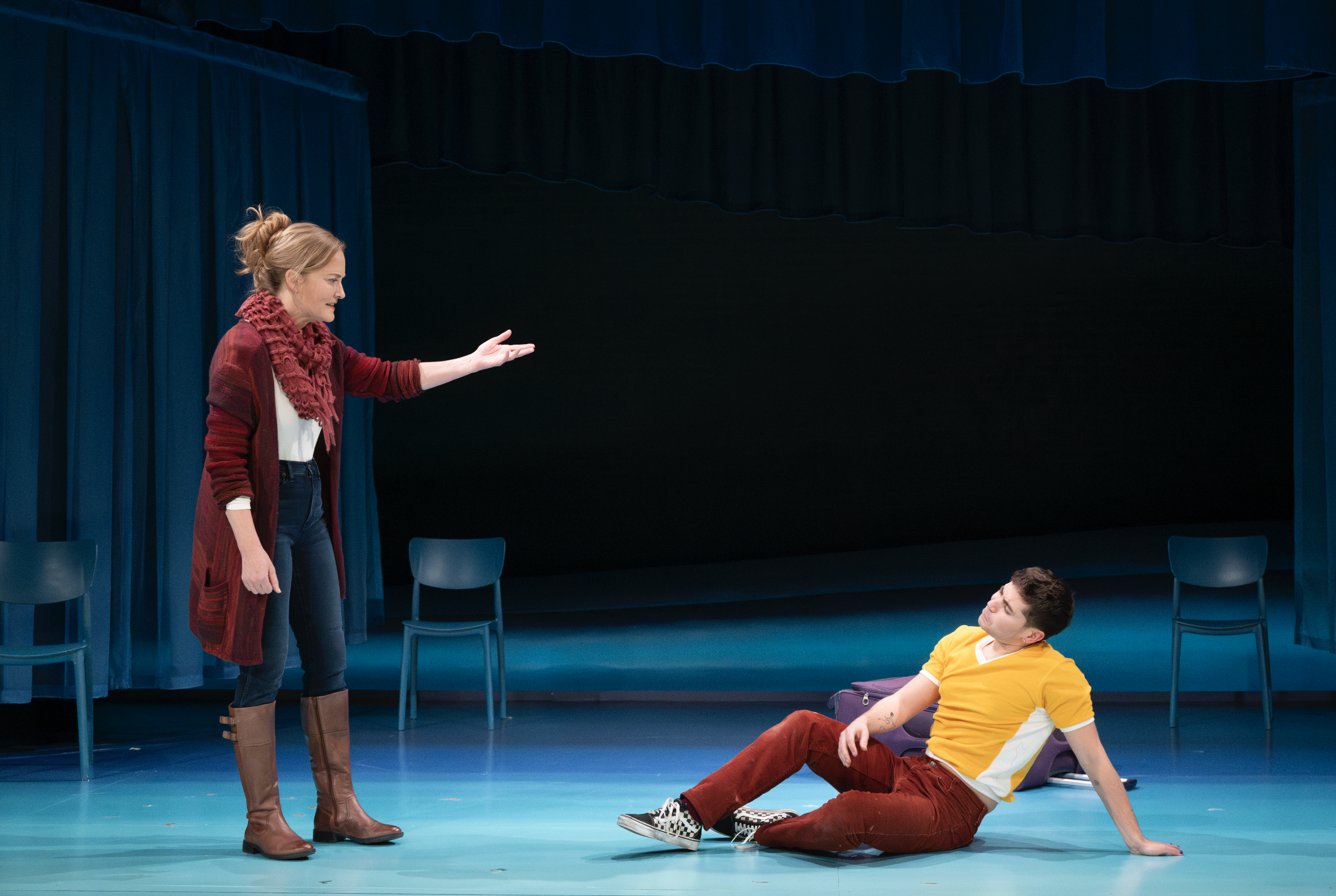
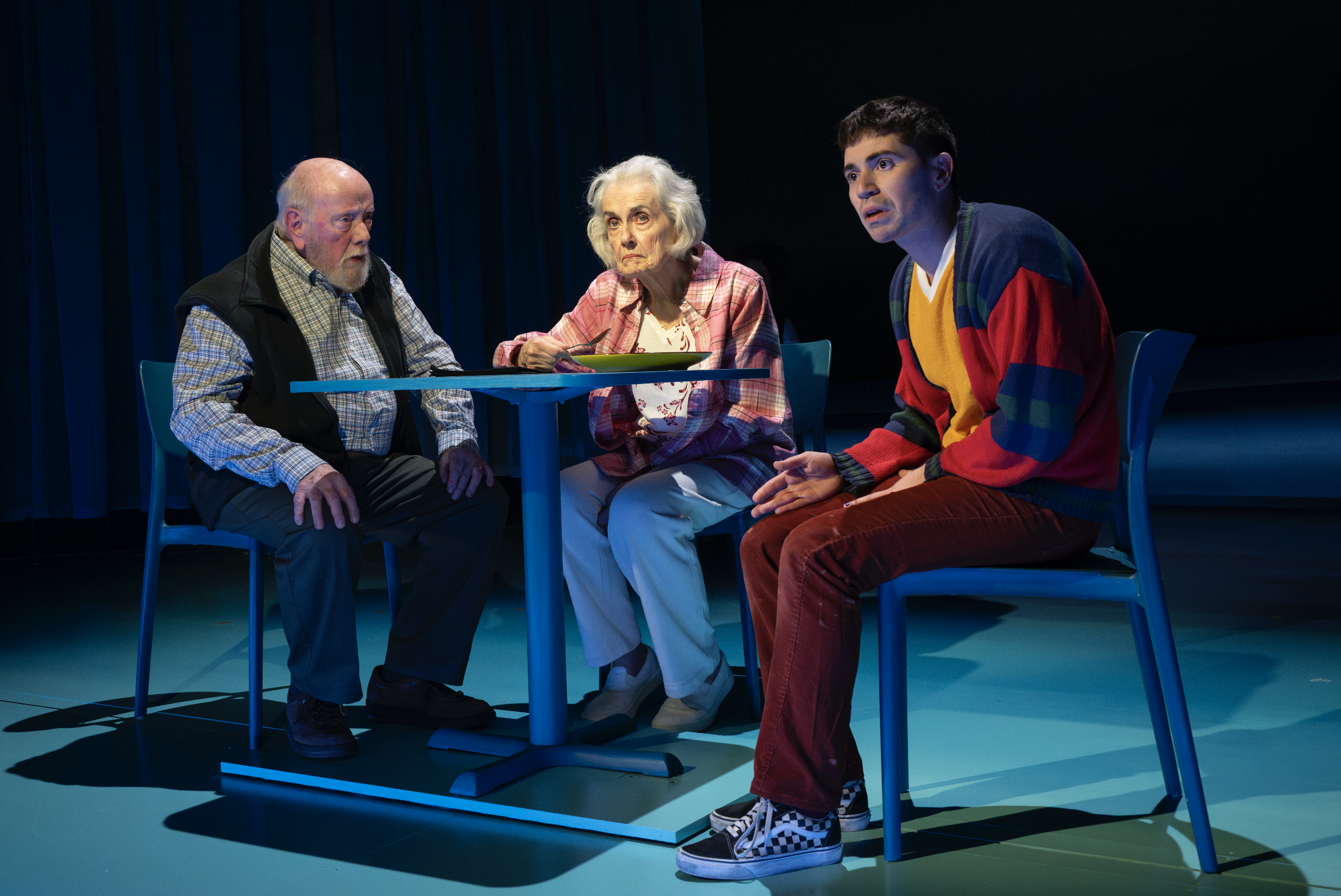
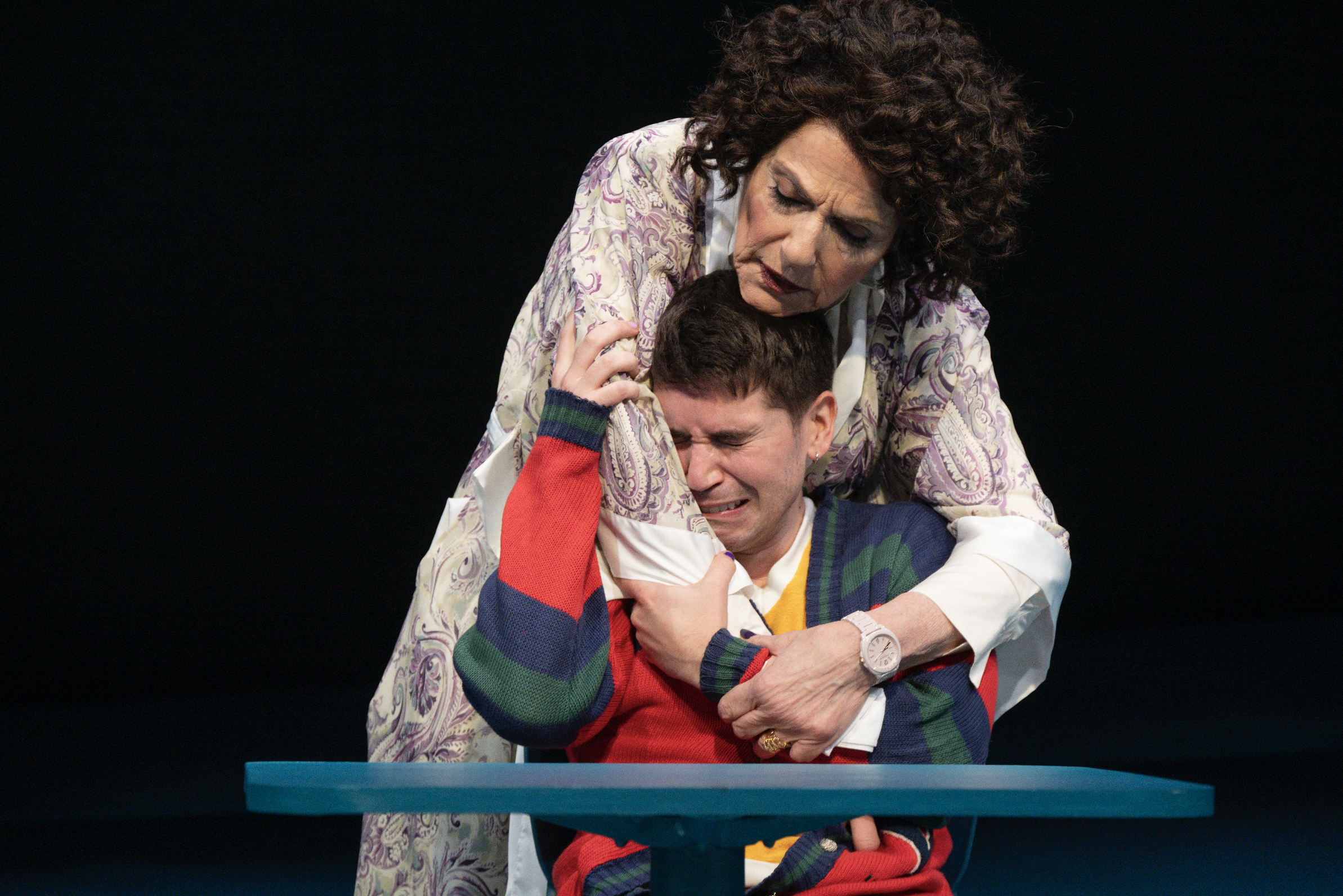


Photo credit by Ahron R. Foster
Jake Brasch’s The Reservoir opens with the quiet confidence of a chamber piece and the emotional amplitude of a symphony, announcing its author as a writer of uncommon wit, compassion, and nerve. Though it shares a generational curiosity with other works about alcoholism, Brasch’s play is operating on a far richer frequency—one attuned not merely to cultural chatter but to the fragile, flickering persistence of love.
Josh, played with astonishing depth by Noah Galvin, wakes up on the banks of Colorado’s Cherry Creek Reservoir with a wound on his arm and a blank space where his memory should be. The last thing he recalls is being expelled from rehab; now he stands, bewildered and abraded, in the thin mountain air of a life he barely recognizes. His mother, embodied with layered intelligence by Heidi Armbruster, is understandably stunned—emotionally and financially—by his reappearance. Thousands of dollars in treatment have yielded this: a son returned like driftwood, battered and inexplicable.
From this premise—addiction, relapse, familial strain—Brasch conjures something miraculous: an against-all-odds comedy of piercing humanity. Josh takes tentative steps toward sobriety, shelving books at a local shop (a job his mom pulls strings for, shelving alphabetically takes a back seat to shelving by scent of a book’s binder) and reintroducing himself to his four grandparents. Hank (the ever-resonant Peter Maloney) and Irene (the luminous Mary Beth Peil) have moved into assisted living as Irene slips into the late stages of Alzheimer’s. Josh, having been consumed by his own unraveling, has missed the grandmother’s warning signs. The realization lands like a bruise. Meanwhile, Beverly (a gloriously unsparing Caroline Aaron) and her long-estranged ex-husband Shrimpy (the ineffably charming Chip Zien) spar and reminisce in rhythms that feel both vaudevillian and devastatingly real.
Josh’s sudden fixation on “improving” his grandparents’ lives—optimizing their diets (an overindulgence in spinach…what would Popeye say?), their routines, their prospects—emerges as both distraction and devotion. It is here that Brasch’s writing performs its high-wire act. The play is laugh-out-loud funny—ribald, sharp, gloriously profane—yet it never trivializes its stakes. Alcoholism, Alzheimer’s, estrangement: these are not narrative ornaments but tectonic pressures. And still, the play vibrates in a way that is constantly enchanting—with a hard-won tenderness that arrives only after endearing us with its clear-eyed reckoning. Brasch’s optimism is tempered, provisional, and therefore profoundly moving.
Steered by the seamless direction of Shelley Butler, the production embraces theatricality without sacrificing intimacy. The scenes ebb and flow in a rhythm that uncannily mirrors Josh’s own mind—at times racing ahead with anxious velocity, at others stalling in fits of uncertainty. The staging frequently keeps the entire ensemble visible, so that moments overlap and brush against one another, as though we were witnessing the cluttered interior landscape of Josh’s thoughts made manifest. Designer Takeshi Kata situates the action amid rippling blue fabric panels that evoke both the titular reservoir and the ceaseless “river of thought” coursing through Josh’s mind. The visual field, enriched by the vibrant costumes of Sara Ryung Clement and the expressive lighting of Jiyoung Chang, refuses drab realism. This is a world saturated in color—an aesthetic manifesto that insists life, even when fractured, remains defiantly vivid.
The ensemble is uniformly superb. Maloney and Peil render late-life vulnerability without a trace of sentimentality; Maloney gives a performance of quiet, accumulating heartbreak as a man whose longtime partner is disappearing into the bewildering fog of advanced dementia. His character’s loneliness is palpable, though he rarely allows it to surface directly; instead, he fends off the abyss with a barrage of dutiful chatter about sports, clinging to box scores and game recaps as though they were life rafts. The strategy feels painfully familiar—the small talk of a man who no longer knows how to reach the person he loves, but who cannot bear the silence that would confirm her absence.
Yet Peil, with exquisite delicacy, reveals that Irene has not entirely vanished. In one of the play’s most unexpectedly radiant moments, she rises in the antiseptic glow of a nursing-home cafeteria and begins to sing “O Come All Ye Faithful.” What might have been merely whimsical becomes, in Peil’s hands, quietly transcendent: a showstopping turn that suggests that music—like memory—can sometimes tunnel through even the most impenetrable cognitive darkness. For a fleeting instant, the old Irene returns, and the room, along with Maloney’s stricken companion, seems to recognize her.
Aaron and Zien find unexpected grace notes beneath their comic bravado. As Shrimpy, Josh’s profanely opinionated Jewish grandfather, Zien proves to be a comic force of nature. The character, now in his later years, has improbably taken on the task of preparing for a second bar mitzvah—a ritual return to boyhood that the play treats with both irreverence and tenderness. Zien mines the premise for abundant laughs, delivering a steady stream of gloriously foul-mouthed commentary with the timing of a seasoned Catskills veteran. Yet beneath the bluster lies something unexpectedly touching: the effort to relearn Hebrew, which becomes one of Josh’s improvised cognitive exercises for his grandfather. In these moments, the generational roles subtly reverse, and what begins as a comic bit acquires a faint but unmistakable poignancy, as memory, tradition, and family devotion intertwine.
The evening’s most indelible performance belongs to Aaron, who inhabits the role of Grandma Beverly with a bracing mixture of steeliness and warmth. Long divorced from the irascible Shrimpy, Beverly carries her own complicated history with alcoholism—a past she reveals to Josh in the aftermath of his particularly ignominious relapse, brought on, of all things, by vanilla extract. The confession arrives not as a sentimental disclosure but as a clear-eyed reckoning. Recalling her younger self in the nineteen-sixties, she speaks in the third person, as though addressing a stranger she has learned, over time, to forgive: “if that woman could ask for help, could forgive herself, could show up to meetings with two toddlers in tow between shifts, then perhaps”... redemption remains possible for Josh as well. Aaron embodies this ethos of hard-earned compassion with magnificent authority. She is the very image of tough love—a dab of grandmotherly spit briskly applied to Josh’s metaphorically soiled collar, a corrective delivered without ceremony. Yet the severity is laced with humor and affection. This is, after all, a woman who thinks nothing of dragging her grown grandson along to her senior Zumba class at the J.C.C., the gesture at once mortifying and deeply loving. In Aaron’s hands, Beverly becomes something rare onstage: a matriarch whose wisdom is not the product of saintliness but of survival.
Armbruster gives a performance of flinty maternal love that never asks for applause and therefore earns it. Armbruster also slips—without so much as a visible seam—into the role of the relentlessly peppy aerobics instructor, gamely coaching a roomful of elder Jewish women in the finer points of popping and locking. The doubling has a sly theatrical wit to it: the same maternal vigilance that governs her scenes with Josh seems to animate the instructor’s buoyant command of the exercise floor. And Matthew Saldívar, in multiple supporting roles, demonstrates an enviable range, shading each appearance with specificity and wit. One can’t help wishing that Saldivar’s bookstore manager might eventually find his way into Josh’s orbit. Once their shared sexual identities—and their parallel determination to overcome the same stubborn alcohol addiction—surface during that chance encounter, the possibility of something deeper quietly flickers. Perhaps their story is simply deferred, destined for another chapter…or another life?
Yet it is Galvin who anchors the evening with a performance of remarkable assurance. His Josh is awkward, searching, intermittently exasperating—and utterly magnetic. Galvin understands that confusion has its own rhythm; he allows silence to pool around him, thoughts to gather and disperse. When Josh addresses the audience directly, narrating his own floundering, Galvin avoids the declamatory trap. There is no podium in his posture, no self-conscious rhetoric. He speaks as one might to a friend across a kitchen table—casual, lucid, disarmingly sincere. It is among the most confident and unshowy star turns of the season.
What makes The Reservoir exceptional is its refusal to indulge in cathartic bombast. Brasch sidesteps the easy swell of violins. Instead, he lets effortless humor do the seduction. The Reservoir proves to be about far more than sobriety or senility. Its deeper preoccupation is memory itself—how it falters, how it erodes, and, sometimes, how it can be painstakingly rebuilt. The play suggests that memory is not merely an archive of the past but an active force in the present, the fragile thread by which we remain tethered to one another. What lingers most is the sense that remembering—however imperfectly—is one of the essential ways we hold on to the people we love, even as time, illness, and circumstance conspire to pull them from us. We fall in love with these people—kooky, bruised, capacious-hearted—and only then does the play permit us to feel the undertow of loss. The tears, when they come, belong to us. Anyone who has had a grandmother as their best friend will need the industrial size box of Kleenex by the end of this play. And by the end of this radiant, humane production, we have thoroughly embraced them all as our own family.
Click HERE for tickets.
Review by Tony Marinelli.
Published by Theatre Beyond Broadway on March 7th, 2026. All rights reserved.
