
THE TRAGEDY OF CORIOLANUS
by William Shakespeare; Directed by Ash K. Tata
Theatre for a New Audience | Polonsky Shakespeare Center at 262 Ashland Place Brooklyn, NY 11217
February 3 - March 1, 2026


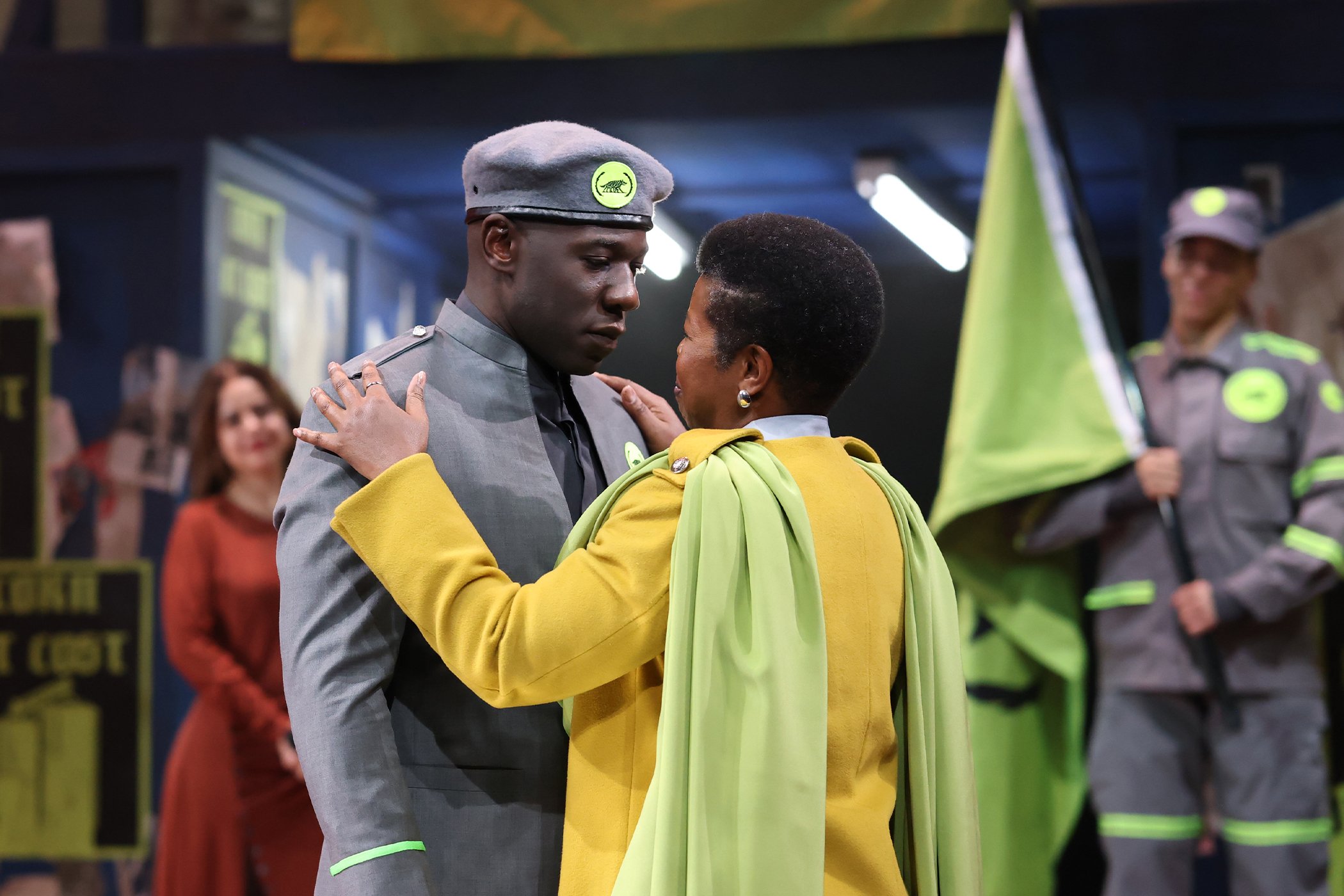




Photo Credit by Hollis King
Productions of Coriolanus are hardly as commonplace as revivals of Macbeth, Hamlet, or Twelfth Night. A new mounting, therefore, need not strain for topicality in order to justify its existence. It may present itself as a kind of curatorial exercise—polished, reverent, faintly dusted with academic mothballs—or it may venture into riskier terrain, refreshing the play not through frantic relevance but through a confident refusal to over-explain. To test both impulses at once, one need only look to Ash K. Tata’s production, now running at Theatre for a New Audience in Brooklyn, where Shakespeare’s prickliest political tragedy is treated neither as relic nor as reckless provocation, but as a live wire—handled with gloves, perhaps, yet still capable of delivering a charge.
The play remains bracingly articulate about the instability that erupts when citizens, ravenous not only for bread but for dignity, collide with a ruling class jealous of its prerogatives. In Coriolanus, William Shakespeare sketches a polity in which resentment curdles on both sides: the populace, starved for acknowledgment, mistakes fury for agency; the patricians, covetous of their authority, mistake condescension for order. What results is not dialogue but detonation—a cycle of grievance and defensiveness that feeds upon itself until the state can scarcely distinguish self-preservation from self-destruction.
As we machete our way toward a future ruled by algorithms and eroded attention spans, it was perhaps inevitable that technology would cease merely assisting the theater (as it always has, from gaslight to amplification) and begin auditioning for a starring role. Language and plot—those antique contrivances—no longer suffice. We now demand apparatus: glowing panels, immersive headgear, sonic jolts calibrated to tickle the amygdala. The stage must not only tell a story; it must rewire us.
Into this brave new bandwidth strides director Tata, who has tricked out The Tragedy of Coriolanus with enough circuitry to power a minor republic. The production, at TFANA’s home base, the Polonsky Shakespeare Center, arrives festooned with projections that streak across Afsoon Pajoufar’s set like breaking news alerts. Characters don VR headsets and brandish tactile pistols. A Jumbotron-like monolith hovers above the stage, blasting out battle sequences rendered as video game carnage, complete with artillery defining targets onstage with precision crosshairs.
Thankfully one does go to the theater to be enthralled by living breathing performers and less intrigued by techno-extratextual gloss than by the human beings laboring beneath it. The director’s point—that we cannot disentangle our experience of politics and civic unrest from the devices through which we consume them—is well taken. Still, with performances as sinewy as these, one longed to power down.
Chief among the unplugged pleasures is McKinley Belcher III, who delivers a Coriolanus of titanic hauteur and barely suppressed vulnerability. As Caius Martius—the patrician war hero who defends Rome while scorning its plebeian citizenry—Belcher commands the stage with leonine authority. Shakespeare’s marathon of a role scarcely seems to wind him. His Martius is a man armoured in contempt, yet disarmingly susceptible to maternal pressure.
That pressure comes from Volumnia, who emerges as a figure of formidable mass and momentum—a matriarch who seems less to enter a room than to claim it. In the commanding hands of Roslyn Ruff, she is an iceberg in ceremonial dress: glacially composed above the waterline, immovable and vast below it. Ruff plays her with a cool, tensile authority, suggesting that the martial ferocity her son brandishes in public is merely the visible tip of a will forged, and long ago hardened, in private. Her pride in her son’s battlefield wounds borders on the devotional.
After conquering Corioli alongside Titus Lartius (the stalwart Sarin Monae West) and defeating the Volscian general Aufidius—played with raptor-like intensity by Mickey Sumner—Martius is rechristened Coriolanus. The laurel sits uneasily. To become consul, he must court the very masses he disdains. The tribunes Sicinius and Brutus, rendered with comic shrewdness by William DeMeritt and Zuzanna Szadkowski, understand the optics better than he does. Coriolanus refuses to perform humility; exile follows. In a spasm of vengeance, he joins forces with Aufidius to menace Rome itself, only to be stayed by Volumnia, his steadfast wife Virgilia (a finely calibrated Meredith Garretson), and his young son (Merlin McCormick). When he relents, he signs his own death warrant.
Though not among Shakespeare’s most frequently mounted works, Coriolanus has enjoyed a conspicuous resurgence over the past decade—no oracle required to divine the reason. Tata refrains from textual surgery, but the visual rhetoric is hardly subtle. Vast orange curtains loom behind a senate house plastered with protest posters decrying food shortages. Coriolanus sports an orange baseball cap emblazoned with “SPQR.” Volumnia, Virgilia, and their confidante Valeria (Emma Ramos) glide about in orange dresses by Avery Reed. The palette does a good deal of editorializing.
As the Roman senator Menenius, Jason O’Connell speaks with a dynamic musicality that gives even his political hedging a kind of lyric contour. His vocal line begins in notes of patrician ease—urbane, lightly amused, confident in the old hierarchies—and then slides, almost imperceptibly at first, into sharper, more strained registers. As Coriolanus slips beyond the reach of counsel, O’Connell lets the timbre thin and fray, descending from affable deference into something closer to supplication. The performance becomes a study in modulation: a statesman trying, through tone alone, to rein in a general who no longer hears the music of compromise. Later, despite the unmistakable whiff of treachery that begins to cling to Coriolanus like battlefield smoke, Menenius refuses to abandon him. Ever the avuncular apologist, he persists in defending his volatile friend, clinging to the conviction that, beneath the bluster and wounded pride, there remains a Roman patriot who will, at the decisive hour, choose the Republic over revenge. In Menenius’ hopeful calculus, Coriolanus’ rage is merely a passing storm; the bedrock of loyalty, he insists, still lies beneath.
Zuzanna Szadkowski, a comic virtuoso, is here cast as one of the tribunes of the people. When she grasps that she has successfully whipped the masses into banishing a thin-skinned, vengeance-drunk warrior who is entirely capable of torching Rome on principle, her face performs a miniature vaudeville routine. The realization dawns, flickers, and settles into a shrug of almost celestial innocence. Incited a demagogue? Exiled a maniac? Done.
Among the more combustible currents in Coriolanus is the hero’s fevered, quasi-romantic fixation on his sworn enemy, the Volscian general Aufidius. On and off the battlefield, Caius Martius speaks of him with a heat that outstrips mere martial respect; their rivalry feels less strategic than chemical, as though each were the other’s chosen mirror—a clash fueled as much by longing as by loathing. Here, in a choice that begs critical questioning, Aufidius is played by Mickey Sumner, and in that casting choice Tata makes a decisive interpretive turn. Shakespeare’s text—written around 1608—offers one of his most startling interrogations of masculinity: a study of men who can sublimate tenderness only into violence, whose deepest attachments must be routed through bloodshed. The homoerotic voltage between Martius and Aufidius is not decorative; it is structural. Their mutual obsession sharpens the tragedy’s edge, suggesting that what Martius cannot admit in peace he can only express in war.
By assigning the role to a woman, Tata drains that voltage and reroutes the charge into something more legible, more conventional. The production’s online program makes clear that this choice was not made casually; thoughtful arguments are offered about what a female Aufidius might illuminate. And yet, for all the conceptual care, something vital seeps away. What is lost is not scandal but friction—the sense of two armored bodies magnetized by a desire they can neither name nor escape. In Shakespeare’s bleak anatomy of masculinity, Martius and Aufidius are twin engines, pistons of blood driving toward collision. Remove the taboo electricity, and the tragedy cools. What remains is rivalry. What disappears are those two pulsing forces, drawn inexorably together, each recognizing in the other a love language available only in the grammar of annihilation. Such a gender switch inevitably siphons off much of the play’s homoerotic voltage. What had once thrummed with the dangerous intimacy of two warriors magnetized by mutual obsession is recalibrated into something more decorous. Under the guidance of Tata, the relationship between Coriolanus and Aufidius becomes an uneasy collegial rivalry—two rival executives circling the same corner office—rather than a pair of combatants locked in a fevered dance of admiration and annihilation. And yet, in the brief, flaring encounters staged by fight choreographer J. David Brimmer, another current flickers to life. The blades clash, the bodies close ranks, and for a moment the choreography suggests a charge that the conceptual framing otherwise dampens. Steel and sinew speak a language the production hesitates to articulate outright.
The screens are the production’s most equivocal asset. Lisa Renkel and her collaborators at Possible lavished care on the projections yet any necessary details are perhaps better savored from the rear and upper portions of the house rather than the front orchestra. Arena-grade illumination (lighting by Masha Tsimring) appropriately accompanies commander in chief Cominius, played by Barzin Akhavan, during a lengthy oration, while other refined lighting choices accompany more private moments sensitively. Brandon Keith Bulls’ sound design handsomely frames David T. Little’s music.
In the end, it is not the circuitry but Belcher who lingers in the mind. Shakespeare traces an unmistakable arc of ascent and catastrophe for his ill-fated hero—a trajectory as clean and cruel as a blade. Belcher rides that swell with exhilarating command. He vaults into triumph with a warrior’s swagger, only to let the undertow of pride and injury pull him toward ruin. Belcher does not merely mark the rise and fall; he surfs it, exultant at the crest, devastating in the crash. His final moments carry a tremor of tragic recognition that no projection can simulate. In Aufidius’ words, “I was moved withal.” So were we all.
Click HERE for tickets.
Review by Tony Marinelli.
Published by Theatre Beyond Broadway on February 24th, 2026. All rights reserved.