
THIS IS REAL
Presented by Target Margin Theater, Directed by David Herskovits
Target Margin Theater’s THE DOXSEE, 232 52nd Street, Brooklyn, NY 11220
March 1, 2026 - April 4, 2026
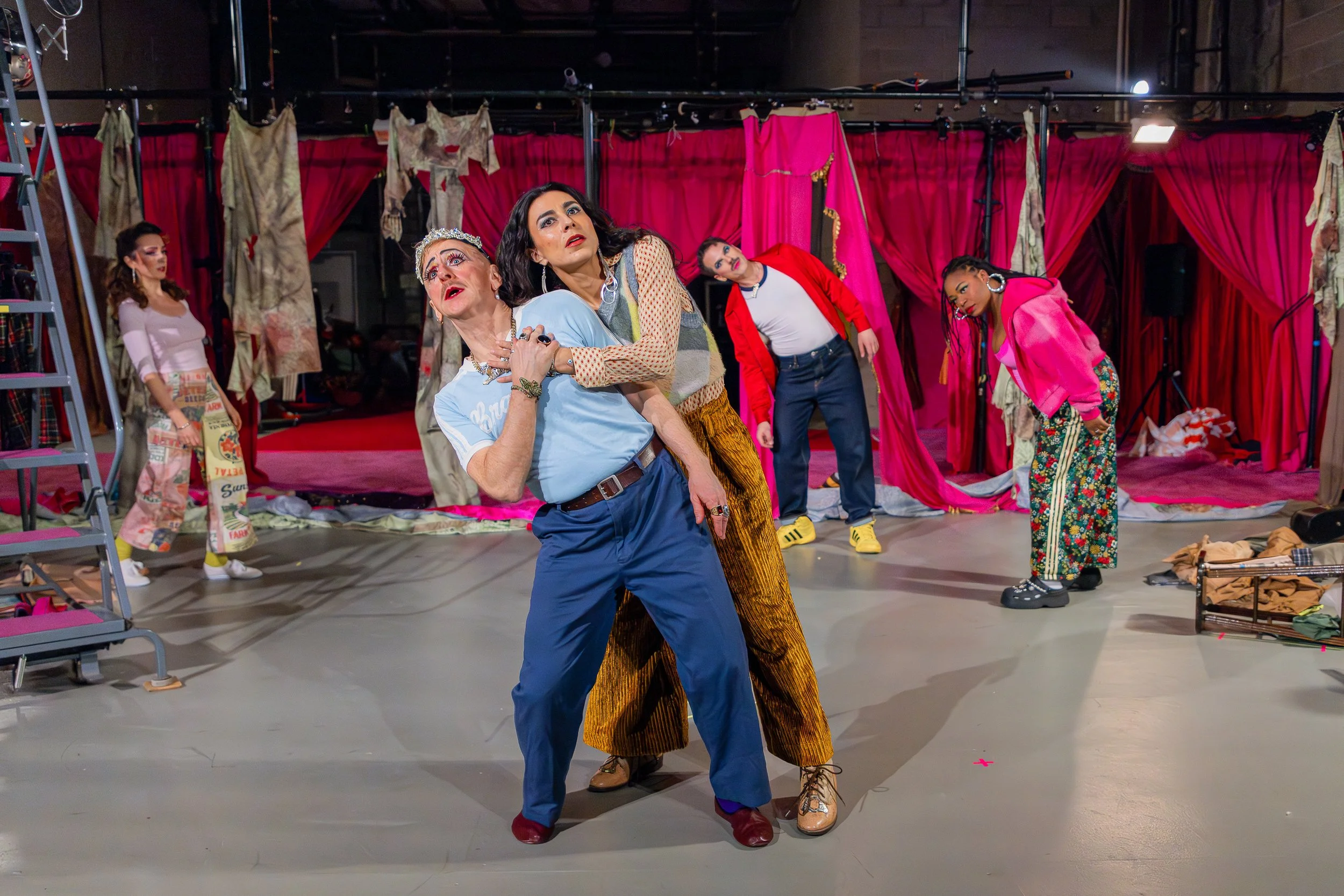
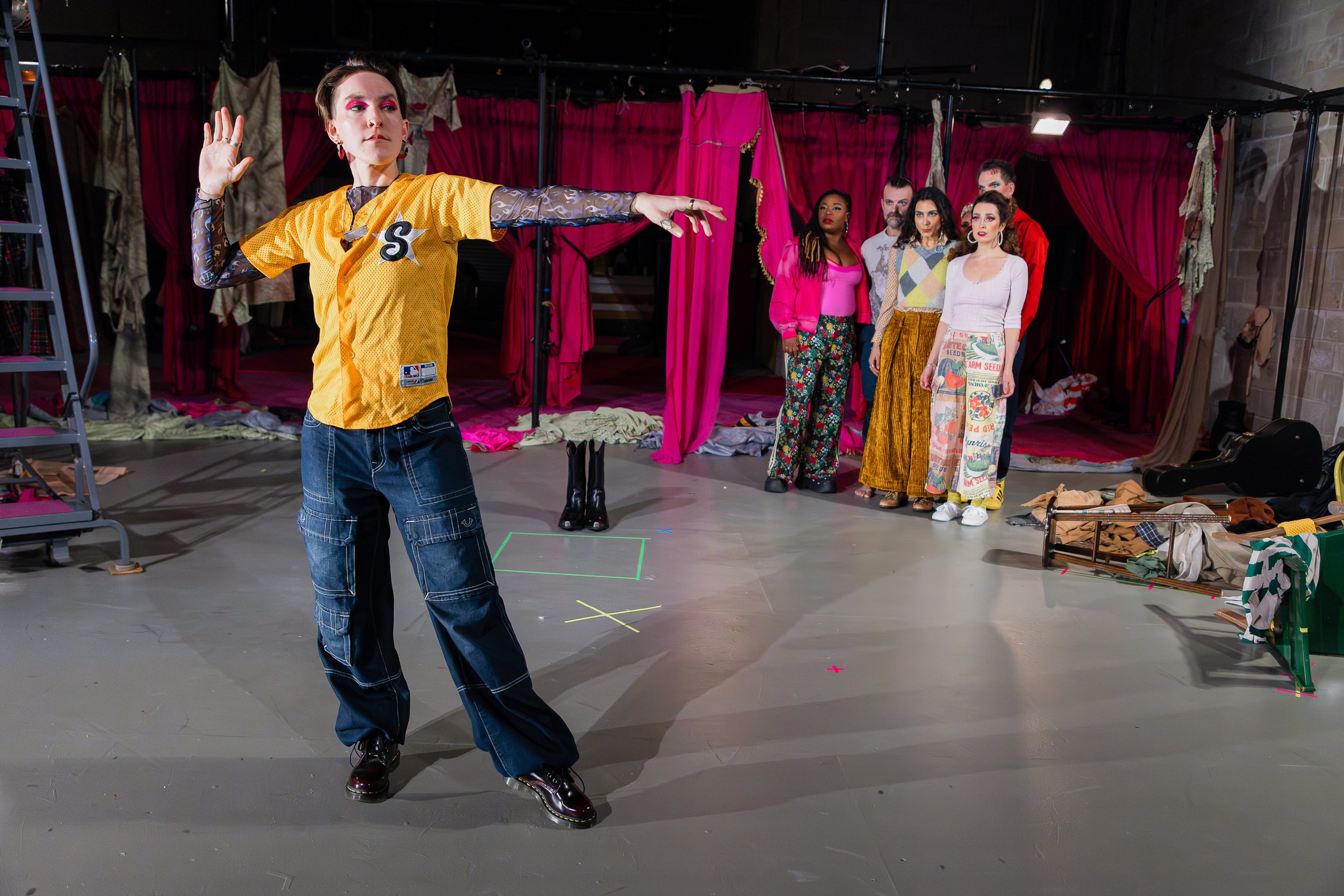
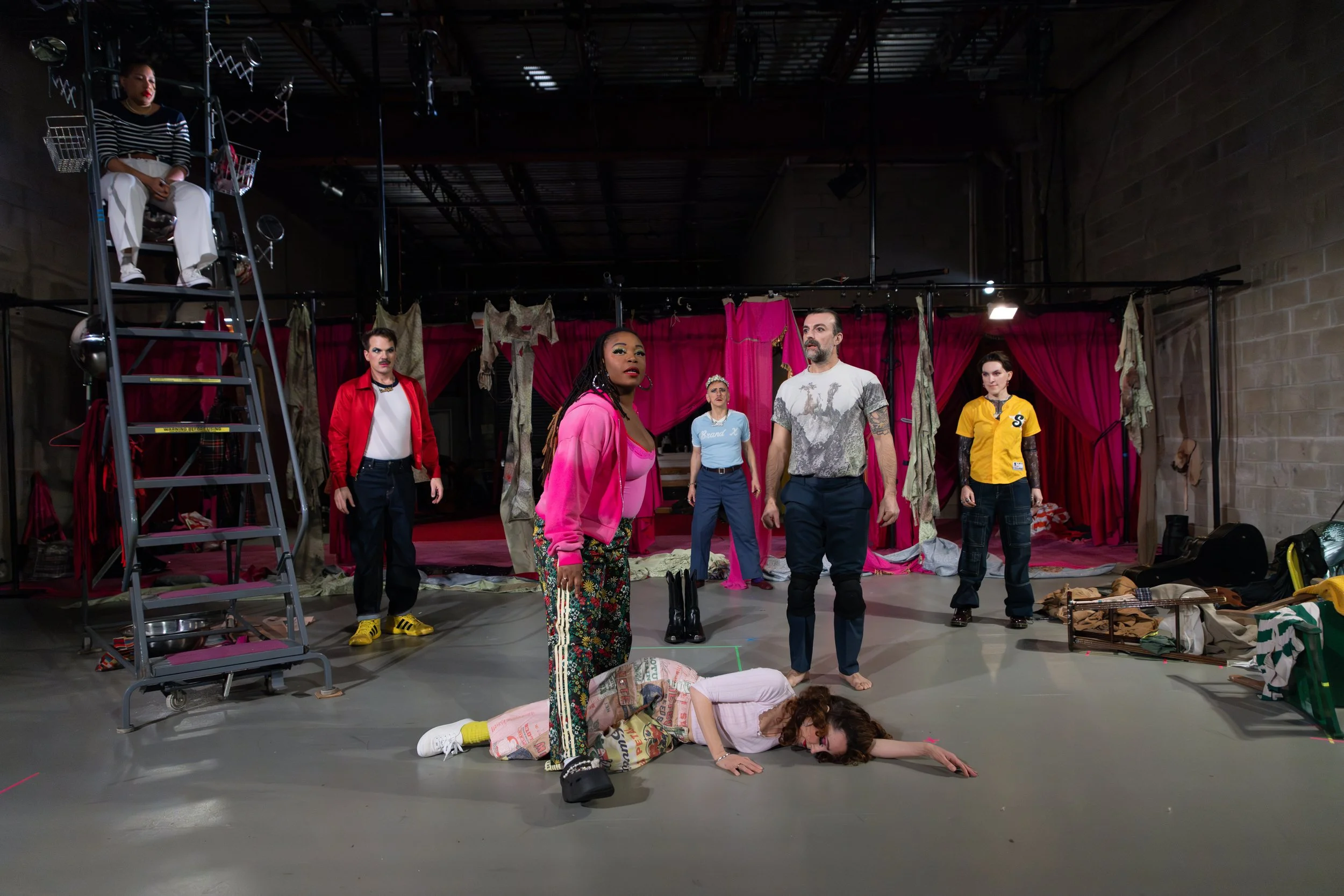
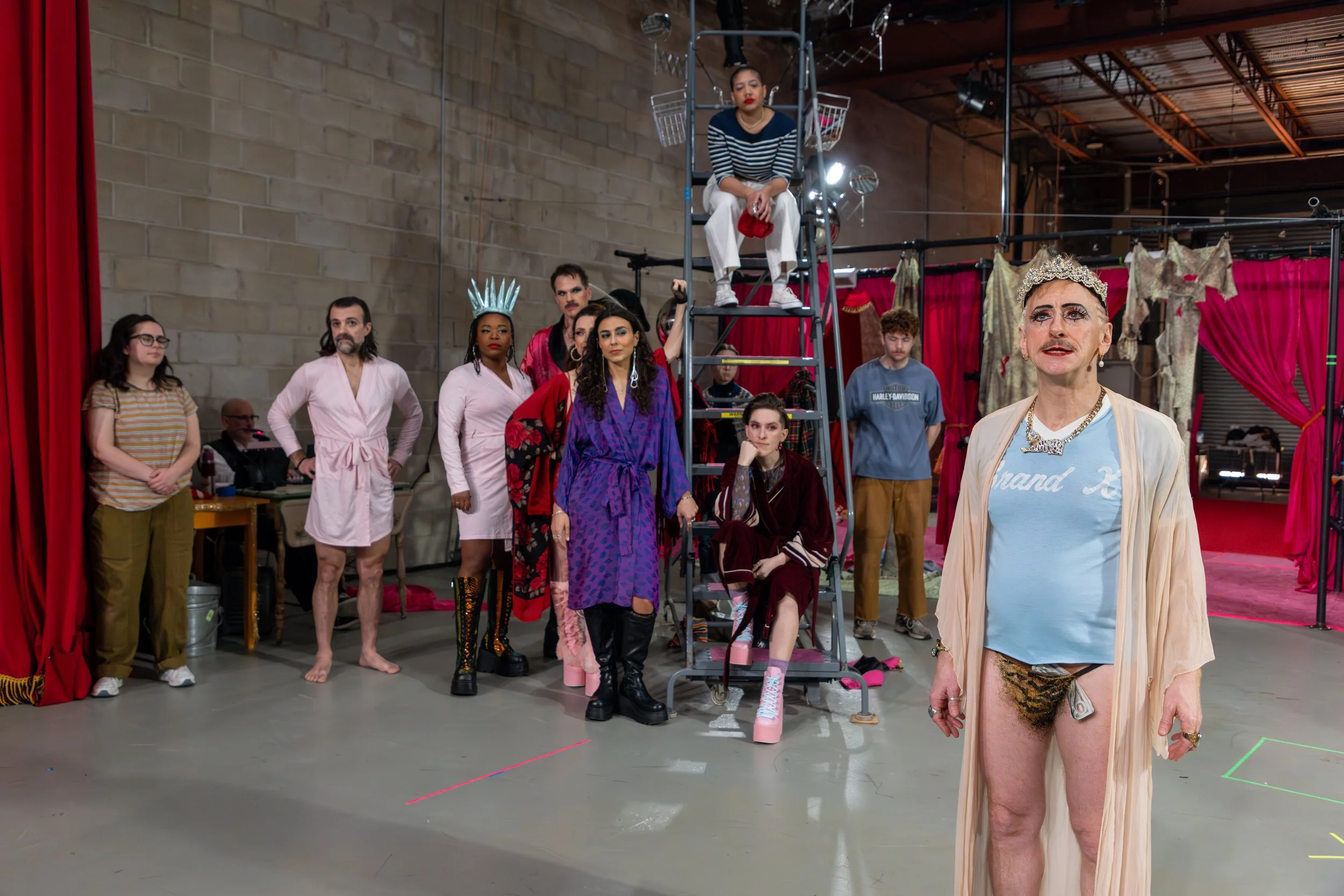
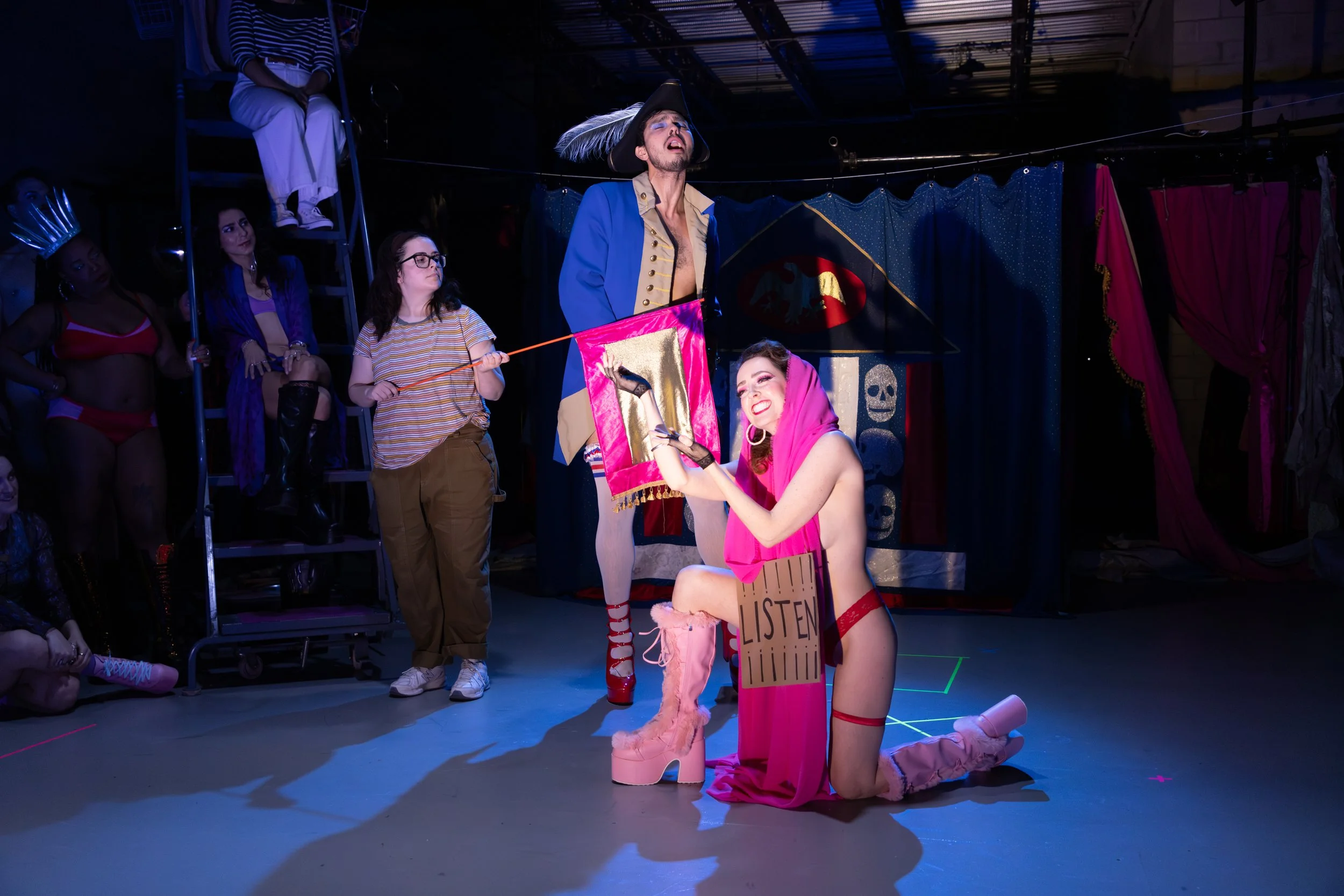
Photo credit by by Whitney Browne
In a season crowded with gestures toward urgency, Target Margin Theater’s THIS IS REAL, now running at their Doxsee Theater in Brooklyn, feels less like a provocation than an inevitability. Directed by the 2025 Obie Award–winning David Herskovits, the production gathers a cohort of collaborators to conjure a work that is at once unruly and rigorously composed, steeped in the rebellious inheritance of Jean Genet—that patron saint of power’s grotesque theater, of sex as currency, of revolution as both spectacle and seduction.
At the outset, performer James Tigger! Ferguson appears nude, welcoming the audience as “David Herskovits,” and perhaps the second sentence of his monologue is “Content Warning.” Er….too late? Beneath a row of curtained awnings—suggestive of a seaside arcade or a disreputable midway—THIS IS REAL opens with a sequence of four simultaneous vignettes that are as mischievous as they are disquieting. In each, a pair of performers enacts a ritualized fantasia of distinctly American submission and power: a flirtatious Statue of Liberty dangles promise before one of her “tired, poor, huddled” supplicants; elsewhere, frontier mythology curdles into something stranger and more abject. The performers, initially unclothed, gradually adorn themselves in burlesque regalia that codes them, with winking exaggeration, as both the powerful and the dispossessed—costume here functioning less as disguise than as indictment.
Daddy Ho (Justin Ivan Brown) and Mari Vial-Golden share text that incorporates our Declaration of Independence. Queerly Femmetastic and Susannah MacLeod are paired here for Emma Lazarus’ 1883 sonnet, The New Colossus. Merlin Whitehawk and J Molière reference Henry Ford’s The International Jew: The World’s Foremost Problem. Timiki Salinas and TANSY lift their voices in Pine Tree Riots’ “We’ll Have Our Home Again.” The entire company join forces for various versions of the classic “Home on the Range,” that include the Goodwins’ 1904 miners’ version and the 1910 Lomax version with its obligatory “the red man was pressed from this part of the west.”
The effect is at once titillating and estranging, a carefully calibrated provocation that announces the production’s governing logic: desire as a theater of domination, identity as a role one purchases or is coerced into playing. The sequence knowingly echoes the opening movements of Jean Genet’s The Balcony, in which men indulge their fantasies of authority—bishop, judge, general—while the women they hire embody degradation in its many guises. What Herskovits and his collaborators achieve here is not mere homage but a transposition, relocating Genet’s ritualized perversities into an American iconography that feels, if anything, even more revealing in its distortions.
The shadow of The Balcony falls long across the evening. Both works situate themselves, however fleetingly in this case, within the charged confines of a brothel, while revolution crackles just beyond the threshold—gunfire puncturing fantasy, reality insisting on its intrusion. Yet THIS IS REAL refuses to keep that upheaval at bay. If Genet allowed revolution to hover, tantalizingly, at the edges, Target Margin drags it center stage. The erotic pageantry that defines the opening gives way to something more volatile and diffuse: a dramaturgy of unrest, in which the script—deliberately elusive—channels the jittery hysteria of contemporary political life.
The setting is deliberately unstable: a theater that is also a brothel, that is also a business. Within this mutable space, performers slip in and out of roles, staging fantasies of American dominance with a feverish theatricality, even as the distant rumble of insurrection presses ever closer. Herskovits, who has long specialized in collapsing the distance between performance and political reality, here allows the outside world to bleed inexorably inward, until the distinction between playacting and power becomes not merely porous but irrelevant. What emerges is less a narrative than a reckoning. As the imagined uprising encroaches, the production asks, with unnerving directness, who will be left to claim authority when the dust settles—and at what cost that authority is secured. The crown, in this world, is never simply worn; it is seized, bartered, or stained.
Yet for all its volatility, THIS IS REAL is animated by a quieter, more persistent inquiry: what might be salvaged from the position of the outsider? In Genet’s universe, marginality is not merely deprivation but a vantage point, a site of illicit clarity. Herskovits and his collaborators extend that proposition to the audience, implicating us in the uneasy recognition that estrangement is not the exception but the rule. We are, each of us, cast slightly askew from the center, left to wonder whether that displacement might contain its own form of beauty—or even a kind of wisdom.
As Herskovits—both the production’s director and the guiding force behind Target Margin Theater—makes emphatically clear, THIS IS REAL does not presume to interpret Genet; it answers him. Where Genet once anatomized the spectacle of a single man rehearsing power in the safety of illusion, Herskovits and his collaborators enlarge the frame to something more ominously collective: a nation itself, feverishly staging its own dominion, unable to distinguish between performance and policy.
What follows is less a story than a cascade of ruptures: assassinations flicker into view, power shifts with disorienting abruptness, and an atmosphere of encroaching authority thickens until it feels almost breathable. At one point, a drone glides with quiet menace from the theater’s upper reaches, its mechanical gaze transforming the space into a zone of surveillance. The gesture is blunt, even brazen, and all the more effective for it. Herskovits seems to suggest that, in the present moment, revolution can no longer be relegated to the wings, awaiting its cue. It is already here—overhead, at the door, embedded in the very structures we once believed were merely theatrical.
THIS IS REAL takes as its animating engine the familiar triad of Genet’s obsessions—power, sex, and revolution—but treats them less as themes than as volatile substances, forever threatening to combust. Genet himself, a thief and drifter, a prostitute and prisoner, wrote from the margins with a ferocity that affronted bourgeois decorum and demanded that audiences interrogate not only what they watched, but who they were while watching. His lineage—extending through figures as various as Charles Ludlam, Rainer Werner Fassbinder, and David Bowie—is one of aesthetic insurgency, a tradition that Target Margin Theater has long claimed as its own.
What distinguished Genet, and what this production seizes upon with bracing clarity, was his unwavering devotion to the dispossessed: the countercultural, the criminal, the misfit, the so-called degenerate. These were not merely his subjects but his saints, figures transfigured by his language into icons of a shadow morality. THIS IS REAL invites us to encounter them again, stripped of sentimentality yet charged with a dangerous allure, asking whether the categories we inherit—of virtue, of vice—can withstand sustained scrutiny.
The production’s textual fabric is deliberately scavenged, even ransacked, from across Genet’s oeuvre: the early prison writings, the fevered lyricism of Our Lady of the Flowers, and the theatrical provocations that run from Deathwatch through The Balcony to The Screens. Threaded through this collage is the late work Prisoner of Love, whose meditations on time spent among Palestinian refugees and freedom fighters in the 1970s reverberate here with an almost disquieting immediacy. In Herskovits’ staging, these fragments do not cohere into a single argument so much as they echo and collide, forming a restless chorus that insists, again and again, on the enduring urgency of Genet’s vision.
THIS IS REAL is grappling—seriously, even recklessly—with the present tense. First, the piece declares itself in active dialogue with Jean Genet, who remains, for any serious student of the stage, among the most destabilizing theatrical imaginations of the twentieth century. Second, its director, Herskovits, has promised an engagement with the political now—a promise that, against the odds, is not only fulfilled but realized with a rare, almost disconcerting immediacy. And third, the ensemble itself—a hybrid of downtown experimental actors and figures drawn from burlesque and performance art—suggests a porousness of form that the evening eagerly exploits. One hesitates to catalogue the production’s shocks, though the company itself has done so with a wink: “Nudity. Flag Burning. Drones.” (The punchline—“This is a patriotic play”—lands with the kind of mordant humor Genet might have admired.) Encountered without forewarning, these moments arrive not as stunts but as detonations, each calibrated for maximum disquiet.
Among the ensemble, Ferguson emerges as a kind of dark ringmaster, delivering lines with a precision that lands somewhere between camp and menace. Two moments, in particular, cut cleanly through the production’s tumult. “Only my jewels are real. Everything else is fake,” he declares, the line shimmering with both vanity and existential dread, as if authenticity itself were a commodity to be worn and displayed. Later, in a brittle exchange with Whitehawk, Ferguson surveys the clientele and delivers, with chilling casualness, “You will have to play dead tonight.” The remark, tossed off as instruction, reverberates outward—at once a piece of stage business and a grim distillation of the production’s larger inquiry into performance, power, and the cost of survival.
To call THIS IS REAL a play feels faintly inadequate. Dialogue—fragmented, incantatory—is only one thread in a dense weave that includes choreographed movement, song, layered soundscapes, and a visual world of striking excess. The image of a burning flag—always potent—has acquired an added, almost accidental resonance in light of recent geopolitical escalations, a reminder that the meanings of theatrical images are never fixed but continually rewritten by circumstance.
The production’s visual and sonic world is rendered with a tactile, often unnerving specificity by a finely attuned creative team. The scenic design by Normandy Sherwood conjures a mutable environment that shifts from lurid intimacy to cavernous spectacle, while Karen Boyer’s costumes revel in a burlesque exaggeration that blurs the line between iconography and parody. Marika Kent sculpts the space with a restless, interrogative glow—at times seductive, at others starkly exposing—while Herskovits’ sound design threads the evening with an aural landscape that is by turns immersive and destabilizing, amplifying the production’s sense of a world perpetually on the brink.
The performers—Queerly Femmetastic, James Tigger! Ferguson, Daddy Ho, Susannah MacLeod, J Molière, Timiki Salinas, TANSY, Mari Vial-Golden, and Merlin Whitehawk—commit themselves with a fearlessness that feels integral to the project’s ethos. Their work, by turns brazen and vulnerable, sustains the production’s precarious balance between spectacle and inquiry.
What lingers, finally, is not only the production’s audacity but its conviction: that there will always be artists compelled to live—and to make work—in opposition. If the world outside the theater edges ever closer to the chaos allegorized within it, THIS IS REAL suggests that resistance, too, will persist, embodied in those temperamentally incapable of acquiescence. For now, Herskovits’s work stands as a volatile, compelling reminder that Genet’s theater has not receded into history; it continues to erupt, unpredictably, into the present.
Click HERE for tickets.
Review by Tony Marinelli.
Published by Theatre Beyond Broadway on March 29th, 2026. All rights reserved.
