The Unusual Chauncey Faust
Written by Coni Koepfinger; Directed by Aviva Katz
The Gene Frankel Theatre | 24 Bond Street, New York, NY 10012
March 19–29, 2026
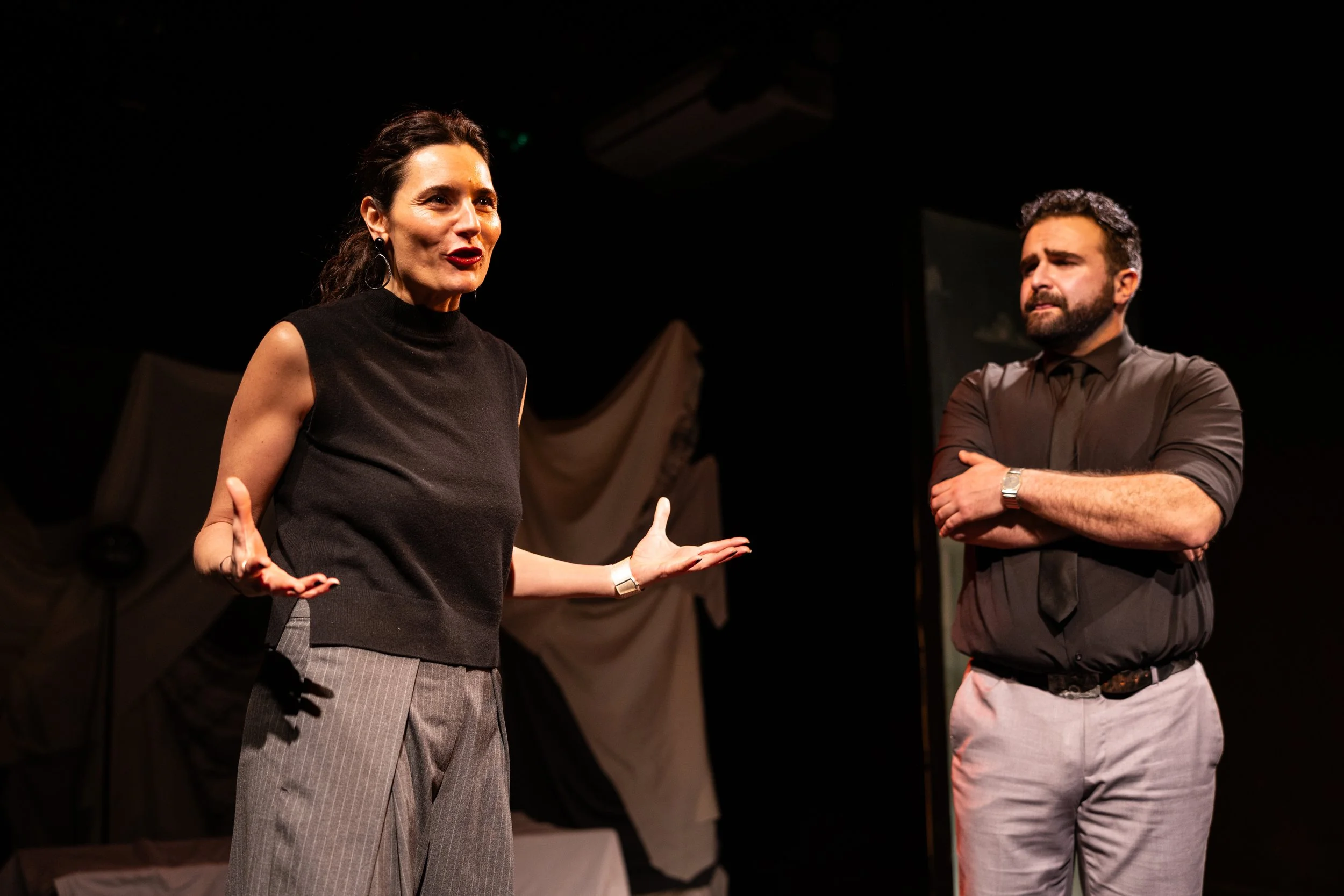
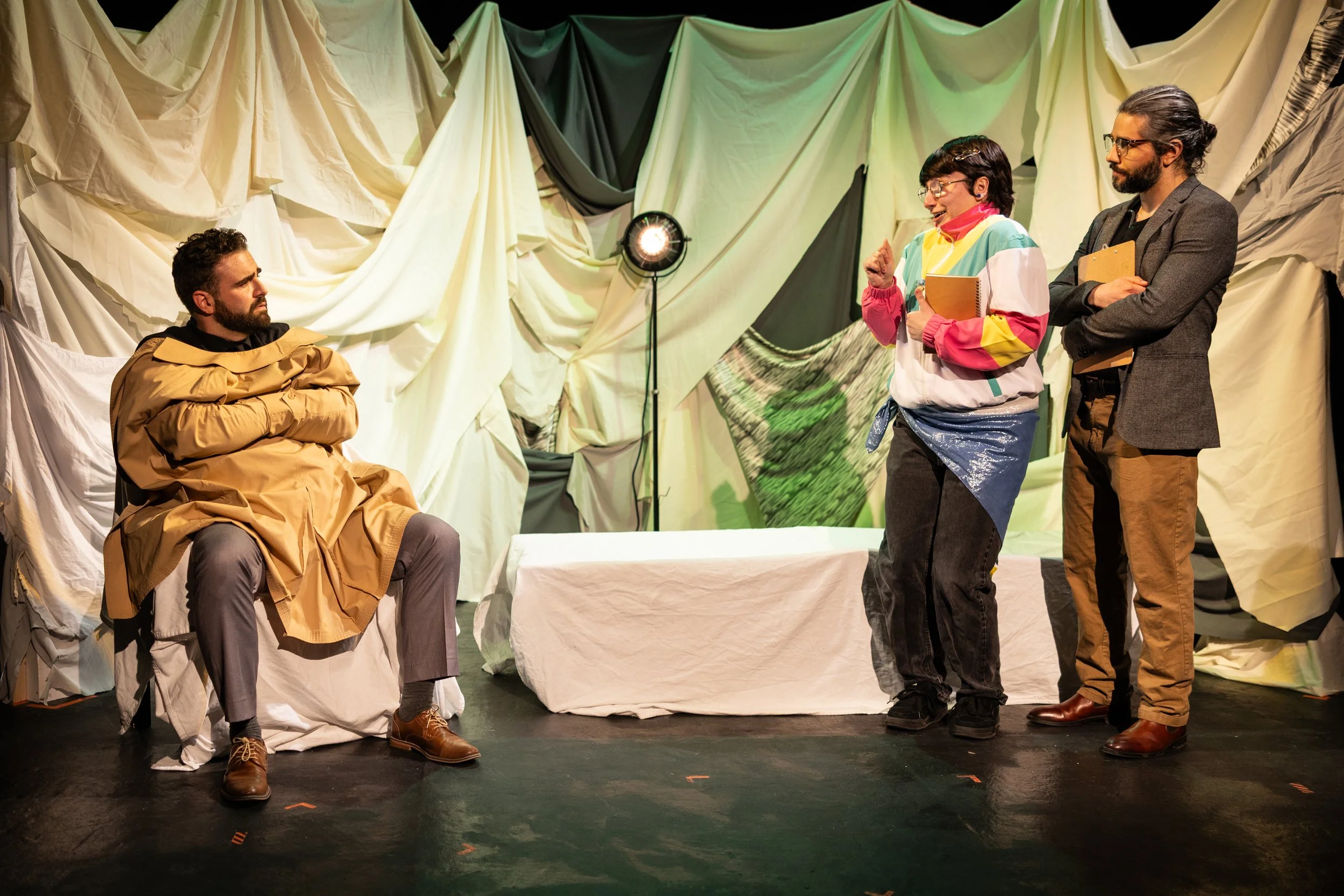
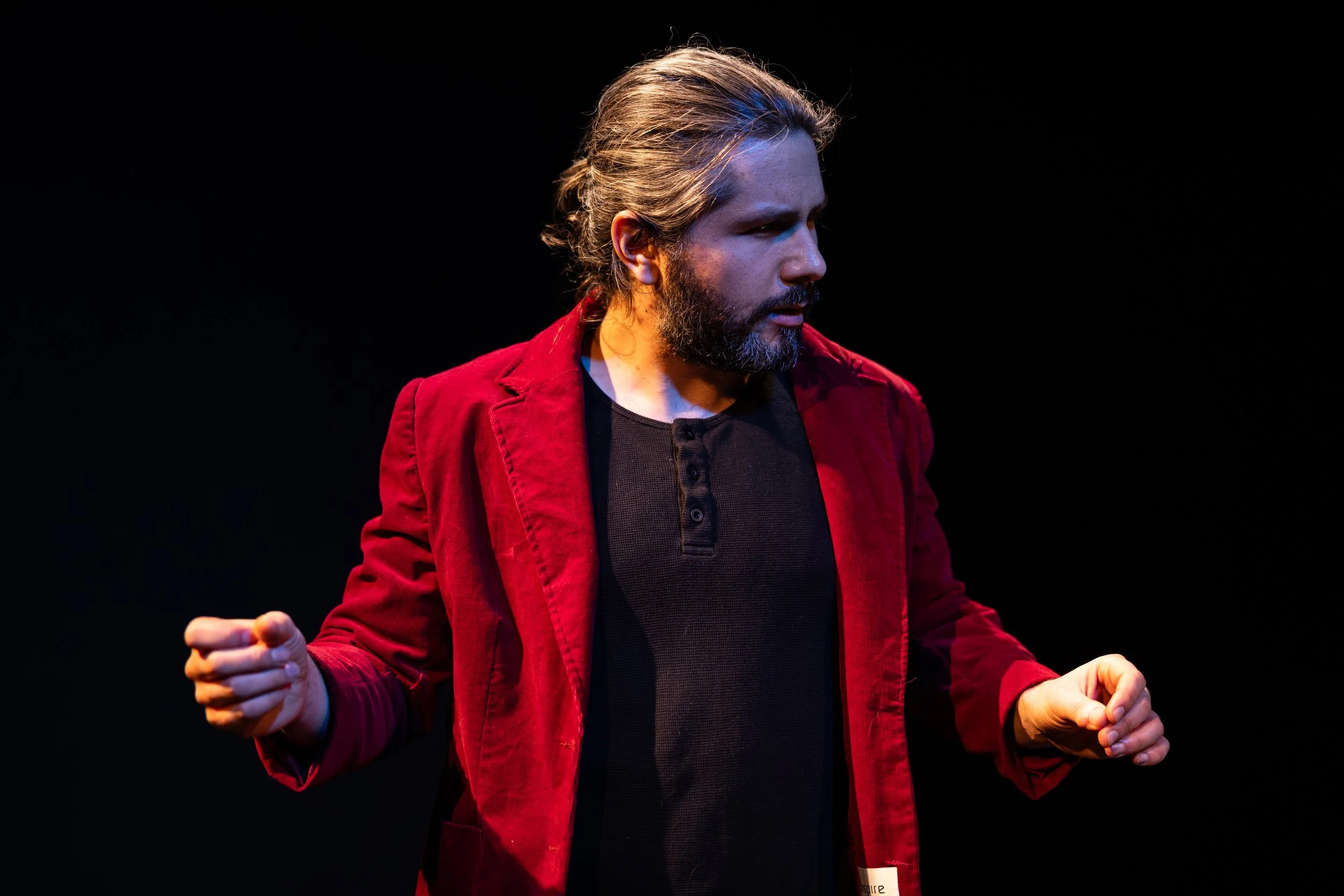
Photo Credit: Reza Mirjalili
Walking into the Gene Frankel Theatre always stirs something warm and familiar, memories of how indie theatre once thrived in intimate spaces where experimentation felt not only possible but essential. Tonight was no exception. The house was full and buzzing with an almost communal sense of support. A violinist greeted the audience as they settled in, while a minimalist set, white fabric draped across the back wall and illuminated by a single light, hinted at the abstract world to come.
The Unusual Chauncey Faust by Coni Koepfinger arrives on this stage after winning last summer’s 15 Minutes of Frame playwrights competition, which granted Koepfinger the opportunity to expand the work into a full-length piece. The play follows Chauncey Faust, an actor haunted by the quiet terror that time may be slipping away from him. His pursuit is not simply ambition, but something more elusive and internal. Drawing on echoes of the classic Faust legend, the script leans into theatricality and abstraction, inviting the audience to consider how much of Chauncey’s searching mirrors their own.
Chauncey’s world is populated by figures who blur the lines between science, theatre, spirituality, and dreamwork. Dr. Stanley Morgan, a boundary-pushing Columbia professor and experimental director, has created DEWDROP 2550, a dream-altering elixir that allows actors to enter one another’s dreams. His assistant, Ms. Candice Appleby, balances devotion with a quiet, growing ambition. Avery Mello provides a voice of unflinching truth, while Dr. Maria Olon’s PAD Theory, a fusion of performance, science, and spiritual practice, strives to awaken hidden human potential. Together, they create a layered theatrical universe where identity, illusion, and purpose merge.
Act One ventures boldly into meta-theatrical territory, though its execution proves uneven. Dr. Morgan’s repeated fourth wall breaks, particularly with the same audience members, begin to feel less like intentional disruption and more like a device that diffuses tension. What initially intrigues soon distracts, pulling focus from Chauncey’s internal stakes rather than deepening them. The pacing struggles to sustain momentum, with moments that linger past their impact rather than building toward a cohesive arc.
The play’s ambition is unmistakable, reaching toward questions of identity, purpose, and the cost of artistic pursuit. However, its reliance on abstraction and layered concepts, including DEWDROP 2550 and PAD Theory, at times obscures rather than clarifies the story. Without a more grounded throughline, the parallels to the Faustian bargain feel more implied than fully realized, leaving the moral and emotional stakes less defined than the material demands.
Under the direction of Aviva Katz, the production features dual performances by Sean Ricciardi and Kenny Harmon as Chauncey Faust. At this performance, Ricciardi approached the role with palpable urgency and emotional openness, anchoring the piece when its structure wavered. Will Lippman as Dr. Stanley Morgan, Emerick King as Ms. Candice Appleby, Kendra MacDevitt as Avery Mello, and Hilal Koyuncu as Dr. Maria Olon round out the ensemble, each contributing distinct textures to this surreal world.
The Unusual Chauncey Faust is undeniably ambitious, committed to theatrical experimentation and philosophical inquiry. Yet its execution does not always support the weight of its ideas. Where the piece reaches for depth, it occasionally drifts into abstraction without anchor, and where it aims for urgency, its pacing softens the impact. Still, its presence at the Gene Frankel Theatre serves as a reminder of the enduring value of indie spaces as laboratories for risk, where all work contributes to the theatrical landscape.
Review by Malini Singh McDonald.
Published by Theatre Beyond Broadway on March 30th, 2026. All rights reserved.