ULSTER AMERICAN
Written by David Ireland, Directed by Ciarán O'Reilly
Francis J. Greenburger Mainstage at Irish Repertory Theatre, 132 West 22nd Street, in Manhattan
March 6, 2026 - May 24, 2026
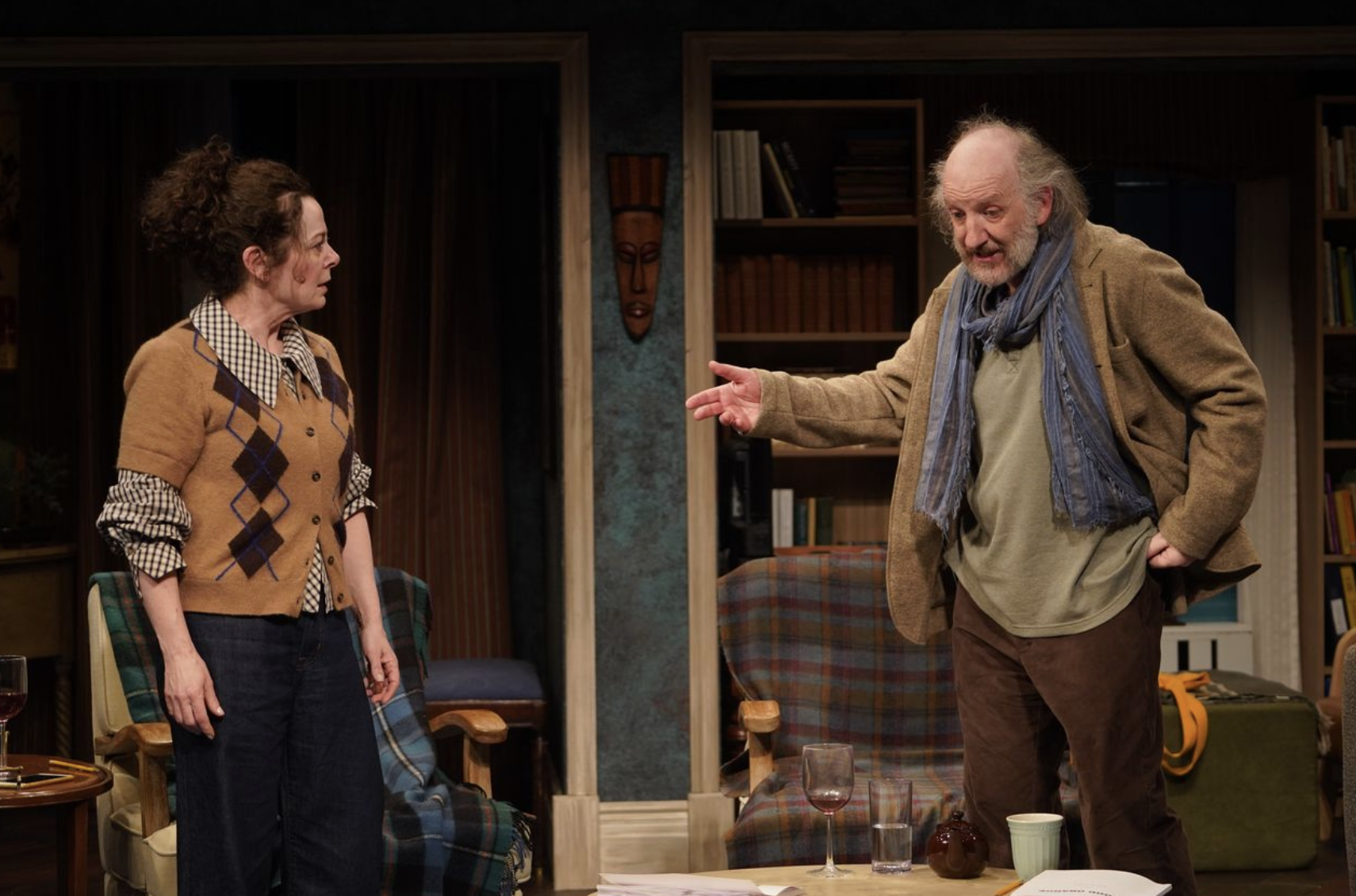
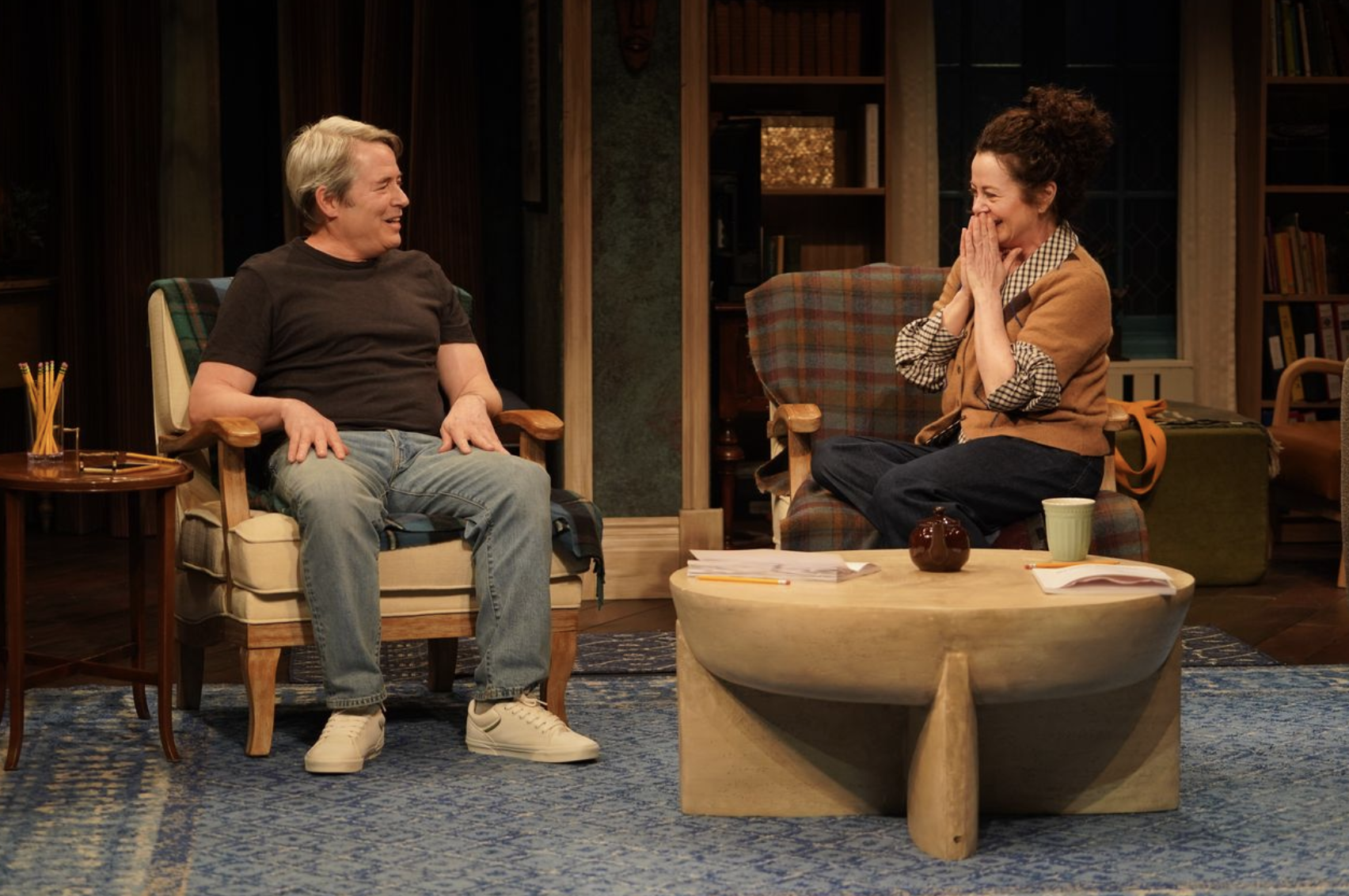
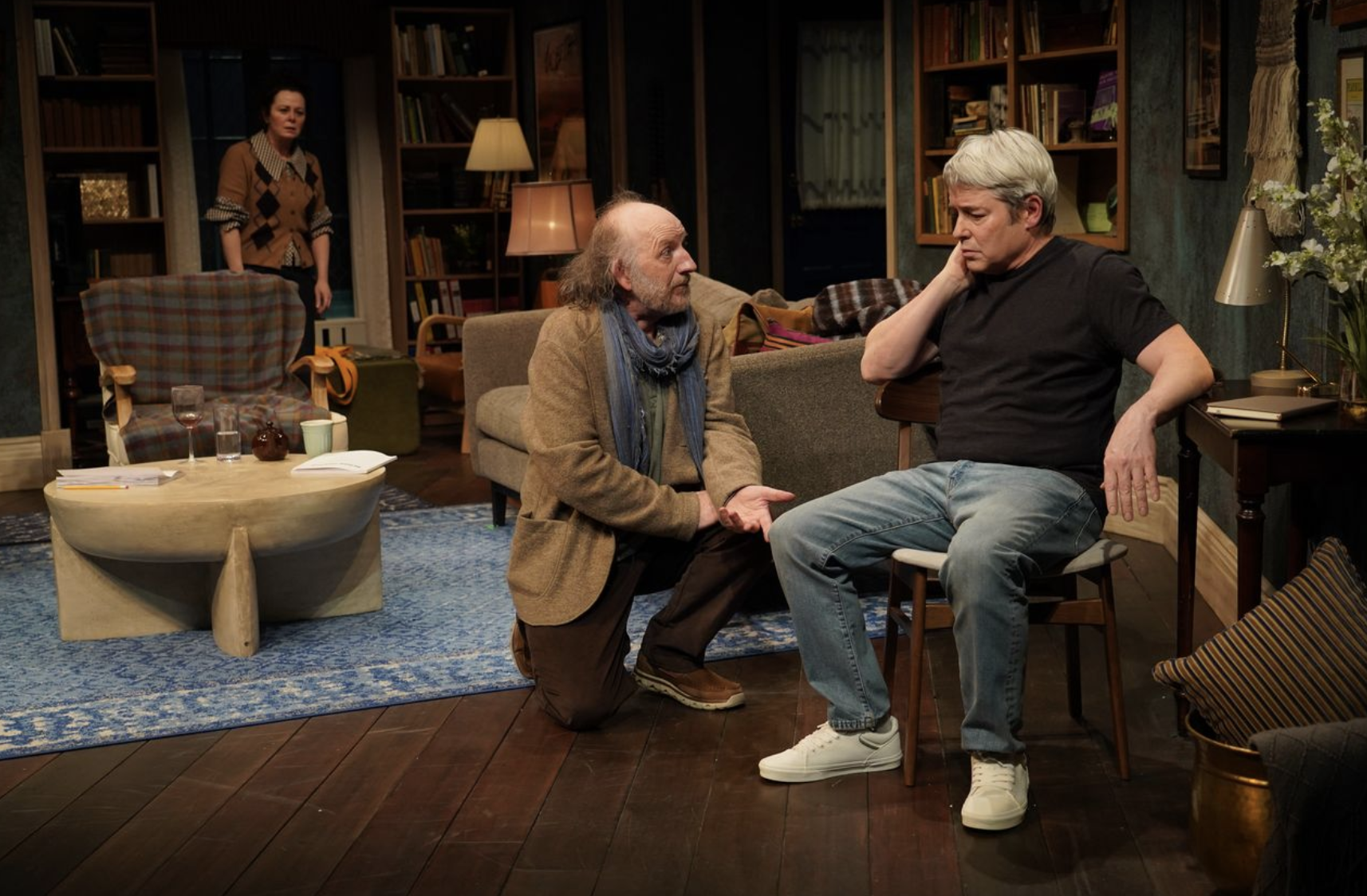
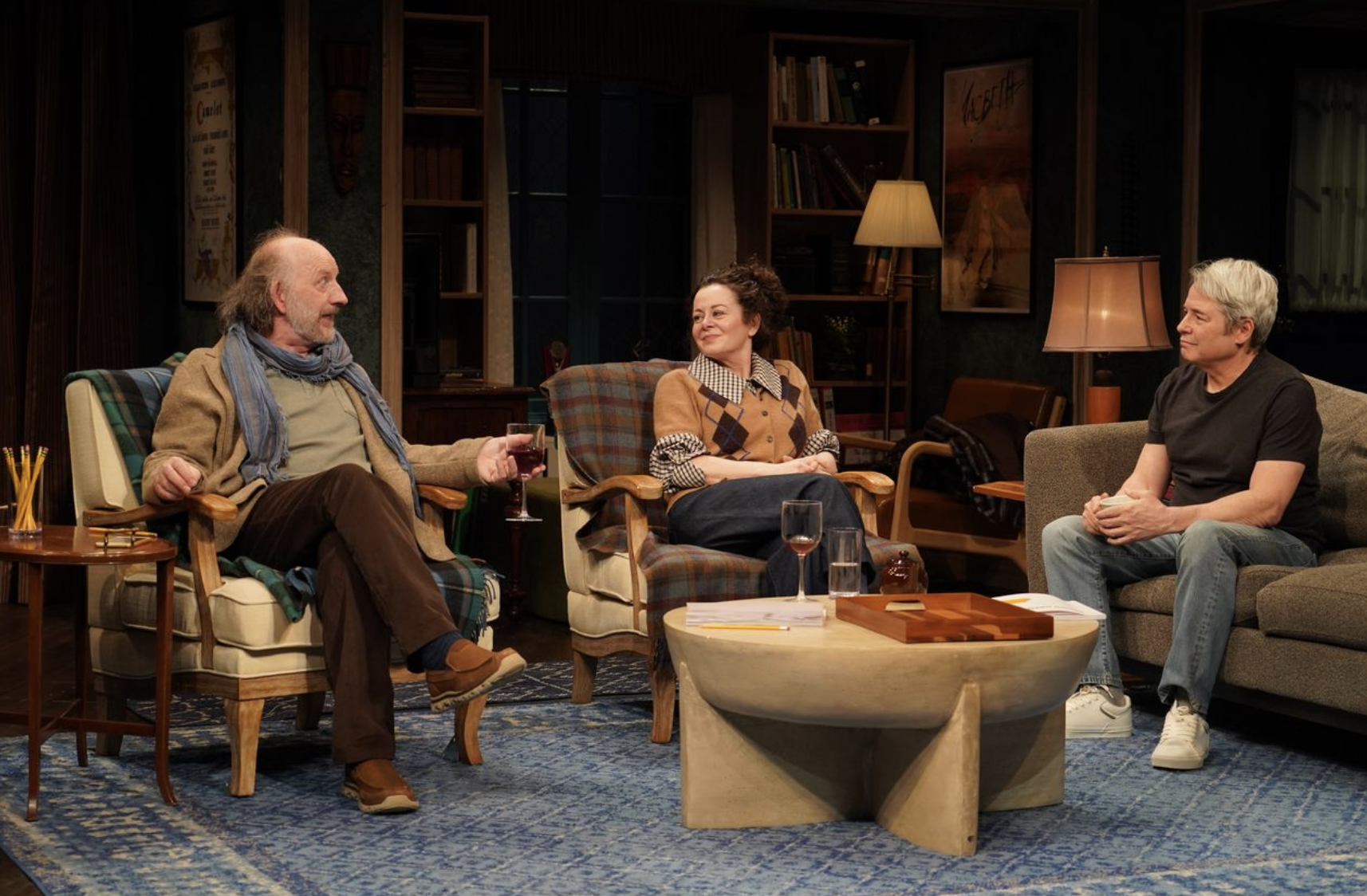
In David Ireland’s ferociously entertaining and strategically abrasive Ulster American, now detonating at the Irish Repertory Theatre under the razor-alert direction of Ciarán O’Reilly, the old Chekhovian principle about the gun on the wall acquires a contemporary mutation. Here, the object introduced early is not a pistol but an Oscar statuette, gleaming silently in a London sitting room like a secular idol before which all artistic integrity, political conviction, and moral coherence may eventually be sacrificed. Violence does indeed arrive, as promised, though for most of the play’s compact and blistering ninety minutes the bloodshed is rhetorical: a fusillade of obscenity, vanity, ideological confusion, and identity panic delivered with such unnerving comic precision that the audience scarcely knows whether to gasp, groan, or howl with laughter. Most do all three.
Ireland, the Belfast-born playwright whose work has repeatedly excavated the psychic wreckage of the Troubles, structures the play with devilish simplicity. On the eve of rehearsals for a new London production concerning Northern Ireland’s sectarian conflict, three collaborators gather in the elegantly appointed home of English director Leigh Carver. Leigh has secured a Hollywood star, Jay Conway, to headline the piece, and has arranged for the actor to meet the playwright, Ruth Davenport, for the first time. What begins as nervous artistic small talk metastasizes almost immediately into a grotesque chamber comedy of political misunderstanding and egoistic delusion. The play’s great trick is that every character enters believing themselves enlightened, sophisticated, humane. Ireland then proceeds, with surgical cruelty, to strip those self-conceptions bare.
The first to collapse is Jay Conway, played by Matthew Broderick with a fascinatingly deadpan vacancy. Jay introduces racist language within minutes as casually as one might mention cloud cover, and from there spirals into increasingly appalling declarations involving rape, nationalism, artistic freedom, and the sanctity of Quentin Tarantino. Yet Broderick refuses to play him as a swaggering monster. Instead, he presents Jay as a strangely placid narcissist, a man whose self-regard is so complete that he lacks even the curiosity to register the pain he causes. The performance becomes funniest precisely because Broderick never strains for shock. The obscenities emerge in the same pleasant tonal register one might use to recommend a wine pairing.
Broderick is, in some respects, improbably cast. One understands the skepticism: Jay is described as a magnetic Hollywood titan, while Broderick’s stage persona has always possessed an anxious, cerebral, faintly apologetic quality. He does not entirely persuade as an alpha-male celebrity brute, particularly once the script demands a more combustible machismo in the final movements. Yet the very mismatch yields unexpected rewards. Jay’s childish cluelessness becomes its own species of horror. Broderick turns him into a cultural tourist wandering idiotically through ideological minefields, puffed up with pseudo-liberal jargon and ancestral Irish sentimentality he barely comprehends. His atrocious attempts at a Belfast accent become recurring punchlines in a production overflowing with them.
If Jay embodies American celebrity narcissism, Max Baker’s magnificent Leigh incarnates the theatrical establishment’s polished cowardice. Baker gives the evening’s most fully calibrated performance, creating a man who seems upholstered into Charlie Corcoran’s sumptuous set: all tasteful bookshelves, National Theatre posters, and expensive self-seriousness. Leigh presents himself as mediator, intellectual, progressive facilitator of difficult conversations. But Baker brilliantly reveals the panic twitching beneath the cultivated composure. The moment Jay threatens to withdraw from the production, Leigh’s principles liquefy instantly. He offers rewrites, compromises, ideological reversals, even the possibility of inserting a Riverdance sequence into Ruth’s grim political drama if it might soothe his star. Baker captures, with exquisite comic timing, the humiliating elasticity of artistic people desperate to remain adjacent to fame.
The emotional and moral center of the play belongs to Geraldine Hughes as Ruth Davenport, who undergoes the evening’s most profound transformation. Hughes enters vibrating with contradictory energies: grief over her hospitalized mother, exhilaration at meeting a movie idol, pride in her work, exhaustion at constantly defending her identity. Ruth is a Protestant from Belfast who identifies as British, a political and cultural reality Jay finds nearly incomprehensible. Ireland uses their collision to expose the flattening ignorance through which Americans often romanticize Ireland while understanding almost nothing about Northern Ireland’s tortured complexities. Hughes charts Ruth’s movement from dazzled admiration to volcanic fury with astonishing control, allowing the character’s rage to accumulate molecule by molecule until the eventual eruption feels both shocking and inevitable.
Ireland’s dialogue is an instrument of astonishing sharpness. Few contemporary playwrights write comic escalation with such athletic precision. The script ricochets from literary references to vulgarity, from geopolitical argument to absurd non sequitur, from feminist critique to catastrophic misunderstanding. One exchange involving the Bechdel test reveals that Jay believes “Bechdel” is a man; another finds Leigh confusing James Baldwin with Alec Baldwin. These jokes are not merely punch lines but diagnoses: symptoms of a culture intoxicated by performance, in which people wield language of social awareness without possessing even rudimentary comprehension. Ireland’s genius lies in allowing the audience to recognize the stupidity while simultaneously implicating them in the pleasure of the ridicule.
O’Reilly’s production understands that pace is everything in comedy this dangerous. He allows the revelations to emerge gradually, never forcing the satire into hysteria too early. The evening accrues dread beneath its laughter, each conversational pivot tightening the screws further. Corcoran’s scenic design contributes immeasurably to this effect. The living room is richly, almost aggressively civilized, lined with books and theatrical paraphernalia that silently advertise cultural sophistication while the inhabitants descend into barbarism. A looming image of Samuel Beckett appears to observe the proceedings with spectral disapproval. The room itself becomes a joke about the fragility of refinement.
Orla Long’s costumes function as subtle but incisive character studies in themselves, locating each figure precisely within the hierarchies of taste, class, and self-invention that the play so gleefully anatomizes. Most revealing is Jay’s studiedly casual jacket, whose effortless-looking luxury announces the carefully curated swagger of a man accustomed to wealth, celebrity, and the assumption that every room already belongs to him. Leigh’s cultivated theatrical chic and Ruth’s more practical, emotionally unvarnished attire likewise deepen the production’s social and psychological textures without ever calling undue attention to themselves. Michael Gottlieb’s lighting shifts elegantly from warm intellectual salon to emotional battleground, tightening almost imperceptibly as the evening’s hostilities mount, while the sound design by Ryan Rumery and Florian Staab provides a finely calibrated atmospheric unease beneath the comedy. Together, the design elements exhibit the same polish and intelligence that characterize the production as a whole: technically immaculate, quietly revealing, and always in service of Ireland’s savagely funny excavation of ego, politics, and performance.
Yet Ulster American is more than a mere exercise in provocation. Beneath the avalanche of obscenity pulses a genuinely anguished inquiry into nationality, artistic ownership, and the instability of identity itself. Ireland understands that Northern Ireland remains, for many Americans, a mythological abstraction populated by sentimental clichés and rebel songs. Ruth’s insistence upon her Britishness continually crashes against Jay’s romanticized Irish Catholic narrative, and the collision produces both comedy and pain. The inability of the characters to agree upon even the basic terms of reality mirrors the irresolvable tensions of the Troubles themselves.
Not every moment lands cleanly. Ireland occasionally presses the shock tactics so insistently that one wonders whether the provocation justifies the queasiness it produces. The play knowingly courts that discomfort, daring the audience to interrogate why they are laughing and at whom. Some viewers will inevitably find the material exhausting or gratuitous. But the production’s intelligence, velocity, and fearless performances carry it through those hazards with remarkable confidence. Even when Ulster American threatens to become smug in its cynicism, it rescues itself through sheer comic audacity.
By the play’s explosive conclusion, Ireland has staged not simply a satire of celebrity culture or theatrical hypocrisy, but a broader autopsy of contemporary discourse itself: a world where everybody performs moral sophistication while remaining trapped inside vanity, tribalism, and appetite. The miracle is that he does so while being uproariously funny. One leaves the theater slightly appalled at having laughed so hard. That queasy exhilaration is precisely the point. Ulster American may not possess Chekhov’s melancholy humanity, but it shares something of his merciless instinct for exposing self-deception. And in this ferocious production, Ireland proves himself a dramatist of rare comic venom and unnerving theatrical control.
Click HERE for tickets.
Review by Tony Marinelli May.
Published by Theatre Beyond Broadway on May 23, 2026. All rights reserved.
