Ulysses
Written by James Joyce; Directed by John Collins with co-direction by Scott Shepherd
The Public Theatre | 425 Lafayette St, New York, NY 10003
January 13, 2026 - March 01, 2026
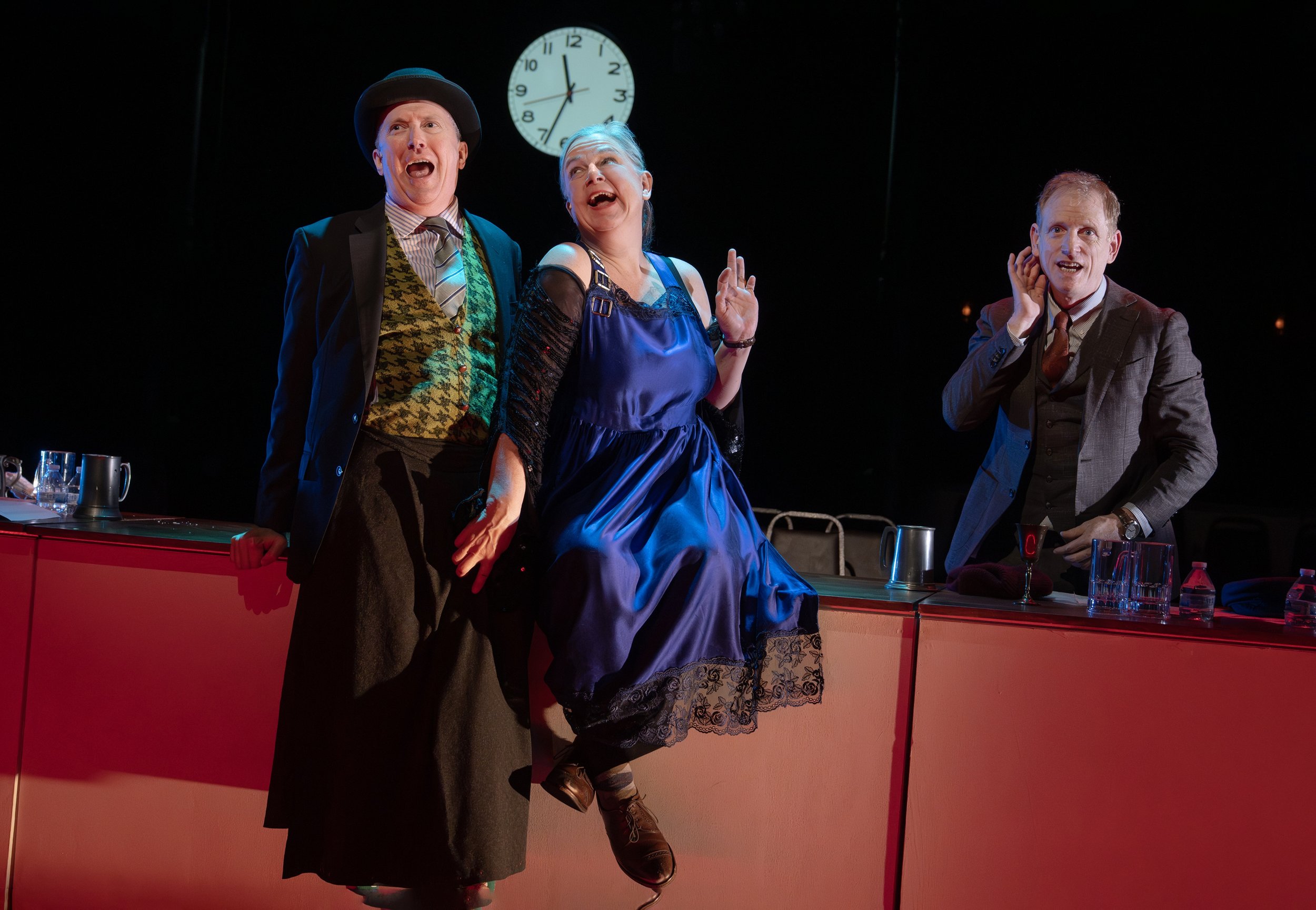
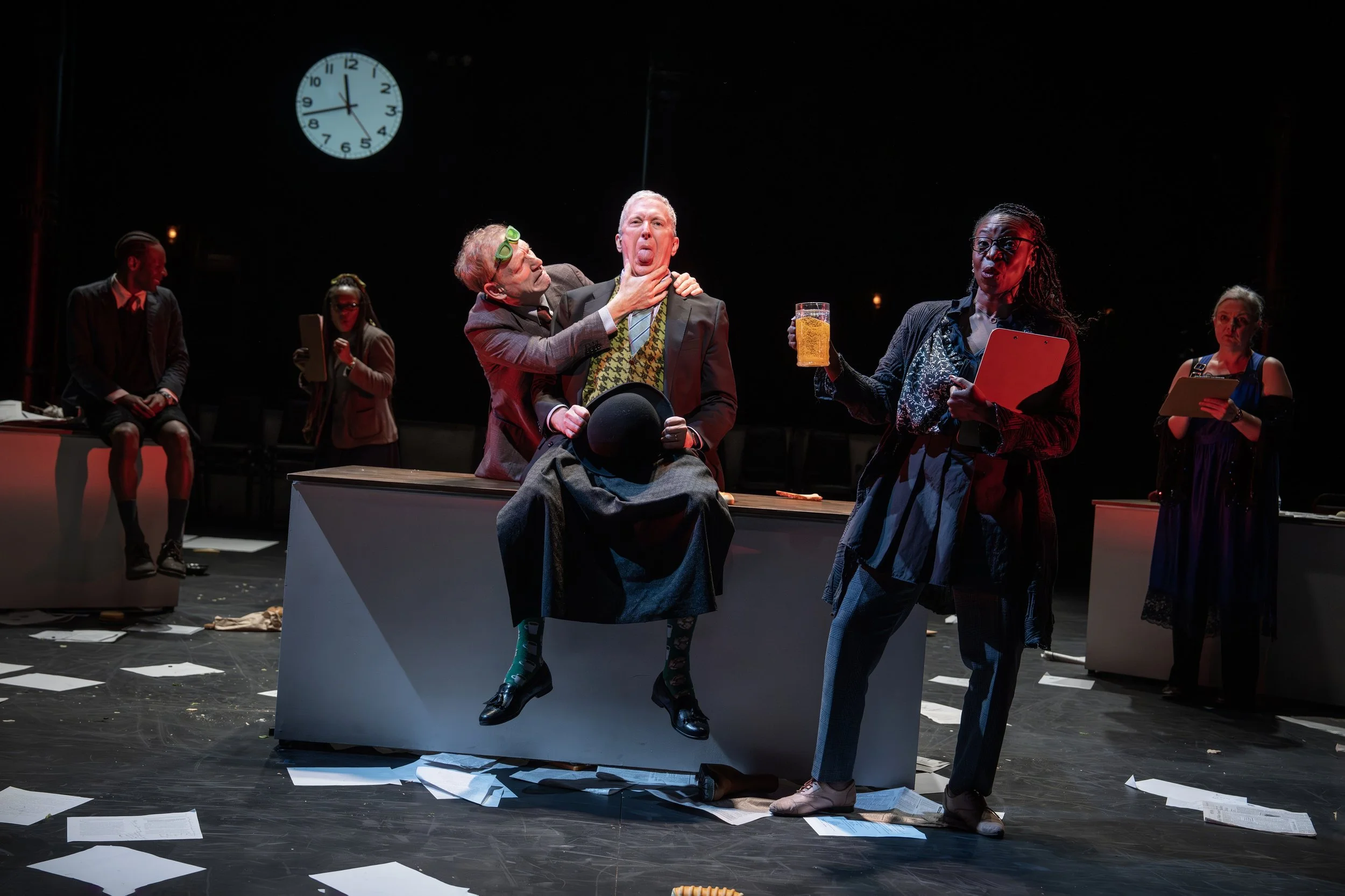
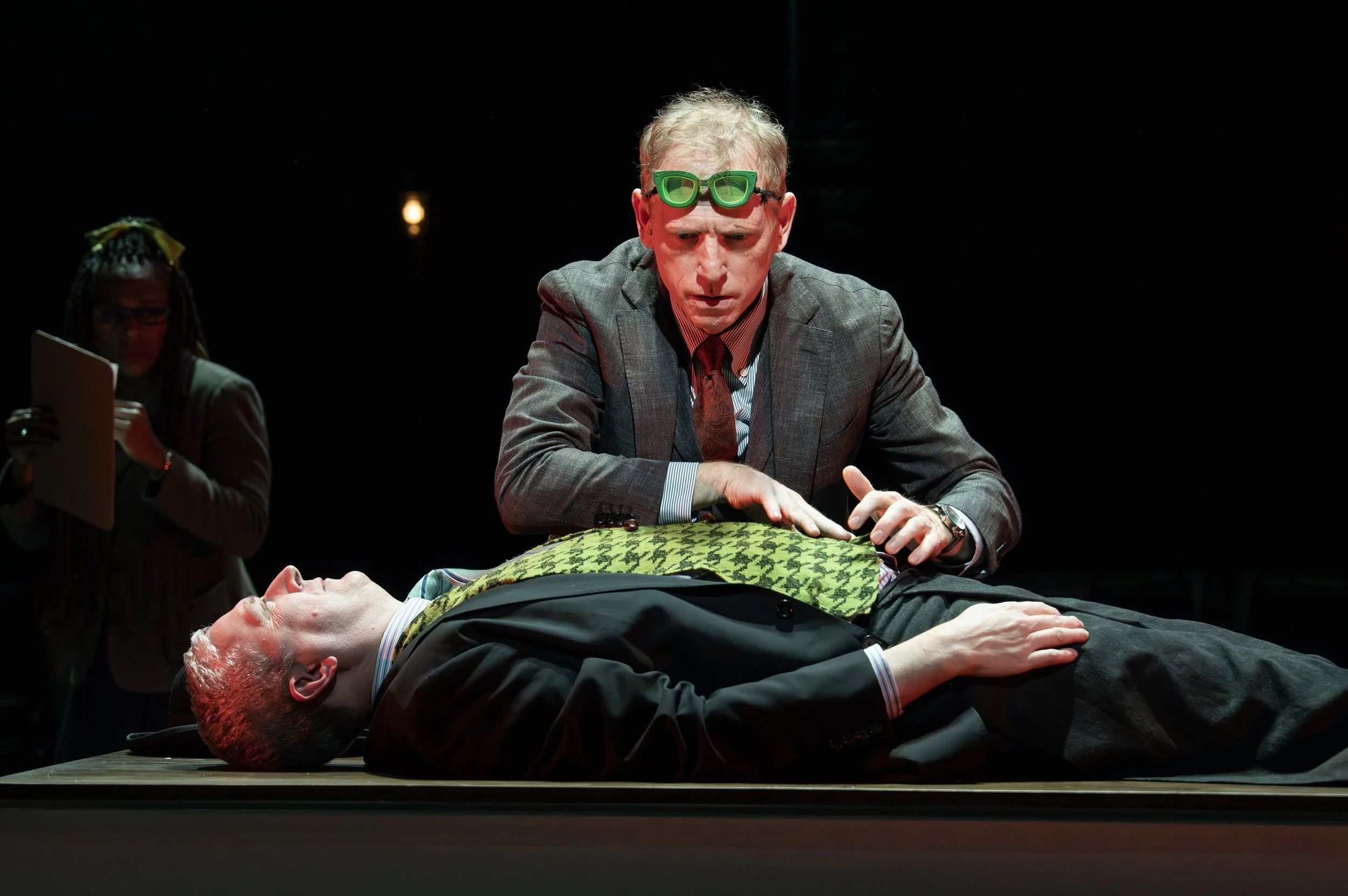
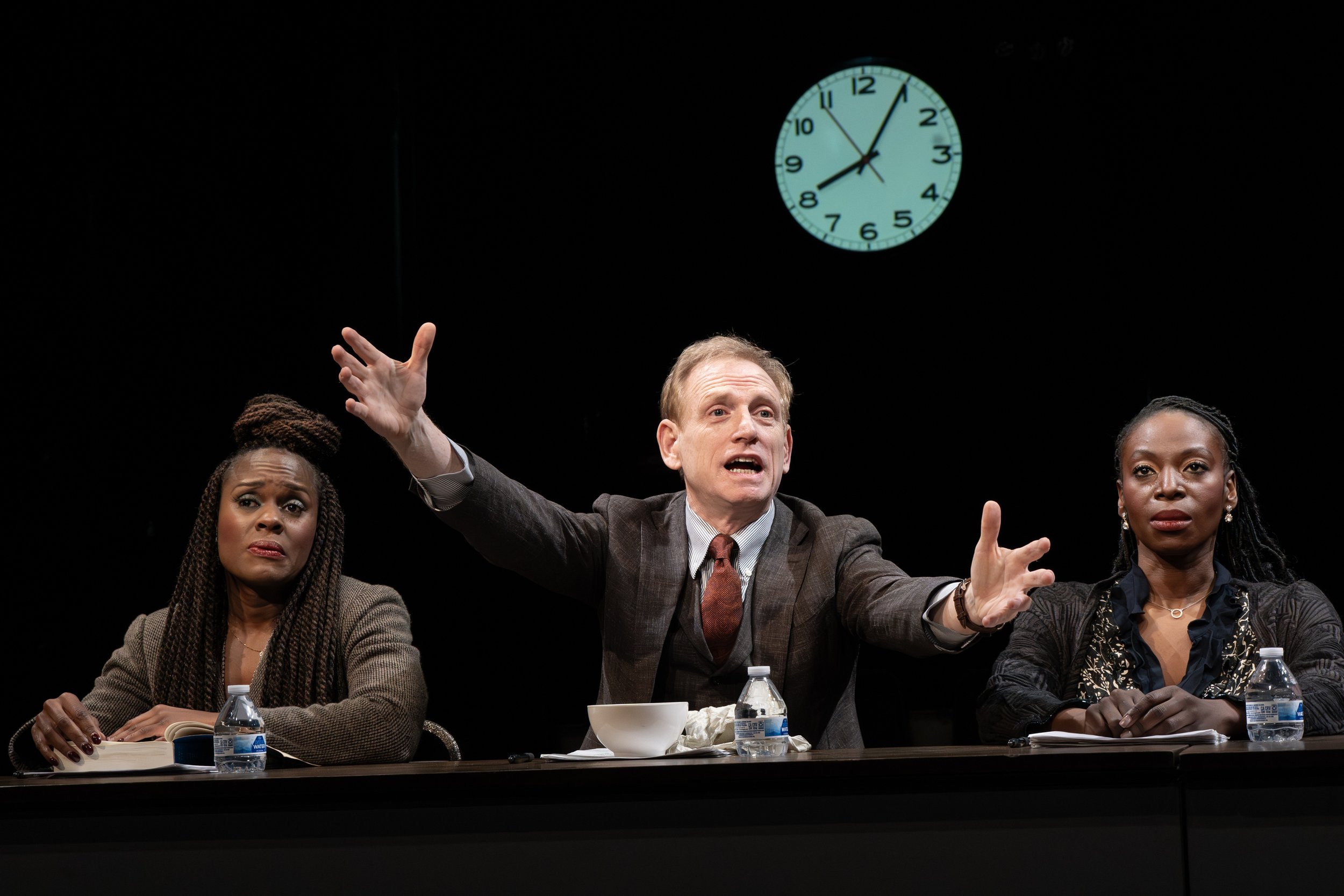
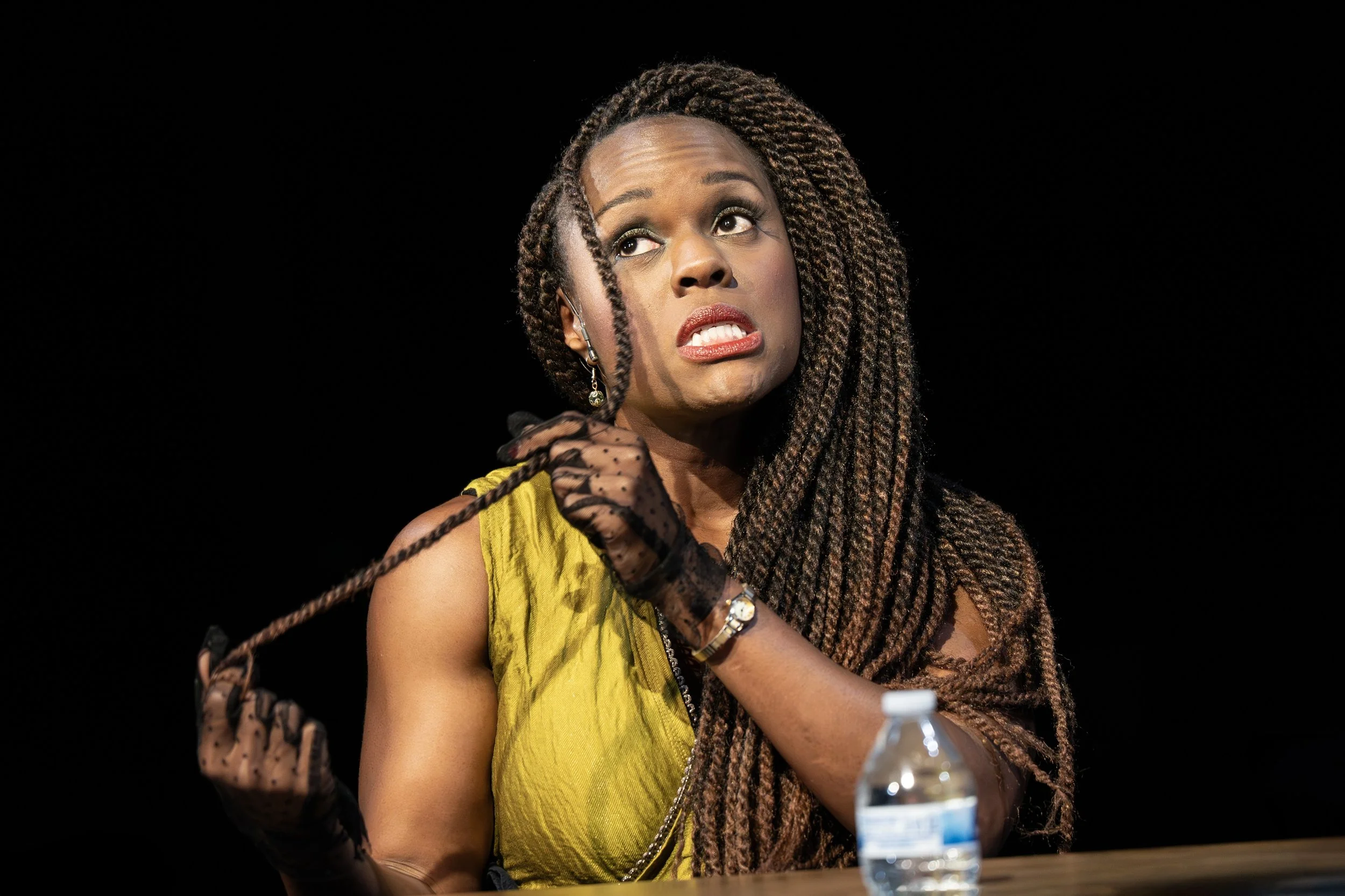
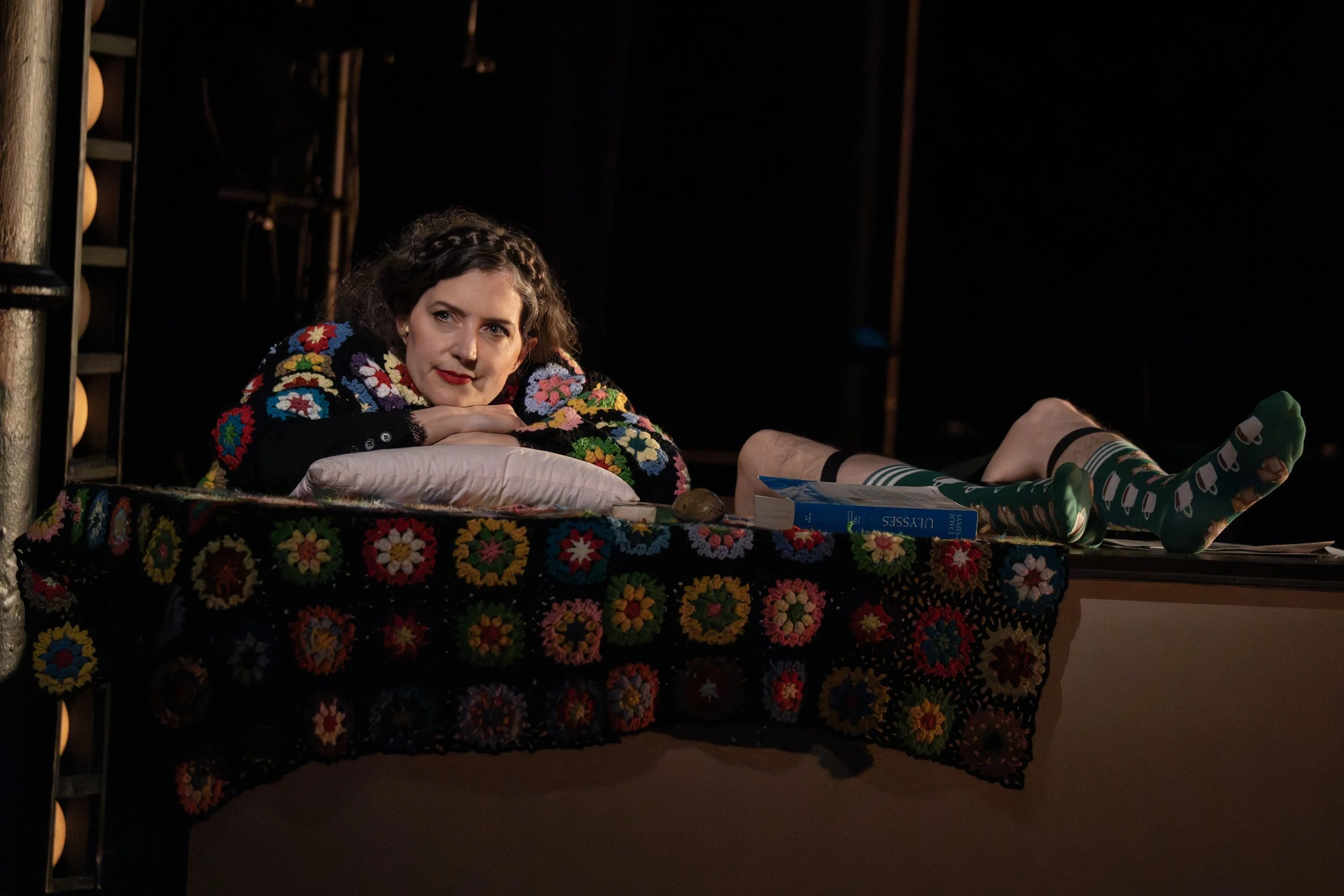
Photo credit: Joan Marcus.
A singular presence on the American stage, the Elevator Repair Service has, over the past two decades, cultivated a reputation for theatrical feats that seem, at first blush, perverse in their difficulty and, on closer encounter, exhilarating in their lucidity. The company’s métier is the unlikely marriage of high modernist literature and live performance: not the loose “inspired by” variety of adaptation, but a near-forensic, text-forward encounter with the novels themselves. Their landmark production Gatz—a durational, day-long staging of The Great Gatsby delivered verbatim from Fitzgerald’s text—remains one of the most audacious literary transpositions of this century, a feat of endurance that revealed, paradoxically, the supple theatricality latent in every line.
ERS has returned repeatedly to the modernist well, each time with a slightly different vessel. The Sound and the Fury (April Seventh, 1928) distilled Faulkner’s polyphonic novel to a single, aching chapter, while The Select (The Sun Also Rises) teased out Hemingway’s brittle expatriate cool into a quietly comic anatomy of disaffection. Now the company turns its collective gaze to Joyce’s Ulysses, that Everest of twentieth-century fiction—at once encyclopedic and intimate, ribald and rhapsodic—following the perambulations and peregrinations of Leopold Bloom across a single June day in 1904 Dublin. In ERS’s hands, Joyce’s labyrinthine prose is not simplified so much as staged as a living process of thought: language as action, consciousness as choreography, the city itself as a score for the human voice.
Ulysses is, of course, another creature entirely—a protean, unruly marvel of modernism whose stream-of-consciousness currents carry the reader into eddies of association, memory, and mischief, and just as often threaten to pull one under. To approach it at all is to accept a certain productive bewilderment; to stage it is to flirt with folly. Joyce’s novel, sprawling to a length nearly seven times that of The Great Gatsby, has long been treated as a kind of secular scripture of literary difficulty. One recalls, with a mixture of awe and incredulity, the Irish national radio’s 1982 unabridged broadcast, a word-for-word marathon that unspooled for nearly thirty hours—less an adaptation than an act of devotional endurance.
Elevator Repair Service, wisely, is not in the business of liturgical completeness. Their Ulysses, running just under three hours including intermission, embraces selection as an aesthetic principle. The novel’s eighteen episodes appear as shards and panels, glimpsed rather than exhaustively surveyed, with brisk temporal leaps marked by canny visual and sonic fast-forward cues. A large analog clock mounted on the rear wall functions both as orienting device and gentle provocation: in Joyce’s Dublin, as in the theatre, time is elastic, liable to skip, stall, or double back on itself in obedience to the mind’s rather than the clock’s logic.
In a genial, lightly professorial onstage prologue, Scott Shepherd—here serving not only as performer but as dramaturg and resident Virgil to Joyce’s labyrinth—offers a remark that doubles as both thesis and tease. Joyce, he tells us, salted Ulysses with such a profusion of enigmas and puzzles that scholars would be consigned to centuries of amiable combat over their meanings, thereby securing for the author a kind of academic afterlife. The line lands as more than a quip: it is a compact theory of Joyce’s ambition, and a gentle warning to the audience that what follows is less a riddle to be solved than a landscape to be wandered.
John Collins, who founded ERS some thirty-five years ago and has become one of our most deft translators of literature into performance, guides the evening with a confidence that never curdles into didacticism. His ensemble of seven—nimble, unpretentious, and alert to the musicality of Joyce’s prose—inhabits thirty-nine roles among them, conjuring a populous Dublin from a handful of bodies and voices. A projected street map appears at one point, as if to reassure us that this phantasmagoria does, nominally, occur in a real city on a real date: June 16, 1904. Yet the deeper cartography is interior. At times the performers are sealed within their own thoughts, which spill into the air as spoken narration; at others they collide in chance or fated encounters. We are not guided toward conclusions so much as placed in the position of eavesdroppers on consciousness itself.
Collins and Shepherd, to their credit, resist the pedagogical temptation to decode Joyce’s riddles for us. The production does not presume to unlock the novel’s ciphers so much as to lay them out, glinting and unresolved, and trust the audience to wrestle with them in its own private inwardness. Meaning here is not delivered but encountered—sometimes obliquely, sometimes in fragments, often in afterthought. The performers shuttle fluidly between two modes: narrator and embodiment, chorus and character. At the outset they sit behind a long panel, like commentators at a symposium on consciousness, voicing the text with a studied plainness. Gradually, almost imperceptibly, they peel away from this arrangement and step into the dramatic present, allowing Joyce’s interiorities to acquire bodies, gestures, and glances. The novel’s language is also made literal through projection, its sentences appearing on screens before the panel as if the book itself were thinking aloud in real time. When the adaptation elects to leap over passages, the text on the screens hurtles forward in a visual blur, and the actors accompany the jump with exaggerated, jittering motions—miming the mechanical lurch of fast-forwarded film. The gag is a small meta-theatrical wink at the impossibility of completeness. What begins as a clever acknowledgment of abridgment gradually hardens into a predictable tic, a reminder that even ingenuity, like time in Ulysses, can overstay its appointed hour.
Three figures provide the production’s emotional triangulation. Vin Knight’s Leopold Bloom emerges as a figure of rueful expansiveness—a wandering, wondering Everyman whose generosity of spirit throws the surrounding pettiness, including the novel’s flashes of antisemitism, into sharp relief. Bloom—rendered with quiet radiance by the superb Vin Knight—moves through Dublin as both participant and observer, a man set slightly askew from the society he inhabits. His Jewishness marks him, in Catholic Dublin, as perpetually other, and Knight lets us feel the small, cumulative abrasions of that fact without ever reducing Bloom to a symbol. His performance is suffused with thought: each pause, each sidelong look suggests a mind forever turning the world over, searching for purchase.
Hovering at the edges of his consciousness are the needling suspicions regarding his wife, Molly, divided between Dee Beasnael and Maggie Hoffman, rendered not as a single emblem of infidelity but as a prism of appetites, memories, and refusals. with a languid self-possession that feels entirely her own. (The specter of her liaison with the brazen Blazes Boylan becomes less a plot point than a psychological climate—one that Bloom breathes, resists, and, in some oblique way, accommodates. Shepherd’s Boylan, all jaunty swagger and comic physical bravado, cuts a memorable figure, sauntering across the stage with loose-limbed exuberance, as if the force of his own vitality might part the air before him. The contrast—Bloom’s inwardness, Molly’s earthy autonomy, Boylan’s strutting immediacy—forms a small but telling anatomy of desire, jealousy, and the fragile arrangements that constitute married life.
Christopher-Rashee Stevenson’s Stephen Dedalus, all tensile intelligence and guarded irony, carries the familiar autobiographical shimmer; in his uneasy orbit around Bloom, Joyce’s theme of elective, makeshift kinship quietly takes hold. Elsewhere, Mr. Shepherd, Kate Benson, and Stephanie Weeks supply a gallery of Dubliners, with Weeks’ turn as Martha, Bloom’s epistolary flirtation, landing with particular comic buoyancy. Notably, the cast forgoes Irish accents altogether—a choice that, rather than diminishing the setting, keeps the focus on the text’s rhythms and ideas, which are challenge enough.
ERS, to its credit, honors the spirit if not the totality of Joyce’s behemoth by curating a sequence of choice encounters from all eighteen episodes—an act of discernment that feels less like abridgment than like composition, as though the company were arranging a bouquet from a famously overgrown garden, trusting that each selected bloom still carries the fragrance of the whole. The production’s bifurcated structure proves especially shrewd. The first half resembles, almost provocatively, a staged reading: performers largely seated at tables, the design spare, the emphasis squarely on language. One learns to relinquish the hope of total comprehension and instead submit to accumulation—one where even half-understood, can still move you through tone and gesture.
Then, after intermission, the aesthetic rug is pulled. The muted quasi-realism gives way to a nocturnal dreamscape: the design collective dots supplies a collage of suggestive imagery; Enver Chakartash’s costumes are believably inhabited by the characters; Marika Kent’s lighting grows sultry and unstable; Ben Williams’ soundscape thickens into something immersive and faintly hallucinatory. The projections, designed by Matthew Deinhart, function as more than decorative supplements; they are a parallel text, flickering across the stage like the visible trace of thought itself. Words, images, and graphic gestures arrive with a scholar’s precision and a poet’s timing, situating us inside Joyce’s verbal weather while gently orienting us in its storms. Deinhart’s work has the rare virtue of being both clarifying and lyrical—the projections do not pin the meaning down so much as give it a surface on which to shimmer. The ever-present clock, now moonlike, presides over a descent into the novel’s more sensual and subconscious territories. Desire, anxiety, and the body in all its comic indignities come to the fore, culminating in Molly Bloom’s great soliloquy—at once erotic manifesto, marital reckoning, and hymn to continued being—whose final assent closes both novel and night on a human, breathing note.
ERS’s Ulysses does not pretend to decode Joyce, nor to deliver a definitive key to his labyrinth. It proposes, instead, that a different attack on reading—one that is creative, attentive, alive—is the only reading such a book finally allows. The production invites us to wander, to get lost, to overhear, to drift. In doing so, it honors the novel’s deepest lesson: that consciousness is messy, time is slippery, and meaning is something we assemble on the move. By the evening’s close, the stage has accrued the detritus of lived-in hours—half-finished food, scattered papers, the casual wreckage of thought and appetite—so that the playing space itself begins to resemble a mind after a long day: cluttered, associative, faintly chaotic. Out of this accumulation emerges a quiet panorama of the human condition as Joyce conceived it. Bloom’s perambulations chart not only a city but a self, his searches for erotic solace entwined with a persistent, dignified assertion of his Jewish identity in a world that meets it with curiosity or cruelty. Molly, orbiting the action like a sensual sun, claims the sovereignty of her own desire, her reflections on husband and lovers alike rendered as neither confession nor apology but as fact—life pulsing in the bloodstream. And Stephen Dedalus, ever the intellectual émigré from certainty, pursues fatherhood in its metaphoric forms, seeking in literature and lineage the guidance that biology has denied him. What remains, finally, is not a solved puzzle but a mosaic of hungers—sexual, spiritual, filial, civic—through which ERS allows Joyce’s capacious sympathy for ordinary consciousness to shimmer. The mess onstage feels earned; it is the residue of being alive.
Click HERE for tickets.
Review by Tony Marinelli.
Published by Theatre Beyond Broadway on February 9th, 2026. All rights reserved.
