The First Line of Dante’s Inferno
Written by Kirk Lynn; Directed by Christian Parker
LaMaMa | 66 East 4th Street, New York, New York 10003
February 5, 2026 - February 22, 2026

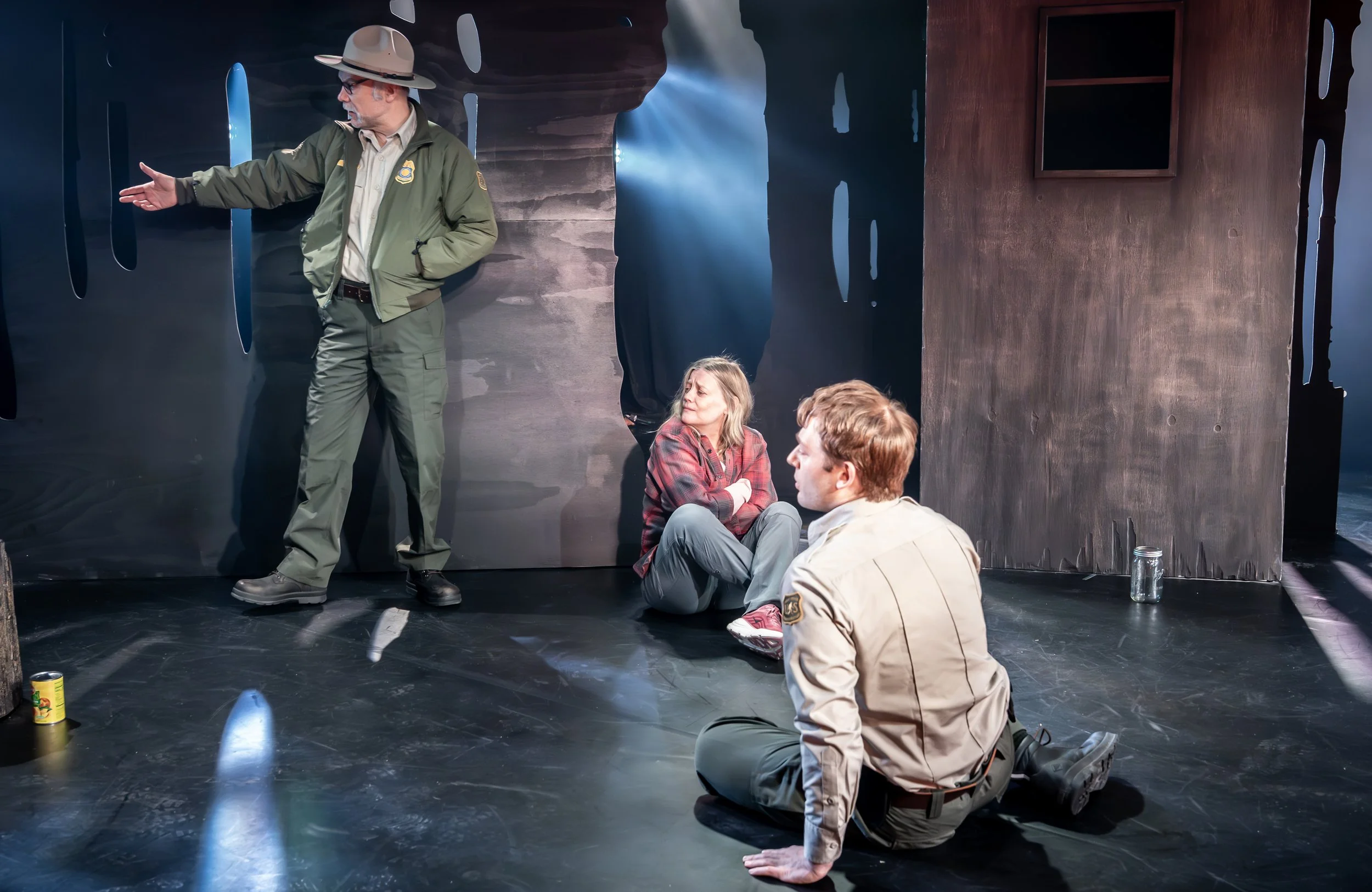
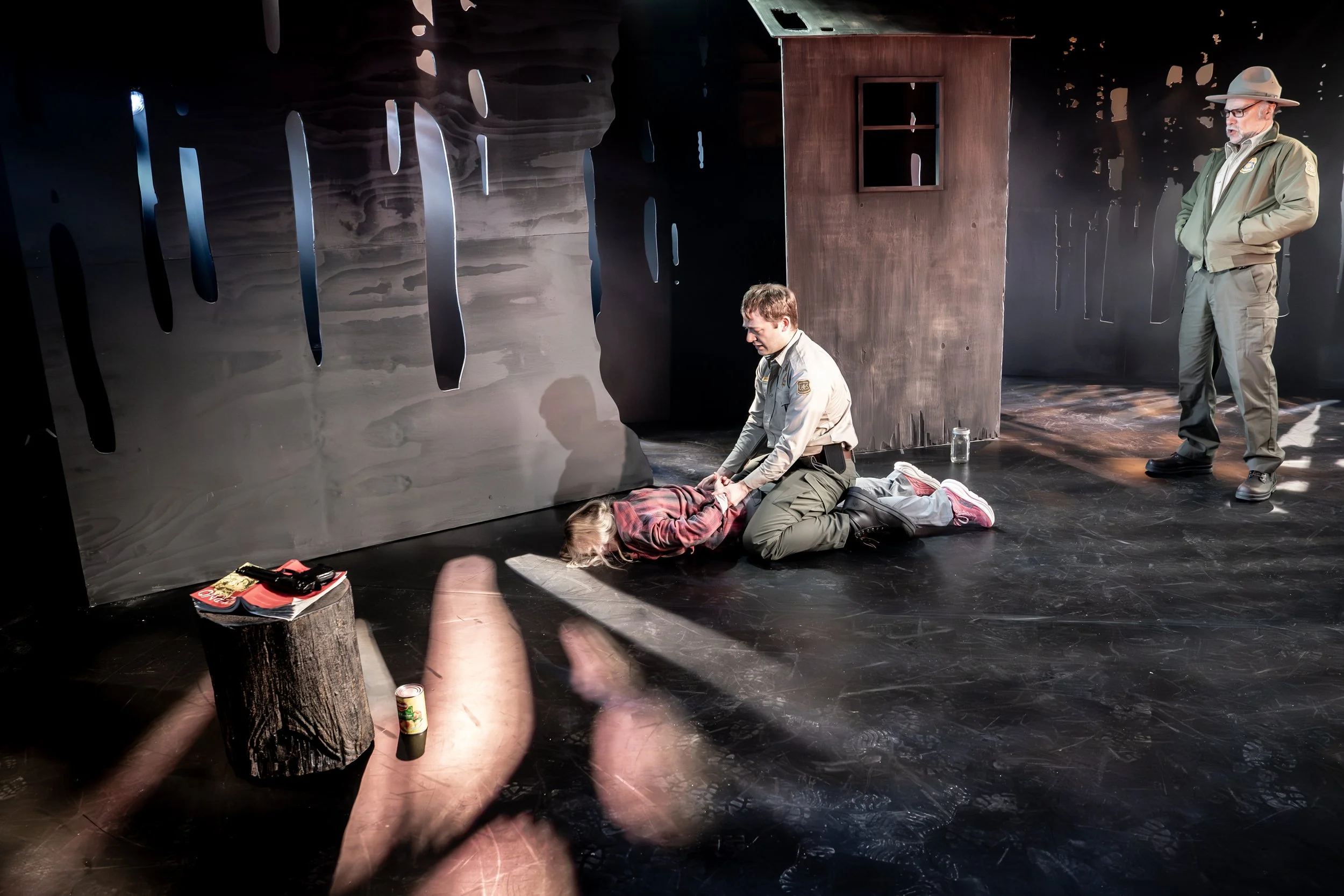
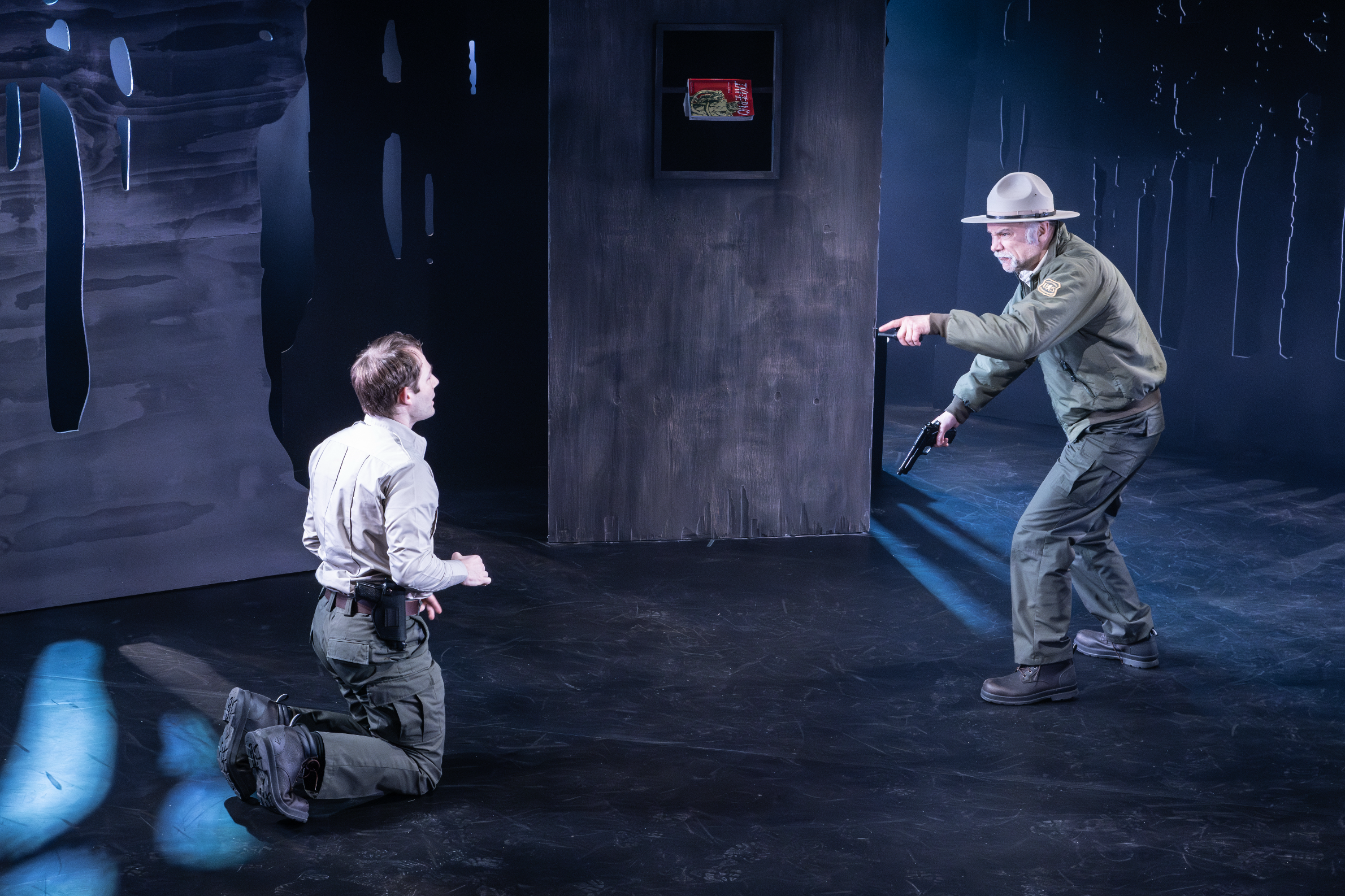
Photo credit: Marina Levitskaya.
Downstairs at La MaMa, a space steeped in decades of artistic risk, The First Line of Dante's Inferno announces its world immediately. The set is stunning in its restraint. We are in a forest rendered through cut-out flats, their negative space as evocative as their form. The proscenium itself is fractured, no longer a protective frame but an opening that feels breached. A tree stump anchors the stage. A hut sits deeper in the woods. Nothing feels decorative. Everything feels necessary.
Backlighting casts elongated shadows against La MaMa’s bare brick walls, giving the space a raw, rustic eeriness. Haze creeps through the room, unsettling rather than theatrical, as if the forest itself is breathing. The lighting quietly guides the loneliness of the wilderness, shaping distance, isolation, and the unsettling sensation of being watched, or not watched at all.
Written by Kirk Lynn, the piece unfolds through a blend of narration and dialogue carried by three characters: Ann Espinoza, a sister searching deep within the wilderness for the sibling she has lost; Craig, a young park ranger whose familiarity with the forest suggests both training and longing; and Bill, a seasoned ranger who appears to have lived so long among the trees that the boundary between duty and disappearance has blurred.
The play takes its title and through-line from the opening of Dante Alighieri's Inferno, the first part of The Divine Comedy:
Nel mezzo del cammin di nostra vita,
mi ritrovai per una selva oscura,
ché la diritta via era smarrita.
Midway upon the journey of our life,
I found myself within a forest dark,
For the straightforward pathway had been lost.
Inspired by this passage, the themes of introspection, self-discovery, and purpose creates high stakes for each character - Ann (Kellie Overbey), Craig (Evan Sibley), and Bill (Greg Stuhr) - while also holding space for the absent fourth figure, Carol, whose disappearance drives the journey. The question hums beneath every step: why do people enter the wilderness at all? To enjoy nature. To seek spiritual connection. To feel freedom. To find themselves. Or to lose themselves entirely. It is not uncommon to learn that some people simply want to disappear.
The storytelling mirrors the terrain. Time is navigated not through conventional scene changes but through narration and moments of power-off orientation. Dialogue emerges like trail markers, guiding but never fully reassuring. This is not a hike with clear signage. It is the kind of wilderness where you assume you will be gone only a few hours, where trails seem obvious until they are not.
The forest here is its own world, and the play leans fully into that truth. Ann’s search for her sister feels newsworthy on the surface, but the deeper question persists: why is Ann really here? The two park rangers, whose lives appear rooted in the woods, know the terrain intimately: Crane Hill, Captain’s Peak, the Meadow, and the invisible line dividing public land from private. Their knowledge suggests long stays, perhaps permanent ones, and their natural chemistry. Then you add Ann’s presence which begins to test not just rules, but her own boundaries, particularly in relation to the younger ranger.
Conversation is not the only force at play. Untethered sexual impulses surface. Fruit is repurposed through imaginative, unsettling gestures. A shack built from stolen plywood becomes a symbol and sanctuary at once, representing escape, shelter, and profound isolation. When Ann holes herself up there, the structure becomes more than protection. It is refusal or maybe refuge. A place where being found is no longer the goal.
The question echoes quietly throughout: if a tree falls in the woods and no one witnesses it, did it really fall? If an experience happens unseen, unreported, unknown to others, did it really happen? The forest does not answer. It simply holds.
Lynn’s prose is written to be performed, with stage directions deliberately sparse, leaving space to create this vision and framework. His direction shapes the void, giving form to what is unsaid and rhythm to what remains unresolved. In this production, under the direction of Christian Parker, narration is the primary device to deepen and extend the actors’ physical actions. Language does not simply accompany movement. It frames it, shadows it, and sometimes contradicts it. The experience feels literary rather than illustrative. I did not feel as though I was watching a play so much as inhabiting a book, one where images, memory, and meaning arrive through voice as much as through sight.
What we witness is an interpretation that belongs uniquely to this run, made vital by the trust Parker places in the text, the performers, and the audience alike. That openness is not a loophole. It is the invitation.
The acting across the board is compelling and deeply engaging. Kellie Overbey grounds Ann Espinoza with commanding resolve and unraveling urgency, her search shaped as much by what she withholds as by what she reveals. Evan Sibley brings Craig a restless attentiveness, a young ranger whose naïveté and curiosity feel both genuine and quietly dangerous. Greg Stuhr’s Bill moves through the space with the ease of someone who may no longer remember the last time he left the woods, yet whose sense of duty remains intact, suggesting a man both absorbed by the wilderness and defined by it.
Together, their narration creates a shared consciousness, a chorus of solitary voices moving through the same dark terrain. It reinforces the play’s central tension: that experience does not require witnesses to be real, and that sometimes the most profound journeys happen precisely because no one else is watching.
My greatest takeaway from this production is the vastness of the wilderness and its seductive promise of escape. One can go off the grid and disappear. One can also enter the unknown parts of oneself without anyone bearing witness. As we observe Ann, Craig, and Bill moving through the forest, another question quietly arises: is Carol out there somewhere, watching them too?
Click HERE for tickets.
Review by Malini Singh McDonald.
Published by Theatre Beyond Broadway on February 9th, 2026. All rights reserved.
