
Written and Directed by Jerry Lieblich
The Brick Theater | 579 Metropolitan Ave, Broolyn, NY 11211
February 12 - March 14, 2026
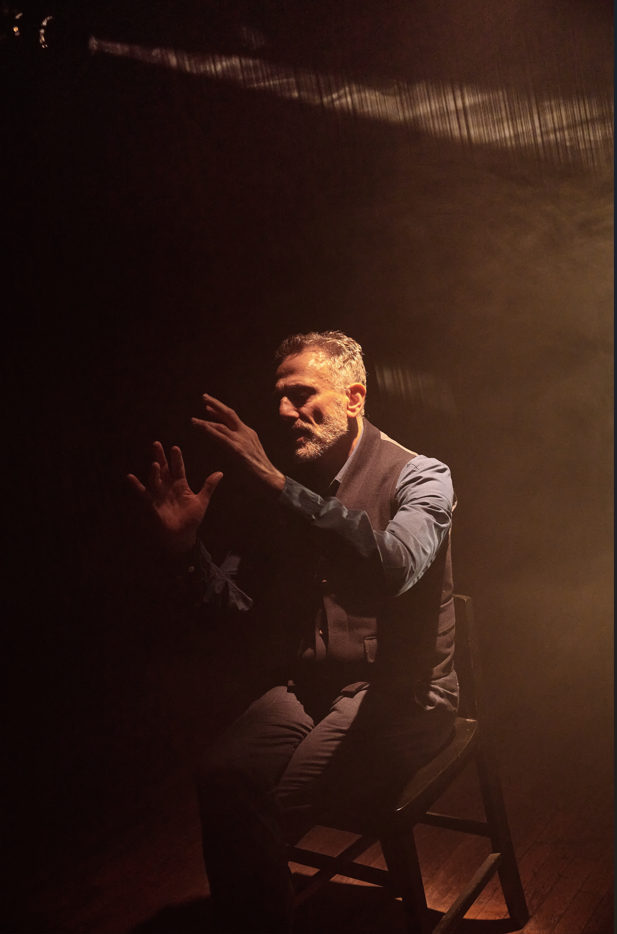
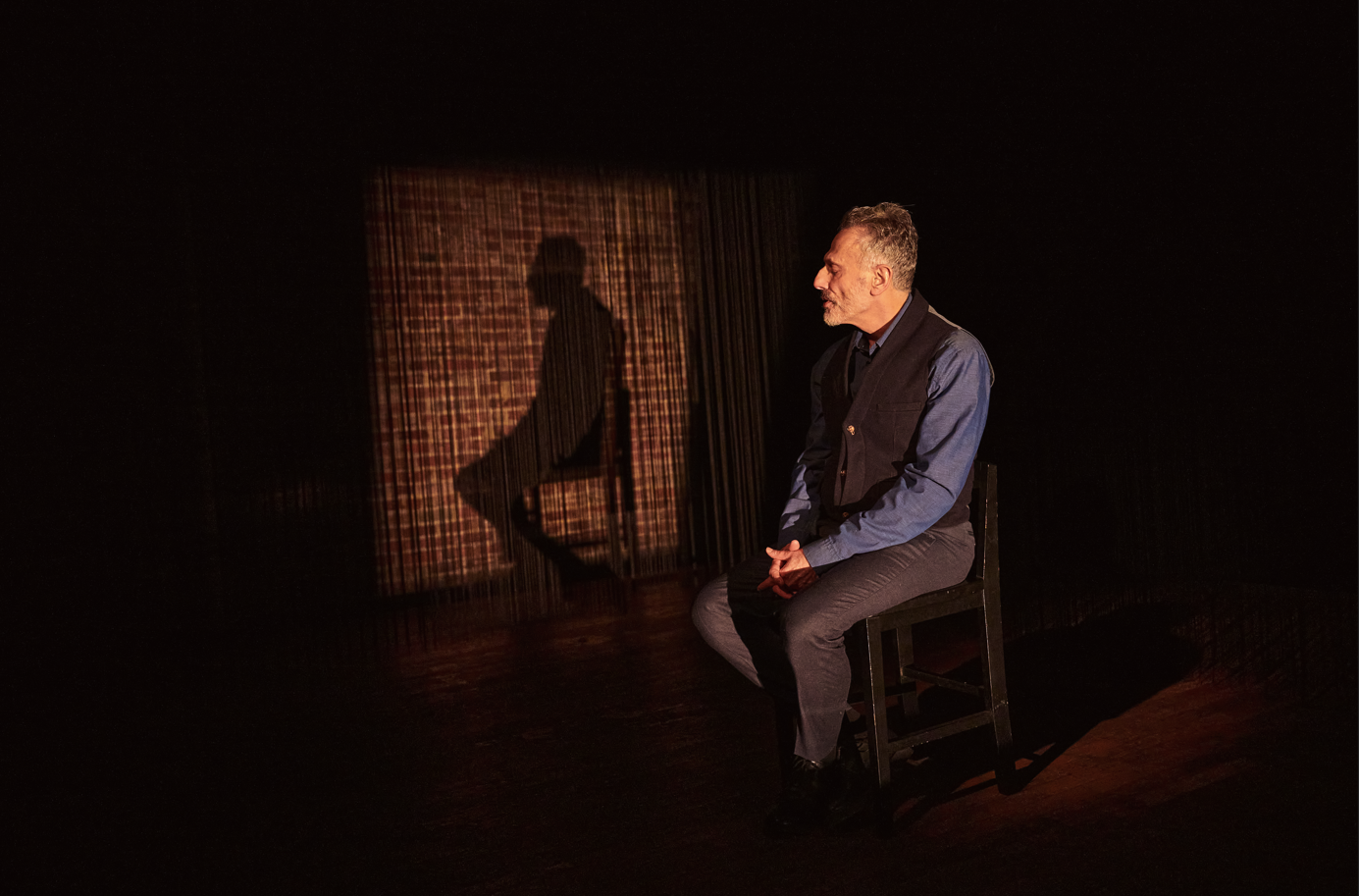
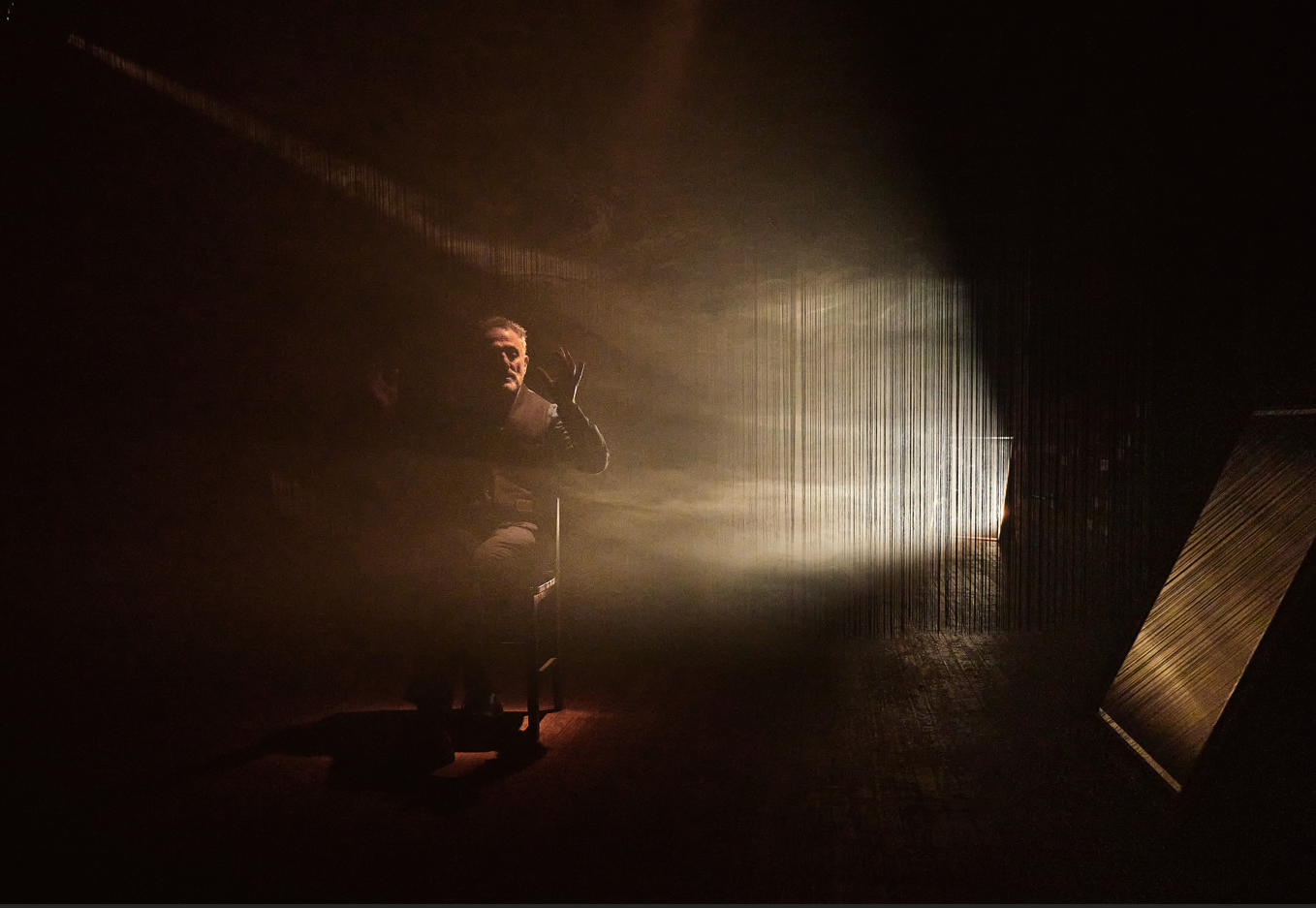
Photo Credit: Valerie Terranova
To encounter without mirrors is to feel, for a moment, as though one has slipped through a temporal seam in the fabric of New York theatre. The piece, written and directed by Jerry Lieblich and now playing at The Brick Theater, summons a downtown scene that once thrived on resistance to coherence. Narrative may very well be absent but the play remains lavish in language: sentences flow outward like yarn from a skein dropped on the floor and carried by a cat from room to room, vertiginous in their extension, studded with clusters of thoughts that haunt. It is the sort of theatre that does not yield easily to paraphrase, and indeed seems built to elude it—holding itself, and its audience, in a kind of conceptual limbo where the subconscious brain gathers impressions that the analytical mind struggles to tame.
For those who came of age in the experimental theatre ecology of the eighties and nineties, the piece carries a powerful whiff of déjà vu. One is reminded of the linguistic density of María Irene Fornés (Fefu and Her Friends, 1977), Len Jenkin (Limbo Tales, 1980), and Mac Wellman (Terminal Hip, 1984), and the intellectual pageantry of Richard Foreman, whose Ontological-Hysteric Theater long made a virtue of theatrical perplexity. In those years, spectators were not always expected to analyze or explain away what they had seen—for the most part non-linear, the most exhilarating works often left one unable to do so.
Where Foreman’s recent showings of Object Collection’s Suppose Beautiful Madeline Harvey at La MaMa, Symphony of Rats at Wooster Group and What to wear at Brooklyn Academy of Music embraced a maximalist carnival of color, performers, and objects, Lieblich chooses the opposite route. without mirrors is spare almost to the point of monasticism: one actor, one chair, two curtains of black fringe, and—despite the title—a scattering of mirrors. (The text toys with the ambiguity of the phrase “without,” noting that it can mean both lacking mirrors and existing outside them.) The scenic and lighting design by Kate McGee carve the stage into stark shadows and deep pools of darkness, incorporating reflections into its architecture; later, when mist seeps into the playing space, the haze becomes yet another type of canvas. The sound design by Johnny Gasper follows suit—attenuated almost to silence, save for one overwhelming sonic eruption that crashes through the room like a weather system.
The piece unfolds as a kind of philosophical solitude. It is, in essence, an attempt to hear oneself reverberate in the darkness. Though saturated with anxiety and grief, it rarely names those emotions directly. Instead, it approaches them obliquely, as if language itself were circling something too large to face head-on.
The narrator—metaphorically, though perhaps not entirely metaphorically—exists alone in a cave. The play begins with a story about a man rescued from such a cavern after his would-be rescuers heard him striking stones together. Yet the man, we learn, had not been signaling for help; he was making noise simply to locate himself in the immense blackness, to confirm that he remained alive. In Lieblich’s script, the monologue uses vocalized “clangs,” those echoes functioning as a skeletal rhythm beneath the text. One gradually realizes that the play itself is an extended version of that gesture: an hour-long effort to prove one’s existence. This man may very well be an unintentional castoff, someone who has no one else to turn to.
The language is by turns inward and outward, repeating, contradicting, erasing itself. In lesser hands, such a structure could feel exhausting after only a few revolutions. But Lieblich’s direction remains admirably restrained, resisting any temptation to distend the piece theatrically. Most crucially, he has entrusted the role to David Greenspan, whose virtuosity with monologue has long been one of the theatre’s quiet marvels.
Greenspan has previously navigated the linguistic landscapes of Gertrude Stein and others with dazzling dexterity—his performance inspired by Four Saints in Three Acts, among many others, demonstrated his capacity to animate entire worlds of characters with minute vocal calibrations. HIs ability to create multiple characters so easily was seen in Barry Conners’ The Patsy and Mona Pirnot’s I’m Assuming You Know David Greenspan but here, however, the playing field is narrower and stranger. There is only language, and only the solitary consciousness speaking it: a narrator who may or may not speak for the playwright, one whose identity hovers in a state of deliberate mystery.
Even Greenspan’s customary wit—the sly complicity he often shares with an audience—is largely absent. He appears reserved, almost hermetic. For the most part, Greenspan sits solidly in his chair and treats each word as if it were a small, fragile instrument, with a decided calibrated weight. Inevitably, the speaker’s perspective becomes egocentric. Cut off from social intercourse of any kind, he is thrown back upon his own interior scaffolding. The play proceeds to hack away at that human creation piece by piece.
At certain moments, the language threatens to dissolve into pure verbal torrent—an expertly articulated barrage of words that may or may not amount to an argument. At others, it opens onto something more unsettling: a glimpse into the hollowed center of contemporary subjectivity, a meditation on what remains of a person in a world where reflection itself has become bleak, this coming from an individual who from the outset refers to himself as “lost and lonely” and “last and lonely.”
In that sense, without mirrors does not merely revive a downtown theatrical tradition. It interrogates it—asking whether, in an era defined by infinite digital reflection, we can still recognize ourselves when the mirrors disappear.
Click HERE for tickets.
Review by Tony Marinelli.
Published by Theatre Beyond Broadway on March 8th, 2026. All rights reserved.